Roleshare’s 2021 Seed deck is a masterclass in narrative positioning. By framing job-sharing not as a niche HR benefit but as the logical next step in the sharing economy—following Airbnb, Uber, and WeWork—the company successfully raised $1.8 million. The deck leans heavily on external validation, citing the World Economic Forum and MIT Sloan to build credibility for a relatively new labor model. While it lacks granular financial projections or detailed unit economics, it compensates with a strong team slide featuring deep marketplace experience from eBay and Gumtree. The deck effectively cap…
Key takeaways
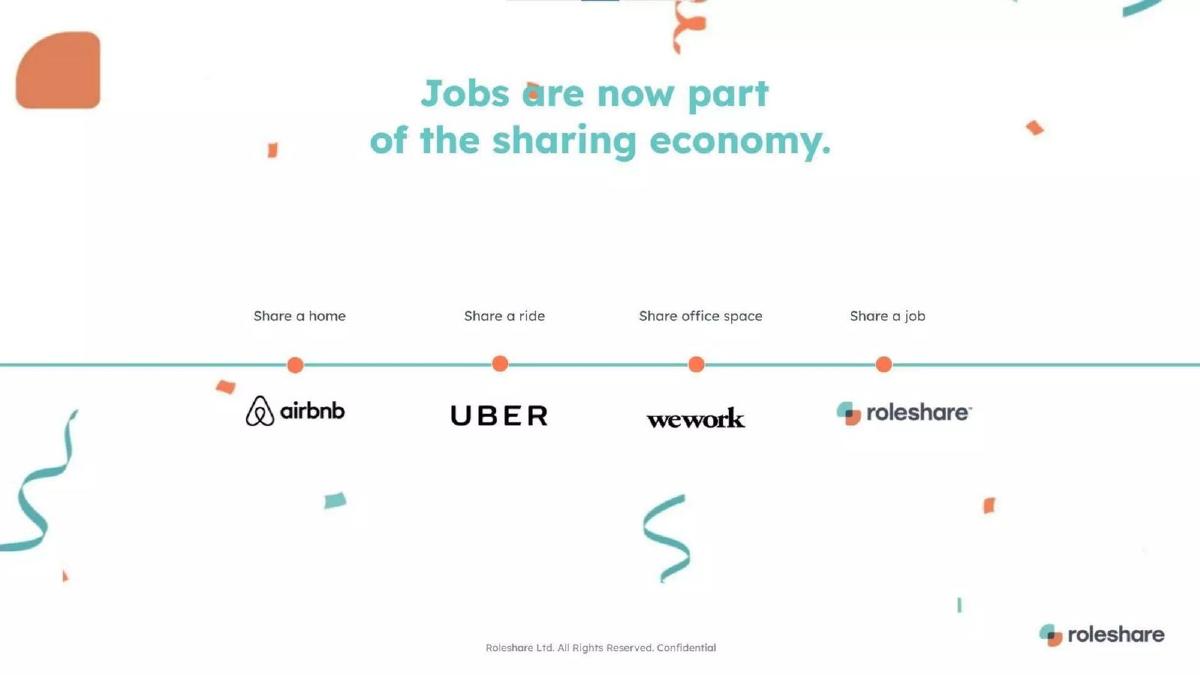
- The deck positions job-sharing as the fourth pillar of the sharing economy alongside Airbnb, Uber, and WeWork (Slide 6).
- Roleshare claims a 30% productivity gain and 11% higher wellbeing for employees using their model (Slide 7).
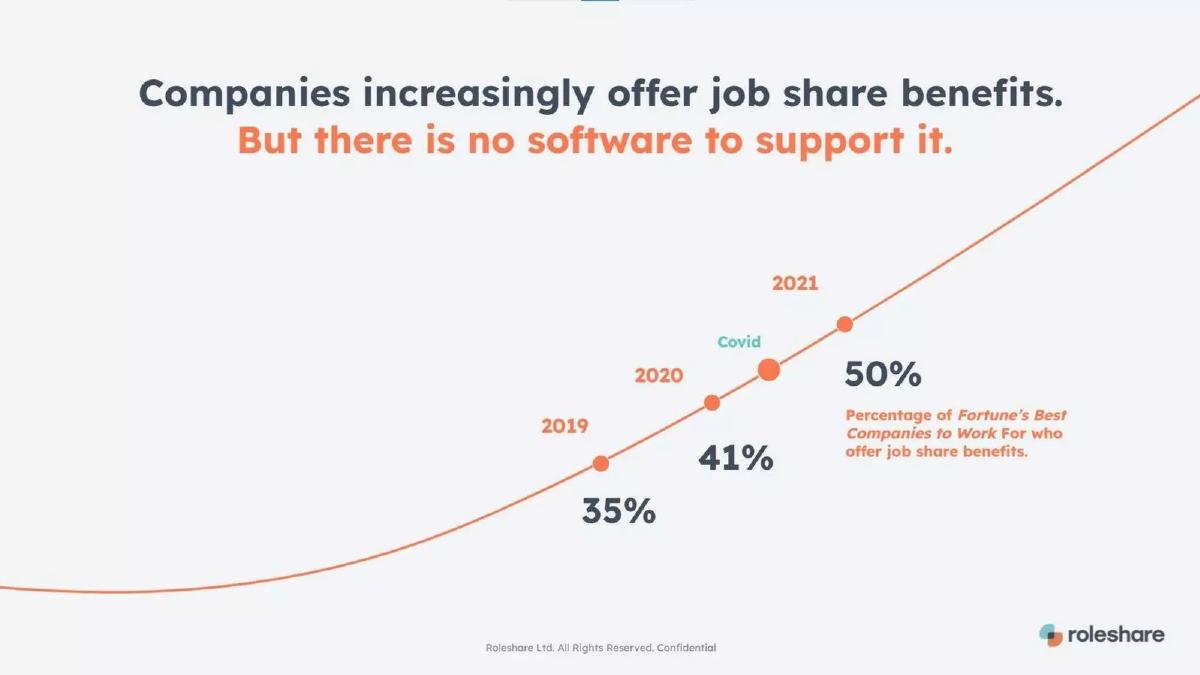
- Market demand is evidenced by the fact that 50% of Fortune’s Best Companies to Work For now offer job share benefits (Slide 5).
- The platform is described as a 'b2b2c' model, matching two people to share a single full-time role (Slide 9).
- Social proof is a core strategy, featuring endorsements from the World Economic Forum and MIT Sloan Management Review (Slide 10).
- The company aligns its mission with five specific UN Sustainable Development Goals, including Gender Equality and Decent Work (Slide 11).
- The leadership team brings significant marketplace experience from companies like eBay, Gumtree, and American Express (Slide 13).
- The deck completely omits a specific 'Ask' slide, financial forecasts, and current revenue metrics.
The Narrative of the New Workforce
Roleshare’s 14-slide deck is a quintessential example of 'trend-riding.' Produced in 2021, it leans heavily into the cultural shifts caused by the global pandemic, specifically the 'Great Resignation.' The deck is less about the technical specifications of a matching algorithm and more about a philosophical shift in how we view labor. By categorizing 'jobs' as the next frontier of the sharing economy, Roleshare attempts to bypass the skepticism often directed at HR-tech startups, instead positioning itself as a foundational infrastructure play for the future of work.
Slides 1-3: Setting the Macro Stage
The deck opens with a minimalist title slide (Slide 1) featuring the tagline: "Meet halfway. Win together." This immediately establishes the collaborative nature of the product. Slide 2 makes a bold, provocative claim: "The full-time job is dying." This is a classic 'change' slide designed to create urgency. If the full-time job is dying, investors need to know what replaces it.
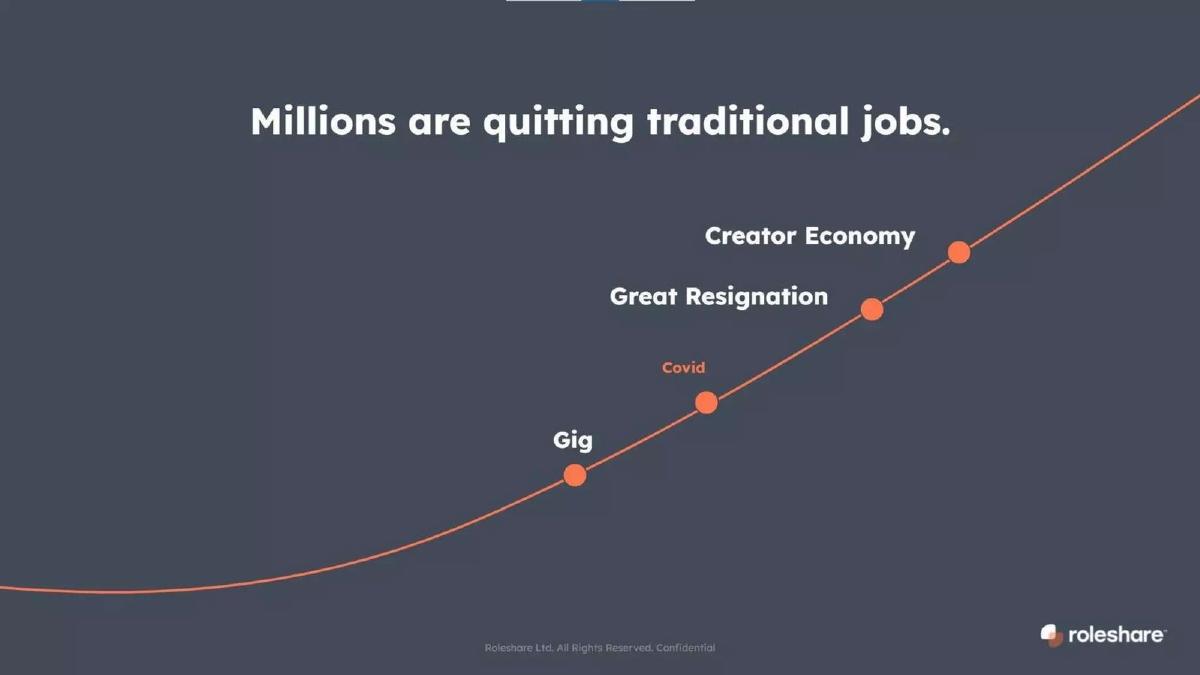
Slide 3 provides the data to support this provocation. It shows a rising curve marked by the "Gig" economy, "Covid," the "Great Resignation," and the "Creator Economy." By placing these disparate trends on a single trajectory, Roleshare argues that the desire for flexible work is an unstoppable force. The slide is effective because it uses recognizable cultural touchstones to make a complex labor shift feel like an obvious, linear progression.
Slides 4-6: The Opportunity and the Gap
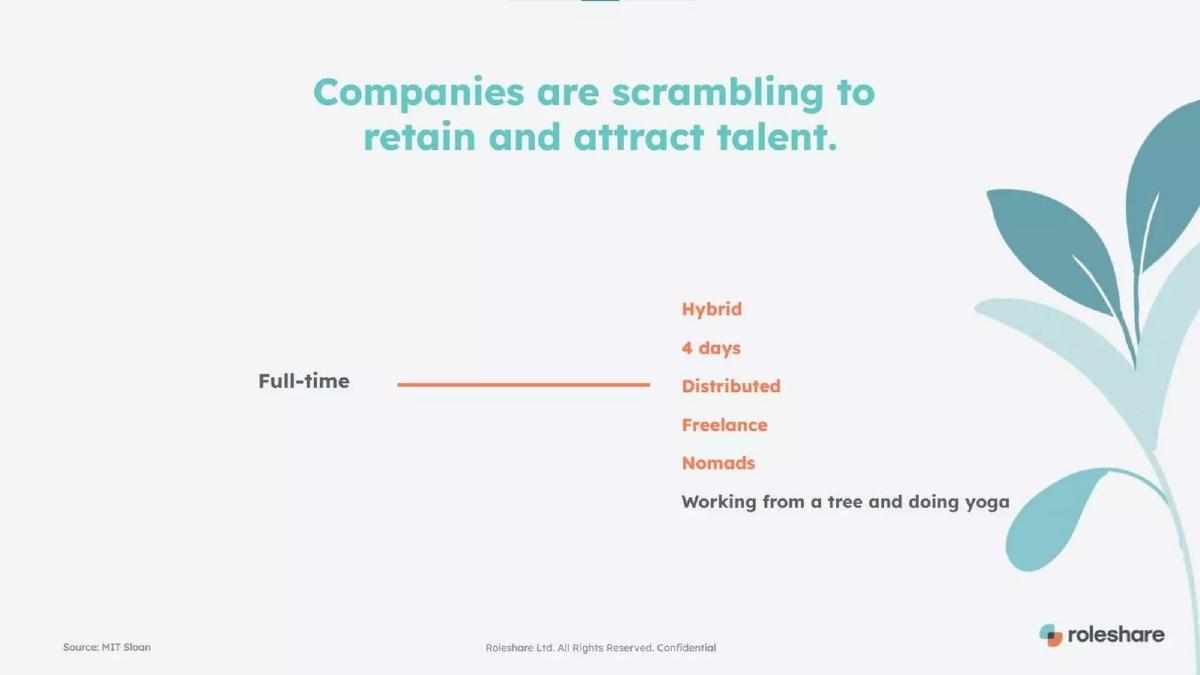
Slide 4 highlights the corporate struggle, stating "Companies are scrambling to retain and attract talent." It lists various flexible options like "Hybrid," "4 days," and "Distributed," but ends with a humorous jab at "Working from a tree and doing yoga," signaling that current solutions are perhaps becoming absurd or unsustainable. This sets up the need for a more structured form of flexibility.
Slide 5 introduces the specific solution: job sharing. It notes that "50%" of Fortune’s Best Companies to Work For now offer job share benefits, up from "35%" in 2019. Crucially, it identifies the market gap: "But there is no software to support it." This is the 'Why Now' slide. The demand exists, the policy exists, but the infrastructure is missing.
Slide 6 is the most important strategic slide in the deck. It places Roleshare on a timeline alongside Airbnb (Share a home), Uber (Share a ride), and WeWork (Share office space). By stating "Jobs are now part of the sharing economy," Roleshare is attempting to anchor its valuation and potential scale to some of the most successful tech companies of the last decade. It is a high-stakes comparison that demands a massive market size.
Slides 7-9: The Product and Value Proposition
Slide 7 moves from the macro to the micro, explaining what is actually shared: "responsibilities, salary, benefits." It claims a "30% productivity gain" and "11% higher wellbeing." While these figures are impressive, the slide does not cite the specific source for the productivity metric, which may lead to questions during due diligence. Slide 8 identifies the friction point Roleshare solves: "Finding the right people to share jobs takes months."
Slide 9 introduces the platform itself, described as "The only b2b2c platform matching two people to share one job." The visual shows a clean UI with "Shareable Jobs" and "Talent" profiles. The use of the term 'b2b2c' is significant; it implies that while the end-users are individuals, the ultimate customer and payer is likely the enterprise, which is a much more attractive business model for VCs than a pure consumer play.
Slides 10-12: Social Proof and Sustainability
Slide 10 is a 'wall of logos' and quotes, but instead of customers, it features prestigious institutions. It cites the World Economic Forum , MIT Sloan Management Review , and Trend Watching . Below these are logos for The Guardian, Business Insider, TechCrunch, and The Times . This level of press and institutional validation is rare for a Seed-stage company and serves to mitigate the perceived risk of a novel business model.
Slide 11 aligns Roleshare with the UN Sustainable Development Goals (SDGs) . It specifically calls out Goal 3 (Good Health), Goal 5 (Gender Equality), Goal 8 (Decent Work), Goal 10 (Reduced Inequalities), and Goal 17 (Partnerships). This positioning appeals to the growing number of ESG-focused (Environmental, Social, and Governance) investors. Slide 12 reinforces the 'Third Way' narrative, visually placing Roleshare between "Full Time" and "Freelance."
Slides 13-14: The Team and The Call to Action
Slide 13 presents a strong leadership team. Co-Founders Sophie Setareh Smallwood and Dave Smallwood bring experience from eBay, American Express, and TripAdvisor . The inclusion of a Chief Product Officer (Polly Howden) from Gumtree and a Chief Technical Officer (Ahmad Mousavi) with experience at Moonpig and Wonga suggests a team that understands how to build and scale two-sided marketplaces. The advisor panel is equally impressive, featuring individuals from Alphabet, Nike, and Airbnb .
Slide 14 is the closing slide. It invites investors to "Join our mission" and includes a button to "Hear our pitch." Notably, this slide (and the deck as a whole) omits a specific financial 'Ask.' There is no mention of the $1.8M target or how the funds will be allocated between engineering, sales, and marketing.
What Works in the Roleshare Deck
The 'Sharing Economy' Anchor: By framing job-sharing as the next logical step after Airbnb and Uber, the founders successfully move the conversation away from 'niche HR tool' to 'massive platform opportunity.' This is a classic framing technique that helps investors visualize a billion-dollar outcome.
Institutional Validation: Citing the World Economic Forum and MIT Sloan provides a level of intellectual 'air cover.' It suggests that the problem Roleshare is solving is being discussed at the highest levels of global policy, which makes the startup feel like an inevitability rather than a gamble.
Marketplace Pedigree: The team slide is excellent. For a marketplace business, investors look for people who have managed liquidity, trust, and safety at scale. Having alumni from eBay and Gumtree on the founding team directly addresses the 'can they build a marketplace?' concern.
What is Missing from the Roleshare Deck
The Financial Ask: The most glaring omission is the lack of a funding slide. While this is common in 'teaser' decks, a full pitch deck should ideally specify how much capital is being raised and what milestones that capital will unlock (e.g., 'Raising $1.8M to reach 50 enterprise customers').
Unit Economics and Traction: The deck is heavy on 'why' but light on 'how much.' There are no slides showing the current number of matches, the cost to acquire a user (CAC), the lifetime value (LTV), or the revenue model (e.g., is it a subscription for companies or a percentage of the salary?).
Competitive Landscape: The deck claims Roleshare is the 'only' platform, but it doesn't address how they compete with traditional recruiters, internal HR mobility tools, or general job boards like LinkedIn that could theoretically add a 'job share' filter.
What a Founder Should Copy
The 'Third Way' Diagram: Slide 12 is a perfect example of how to use a simple visual to explain market positioning. If your product sits between two established categories, use a spectrum diagram to show how you capture the benefits of both while avoiding the drawbacks of either.
ESG Alignment: If your startup has a social impact, don't just say it—map it to the UN Sustainable Development Goals as seen on Slide 11. It provides a standardized language for impact that is increasingly important to institutional investors.
Narrative Consistency: From the first slide to the last, the deck maintains a consistent visual style and a singular message: the world of work has changed, and Roleshare is the tool for the new reality. Founders should ensure their deck tells one cohesive story rather than a collection of unrelated data points.
Frequently asked questions
- How much did Roleshare raise with this deck?
- According to catalogue facts, Roleshare raised $1,800,000 in 2021 during their Seed round. The deck itself does not state the amount being raised or the valuation, which is common for decks intended for broad distribution or those used as a visual aid during a live pitch.
- What is the core business model of Roleshare?
- Roleshare operates as a b2b2c platform. As shown on Slide 9, it acts as a matching engine that pairs two individuals to share one full-time job. This allows companies to retain talent that might otherwise leave for freelance work, while providing individuals with full-time benefits and salary on a part-time schedule.
- Does the deck provide any evidence of product-market fit?
- The deck focuses more on macro-trends than internal metrics. It cites that 50% of top-tier companies offer these benefits (Slide 5) and highlights a '30% productivity gain' (Slide 7). However, it does not list current active users, number of successful matches, or revenue generated to date.
- Who are the key people behind Roleshare?
- The company is led by Co-Founders and Co-CEOs Sophie Setareh Smallwood and Dave Smallwood. Their backgrounds include tenure at eBay, American Express, and TripAdvisor. The team also includes a CPO with experience at Gumtree and a CTO from Moonpig, suggesting deep expertise in building and scaling digital marketplaces.
- What is the 'Third Way' mentioned in the deck?
- Roleshare positions itself as a 'third way' between traditional full-time employment and freelance/gig work. Slide 12 illustrates this by showing Roleshare as the bridge that combines the stability and benefits of full-time work with the flexibility typically associated with freelancing.