RocketBolt's 13-slide pitch deck is a masterclass in simplicity and metric-driven storytelling. By focusing on a single, powerful value proposition—doubling the number of leads for inside sales teams—the founders created a compelling case for their intelligent lead tracking software. The deck successfully balances high-level vision with concrete performance data, showcasing over 100 paid beta customers and $35,000 in monthly recurring revenue. While it lacks traditional sections like a detailed competitive landscape or a formal 'ask' slide, the inclusion of a $1.2 million seed round milestone…
Key takeaways
- The deck leads with a bold claim on slide 3: '2x Leads going to your inside sales teams.'
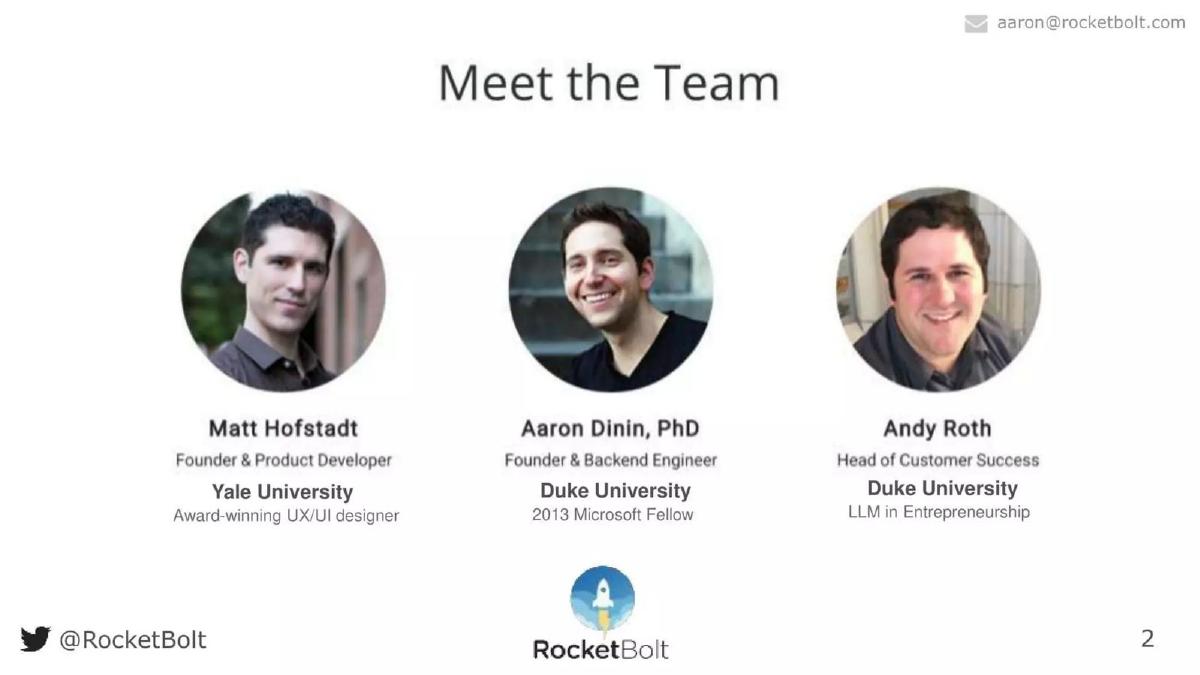
- The team slide (slide 2) highlights academic credentials from Yale and Duke, including a 2013 Microsoft Fellow.
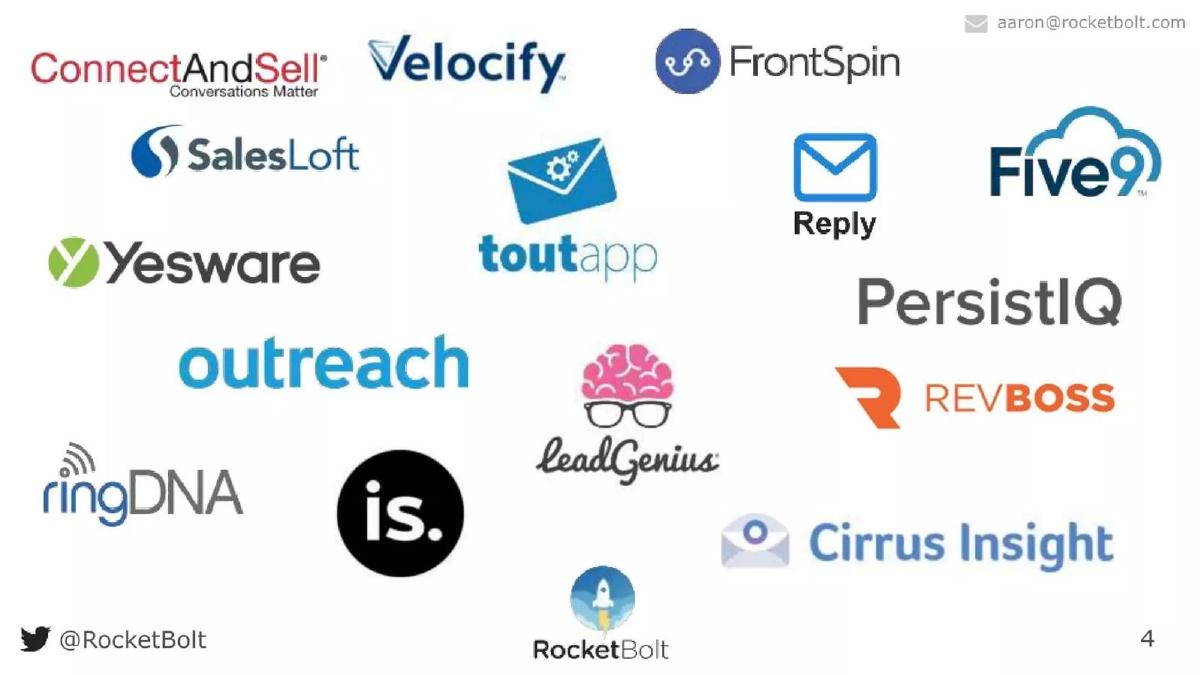
- Slide 4 displays a crowded ecosystem of sales tools, positioning RocketBolt within a busy but lucrative market.
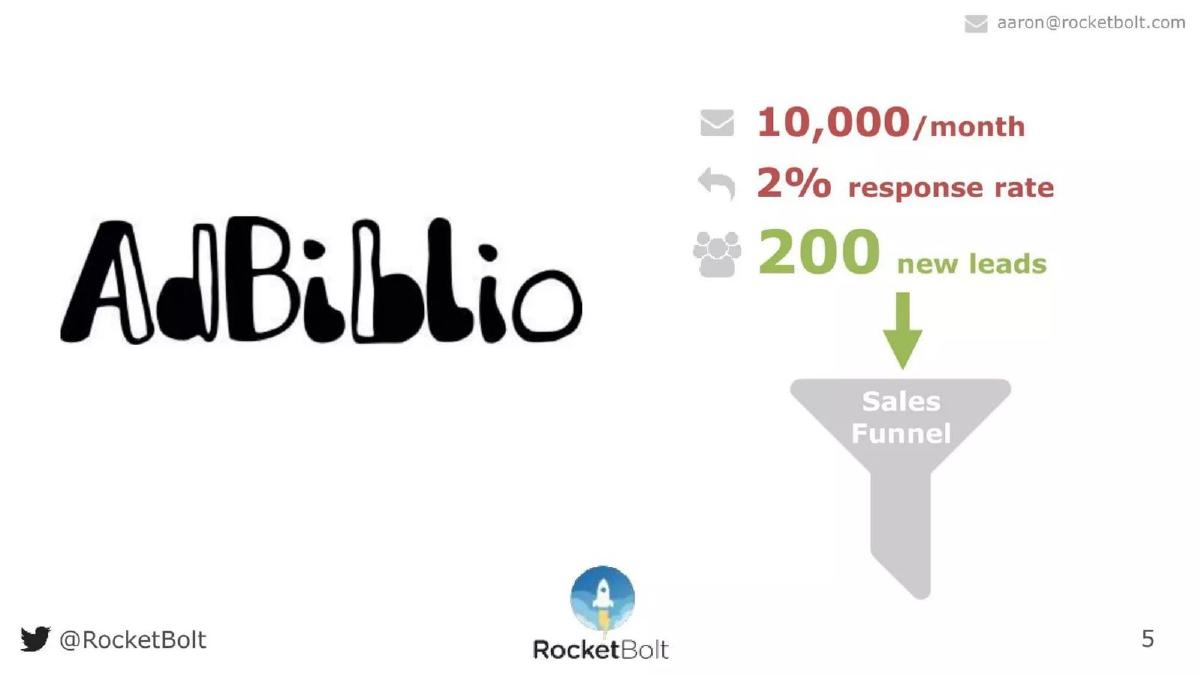
- A detailed funnel breakdown on slides 5 through 9 illustrates how tracking 'interested, non-responding' prospects adds 200 leads to a baseline of 200.
- The company reported significant early traction on slide 11 with '100+ Paid Beta Customers' and '$35k Monthly Recurring Revenue.'
- Slide 12 confirms a '$1.2m Seed Round' which was closed at the beginning of their 500 Startups tenure.
- Customer testimonials on slide 13 provide specific ROI data, such as a 55% increase in demos for Blogads.
- The deck utilizes a minimalist design with very little text, relying instead on large-scale numbers and icons to convey the message.
The RocketBolt Narrative: Data Over Decoration
The RocketBolt pitch deck from 2013 is a quintessential example of the 'less is more' philosophy in early-stage fundraising. Comprising 13 slides, the presentation avoids the dense blocks of text often found in enterprise software decks, opting instead for a visual narrative centered on a single metric: lead volume. At its core, the deck argues that sales teams are leaving half of their potential revenue on the table by ignoring non-responsive but interested prospects. By the time the viewer reaches the final slide, the company has backed this claim with $35,000 in MRR and a $1.2 million seed round milestone.
Slides 1-2: Identity and Pedigree
Slide 1 serves as the title card, featuring the RocketBolt logo—a rocket ship with a lightning bolt exhaust—and the tagline 'Sell more with Intelligent Lead Tracking.' It is clean and professional, providing the company's website and social handles immediately. Slide 2 introduces the team. The founders, Matt Hofstadt and Aaron Dinin, PhD, along with Head of Customer Success Andy Roth, present a strong academic front with degrees from Yale and Duke. Highlighting Aaron Dinin as a '2013 Microsoft Fellow' adds significant technical credibility to the backend engineering of the product, while Matt Hofstadt’s 'Award-winning UX/UI designer' status explains the polished look of the deck itself.
Slides 3-4: The Value Proposition and the Ecosystem
Slide 3 is the 'hook.' It contains only five words: '2x Leads going to your inside sales teams.' This is a bold, quantifiable promise that immediately addresses the primary pain point of any sales organization. Slide 4 provides market context without using a traditional 'Competitors' header. By surrounding the RocketBolt logo with established players like SalesLoft, Outreach, and Yesware, the deck suggests that RocketBolt is a necessary addition to the modern sales stack. It implies that while these other tools handle communication, RocketBolt provides the 'intelligence' layer that makes those communications twice as effective.
Slides 5-9: The Funnel Mathematics
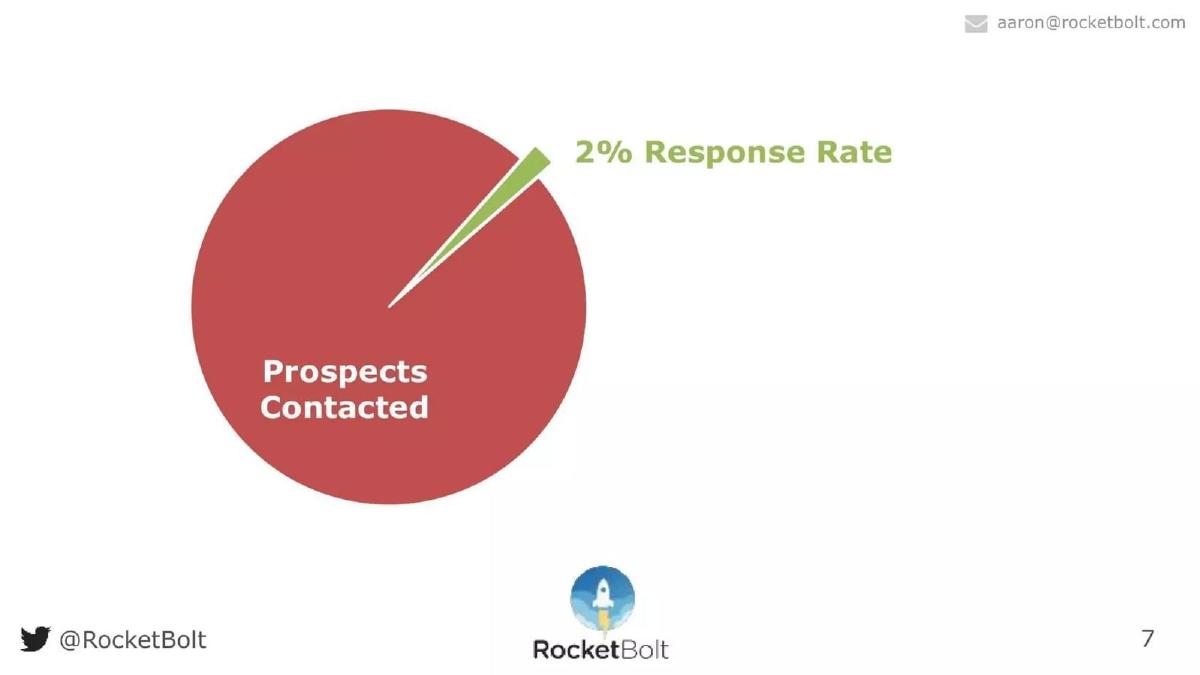
This sequence of slides is the most critical part of the presentation, as it explains the 'how' behind the '2x leads' claim. Slide 5 uses a hypothetical customer, 'AdBiblio,' to establish a baseline: 10,000 emails sent per month resulting in a 2% response rate, or 200 new leads. Slide 6 is a duplicate of the title slide, acting as a transition. Slide 7 visualizes that 2% response rate as a tiny sliver of a large red pie chart representing 'Prospects Contacted.' Slide 8 introduces the 'RocketBolt Effect': identifying an additional 6% of prospects who are 'Interested, Non-Responding.' Slide 9 brings it all together, showing the original 200 leads plus an additional 200 leads 'from RocketBolt.' This visual logic is undeniable; it transforms a vague concept like 'intelligent tracking' into a concrete mathematical advantage.
Slides 10-11: Traction and Results
Slide 10 is a humorous, albeit slightly dated, stock photo of a man in a suit being showered with money. While it breaks the minimalist aesthetic of the rest of the deck, it serves as a high-energy transition to the hard data. Slide 11 delivers the 'proof of life' for the business. It states the company has '100+ Paid Beta Customers' and '$35k Monthly Recurring Revenue.' For a seed-stage startup in 2013, $35k MRR was an exceptionally strong signal of product-market fit. The use of the term 'Beta' suggests that there is still significant room for growth and price optimization, which is an attractive prospect for investors.
Slides 12-13: Funding and Social Proof
Slide 12 announces a '$1.2m Seed Round' that was 'closed beginning of 500 Startups.' This is a strategic inclusion; it tells new investors that the company is already backed by a major accelerator and has sufficient runway, reducing the perceived risk. Finally, Slide 13 provides the social proof. Testimonials from Blogads and Shoeboxed reinforce the earlier claims. The Blogads quote is particularly effective because it includes a specific metric: 'Our DEMOS have INCREASED 55%.' This anchors the '2x leads' promise in real-world results from a named customer.
What Works in This Deck
The Funnel Walkthrough: The step-by-step breakdown of the sales funnel (Slides 5-9) is excellent. It takes a complex data-tracking product and explains its value through simple arithmetic that any business owner can understand. · Metric-Heavy Traction: Leading with $35k MRR and 100+ paid customers is a powerful way to silence doubts about whether people will actually pay for the service. · Minimalist Design: The deck uses a consistent color palette (blue, green, and grey) and very little text. This ensures that the audience stays focused on the presenter rather than reading slides. · Clear ROI: The deck doesn't just say the product is 'better'; it says it will double your leads. Specificity is a fundraiser's best friend.
What is Missing from This Deck
The 'Ask' Slide: There is no slide detailing how much money the company is currently raising or what they plan to do with the funds. While Slide 12 mentions a previous $1.2m round, a standard pitch deck usually concludes with a clear funding target and milestones. · Product Screenshots: For a tool that prides itself on 'intelligent tracking,' there are no visuals of the actual software interface. Investors often want to see the 'magic' behind the metrics. · Detailed Market Size: The deck assumes the market for sales tools is large (as implied by Slide 4), but it doesn't provide TAM/SAM/SOM figures to quantify the total opportunity. · Competitor Differentiation: While Slide 4 shows other logos, it doesn't explain why RocketBolt is better or different than Yesware or ToutApp. It relies entirely on the '2x leads' claim to differentiate.
What a Founder Should Copy
The 'One Big Number' Approach: RocketBolt picked one metric (2x leads) and built the entire narrative around it. Founders should identify their 'North Star' metric and make it the centerpiece of their deck. · Visualizing the Gap: Slides 7 and 8 do a great job of showing the 'lost' opportunity that the product recovers. If your startup solves an inefficiency, visualize the 'waste' you are eliminating. · Using Testimonials for ROI: Don't just use quotes that say 'we love this product.' Use quotes that cite specific business outcomes, like the 55% increase in demos shown on Slide 13. · The Traction Slide: Slide 11 is a perfect example of how to present traction. Large font, two key numbers, and no clutter.
Frequently asked questions
- What is the core value proposition of RocketBolt according to the deck?
- RocketBolt's core value proposition is 'Intelligent Lead Tracking.' As stated on slide 3, the primary benefit is providing '2x Leads' to inside sales teams. The deck explains this by showing how the software identifies prospects who are interested but haven't responded to emails yet, effectively doubling the actionable lead pool from a standard 2% response rate to a 4% total engagement rate.
- How much revenue was RocketBolt generating at the time of this pitch?
- According to slide 11, RocketBolt was generating $35,000 in Monthly Recurring Revenue (MRR). This is a substantial figure for a seed-stage company in 2013, especially considering they were still in a 'Paid Beta' phase with over 100 customers. This level of traction likely served as the primary validator for investors during their 500 Startups demo day or subsequent meetings.
- Who are the founders and what are their backgrounds?
- The team consists of three key members shown on slide 2: Matt Hofstadt (Founder & Product Developer), an award-winning UX/UI designer from Yale; Aaron Dinin, PhD (Founder & Backend Engineer), a Duke graduate and 2013 Microsoft Fellow; and Andy Roth (Head of Customer Success), who holds an LLM in Entrepreneurship from Duke. The team combines technical depth with high-end design and academic prestige.
- Does the deck mention any specific competitors?
- Slide 4 features a logo cloud of approximately 15 companies, including SalesLoft, Yesware, Outreach, ToutApp, and Five9. While the slide doesn't explicitly label them as competitors, it places RocketBolt in the center of this ecosystem. This suggests that RocketBolt either competes with or integrates into the workflows established by these major sales enablement and CRM tools.
- What evidence of customer success does the deck provide?
- The deck provides both quantitative and qualitative evidence. Slide 11 notes 100+ paid beta customers. Slide 13 features two specific testimonials: Henry Copeland from Blogads, who claims demos increased by 55%, and Lizzy Hazeltine from Shoeboxed, who describes the service as 'like having extra team members.' These quotes validate the '2x leads' claim made earlier in the presentation.