Sonder's Series D pitch deck is a highly professional document that transitions the company from a hospitality startup to a mature, tech-enabled brand. The deck is structured around five core pillars: Guest Experience, Unit Economics, Supply, Demand, and Defensibility. It avoids the common pitfalls of early-stage decks by providing granular data on cohort performance, showing annualized contribution per unit growing steadily over 39 months (Slide 15). The narrative centers on a 'growth machine' capable of accurate underwriting and predictable conversion, boasting a 91% conversion rate from si…
Key takeaways
- The company claims a ~10x ROI per unit over a 12-year contract duration, with a location acquisition cost (LAC) of -$9.5k (Slide 14).
- Sonder differentiates itself from hotels and individual hosts by offering 'jaw-dropping space' and 'seamless service' (Slide 11).
- The deck highlights 100% compliance by targeting under-construction supply that meets hotel standards for zoning, ADA, and fire safety (Slide 18).
- A supply-side funnel shows a 39% conversion from LOIs sent to LOIs signed, and a 91% conversion from signed LOIs to signed leases (Slide 19).
- Sonder positions itself as larger than all VC-backed competitors combined, specifically showing 4x the units of Stay Alfred by 2019E (Slide 41).
- The 'Sonder Flywheel' illustrates how growth leads to scale economies, which in turn leads to cheaper asset financing and better lease terms (Slide 42).
- Future verticals include transforming traditional hotels (2020), selling furniture within units (2021), and housing as a service (2022) (Slide 45).
- The deck omits a traditional team slide and a specific funding 'ask' amount in the provided 24-slide selection.
The Sonder Series D Teardown: Scaling a Tech-Enabled Hospitality Giant
Sonder’s Series D pitch deck is a masterclass in how to present a complex, operationally intensive business as a scalable technology platform. While the company operates in the physical world of real estate and hospitality, the deck focuses heavily on the 'machine' behind the scenes—the underwriting, the compliance, and the unit economics that allow for rapid, defensible growth. This teardown examines the 24 slides provided from the 47-slide original deck.
Introduction and Market Context
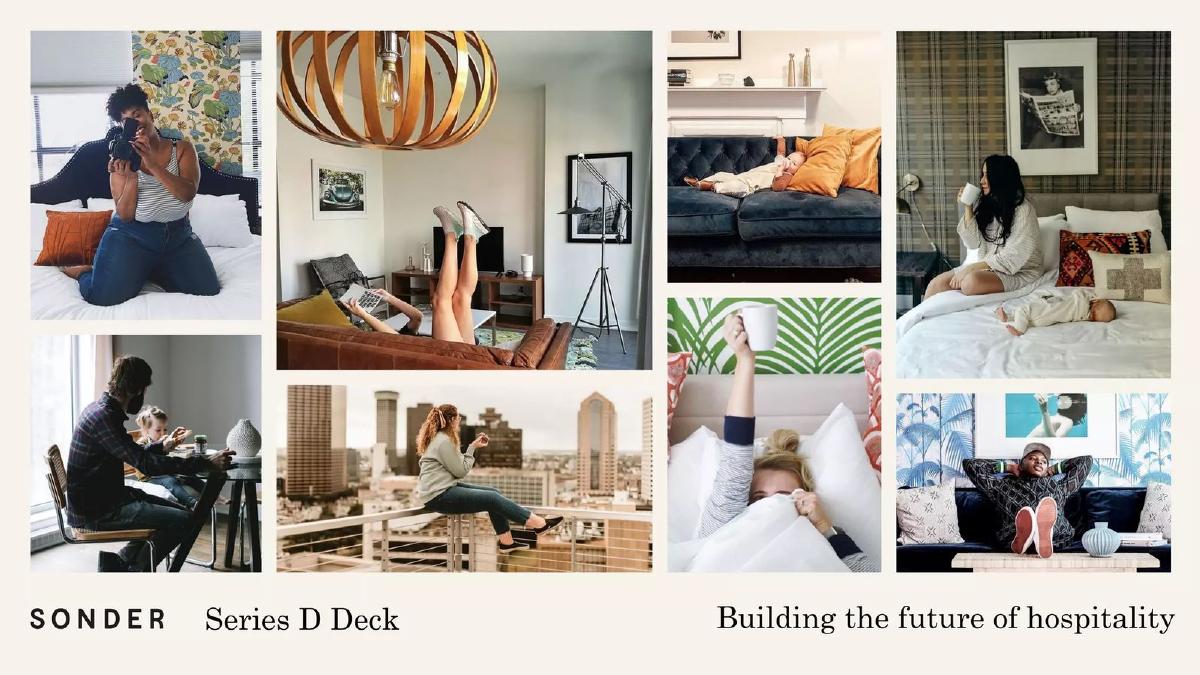
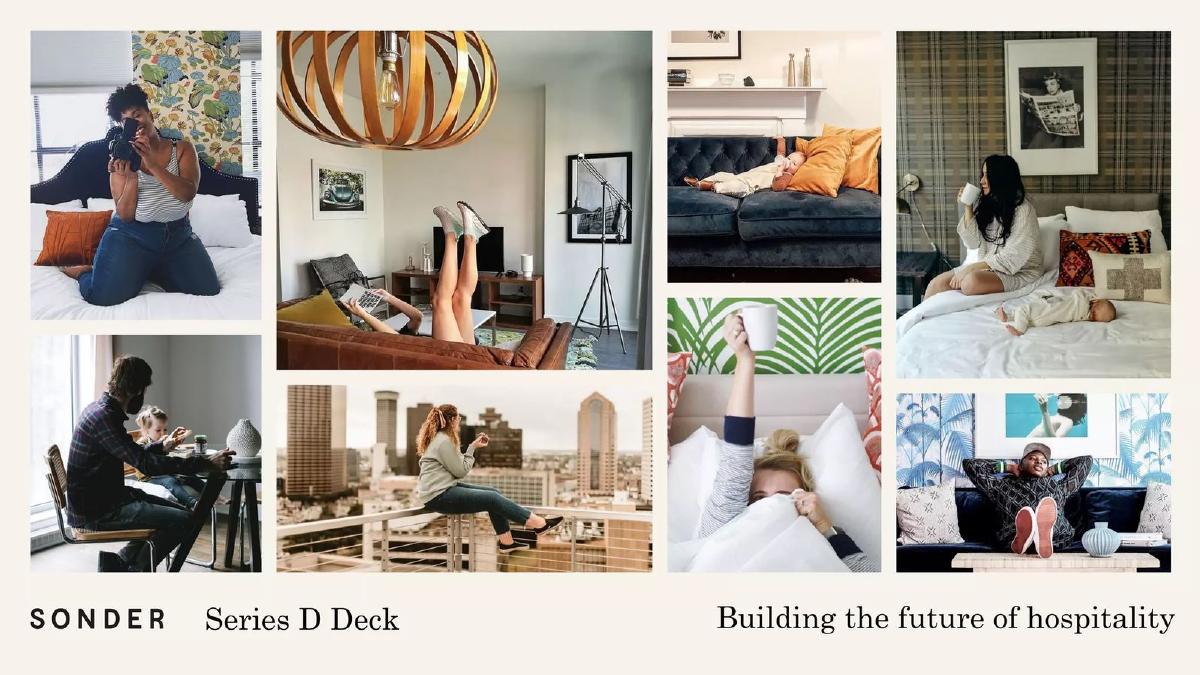
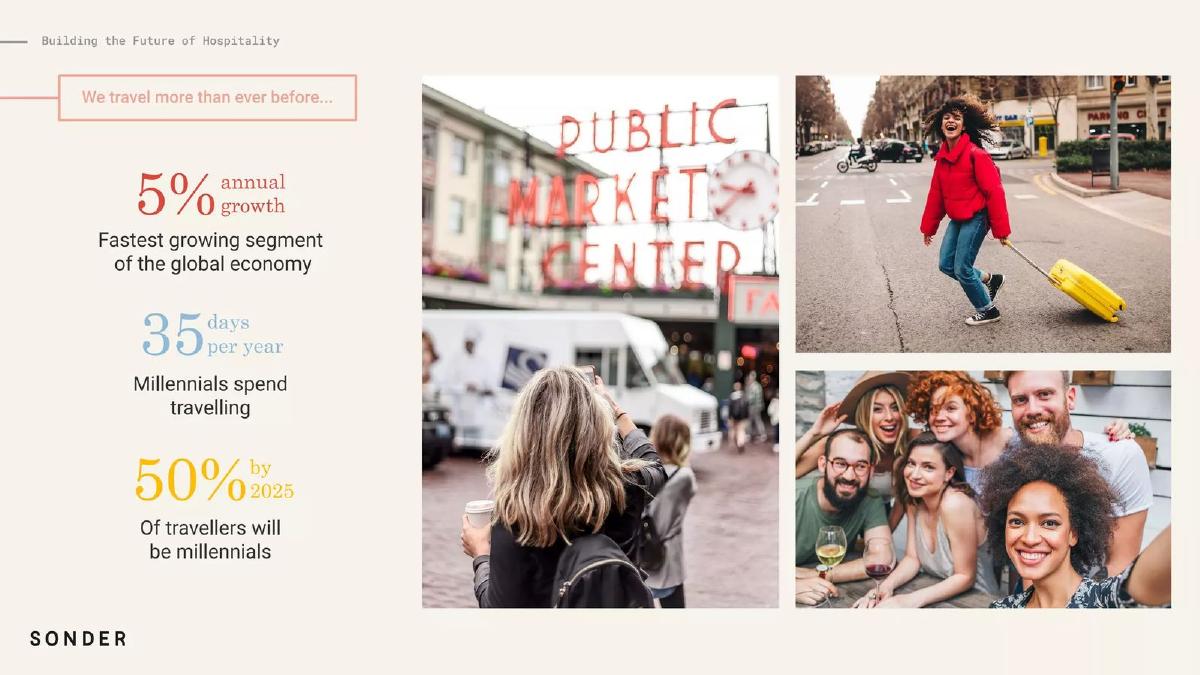
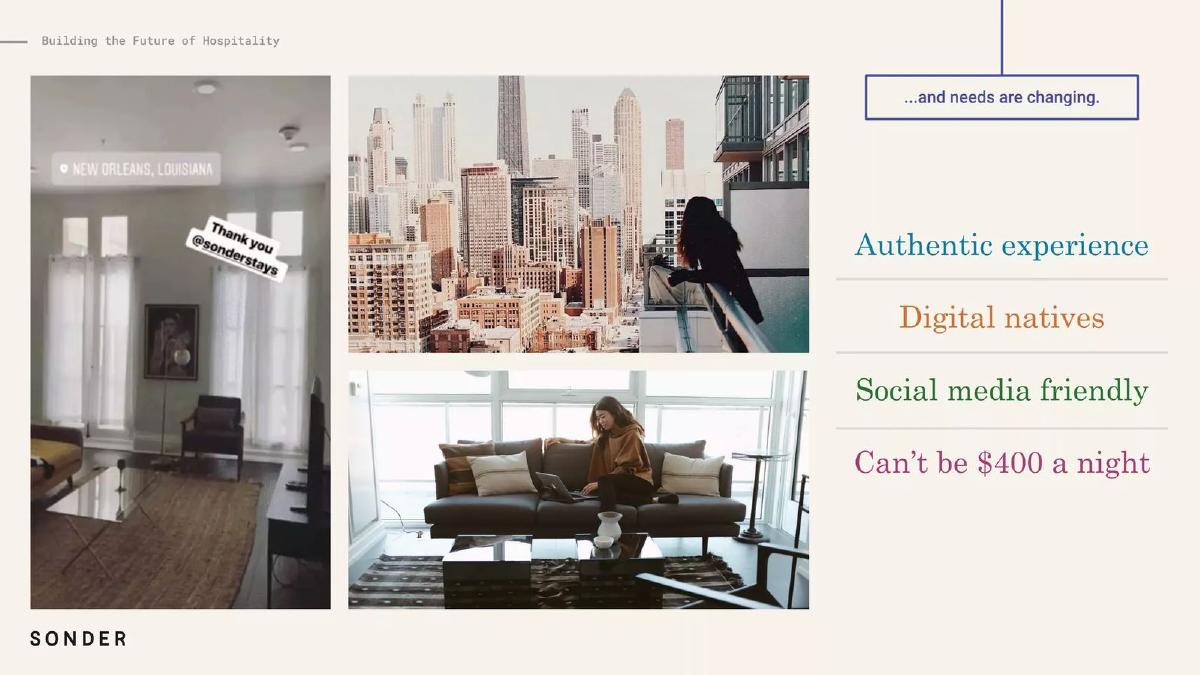
Slides 1-2: The Hook and the Macro Trend The deck opens with a lifestyle-heavy cover slide (Slide 1) featuring a collage of diverse travelers in well-designed 'Sonders.' The tagline, 'Building the future of hospitality,' sets a high-level vision. Slide 2 immediately grounds this in macro data: 5% annual growth in travel, millennials spending 35 days a year traveling, and the prediction that 50% of travelers will be millennials by 2025. This establishes a massive, growing target demographic that is dissatisfied with current options.
The Problem and Evolution
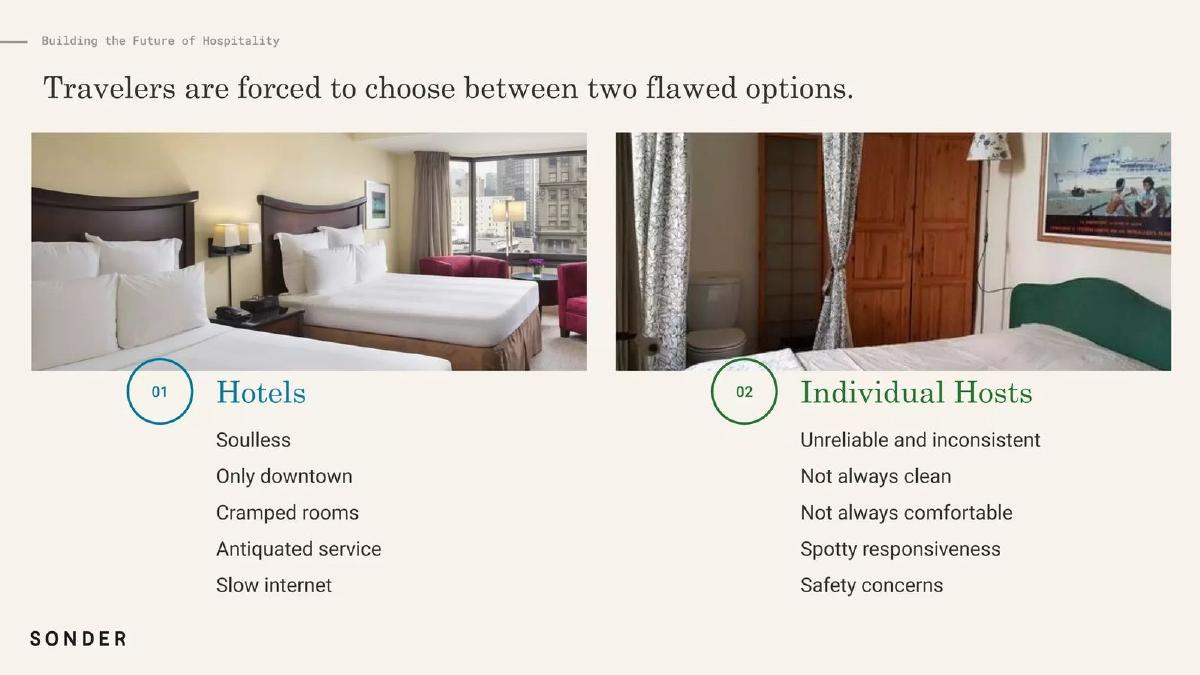
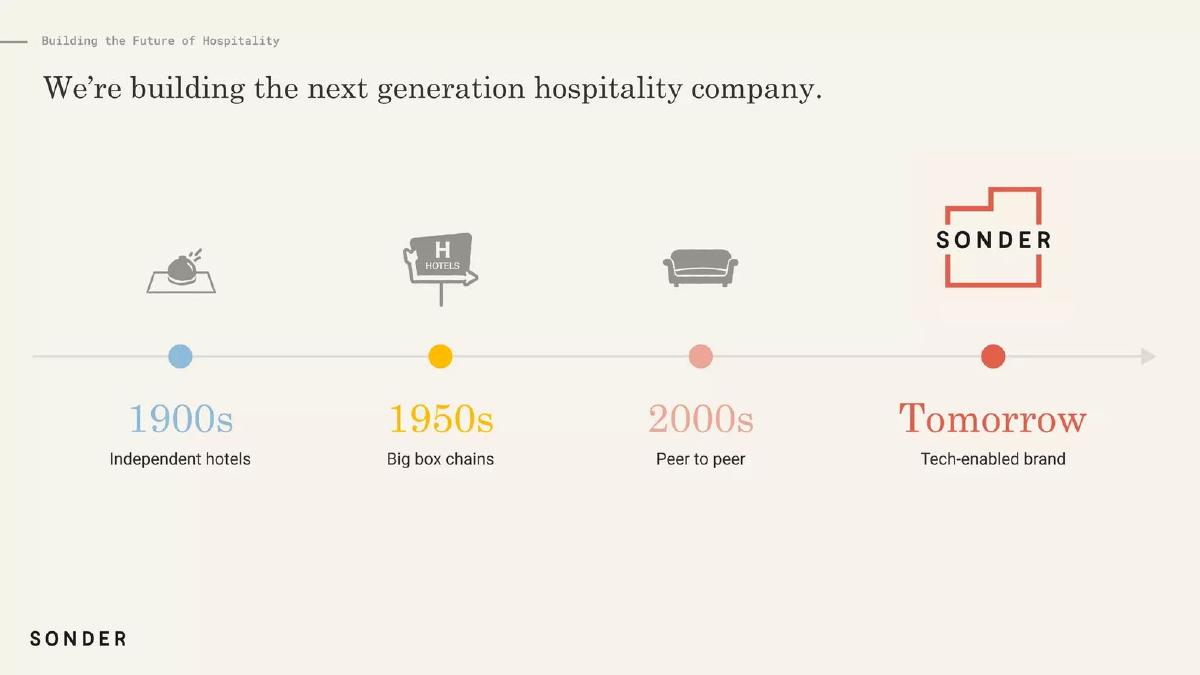
Slides 3-4: The Flawed Status Quo Slide 3 presents the 'two flawed options' for travelers: Hotels (soulless, cramped, antiquated) and Individual Hosts (unreliable, inconsistent, safety concerns). By positioning itself between these two extremes, Sonder carves out a 'Goldilocks' zone. Slide 4 provides a historical timeline, comparing the evolution of hospitality to retail. It moves from 1900s independent hotels to 1950s big box chains (Walmart), to 2000s peer-to-peer (eBay), and finally to Sonder as the 'Tomorrow' tech-enabled brand (Amazon). This is a bold comparison that suggests Sonder isn't just a hotel company, but a platform play.
Product Showcase
Slides 5-6: Visual Proof Before diving into data, the deck shows the product. Slide 5 features a New Orleans property (111 units in the CBD at $151 a night), and Slide 6 shows a New York property (169 units in FiDi at $225 a night). These slides serve two purposes: they prove the aesthetic appeal ('jaw-dropping spaces') and demonstrate the ability to manage large-scale clusters of units in prime urban locations.
Section 1: Guest Experience
Slides 7-11: Consistency and Quality Slide 7 introduces the first of five pillars: Guest Experience. Slide 9 is a critical data point, showing a declining 'Guest issue rate' over time. The deck attributes this to a 'connected home initiative' and improved QA processes. Slide 11 summarizes the guest demand: 'A jaw-dropping space in a fantastic location with seamless service.' Slide 12 uses a map of Philadelphia to show their density strategy, focusing on 'walkable neighborhoods' that are 'lively & safe.'
Section 2: Unit Economics
Slides 13-15: The Profitability Engine This is the heart of the Series D pitch. Slide 14 shows the cumulative cash flow by unit, claiming a ~10x ROI over a 12-year contract. The initial cost to acquire a location (LAC) is cited as $9,500, with a total cumulative cash flow of $96,000. Slide 15 provides a cohort analysis of annualized contribution per unit by market-launch year (2015-2018). The graph shows that while newer cohorts start lower, they trend upward significantly over 39 months, proving that the business becomes more profitable as markets mature.
Section 3: Supply
Slides 17-21: The Growth Machine Supply is often the bottleneck for hospitality startups. Sonder addresses this by highlighting '100% compliance' on Slide 18. They target under-construction supply to meet hotel standards for zoning, ADA, and fire safety, which mitigates the regulatory risk that plagued early peer-to-peer models. Slide 19 details their 'growth machine,' showing a funnel where 91% of signed LOIs result in signed leases. Slides 20 and 21 provide renderings of upcoming projects in Montreal and Philadelphia, reinforcing their pipeline of large-scale, high-quality assets.
Section 4: Demand and Defensibility
Slides 37-42: Brand and Scale Slide 37 transitions to Demand, and Slide 39 shows the 2019 brand campaign ('It's a Sonder'). This signals a shift from purely functional growth to building an 'iconic consumer brand.' Slide 41 is the 'Defensibility' slide, claiming Sonder is 'larger than all of our VC-backed competitors combined.' It specifically compares Sonder to Stay Alfred, showing Sonder with roughly 4x the units by 2019E. Slide 42 introduces the 'Sonder Flywheel,' where growth leads to scale economies, which leads to better economics and cheaper capital, which in turn fuels more growth.
Future Vision
Slide 45: The Roadmap The deck concludes its narrative with a look at future verticals. By 2020, Sonder planned to 'transform traditional hotels.' By 2021, they aimed to sell the furniture and decor within their units ('Everything in a Sonder is for sale'). By 2022, they envisioned 'housing as a service,' suggesting a move into the long-term rental market. This slide tells investors that the current business is just the first act of a much larger play.
What Works in the Sonder Pitch Deck
1. Granular Unit Economics: For a Series D, investors need to see more than just top-line growth. Sonder’s Slide 14 and 15 provide the specific ROI and cohort data required to prove the business model is sustainable and improves with time.
2. Regulatory Proactivity: By dedicating Slide 18 to 100% compliance, Sonder addresses the biggest 'elephant in the room' for proptech startups. They turn a potential liability (zoning and ADA laws) into a competitive advantage by showing they are the 'grown-ups' in the room.
3. The 'Amazon' Analogy: Comparing the hospitality evolution to the retail evolution (Slide 4) is a powerful framing device. It helps investors categorize Sonder not as a real estate company, but as a tech-enabled brand that can dominate a category through superior operations and data.
4. Supply Chain Discipline: The conversion funnel on Slide 19 shows that Sonder has a repeatable process for acquiring inventory. This reduces the perceived risk of scaling, as it demonstrates that growth isn't just about luck, but about a 'growth machine.'
What is Missing from the Sonder Pitch Deck
1. The Team Slide: In the 24 slides provided, there is no mention of the founders or the executive team. While this may be present in the full 47-slide version, its absence here is notable, as the ability to execute on such a complex operational model depends entirely on the leadership.
2. The 'Ask': There is no slide detailing how much capital is being raised in this round or how that capital will be allocated. Again, this is likely in the omitted slides, but it is a critical component of any fundraising document.
3. Technology Deep-Dive: While the deck calls Sonder a 'tech-driven' company, there is very little detail on the actual technology. We see the results (lower issue rates, better underwriting), but we don't see the proprietary software or data science that makes it happen.
4. Detailed P&L: While unit economics are shown, a full corporate P&L or a path to EBITDA profitability is missing. High unit ROI is great, but investors also need to see how corporate overhead and marketing spend impact the bottom line at scale.
What a Founder Should Copy
1. The Pillar Structure: Grouping the deck into clear sections like 'Guest Experience,' 'Unit Economics,' and 'Supply' makes a complex business easy to digest. It shows that the founders understand the key drivers of their business.
2. The Flywheel Graphic: Slide 42 is an excellent way to show how different parts of the business reinforce each other. Founders should always try to illustrate how their company becomes more defensible as it grows.
3. Competitive Benchmarking: Slide 41 doesn't just list competitors; it uses a bar chart to show Sonder's dominance in terms of units and capital efficiency. If you are the leader in your space, show it visually.
4. Use of Photography: Sonder uses high-quality, professional photography throughout the deck. In a lifestyle or hospitality business, the 'vibe' matters. The deck feels premium because the product looks premium.
Conclusion Sonder’s Series D deck is a sophisticated document that successfully balances the 'dream' of a trillion-dollar vertical with the 'reality' of cohort data and regulatory compliance. It is a model for any late-stage startup that needs to prove it has moved beyond the experimental phase and into the execution phase.
Frequently asked questions
- What is Sonder's core value proposition compared to Airbnb or Marriott?
- Sonder positions itself as the 'next generation' hospitality company (Slide 4). It critiques hotels as 'soulless' and 'cramped,' while labeling individual hosts (like those on Airbnb) as 'unreliable' and 'not always clean' (Slide 3). Sonder aims to provide the consistency and safety of a hotel with the design and space of a high-end apartment, utilizing a tech-enabled brand model.
- How does Sonder manage regulatory risk in the short-term rental market?
- Unlike many competitors that operated in regulatory gray areas, Sonder emphasizes 100% compliance (Slide 18). They achieve this by targeting commercially zoned units eligible for hotel or transient licensing, ensuring ADA compliance, and maintaining $10M in liability coverage. This focus on 'under-construction supply' allows them to build compliance into the property from day one.
- What do the unit economics look like for a single Sonder property?
- According to Slide 14, a typical unit has a Location Acquisition Cost (LAC) of $9,500. Over a 12-year period, assuming a CapEx refresh at year 6, the unit generates a cumulative cash flow of $96,000. This represents a ~10x ROI. The model relies on three levers: improving revenue per available day, decreasing direct costs, and lowering LAC.
- How does Sonder acquire its property supply?
- Sonder uses a 'growth machine' for supply acquisition (Slide 19). This involves a disciplined funnel: sending Letters of Intent (LOIs), converting 39% of those to signed LOIs, and then converting 91% of signed LOIs into finalized leases. They use data-driven underwriting to ensure actual performance meets or exceeds forecasts, which they claim to have achieved by 2018.
- What is the long-term vision for the company beyond short-term rentals?
- Slide 45 outlines a roadmap into three 'trillion dollar verticals.' By 2020, they planned to transform traditional hotels. By 2021, they intended to monetize their interior design by making everything in a Sonder unit available for sale. By 2022, the goal was to transition into 'housing as a service,' likely moving into longer-term residential rentals.