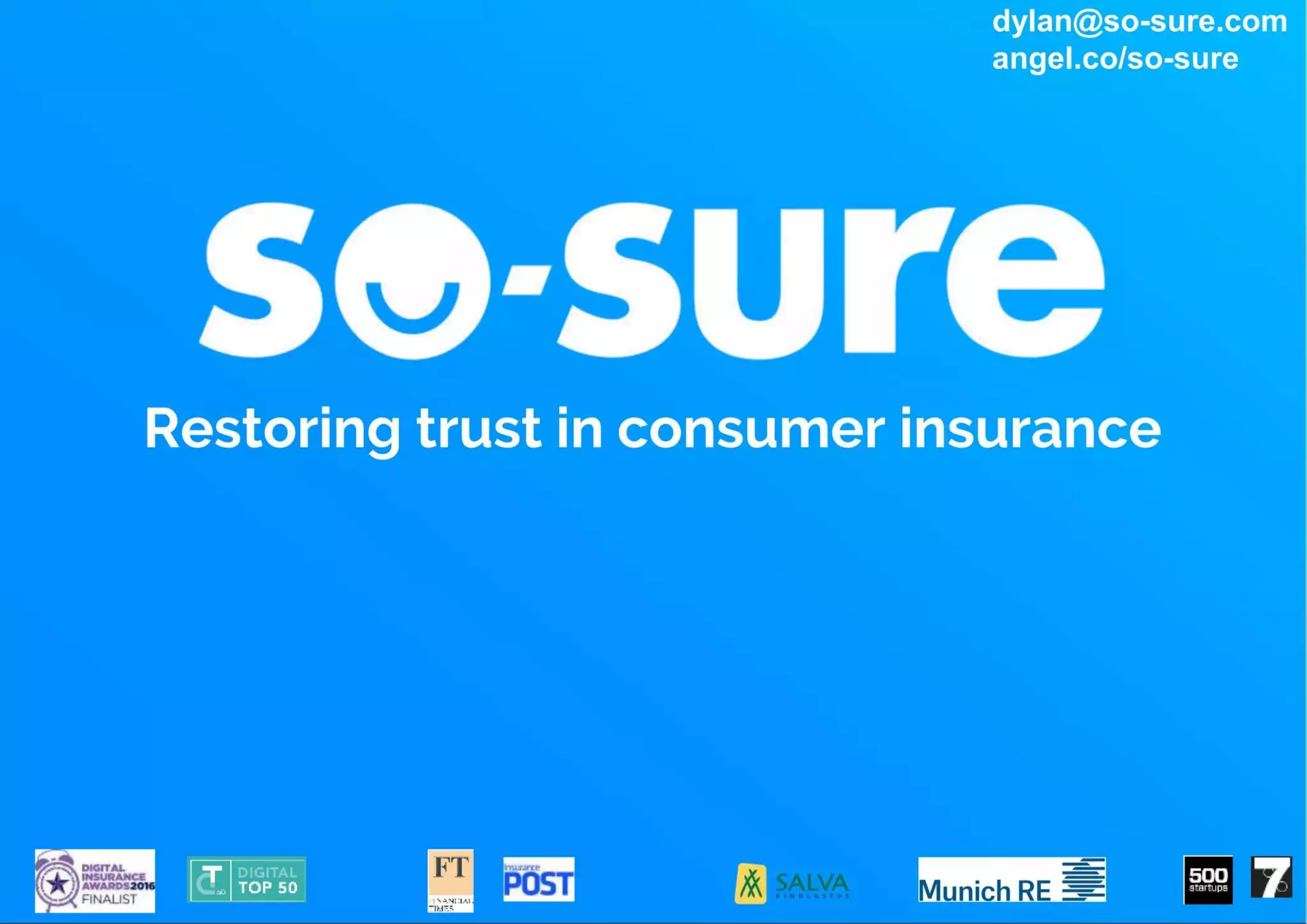
SoSure’s pitch deck centers on a 'social insurance' model that aims to fix the misaligned incentives of traditional insurance providers. The company positions itself as an asset-light intermediary—an 'insurance co. with no balance sheet'—leveraging partnerships with established giants like Munich RE. The deck highlights strong early traction, showing a jump from near-zero to over 60,000 in annualised revenue within ten months, significantly outperforming their 8% week-over-week growth target. While the visual storytelling is minimalist, focusing on high-level pain points like 'Expensive' prem…
Key takeaways
- The company claims to be 'restoring trust in consumer insurance' by returning to 17th-century roots of aligned incentives (Slide 1, 3).
- SoSure operates as an asset-light entity, described as an 'Insurance co. with no balance sheet' (Slide 6).
- The model offers 'Money back when no claims' are made, incentivizing lower fraud and better risk selection (Slide 3).
- Actual revenue growth is outpacing the 8% WoW target, reaching approximately 65,000 in annualised revenue by July (Slide 5).
- Customer satisfaction is a primary metric, with a reported NPS of 79 (Slide 5, 6).
- The company has global ambitions, targeting mobile, home, and travel insurance sectors (Slide 4).
- Strategic partnerships or recognitions are signaled via logos for Munich RE, Salva, and 500 Startups (Slide 1).
- The deck omits a team slide, detailed competitive landscape, and a specific financial ask in the provided pages.
Executive Summary: The Social Insurance Pivot
SoSure’s pitch deck is a study in minimalist, narrative-driven fundraising. The company identifies a fundamental lack of trust in the consumer insurance industry, characterized by high costs and difficult claims processes. Their solution is a return to the 'social' roots of insurance, where incentives are aligned through a money-back mechanism for claim-free users. By operating without a balance sheet, SoSure positions itself as a scalable technology layer on top of traditional reinsurance capacity.
Slide 1: Title and Validation
The cover slide introduces the brand with the tagline: "Restoring trust in consumer insurance." It is heavy on social proof, featuring logos from Munich RE , Salva , 500 Startups , and the Financial Times . The inclusion of a 'Digital Insurance Awards 2016 Finalist' badge provides a temporal marker for the deck's era. The contact information points to an AngelList profile, suggesting the deck was used for early-stage seed or bridge financing. The branding is friendly, using a smile motif in the 'o' of SoSure, which reinforces the 'trust' narrative.
Slide 2: The Problem Statement
Slide 2 uses visceral imagery to define the problem. On the left, a vortex of dollar bills is labeled "Expensive." On the right, a woman in distress is labeled "Painful claims." This slide avoids complex statistics about loss ratios or churn, opting instead to tap into the universal consumer frustration with insurance: that it costs too much and fails when you actually need it. It sets the stage for a solution that must be both affordable and user-friendly.
Slide 3: The Solution and Historical Context
SoSure uses a "Back to the Future" theme to explain their model. They cite "17th century roots" with an illustration of the original Lloyd’s coffee house. The two key pillars of their solution are "Aligned incentives" and "Money back when no claims." This is the core of the 'Social Insurance' pitch: by rewarding customers for not claiming, the company reduces the adversarial relationship between the insurer and the policyholder, theoretically lowering fraud and administrative costs.
Slide 4: Market Scope and Ambition
The company outlines "Global ambitions across consumer lines." The slide features a world map with three large icons: a smartphone, a house, and an airplane. This indicates that while they may have launched with mobile phone insurance (a common entry point for insurtechs due to high frequency and lower complexity), their roadmap includes the much larger home and travel insurance markets. The 'Global' claim suggests the technology platform is built to handle multiple currencies and regulatory environments.
Slide 5: Traction and Revenue Growth
This is the most data-dense slide in the deck. It features an "Annualised Revenue" chart covering a ten-month period from October to July. The "Actual" revenue (red line) shows an exponential curve, ending at approximately 65,000 (currency not specified, but likely GBP given the UK-centric nature of the referenced awards). The deck notes an "8% WoW Growth Target" (blue dashed line), which the actual performance consistently exceeds. Additionally, the slide highlights an "NPS 79," a very high Net Promoter Score for the insurance industry, intended to prove that their 'restoring trust' mission is resonating with users.
Slide 6: The Business Model Summary
The final provided slide summarizes the investment thesis in three bullet points: "Insurance co. with no balance sheet," "9% WoW growth," and "NPS 79." The 'no balance sheet' claim is critical; it tells investors that SoSure is a capital-light software business, not a capital-intensive insurance carrier. They take a fee for distribution and technology while the actual risk is held by their partners (like Munich RE). This makes the business significantly more attractive to venture capital investors who prefer high-margin software over regulated risk-taking.
What Works in the SoSure Deck
The deck excels at narrative simplicity . Instead of getting bogged down in the minutiae of insurance regulation, it focuses on the emotional gap in the market: trust. The use of week-over-week growth (9%) is a classic 'startup' metric that signals high velocity, which is often more persuasive to early-stage investors than absolute revenue numbers. The NPS of 79 is a powerful counter-narrative to the 'Painful claims' slide, suggesting they have solved the primary consumer complaint. Finally, the asset-light model is clearly articulated, which is essential for justifying a tech-style valuation in a traditional industry.
What is Missing from the SoSure Deck
Several critical components are absent from these slides. There is no team slide , which is usually the most important factor for seed-stage investors. We don't know if the founders have insurance backgrounds or technical expertise. There is also no mention of unit economics —specifically Customer Acquisition Cost (CAC) vs. Lifetime Value (LTV). While revenue is growing, we don't know if it is profitable or how much they are spending to acquire each user. The competitive landscape is also ignored; there is no mention of other peer-to-peer players like Lemonade or Friendsurance. Lastly, there is no specific 'Ask' slide detailing how much capital they are raising and what the milestones for that capital will be.
Founder's Guide: What to Copy
Founders should emulate SoSure's use of social proof logos on the cover slide to immediately establish credibility in a highly regulated space. The traction chart (Slide 5) is also a model of clarity, showing both a target and actual performance to demonstrate that the team is hitting its internal goals. The 'Problem/Solution' framing using historical context (Slide 3) is a clever way to make a complex new model feel grounded and logical rather than risky and unproven. If you are building a 'social' or 'community' based product, using the 'aligned incentives' argument is a strong way to differentiate from incumbent 'extractive' business models.
Frequently asked questions
- What is SoSure's core business model?
- SoSure operates a 'social insurance' model that emphasizes aligned incentives between the insurer and the insured. Unlike traditional models where the insurer profits by denying claims, SoSure offers money back to users who do not make claims. They act as an MGA (Managing General Agent) or intermediary, described as having 'no balance sheet,' meaning they likely pass the underwriting risk to partners like Munich RE.
- How fast is SoSure growing according to the deck?
- The deck reports a 9% week-over-week (WoW) growth rate. On Slide 5, a chart shows 'Annualised Revenue' starting near zero in October and climbing to over 60,000 by July. This 'Actual' growth line consistently sits above their internal '8% WoW Growth Target,' suggesting the company is exceeding its early-stage traction expectations.
- What insurance products does SoSure offer?
- Slide 4 indicates 'Global ambitions across consumer lines' using icons for mobile phones, houses, and airplanes. This suggests their initial focus is on gadget (mobile) insurance, with plans to expand into home and travel insurance. The use of a world map background implies a strategy intended for international scalability rather than a single-market focus.
- Who are SoSure's partners and backers?
- The cover slide displays logos for Munich RE and Salva, indicating these are likely the capacity providers or reinsurers backing their policies. The presence of the 500 Startups logo suggests they are an alumnus of that accelerator program. Other logos include 'Digital Insurance Awards 2016 Finalist' and 'FT,' indicating early industry recognition.
- What is the significance of the '17th century roots' mention?
- SoSure references the early days of Lloyd’s of London to contrast modern insurance with original mutual aid models. By highlighting 'Aligned incentives,' they argue that modern insurance has become adversarial. Their 'Money back' feature is a modern take on the historical practice where groups of individuals shared risk and shared in the surplus if losses were low.