The Sonder SPAC deck is a comprehensive 50-slide document (17 analyzed here) designed to transition the company from a private startup to a public entity via a merger with Gores Metropoulos II. The presentation leans heavily on the 'tech-enabled' narrative, positioning Sonder not as a mere property manager, but as an operating system for hospitality. Key themes include a rapid recovery from COVID-19, significant RevPAR (Revenue Per Available Room) outperformance compared to traditional hotels, and a clear path to 32% property-level profit margins by 2025. By benchmarking itself against 'Verti…
Key takeaways
- Sonder positions itself as a 'design-led, tech-enabled' alternative to boutique hotels, big-box hotels, and unpredictable short-term rentals (Slide 10).
- The company claims a proprietary 'operating system' that automates everything from revenue forecasting and underwriting to pricing and housekeeping dispatch (Slide 16).
- As of Q3 2021, Sonder operated 350+ properties across 39 markets with over 16,000 live and contracted units (Slide 19).
- Direct bookings reached a peak of 59% in Q2 2020, though they stabilized around 45% by Q3 2021 as market conditions shifted (Slide 22).
- Sonder projects a conservative 17% RevPAR CAGR from 2020-2025, intentionally undercutting the CBRE hotel forecast of 29% to signal prudence (Slide 34).
- The financial model targets a 32% Property Level Profit Margin by 2025, up from a COVID-era low of negative 67% (Slide 37).
- Unit economics are anchored by a claimed 3-month average estimated payback period for new deals (Slide 40).
- The deck utilizes 'Vertical Disruptors' like Carvana and DoorDash as primary valuation benchmarks rather than traditional hotel chains (Slide 46).
The 2021 Sonder SPAC Teardown
The Sonder investor presentation from November 2021 is a quintessential example of late-stage SPAC (Special Purpose Acquisition Company) storytelling. At 50 slides total, it is an exhaustive document designed to satisfy institutional investors and retail traders alike. The deck attempts to rebrand the capital-intensive world of property management as a high-margin technology platform. By analyzing the 17 key slides provided, we can see the mechanics of how Sonder pitched its $2.2 billion-plus valuation.
The Introduction and Leadership (Slides 1-4)
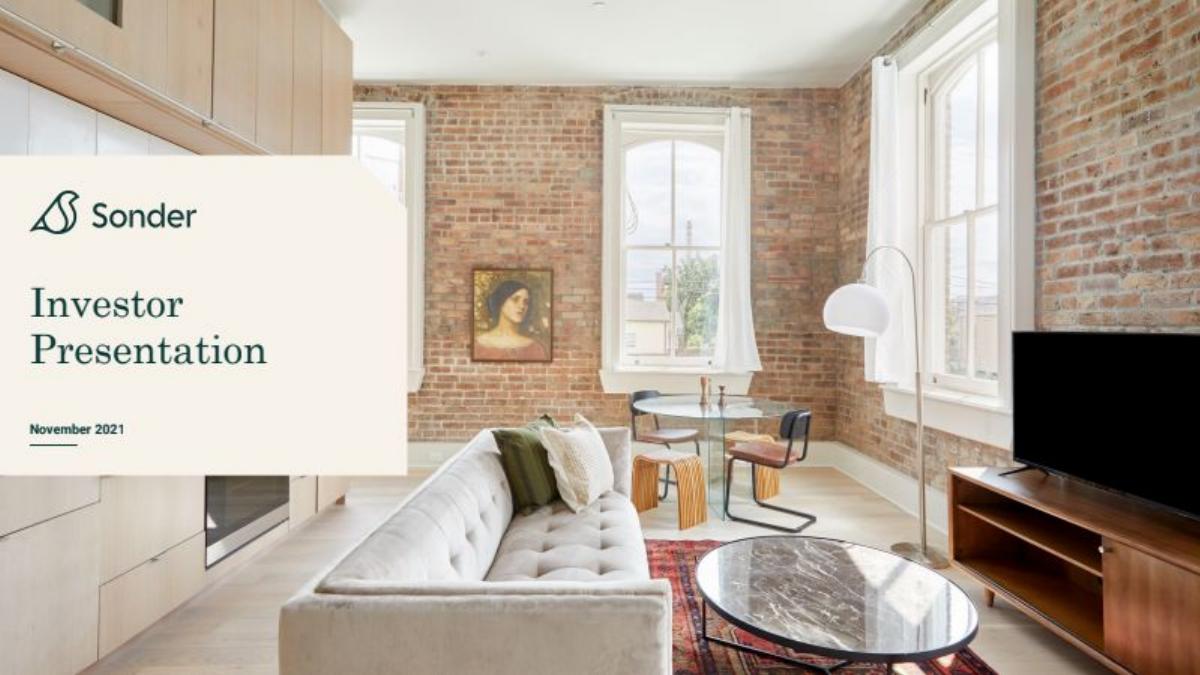
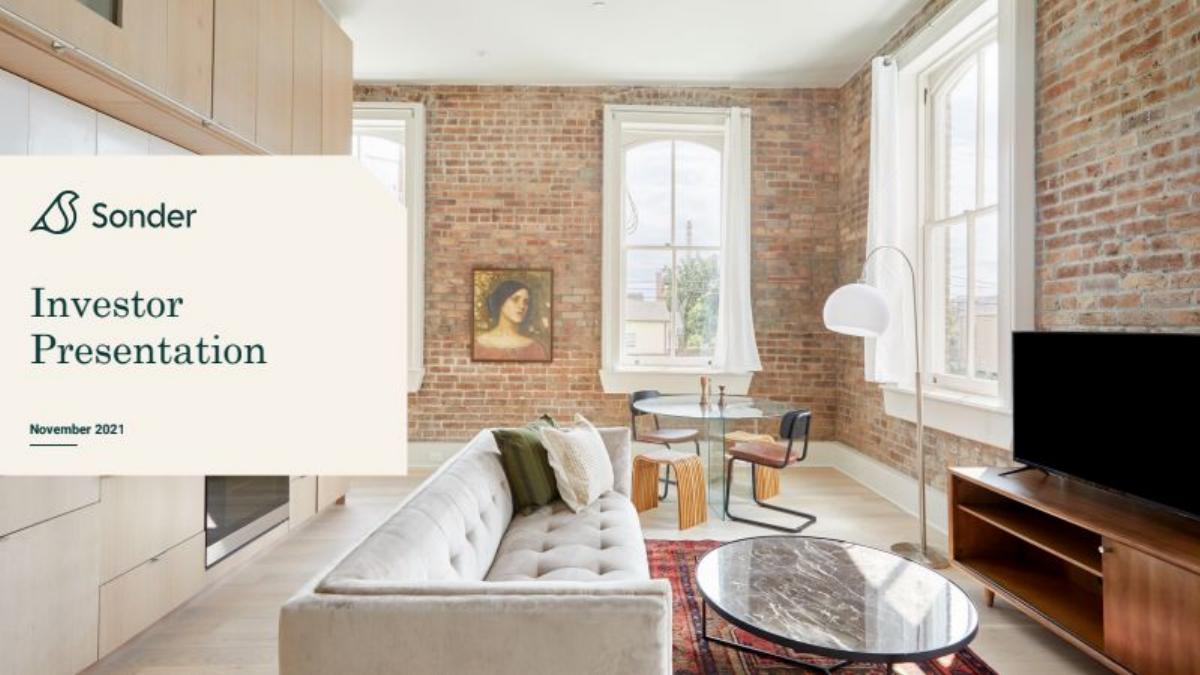
Slide 1 sets a lifestyle-first tone. Instead of charts or data, we see a high-end, sun-drenched apartment with exposed brick and mid-century modern furniture. This is the 'Sonder aesthetic.' The branding is minimalist and premium, signaling that the company is selling an experience, not just a room.
Slide 4 introduces the speakers. It is a combined front of Sonder executives (CEO Francis Davidson and CFO Sanjay Banker) and the SPAC sponsors from The Gores Group (Alec Gores, Ted Fike, Justin Wilson). This slide is crucial for a SPAC deck; it lends the 'Gores' institutional credibility to the younger startup founders. The presence of three Senior Managing Directors from the SPAC sponsor suggests a high level of involvement and vetting.
The Problem and Solution (Slides 10-13)
Slide 10 defines the market gap. Sonder categorizes the competition into three 'flawed' buckets: Boutique Hotels (Expensive), 'Big Box' Hotels (Boring), and Short Term Rentals (Unpredictable). By using unflattering photos for the competitors—particularly the 'unpredictable' short-term rentals which show cluttered, poorly lit rooms—Sonder positions itself as the logical, modernized middle ground.
Slide 13 explains the dual-sided value proposition. For guests, it is 'Tech-centric' and 'Lower cost.' For real estate owners, Sonder offers 'Hands-off management' and 'Compelling economics.' The central image of a smartphone running the Sonder app emphasizes that the entire guest journey—from booking to entry—is digital. This is the first hint at their 'operating system' narrative.
The Technology Moat (Slide 16)
Slide 16 is perhaps the most important slide for justifying a tech valuation. Titled 'The operating system for hospitality,' it breaks down the software stack into three pillars: Supply Growth, Building Openings, and Operations. They cite specific tools like 'RevPAR triangulation' for underwriting and a 'Room attribution algorithm' for pricing. By showing screenshots of internal dashboards, Sonder attempts to prove that their efficiency isn't just a result of good hiring, but of proprietary code that traditional hotels lack.
Scale and Market Share (Slides 19-25)
Slide 19 provides the 'proof of life' for their expansion. With 350+ properties across 39 markets and 16,000+ units, Sonder demonstrates that they are no longer a pilot project. They claim to be ~6x the size of their largest direct competitor (though that competitor is not named). The map shows a heavy concentration in North America with a growing footprint in Europe and Dubai.
Slide 22 tackles the 'Direct Booking' metric, a key indicator of brand strength and marketing efficiency. The chart shows a dramatic spike in direct bookings during 2020, peaking at 59%. While this number dipped to 45% in Q3 2021, the deck notes that ~70% of repeat bookings are direct. This is used to argue that Sonder isn't beholden to Expedia or Booking.com, which would otherwise eat their margins via commissions.
Slide 25 addresses 'Whitespace.' Even with 16,000 units, Sonder points out they have captured less than 1% of the US apartment market and 1.8% of the global hotel market in their current cities. This slide is designed to show that the 'ceiling' for growth is still years away.
The Flywheel and Financial Path (Slides 28-37)
Slide 28 introduces the 'Sonder Flywheel.' It’s a standard circular growth logic: Tech investments lead to better guest experiences, which lead to better unit economics, which lead to better deal terms with landlords, which lead to more supply. It’s a classic 'blitzscaling' argument: capital invested today creates a self-sustaining growth machine tomorrow.
Slide 34 presents their RevPAR (Revenue Per Available Room) outlook. In a move of 'performative conservatism,' Sonder notes that while CBRE forecasts a 29% CAGR for hotels, Sonder is only modeling 17%. This is a tactical choice to make their multi-billion dollar projections seem 'grounded,' despite the fact that 17% CAGR is still highly aggressive for a hospitality business.
Slide 37 is the 'Path to Profitability' bridge. It shows how they plan to go from a -67% margin during COVID to a 32% margin by 2025. The bridge relies heavily on 'Market recovery' and 'Vintage shift to post-COVID signings.' This implies that the leases they signed during the pandemic downturn are significantly cheaper, which will act as a massive tailwind for future profitability.
The Investment Thesis and Benchmarking (Slides 40-46)
Slide 40 summarizes the 'Iconic 21st Century Brand' thesis. It lists impressive stats: ~50% operating cost reduction, 103% Revenue CAGR, and a 3-month average estimated payback period. That 3-month payback period is a staggering claim for a real estate-adjacent business and is likely the most scrutinized figure in the entire deck.
Slide 43 and Slide 46 are the 'Valuation' slides. Sonder places itself at the intersection of 'Vertical Disruptors' (Airbnb, DoorDash, Uber), 'Digital Hospitality' (Zillow, Expedia), and 'Upper Upscale Lodging' (Hilton, Marriott). On slide 46, they show their 117% historical revenue CAGR dwarfing every other company on the list. This is the core of the SPAC pitch: 'We are growing faster than the best tech companies, but we are being priced like a hospitality company.'
The Reality Check (Slide 49)
Slide 49 is the 'Non-GAAP reconciliation.' This is where the 'Adjusted EBITDA' magic happens. It shows a 2020 Net Loss of $250.3 million. After adding back interest, taxes, depreciation, stock-based compensation, and 'COVID-19 related offboardings,' they arrive at a more palatable (but still negative) Adjusted EBITDA of -$209.7 million. This slide is a reminder of the massive burn rate required to fuel the growth shown in the earlier slides.
What Sonder Does Well
Visual Storytelling: The deck uses high-quality photography to sell the 'Sonder' brand. It doesn't feel like a corporate hotel presentation; it feels like a lifestyle brand. · The 'Operating System' Narrative: By framing their business as a software-driven platform, they successfully distance themselves from the low-multiple valuations of traditional real estate companies. · Comparative Benchmarking: Choosing to compare themselves to DoorDash and Carvana rather than just Marriott is a brilliant (if aggressive) way to frame their growth potential. · Addressing the COVID Elephant: Instead of hiding the 2020 losses, they use them to argue that they have already survived the 'worst-case scenario' and are now poised for a 'coiled spring' recovery.
What is Missing from the Deck
Unit-Level Detail: While they mention a '3-month payback,' they don't provide a detailed breakdown of the CapEx required to furnish a single unit versus the monthly cash flow. · Churn and Retention: There is very little data on guest retention or 'Lifetime Value' (LTV). They mention repeat bookings are direct, but not how often a guest actually returns. · Regulatory Risk: The hospitality and short-term rental industry is plagued by changing local laws. The deck omits any discussion of how they navigate zoning laws or hotel taxes in 39 different markets. · Competitive Response: There is no mention of how Marriott (with 'Homes & Villas') or Airbnb are reacting to Sonder’s growth.
What Other Founders Should Copy
The 'Flywheel' Slide: Every founder should be able to articulate how their business gets easier/cheaper to run as it gets bigger. Slide 28 is a perfect template for this. · The 'Whitespace' Slide: Showing that you have a tiny fraction of a massive market (Slide 25) is the best way to prove 'room to run' to an investor. · The 'Conservative' Projection: By intentionally forecasting lower than the industry standard (Slide 34), you build trust with investors, making your other aggressive claims more believable. · Segmented Benchmarking: Don't just compare yourself to your direct peers. Compare yourself to companies with the financial profile you want to emulate (Slide 43).
Frequently asked questions
- What is Sonder's core value proposition to guests?
- Sonder aims to eliminate the 'flaws' of existing hospitality options. According to slide 10, boutique hotels are too expensive, 'big box' hotels are boring, and short-term rentals are unpredictable. Sonder offers a tech-centric, design-led experience that provides higher quality at a lower cost by removing traditional hotel overhead through automation.
- How does Sonder justify its 'tech' label in a real estate business?
- The company presents its 'Operating System for Hospitality' on slide 16. This includes custom software for revenue forecasting, automated underwriting, warehouse management for building openings, and a 'room attribution algorithm' for pricing. By automating the 'back of house,' they claim to reduce operating costs by ~50% compared to traditional hotels.
- What are the key growth drivers identified in the deck?
- Growth is visualized through the 'Sonder Flywheel' on slide 28. It starts with investments in tech, leading to better guest experiences and cost structures, which improves unit economics. These better economics allow for improved deal terms with landlords, which in turn accelerates supply and revenue growth, feeding back into further tech investment.
- How did COVID-19 impact Sonder's financial projections?
- Slide 37 shows that Property Level Profit (PLP) margins plummeted to negative 67% during the height of COVID. However, the deck argues this was a temporary anomaly. They project a return to 32% PLP by 2025, driven by market recovery (accounting for a 67% swing) and new 'post-COVID' lease terms that are more favorable to Sonder.
- Who does Sonder consider its primary competitors?
- Interestingly, Sonder avoids direct comparison with Marriott or Hilton on a growth basis. Slide 43 and 46 group Sonder with 'Vertical Disruptors' like Airbnb, DoorDash, and Carvana. They argue their revenue CAGR (117% from 2017-2019) is more aligned with high-growth tech platforms than with the 1-8% CAGR of traditional lodging giants.