Upflex’s 12-slide deck is a masterclass in 'aggregator' storytelling. By focusing on the logistical nightmare of managing multiple coworking vendors, they present a solution centered on the 'One MSA, One Platform, One Bill' value proposition. The deck effectively uses market data from 2020 to capitalize on the post-pandemic shift toward distributed work, citing a $111 billion flex office market opportunity. While the deck is light on specific unit economics and financial historicals, it leans heavily on its massive supply-side moat—6,000 locations across 80 countries—and an exclusive partners…
Key takeaways
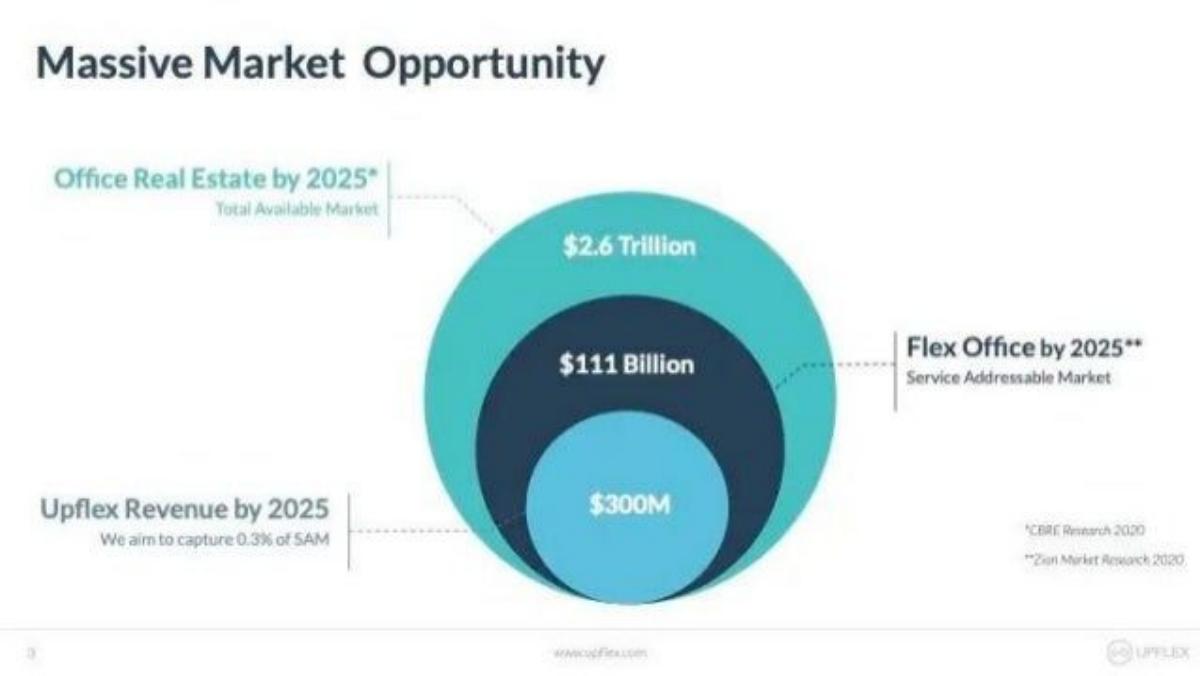
- The deck identifies a $2.6 trillion total office real estate market, narrowing it down to a $111 billion flex office SAM by 2025 (Slide 3).
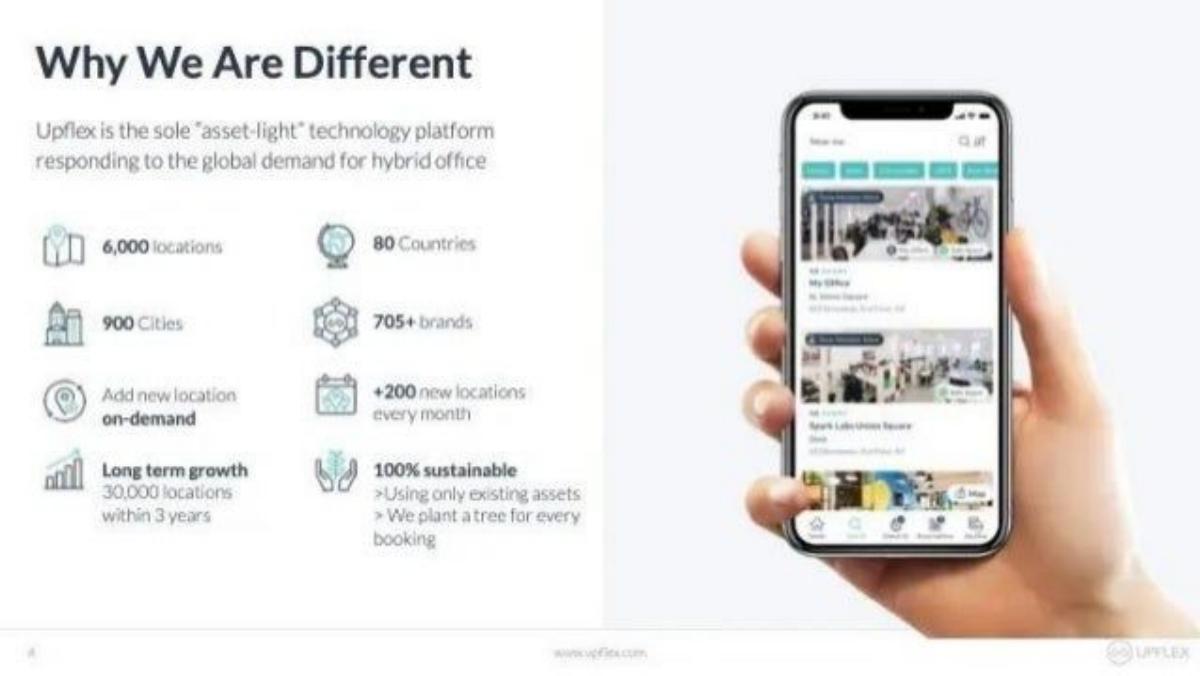
- Upflex positions itself as the sole 'asset-light' technology platform in the space, avoiding the heavy CapEx of traditional coworking (Slide 4).
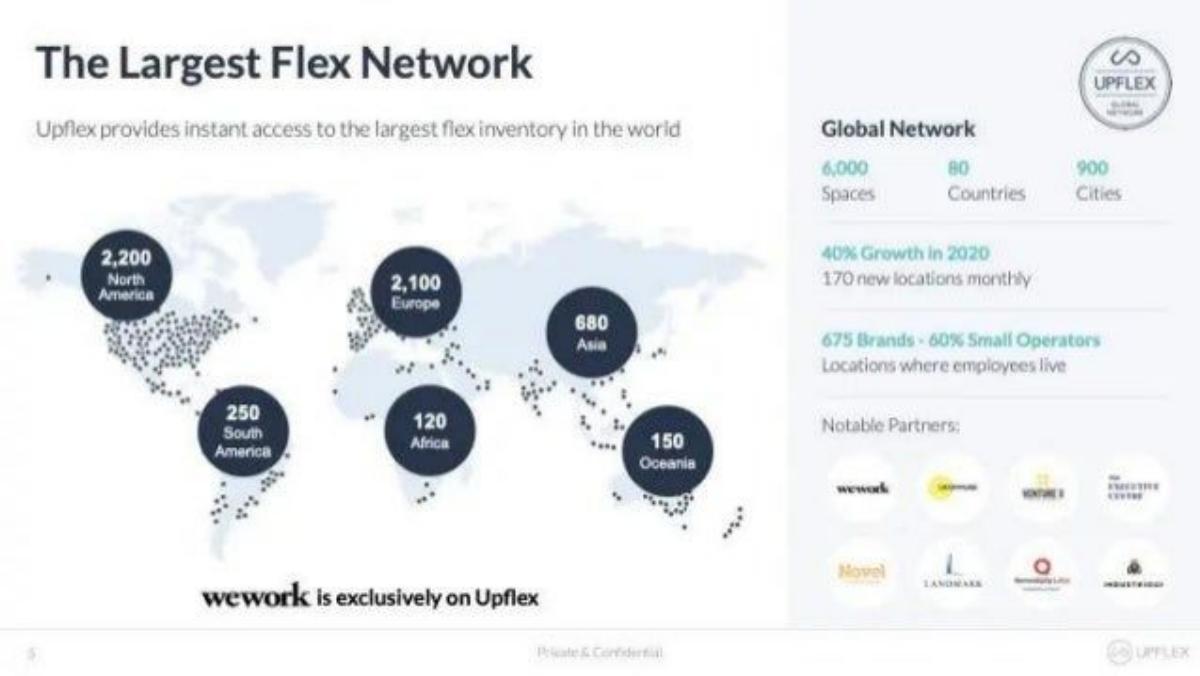
- The company claims a massive supply-side advantage with 6,000 spaces across 80 countries and 900 cities (Slide 5).
- A major competitive moat is highlighted via an exclusive partnership where WeWork is available only on the Upflex platform (Slide 5).
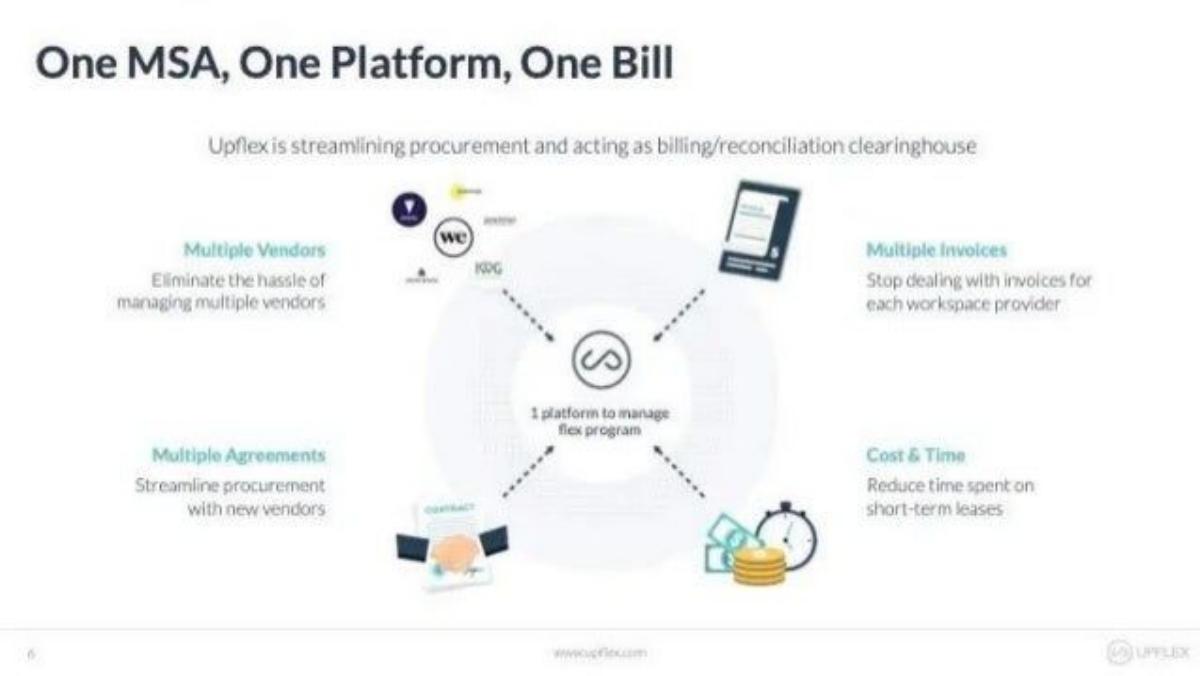
- The core value proposition for B2B customers is summarized as 'One MSA, One Platform, One Bill' to solve vendor fragmentation (Slide 6).
- The management team features significant industry experience, including a CEO with 8 years of coworking ops and a CSO with 30 years in commercial real estate (Slide 11).
- Upflex aims for a specific revenue target of $300M by 2025, representing 0.3% of their SAM (Slide 3).
- The deck lacks a specific 'Ask' slide or a detailed breakdown of how the $30M Series A funds will be allocated.
The Narrative: Infrastructure for the New Standard of Work
The Upflex Series A deck arrived at a pivotal moment in 2022. Following the global shift in work habits, the company needed to prove that 'hybrid work' wasn't just a trend, but a permanent structural change requiring new enterprise infrastructure. The deck moves quickly from macro-trends to a specific logistical solution, positioning Upflex as the 'clearinghouse' for the flex office industry.
Slides 1-2: Setting the Macro Stage
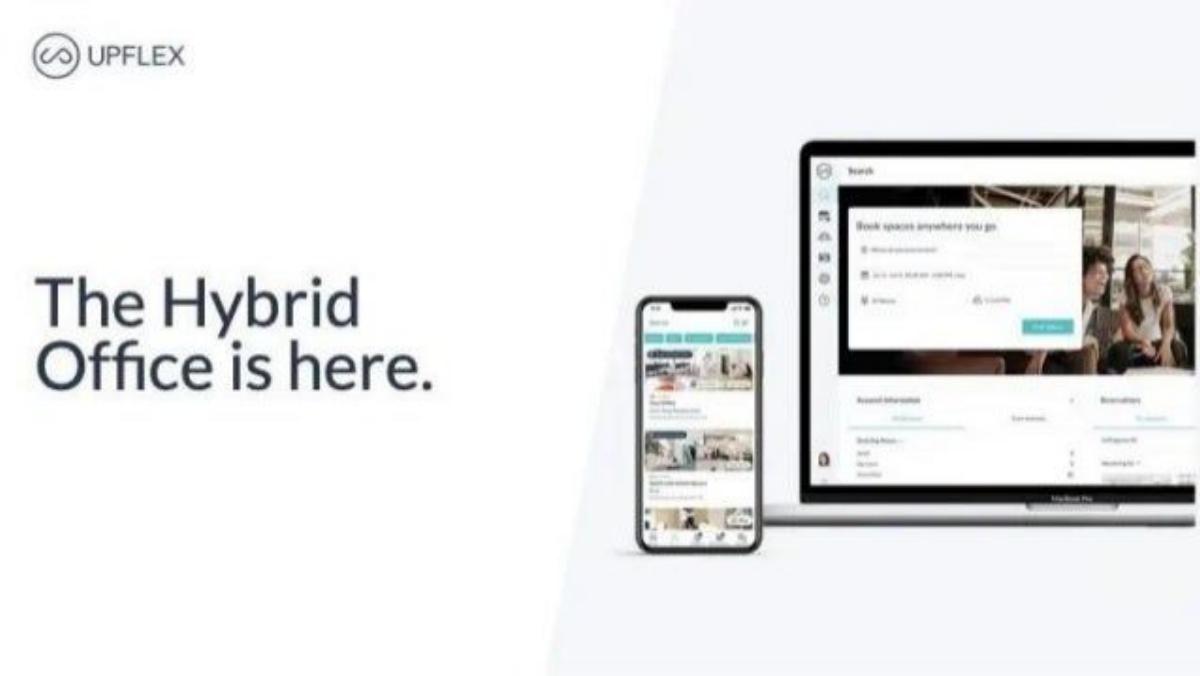
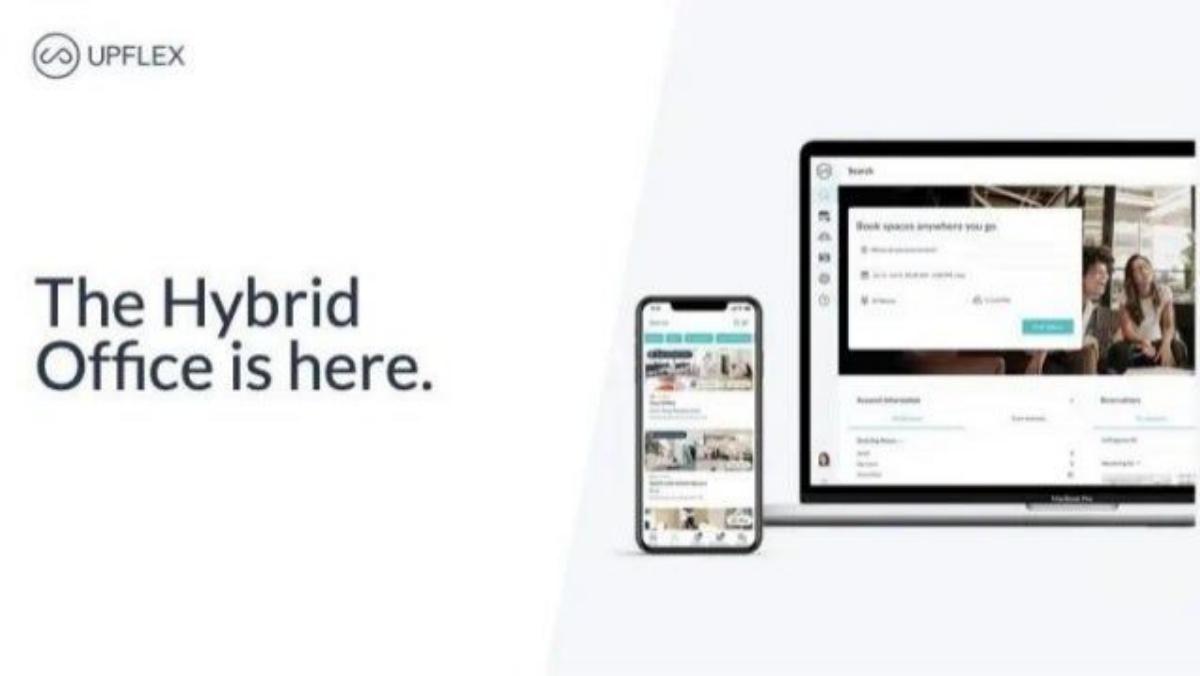
Slide 1 is a clean title slide featuring the tagline 'The Hybrid Office is here.' It immediately establishes the product's visual identity with a laptop and mobile device showing the interface, signaling a tech-first approach to real estate.
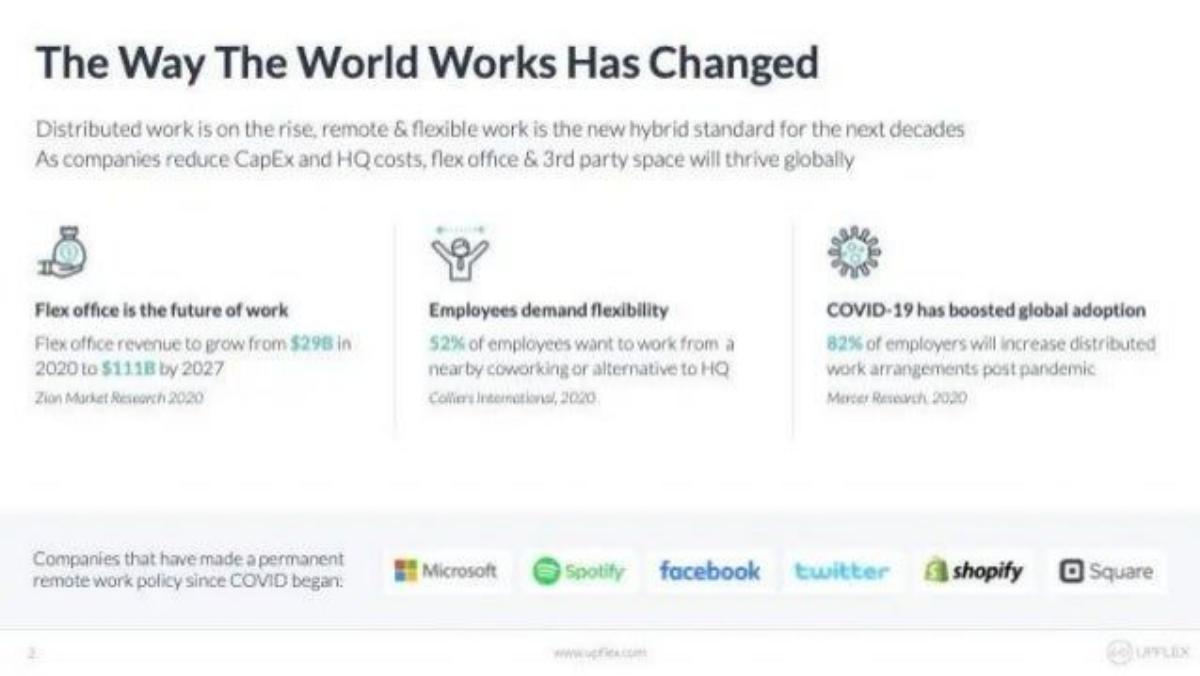
Slide 2 , titled 'The Way The World Works Has Changed,' uses third-party data to validate the market shift. It cites Zion Market Research and Mercer Research to show that 82% of employers will increase distributed work arrangements. By listing logos like Microsoft, Spotify, and Facebook at the bottom, Upflex anchors its potential customer base in the world's largest tech employers who have already committed to remote-first or hybrid policies.
Slide 3: The Trillion-Dollar Opportunity
The 'Massive Market Opportunity' on Slide 3 uses a classic TAM/SAM/SOM concentric circle visualization. They define the Total Available Market as the $2.6 Trillion Office Real Estate market. More importantly, they identify a $111 Billion Service Addressable Market for 'Flex Office' by 2025. The most grounded figure here is their revenue target: $300M by 2025 , which they note is only 0.3% of the SAM. This makes the goal feel attainable rather than hyperbolic.
Slides 4-5: The Supply-Side Moat
Slide 4 introduces the 'Why We Are Different' argument. The key phrase is 'asset-light technology platform.' By emphasizing that they use 'only existing assets,' they distance themselves from the high-risk, high-CapEx models that led to the downfall of other coworking giants. They claim 6,000 locations and a growth trajectory to 30,000 locations within 3 years.
Slide 5 provides the geographic proof. The map shows a global footprint: 2,200 in North America, 2,100 in Europe, and 680 in Asia. The most significant piece of 'social proof' on this slide is the statement: 'WeWork is exclusively on Upflex.' For an investor, an exclusive partnership with the most recognizable brand in the sector is a massive defensive moat.
Slide 6: The Core Value Proposition
This is arguably the most important slide in the deck. Titled 'One MSA, One Platform, One Bill,' it addresses the 'operational chaos' mentioned in the editorial context. It lists four specific pain points: Multiple Vendors, Multiple Invoices, Multiple Agreements, and Cost & Time. By positioning Upflex as the 'billing/reconciliation clearinghouse,' they move the conversation from 'finding a desk' to 'solving a procurement nightmare.'
Slides 7-9: Product Deep Dive
Slide 7 (Management Dashboard): Focuses on the employer. Features include user-role management, team-based billing, and SSO (Single Sign-On). This is the 'SaaS' side of the business. · Slide 8 (Employee App): Focuses on the end-user. It highlights 'on-demand booking,' 'geo-fencing,' and '24/7 chat support.' This ensures the investor understands the product is easy for employees to use, which drives the 'usage' part of the revenue model. · Slide 9 (Unified Reporting): Focuses on data. It promises 'user-level booking data' and 'aggregated overview of utilization.' In a world where companies are trying to figure out how much office space they actually need, this data is the 'sticky' feature that keeps enterprise clients on the platform.
Slide 10: Use Cases
Slide 10 , 'How Businesses Use Upflex,' provides six specific scenarios: Office Elasticity, Remote Teams, Commute Reducer, Workspaces On-Demand, Benefit for New Talent, and Workplace Continuity. This slide helps investors visualize the 'land and expand' strategy—a company might start using Upflex for 'Workspaces On-Demand' and eventually move to 'Office Elasticity' as they scale back their permanent HQ.
Slide 11: The Management Team
The team slide is exceptionally strong for a Series A. Christophe Garnier (CEO) brings 8 years of coworking ops experience. Andre Jacquet (COO) brings 'Big Tech' pedigree as an ex-Regional President at Dyson and Microsoft. Vincent Lottefier (CSO) adds 30 years of commercial real estate experience, specifically 25 years at JLL. This combination of SaaS, tech-scaling, and deep real estate industry ties is exactly what investors look for in a prop-tech play.
Slide 12: The Conclusion
The deck ends on Slide 12 with a simple 'Thank you' and contact information for the CEO. Notably, the deck does not include a 'The Ask' slide or a 'Financials' slide in this public version. While these are often removed for confidentiality, their absence in a teardown means we cannot evaluate the valuation or the specific use of the $30M raised.
What Upflex Does Well
Clarity of the 'Middleman' Value: Upflex doesn't try to be a real estate company. They are very clear about being a technology layer. The 'One MSA' pitch is a direct hit on the biggest hurdle for enterprise procurement departments.
Supply Dominance: By highlighting 6,000 locations and an exclusive WeWork deal, they answer the 'liquidity' question immediately. A marketplace only works if there is enough supply to satisfy demand anywhere a company has employees.
Visual Consistency: The deck uses a consistent, professional color palette and high-quality UI mockups. It feels like a finished, enterprise-ready product, not a prototype.
What is Missing
Unit Economics: There is no mention of take rates, subscription tiers, or Customer Acquisition Cost (CAC). For a Series A, investors usually want to see the 'machine'—how much does it cost to acquire a corporate client and what is their Lifetime Value (LTV)?
Historical Traction: While they mention network growth, they don't show a chart of revenue growth or active user growth over time. We see the 'future' ($300M by 2025) but not the 'past.'
Competitive Landscape: The deck assumes a vacuum. There is no mention of competitors like LiquidSpace or IWG’s own digital offerings. A 'Competitive Matrix' slide would have helped define their unique positioning more sharply.
What Founders Should Copy
The 'Clearinghouse' Angle: If you are building a marketplace in a fragmented industry, don't just sell the 'access.' Sell the 'consolidation.' The 'One Bill' pitch is often more attractive to a CFO than the actual service being provided.
The 'Asset-Light' Narrative: In industries with high CapEx (like real estate or logistics), emphasizing your tech-only, low-overhead model is a great way to justify a SaaS-like valuation rather than a service-company valuation.
Strategic Partnerships as Moats: If you have an exclusive deal with a major player (like the WeWork deal on Slide 5), make it a centerpiece. It is the fastest way to build credibility and prove that you have already 'won' a segment of the market.
Frequently asked questions
- What is the primary problem Upflex is solving?
- Upflex addresses the 'operational chaos' of the hybrid work model. Specifically, it solves the fragmentation caused by companies having to manage multiple vendors, multiple invoices, and various legal agreements (MSAs) across different global coworking providers. By consolidating these into a single platform, they reduce the administrative burden on HR and Real Estate teams.
- How does Upflex's business model differ from WeWork?
- Unlike WeWork, which traditionally signs long-term leases and manages physical assets (high CapEx), Upflex describes itself as 'asset-light.' It does not own or lease the spaces; instead, it acts as a technology layer and marketplace that connects existing coworking inventory to corporate clients, earning revenue through subscriptions and transaction fees.
- What are the key metrics used to demonstrate traction?
- The deck focuses on network scale rather than revenue growth. Key metrics include 6,000 locations, 80 countries, 900 cities, and 705+ brands. They also highlight a growth rate of 170 new locations added monthly and a 40% growth in their network during 2020.
- Who is the target customer for Upflex?
- Upflex is a B2B platform targeting mid-market and enterprise companies that have adopted permanent remote or hybrid work policies. Slide 2 lists examples of companies with such policies, including Microsoft, Spotify, Facebook, Twitter, Shopify, and Square, indicating the caliber of organizations they aim to serve.
- Is there a financial projection included in the deck?
- The deck is sparse on detailed financials. The only forward-looking financial metric is on Slide 3, where they state a goal of reaching $300M in revenue by 2025. There is no breakdown of current ARR, burn rate, or margins.