Unito's Series B deck is a concise 13-slide narrative that avoids the common trap of over-explaining features, focusing instead on a fundamental paradigm shift in the integration market. By positioning themselves as the 'Wave 3' of integration—moving beyond the 'Trigger-Action' model used by Zapier and Workato—Unito makes a compelling case for a 16x improvement in efficiency. The deck relies heavily on technical differentiation, specifically their ability to handle two-way syncs that would otherwise require dozens of individual automation 'zaps.' While the deck is light on traditional financi…
Key takeaways
- Unito positions itself as the third wave of integration, focusing on 'Democratization' for knowledge workers (Slide 3).
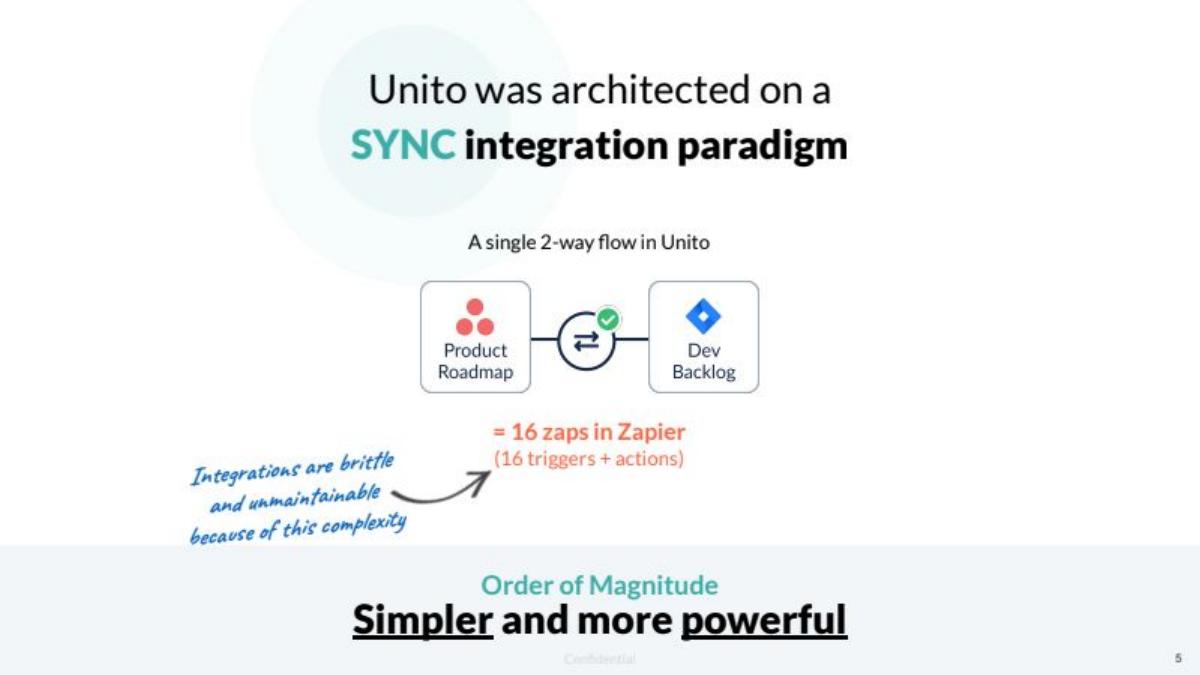
- The company claims a 16x improvement over current offerings by replacing complex trigger-action chains with a single 2-way flow (Slide 2 and 5).
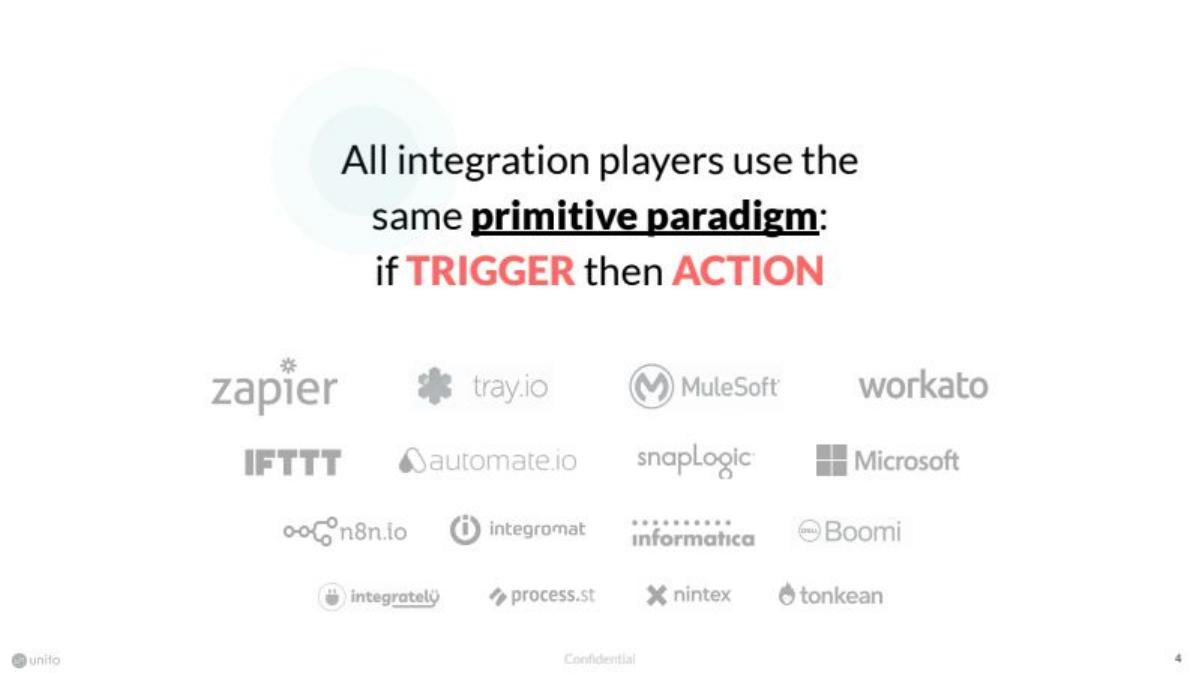
- Technical differentiation is centered on a 'SYNC' paradigm rather than the traditional 'If Trigger then Action' model used by competitors like Zapier and Tray.io (Slide 4 and 5).
- The deck highlights a successful expansion strategy, showing 33% MoM growth in CRMs and 34% MoM growth in Sheets & Tables (Slide 9).
- Unito identifies a specific competitive gap: high ease of use combined with deep 2-way integration, whereas competitors offer either depth or ease, but rarely both (Slide 10).
- The team slide emphasizes a strong company culture, citing a 5-star Glassdoor rating and 100% CEO approval (Slide 11).
- The deck omits a specific 'Ask' slide, though catalogue data confirms a $20M Series B raise.
- The product is battle-tested on 11 project management connectors and 5 dev tool connectors before expanding to 20+ other categories (Slide 7 and 8).
The Narrative Strategy: Paradigm Shifting
Unito’s Series B deck is a masterclass in positioning. Instead of fighting for a slice of the existing 'automation' pie, they attempt to bake a new one. By labeling industry giants like Zapier and MuleSoft as 'Wave 2' or 'Primitive,' they create a vacuum that only their 'Wave 3' SYNC paradigm can fill. This is a classic high-growth SaaS strategy: redefine the problem so that you are the only logical solution.
Slide 1: Title and Mission
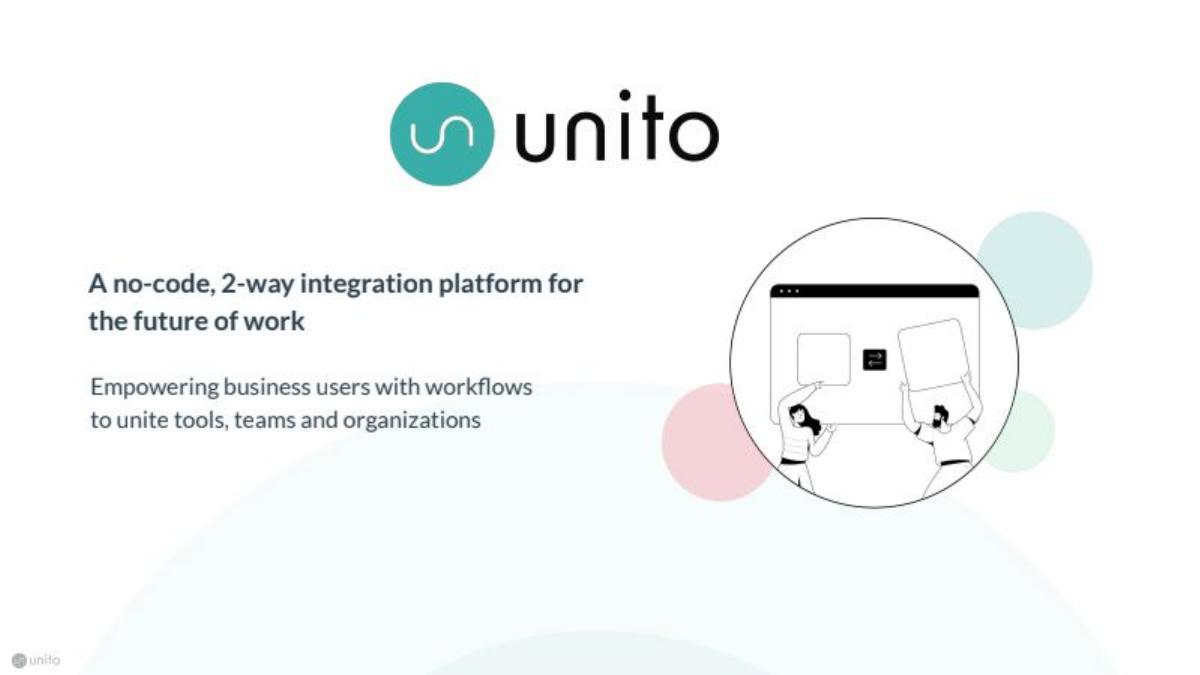
The cover slide introduces Unito as a 'no-code, 2-way integration platform for the future of work.' It establishes two key themes: empowering business users and uniting organizations. The visual is clean, using a simple illustration of two users connecting blocks, reinforcing the 'no-code' and 'collaboration' aspects of the product.
Slide 2: Unito Highlights
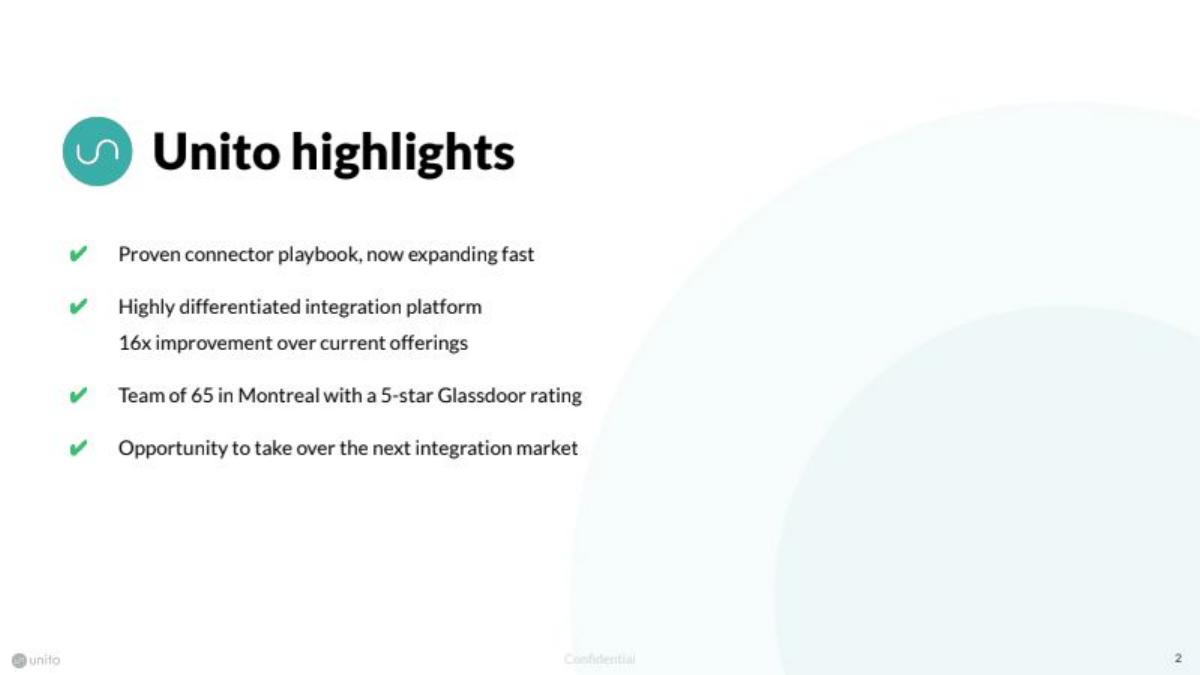
This slide acts as an executive summary. It lists four key pillars: a proven connector playbook, a 'highly differentiated' platform claiming a 16x improvement over current offerings, a 65-person team in Montreal with a 5-star Glassdoor rating, and the opportunity to capture the 'next integration market.' This slide sets the stakes for the rest of the presentation.
Slide 3: The Market Evolution
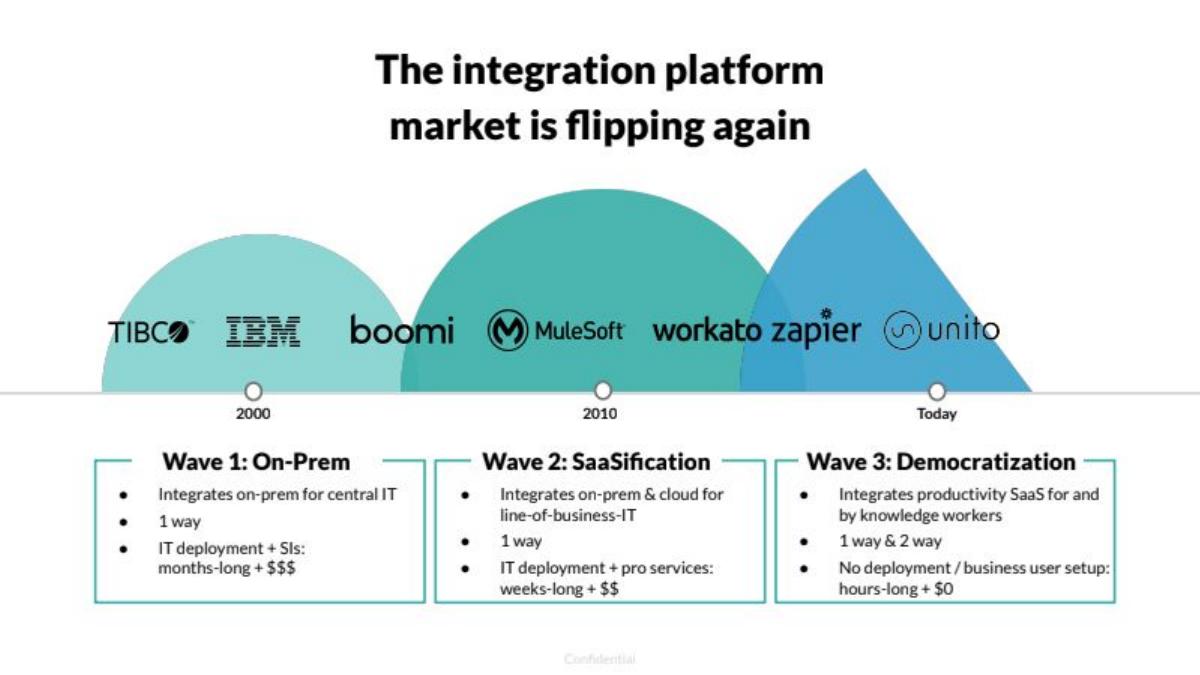
Slide 3 is the most important strategic slide in the deck. It visualizes the history of integration in three waves. Wave 1 (2000s) was on-prem, 1-way, and expensive (IBM, TIBCO). Wave 2 (2010s) was 'SaaSification,' still largely 1-way and IT-centric (MuleSoft, Zapier). Wave 3 (Today) is 'Democratization,' featuring 2-way sync for knowledge workers with 'hours-long' setup and '$0' deployment costs. Unito places itself at the forefront of this third wave.
Slide 4: The Problem with Triggers
Unito takes a direct shot at the status quo here. They state that 'All integration players use the same primitive paradigm: if TRIGGER then ACTION.' By showing the logos of nearly twenty competitors—including Microsoft, Dell Boomi, and Tray.io—under this 'primitive' label, they effectively bucket the entire market as legacy technology.
Slide 5: The SYNC Paradigm
This slide provides the technical 'aha' moment. It compares a single 2-way flow in Unito to 16 'zaps' in Zapier. The text notes that traditional integrations are 'brittle and unmaintainable because of this complexity.' By claiming an 'Order of Magnitude' improvement in simplicity and power, Unito justifies its 16x improvement claim from slide 2.
Slide 6: Product in Action
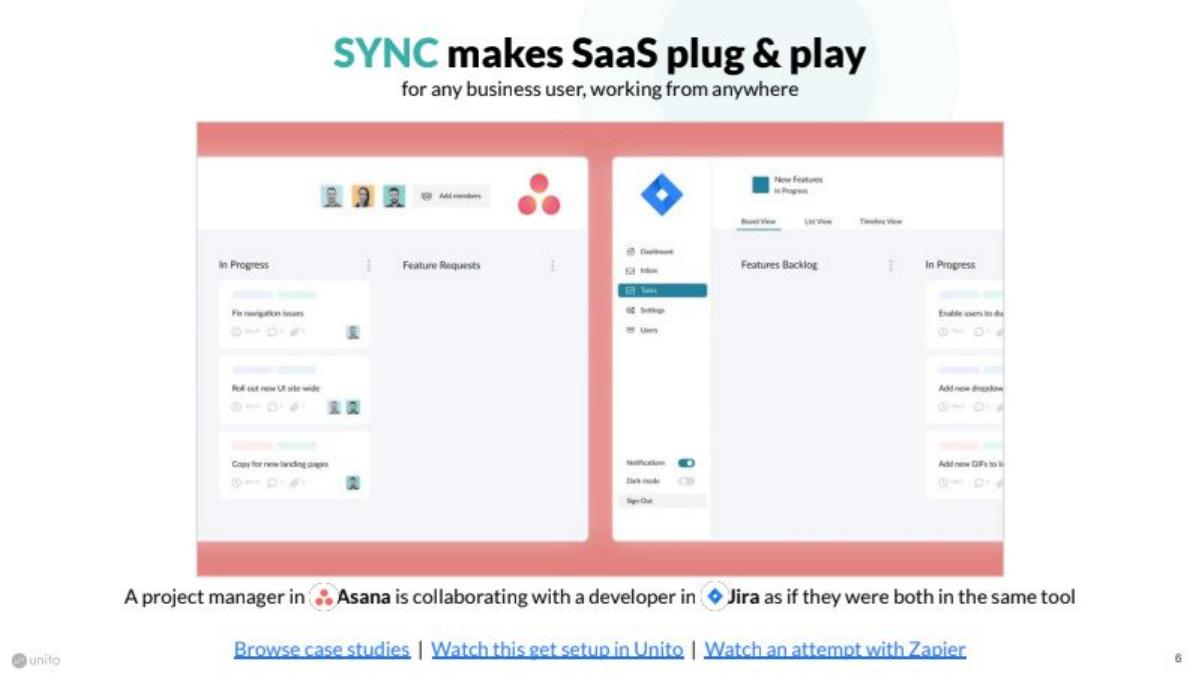
Slide 6 shows a split-screen interface of Asana and Jira. The caption explains that a project manager and a developer can collaborate 'as if they were both in the same tool.' This is the core user experience: invisible, real-time synchronization. The slide also includes links to case studies and video comparisons, though these are not accessible in the static deck.
Slide 7: Technical Moat
To prevent investors from thinking this is 'just another connector,' slide 7 lists the 'really hard technical challenges' Unito has solved. These include specialized algorithms for multi-tool work graphs (multi-hop sync, loop detection) and 2-way sync for complex data (rich text formatting, object hierarchy support). This slide is designed to satisfy the technical due diligence requirements of a Series B investor.
Slide 8: The Expansion Strategy
Slide 8 shows how Unito moved from its 'niche' (Project Management and Dev Tools) into a broader ecosystem. It displays a honeycomb of categories including CRM, Sheets, CMS, E-commerce, and Social Media. The message is clear: the technology is horizontal and can 'unite work across the entire digital productivity suite.'
Slide 9: Growth Evidence
This is the primary traction slide. It features a growth chart from September 2021 to February 2022. While the Y-axis lacks specific dollar amounts, the annotations are specific: CRMs are growing at 33% MoM and Sheets & Tables at 34% MoM. It also notes that their original 'test niche' is being 'pulled up by new categories,' proving the expansion playbook is working.
Slide 10: Competitive Positioning
Slide 10 uses bar charts to compare Unito against Zapier and Workato. Zapier is shown as having high ease of use but shallow (1-way) integration. Workato is shown as having deep integration but lower ease of use. Unito claims the high ground in both ease of use and depth of integration, while acknowledging they currently have fewer connectors (35+) compared to Zapier's 3000+.
Slide 11: The Team
The team slide features four leaders: Marc Boscher (CEO), Eryk Warren (CTO), Vanessa Dreifuss (VP Product & Marketing), and Marie-Rose Rioux (CFO). It highlights 20-25 years of experience and exits to Microsoft and Thales. Notably, it emphasizes culture again, showing a 100% 'Recommend to a Friend' rating and 100% CEO approval on Glassdoor.
Slide 12: Conclusion
The final content slide reiterates the core value propositions: differentiation, 16x improvement, and the expansion playbook. It ends with a call to action: 'Let’s unite work across the entire digital productivity suite of business.'
What Makes This Deck Effective?
Unito succeeds because it focuses on a single, powerful differentiator : the 2-way sync. In a crowded market like SaaS integrations, trying to list every feature is a losing battle. Instead, Unito spends five slides (3 through 7) explaining why their underlying architecture is fundamentally superior to the 'primitive' trigger-action model. This creates a logical bridge to their growth metrics; if the tech is 16x better, it makes sense that they are seeing 30%+ MoM growth in new categories.
The deck also handles the 'connector count' objection gracefully. On slide 10, they admit they have 35+ connectors compared to Zapier's 3000+. However, they frame this as an 'opportunity to take over the market' because their 35 connectors are 'deeper' than the competitors' thousands. This turns a potential weakness into a strategic choice.
What Is Missing?
Despite being a Series B deck, there is a significant lack of hard financial data . There are no mentions of Annual Recurring Revenue (ARR), Net Revenue Retention (NRR), Customer Acquisition Cost (CAC), or Lifetime Value (LTV). While the MoM growth percentages on slide 9 are impressive, they are relative figures that don't reveal the actual scale of the business.
Furthermore, there is no 'Ask' slide . A standard pitch deck usually concludes with the amount of capital sought and a breakdown of how that capital will be deployed (e.g., 40% engineering, 40% sales, 20% ops). While we know from catalogue data that they raised $20M, the deck itself leaves the investor guessing about the specific terms or goals of the round.
Founder's Guide: What to Copy
The 'Wave' Slide: Use a historical timeline (like Slide 3) to show why your company is the inevitable next step in your industry's evolution. · The 10x Comparison: If your product replaces multiple steps of a competitor's product, visualize it. Slide 5’s '1 flow vs 16 zaps' is a perfect example of showing, not just telling, value. · Category Expansion Proof: If you are moving from a niche to a broad market, show the growth rates of the new categories specifically (Slide 9) to prove you aren't a one-trick pony. · Culture as a Metric: In a tight talent market, including Glassdoor ratings and CEO approval (Slide 11) can be a powerful signal of operational stability and maturity.
Frequently asked questions
- What is Unito's core value proposition compared to Zapier?
- Unito argues that Zapier and similar tools rely on a 'primitive' trigger-action paradigm that becomes brittle and unmaintainable as complexity grows. On slide 5, Unito demonstrates that a single 2-way flow in their system replaces 16 individual 'zaps' in Zapier. This 'SYNC' paradigm allows for real-time, two-way data exchange that keeps tools like Asana and Jira perfectly aligned without manual intervention.
- How does Unito demonstrate market traction in this deck?
- Rather than showing total revenue, Unito uses slide 9 to show growth velocity in new categories. They report 33% month-over-month growth in CRM integrations and 34% month-over-month growth in Sheets & Tables. This data is intended to prove that their technology is not just for project management, but is a scalable 'playbook' applicable to the entire digital productivity suite.
- Who are the primary users of Unito according to the deck?
- Unito targets 'knowledge workers' and 'business users' rather than central IT. Slide 3 contrasts their approach with earlier waves of integration that required months of IT deployment. Their goal is a 'zero-dollar' setup that takes hours rather than weeks, empowering non-technical users to unite their own workflows across different departments, such as marketing and development.
- What technical challenges does Unito claim to have solved?
- Slide 7 lists several 'hard technical challenges' including multi-hop sync, cycle/loop detection, and concurrent change resolution. Crucially, they highlight the ability to sync complex data types like rich text formatting across different markup languages and auto-mapping user fields (assignees, mentions) and object hierarchies (comments, sub-tasks) between disparate software platforms.
- Is there a clear financial 'Ask' or use of funds in the deck?
- No. The 13 slides provided do not include a specific 'Ask' slide detailing the amount being raised or how the capital will be allocated. However, external catalogue data indicates this deck was part of a $20M Series B round. The narrative focus on 'expanding fast' and 'taking over the next integration market' suggests the funds were intended for category expansion and scaling the connector playbook.