Unicorn Skincare’s 8-slide pitch deck is a masterclass in brevity and high-impact metrics. Operating in the $77B Asian men’s personal care market, the Taiwan-based brand showcases a jump from $100K+ revenue in 2015 to $536K in 2016. The deck leans heavily on lifestyle imagery to define its target demographic—modern men in Korea, China, and Taiwan who value fitness and charm. While the deck lacks a formal 'ask,' financial projections, or a detailed roadmap, it compensates with strong unit economics, specifically an 80% gross profit margin. By highlighting a 'World’s First' niche product and ex…
Key takeaways
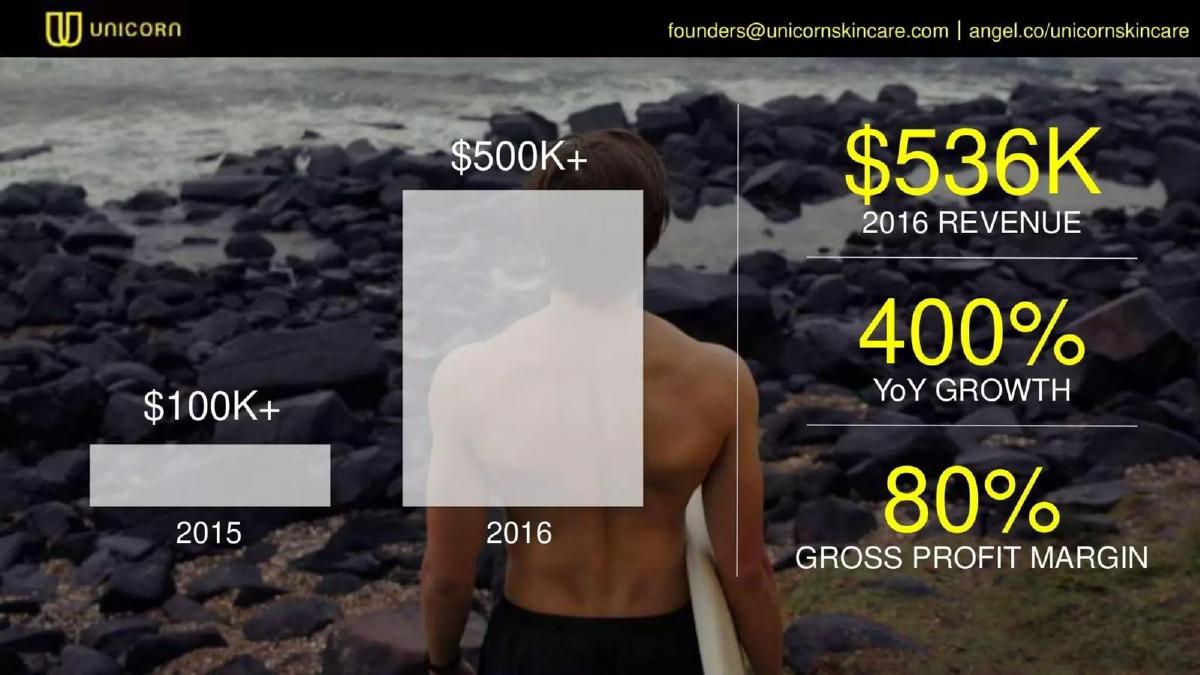
- The company achieved $536K in revenue for 2016, representing a 400% year-over-year growth rate from 2015 (Slide 2).
- Unicorn Skincare maintains a high gross profit margin of 80%, suggesting strong unit economics and premium pricing (Slide 2).
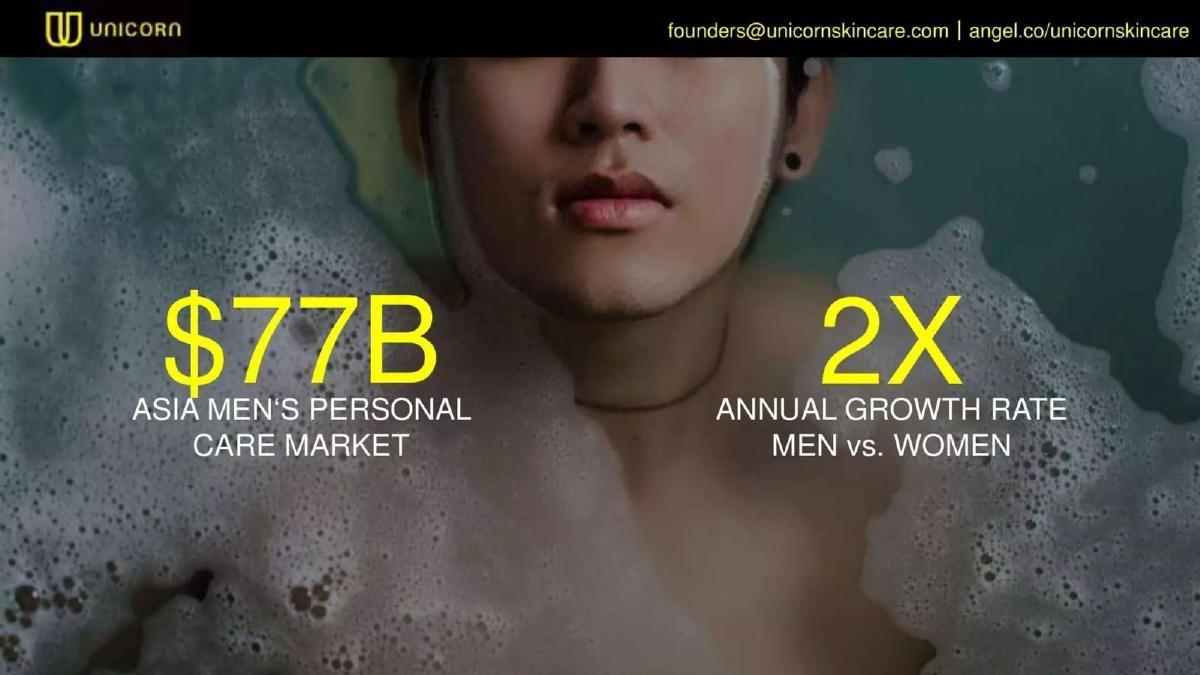
- The total addressable market for Asian men's personal care is cited at $77B, with men's grooming growing at 2x the rate of women's (Slide 3).
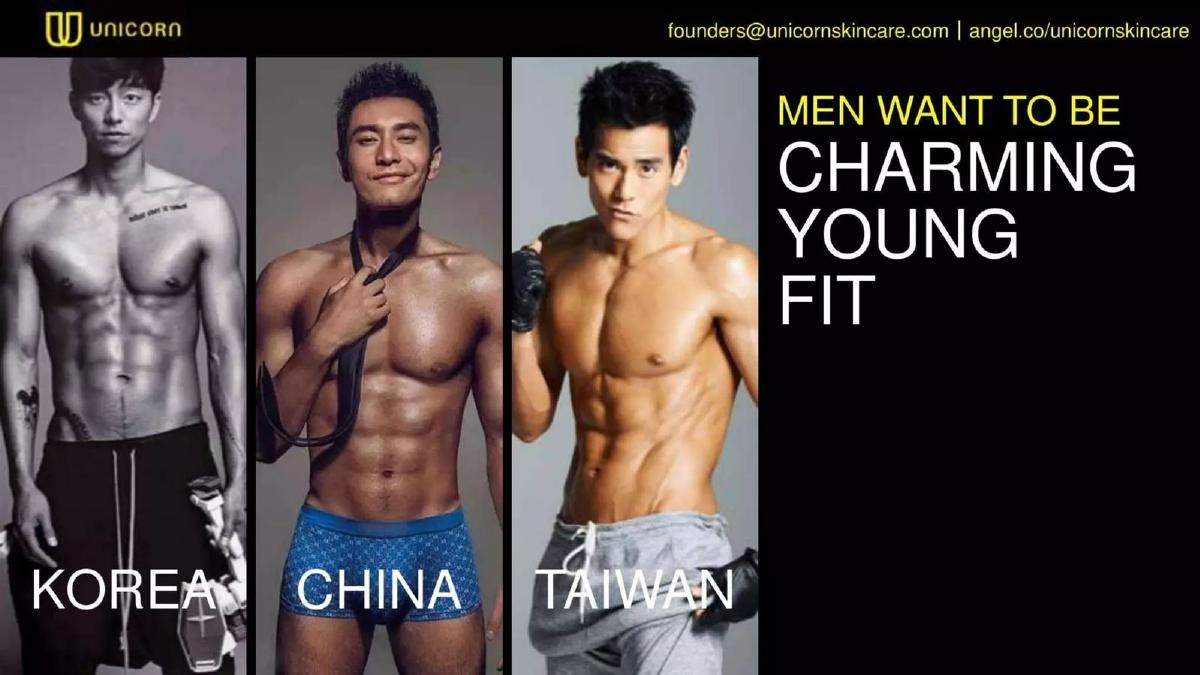
- The brand targets a specific 'lifestyle' demographic across Korea, China, and Taiwan, focusing on men who want to be 'Charming, Young, Fit' (Slide 4).
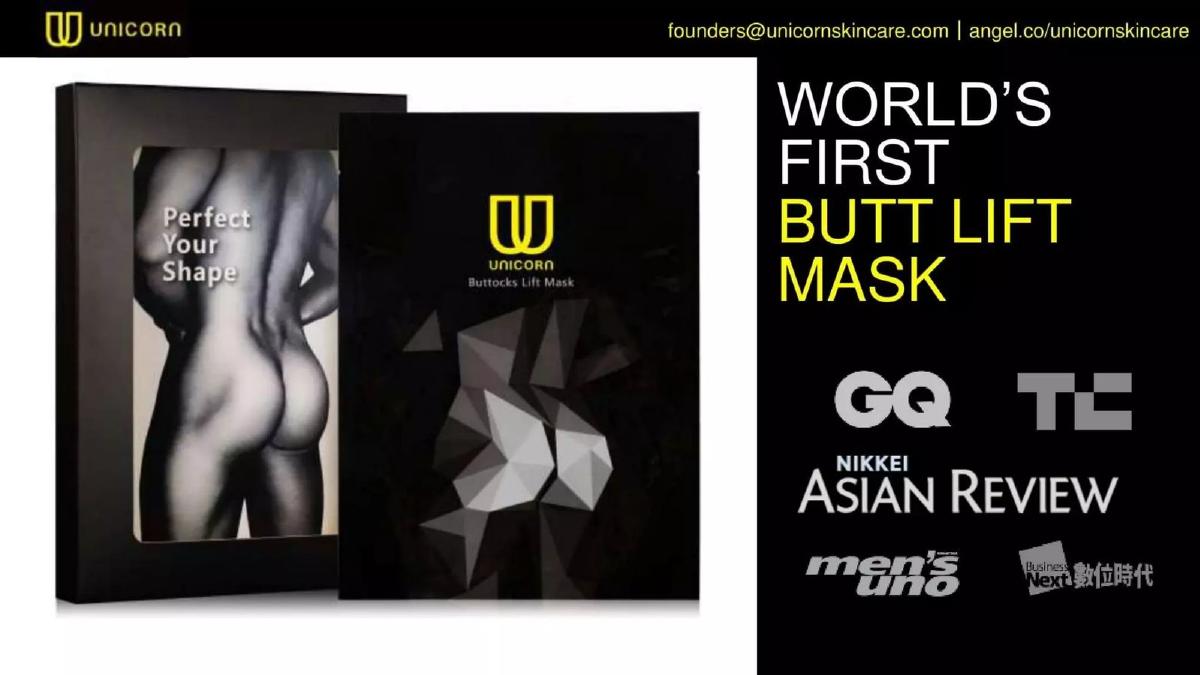
- Product differentiation is anchored by the 'World’s First Butt Lift Mask,' a niche item that garnered media attention (Slide 6).
- The brand has secured press coverage from major international and regional outlets including GQ, TechCrunch, and Nikkei Asian Review (Slide 6).
- The leadership team consists of two co-founders, Johnny Shih (CEO) and Tim Liu (CFO), covering R&D, operations, strategy, and finance (Slide 7).
- The deck omits a specific funding ask, valuation, or detailed use of funds, serving more as a high-level traction summary (Slide 8).
The Lean Brand Teardown: Unicorn Skincare
Unicorn Skincare’s 2015-2016 pitch deck is a concise, 8-slide presentation that prioritizes visual identity and high-level traction over granular operational detail. Based in Taiwan, the company targets the burgeoning Asian men’s grooming market. This teardown examines how the brand uses a minimalist approach to signal high growth and market fit.
The Hook and Traction (Slides 1-2)
Slide 1: Title Slide The deck opens with a stark black background featuring a bold yellow 'U' logo. The tagline, "Stylish Skincare Brand For Modern Men," immediately establishes the target demographic. The inclusion of contact emails and an AngelList link in the header of every slide suggests this was used for digital outreach and platform-based fundraising.
Slide 2: Traction and Margins Unicorn Skincare does not wait to show its numbers. Slide 2 is a high-impact traction slide. It shows a bar chart moving from "$100K+" in 2015 to "$536K" in 2016. To the right, three key metrics are highlighted in large yellow text: "$536K 2016 Revenue," "400% YoY Growth," and "80% Gross Profit Margin." The background image of a shirtless man with a surfboard reinforces the 'lifestyle' aspect of the brand. Starting with these numbers is a strong move; an 80% margin in consumer packaged goods (CPG) is exceptional and immediately validates the brand's premium positioning.
Market Opportunity and Demographics (Slides 3-4)
Slide 3: Market Size The deck moves from internal performance to the external opportunity. It cites a "$77B Asia Men’s Personal Care Market" and notes that the "Annual Growth Rate Men vs. Women" is "2X." This slide justifies why an investor should care about this specific niche: it is large and growing faster than the traditional skincare market. The imagery remains consistent, using a close-up of a man in a bath to maintain the skincare theme.
Slide 4: Target Audience Slide 4 defines the "Unicorn Man." It features three fit, attractive men labeled "Korea," "China," and "Taiwan." The text states: "Men want to be Charming, Young, Fit." This slide identifies the geographic focus (East Asia) and the aspirational nature of the brand. It suggests that Unicorn isn't just selling soap; it's selling a path to a specific aesthetic ideal that is currently trending across these three major markets.
Product and PR (Slides 5-6)
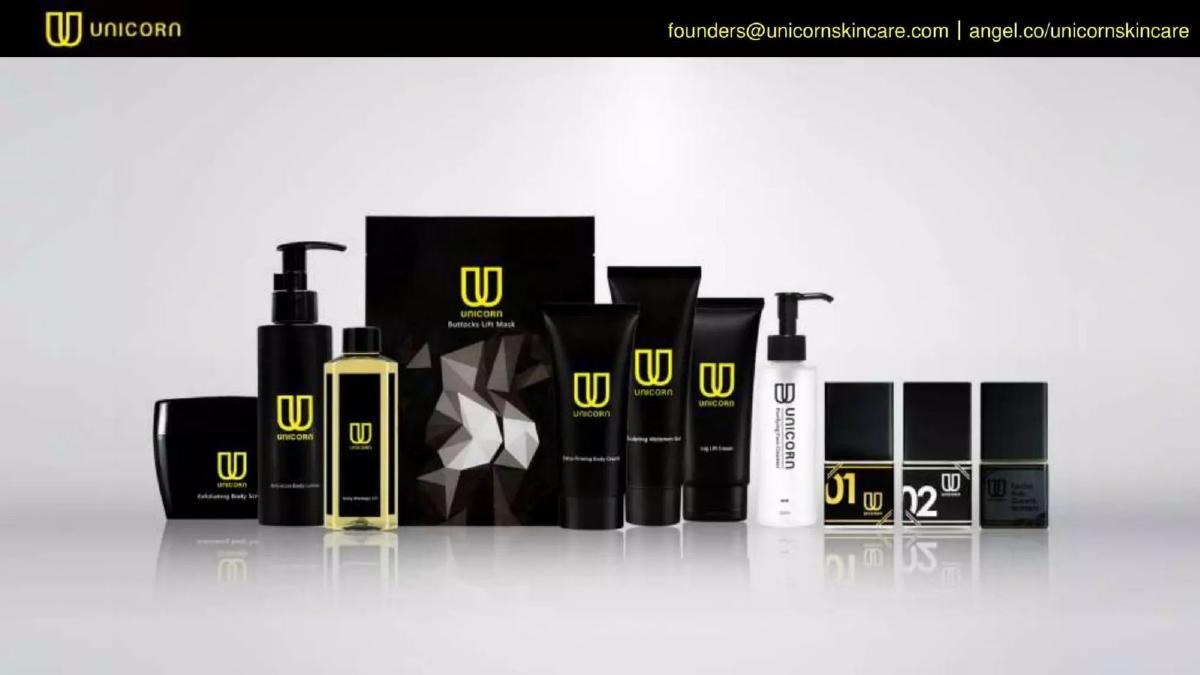
Slide 5: Product Lineup This slide provides a clean product shot of the entire range. The packaging is uniform—matte black with the yellow logo—which gives it a high-end, masculine feel. Visible products include an "Exfoliating Body Scrub," "Anti-acne Body Lotion," and various serums and cleansers. The visual consistency here is important for a brand-led startup; it shows that the product development is mature and ready for retail or e-commerce scaling.
Slide 6: The Hero Product and Press Unicorn highlights its most unique offering: the "World’s First Butt Lift Mask." This is a classic 'purple cow' strategy—offering something so unusual that it generates its own PR. The right side of the slide displays logos for GQ, TechCrunch, Nikkei Asian Review, Men’s Uno, and Business Next. This proves that the brand’s quirky product strategy successfully captured media attention, providing third-party validation that is crucial for consumer brands.
Team and Summary (Slides 7-8)
Slide 7: The Founders The team slide is simple, featuring a photo of the two co-founders sitting behind their product line. Johnny Shih is listed as Co-Founder/CEO, handling R&D and Operations. Tim Liu is listed as Co-Founder/CFO, handling Strategy and Finance. While the slide lacks the typical 'ex-Google' or 'ex-L'Oreal' pedigree descriptions often seen in decks, it shows a clear division of labor between the creative/technical side and the business/financial side.
Slide 8: Closing and Contact The final slide repeats the core metrics from slide 2: $536K revenue, 400% growth, and 80% GPM. It ends with the contact information. Curiously, there is no 'Ask' on this slide or anywhere else in the deck. There is no mention of how much money they are looking for or what they plan to do with it.
What Works in This Deck
Strong Unit Economics: Leading with an 80% gross profit margin is the most compelling part of the deck. It tells investors that the business model is inherently profitable and can afford high customer acquisition costs if necessary. · Visual Identity: The deck is professionally designed with a consistent color palette and high-quality photography. For a skincare brand, the 'look and feel' of the pitch deck is a proxy for the 'look and feel' of the product. · Market Timing: By highlighting that the men's market is growing at 2x the rate of the women's market, they tap into a 'rising tide' narrative that investors find attractive. · PR Validation: Including TechCrunch and GQ logos helps overcome the skepticism that often meets early-stage international CPG brands.
What Is Missing
The Ask: This is the most glaring omission. A pitch deck is a tool to raise money; without a slide stating the amount sought and the milestones it will fund, the deck feels like a company profile rather than a solicitation for investment. · Distribution Strategy: The deck doesn't explain how they sell. Are they 100% D2C? Are they in physical retail in Taipei or Shanghai? Do they sell via Tmall or WeChat? For a CPG brand, the distribution 'moat' is as important as the product. · Competitive Landscape: The deck ignores competitors like Baxter of California, Lab Series, or local Asian incumbents. Investors need to know why a customer chooses Unicorn over a legacy brand. · Customer Metrics: While they show revenue growth, they omit CAC (Customer Acquisition Cost) and LTV (Lifetime Value). In modern e-commerce, these are the metrics that determine if a 400% growth rate is sustainable or just the result of burning cash.
What a Founder Should Copy
The 'One Metric' Focus: If you have a standout metric (like an 80% margin), repeat it. Unicorn puts their best numbers on the second slide and the last slide, ensuring they are the most memorable part of the presentation. · Niche Product Hook: Use a 'World's First' or a highly specific product to grab attention. Even if the 'Butt Lift Mask' isn't their top seller, it is the product that gets them into GQ and TechCrunch. · Geographic Specificity: They didn't just say "Asia." They specified Korea, China, and Taiwan. Being specific about your initial target markets makes your growth plan feel more grounded and achievable.
Frequently asked questions
- What is Unicorn Skincare's primary market and growth rate?
- Unicorn Skincare focuses on the Asian men's personal care market, which they value at $77B. According to slide 2, the company saw explosive growth between 2015 and 2016, increasing revenue from over $100K to $536K, which constitutes a 400% year-over-year growth rate. This growth is set against a broader market trend where men's grooming products are growing at twice the annual rate of women's products.
- What are the key financial metrics mentioned in the deck?
- The deck highlights three primary financial metrics: a 2016 revenue of $536K, a 400% year-over-year growth rate, and an impressive 80% gross profit margin (GPM). These figures appear on both slide 2 and slide 8, emphasizing the brand's profitability and rapid scaling during its early years. The high GPM is particularly notable for a physical goods brand, indicating a premium market position.
- What is the 'hero product' used to differentiate the brand?
- Unicorn Skincare differentiates itself through niche, lifestyle-oriented products. Slide 6 explicitly highlights the 'World’s First Butt Lift Mask' as a key innovation. This product, along with their broader range of cleansers and lotions shown on slide 5, is designed to appeal to the 'modern man' who is concerned with fitness and aesthetics beyond basic facial skincare.
- Who are the founders and what are their roles?
- The company was founded by Johnny Shih and Tim Liu. As shown on slide 7, Johnny Shih serves as the Co-Founder and CEO, overseeing R&D and Operations. Tim Liu serves as the Co-Founder and CFO, responsible for Strategy and Finance. The deck does not provide their professional backgrounds or previous successes, focusing instead on their current roles within Unicorn Skincare.
- What is missing from this pitch deck?
- The deck is missing several standard components of a Series A or Seed round pitch. There is no 'Ask' slide detailing how much capital is being raised or the intended use of funds. It also lacks a competitive analysis, a detailed product roadmap, customer acquisition cost (CAC) data, and long-term financial projections. It functions more as a brand lookbook and traction summary than a comprehensive investment memorandum.