Unea’s 2021 pre-seed deck is a textbook example of how to pitch a 'boring' back-office problem as a massive venture opportunity. By framing trade spend—a €465bn market—as the 'second-largest item on the P&L of brands' that is still managed via Excel and telephone, the founders created a compelling case for an 'operating system.' Despite having only 10 slides and omitting a formal financial ask or roadmap, the deck leans heavily on the team’s deep domain expertise, featuring former leaders from BCG Digital Ventures and MediaMarkt. The narrative is tight, moving from a clear +90% manual process…
Key takeaways
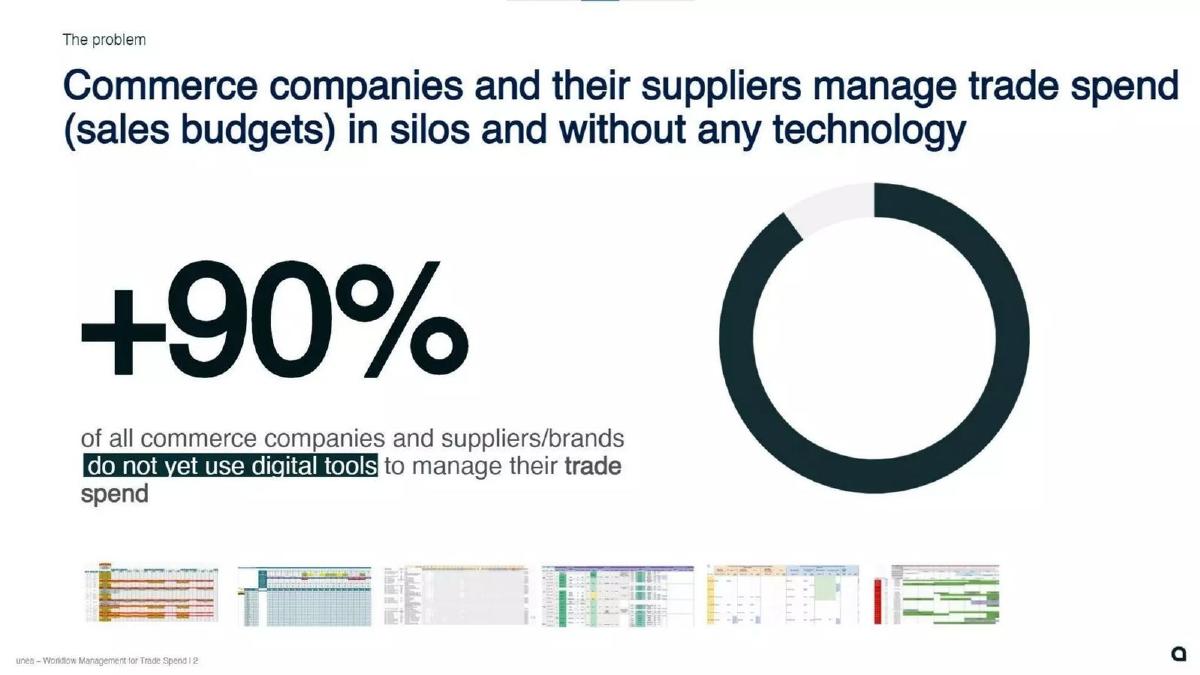
- Over 90% of commerce companies and suppliers do not use digital tools to manage trade spend (Slide 2).
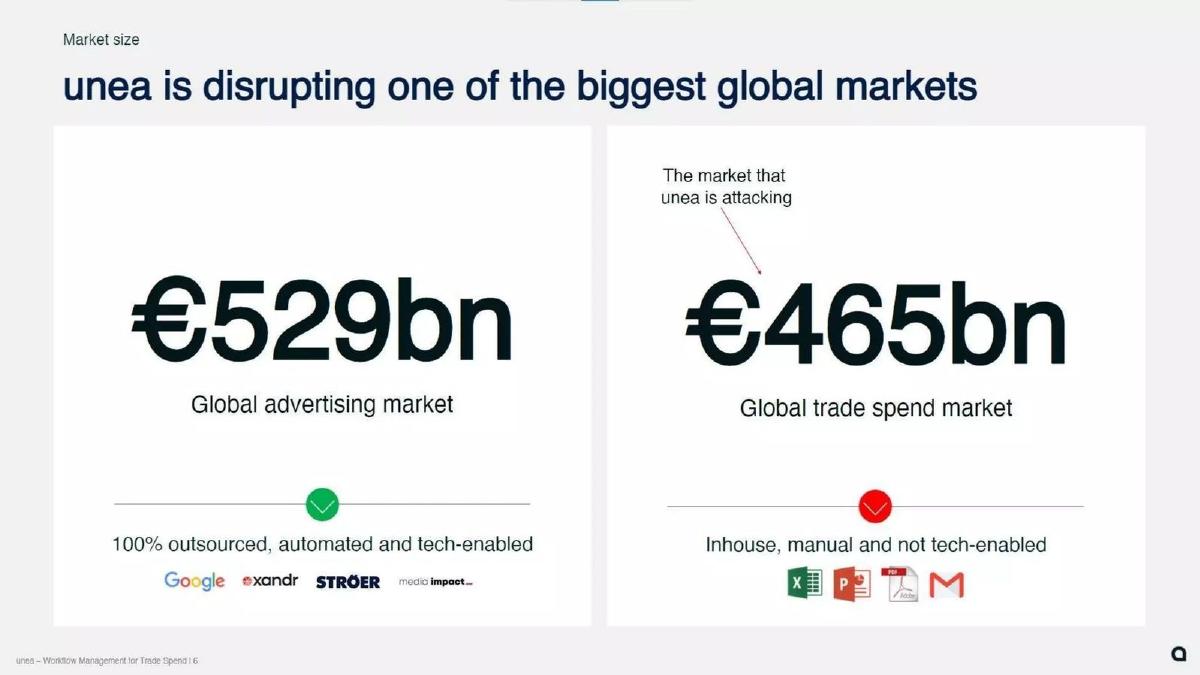
- The global trade spend market is valued at €465bn, nearly rivaling the €529bn global advertising market (Slide 6).
- Trade spend is identified as the second-largest item on the P&L for brands, representing 20-40% of gross sales (Slide 7).
- 55.5% of respondents reported an increase in trade spend budgets over the last five years (Slide 7).
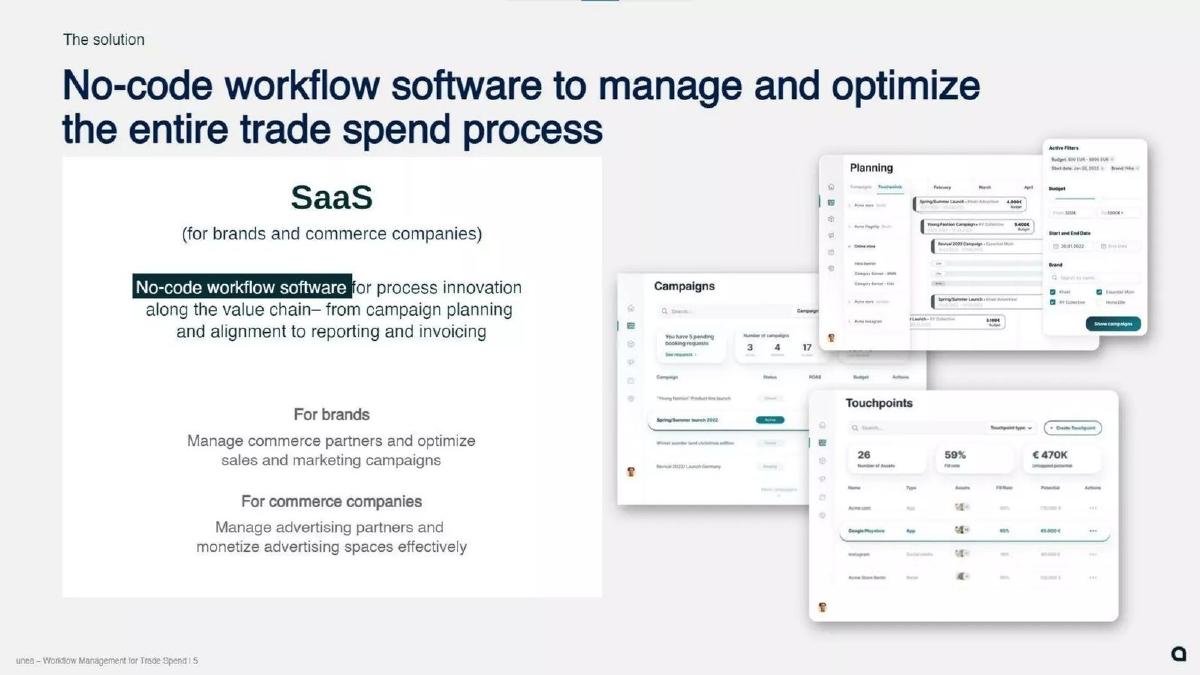
- The solution is positioned as a no-code workflow software for both brands and commerce companies (Slide 5).
- The team includes a CEO who built a 'non-tech unea' model for major retailers like METRO and MediaMarkt (Slide 9).
- The deck completely omits a specific funding ask, valuation, or use-of-funds breakdown (Slide 10).
- Expert testimonials from OMR and Pilot Agency founders provide early social proof for the platform's scalability (Slide 8).
The Vision: An Operating System for the Un-Digitized
Unea’s pitch deck is a masterclass in the 'unsexy' business opportunity. While many startups chase the €529bn advertising market dominated by Google, Unea identifies a parallel universe: the €465bn trade spend market. This deck, which secured $2.3 million in pre-seed funding in 2021, focuses entirely on the friction of manual workflows. It doesn't rely on complex AI buzzwords; instead, it promises to replace Excel and telephone calls with a streamlined SaaS operating system. The 10-slide structure is lean, professional, and relies heavily on the pedigree of its team to bridge the gap where metrics might be thin at the pre-seed stage.
Slides 1-3: The Problem of Manual Silos
Slide 1: Title The deck opens with a minimalist title slide. The logo is prominent, accompanied by the tagline: 'The operating system for trade spend.' This sets an immediate tone of infrastructure and utility rather than just a simple tool.
Slide 2: The Problem This slide uses a high-impact statistic to anchor the narrative. It states that '+90% of all commerce companies and suppliers/brands do not yet use digital tools to manage their trade spend.' Below the text, a series of small, blurred screenshots of complex Excel spreadsheets visually represent the 'mess' the startup intends to clean up. The use of a large ring chart reinforces the 90% figure, making the lack of technology in the sector feel like a glaring oversight.
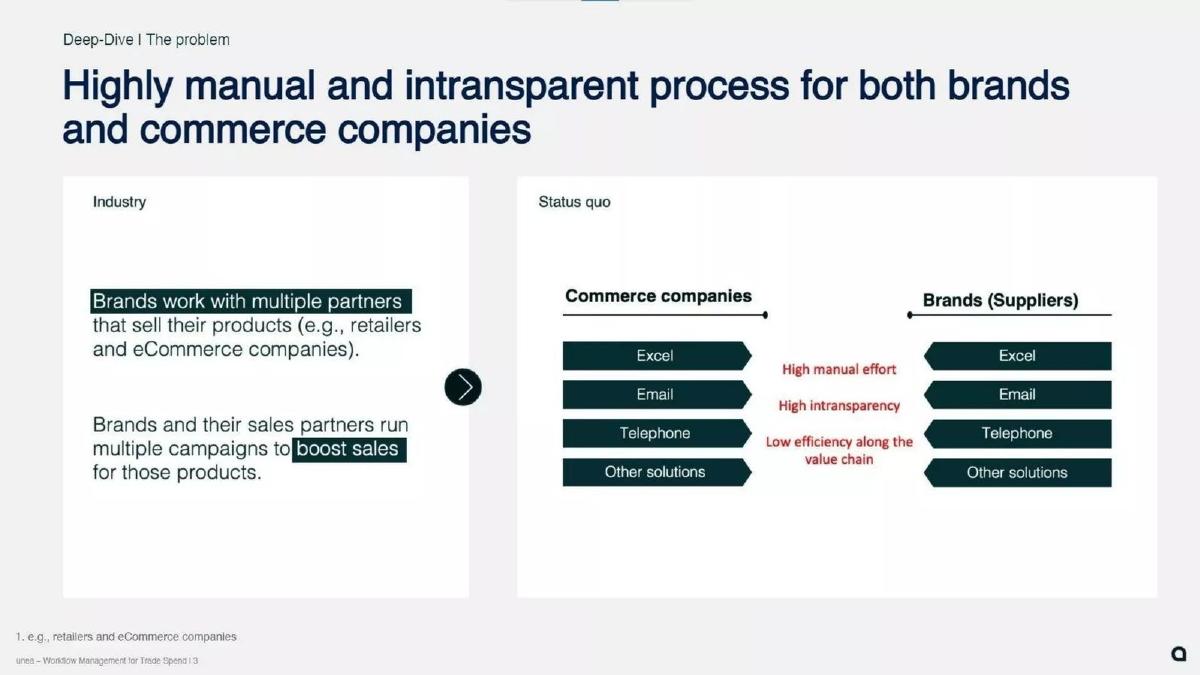
Slide 3: Deep-Dive | The Problem Unea breaks down the status quo into a clear flow chart. On one side are brands; on the other are commerce companies. Between them, the communication channels are listed as 'Excel, Email, Telephone, and Other solutions.' The deck labels the result of this fragmentation as 'High manual effort,' 'High intransparency,' and 'Low efficiency along the value chain.' This slide is critical because it identifies that the problem is bilateral—both the buyer and the seller are suffering from the same lack of infrastructure.
Slides 4-5: The SaaS Solution
Slide 4: Transition A simple text-based transition slide: 'We are creating the operating system for trade spend.' This reinforces the mission statement before showing the product.
Slide 5: The Solution Unea defines its product as 'No-code workflow software to manage and optimize the entire trade spend process.' The slide is split between a value proposition list and product mockups. The software is positioned as a tool for process innovation from planning to invoicing. The mockups show a clean, modern interface with tabs for 'Planning,' 'Campaigns,' and 'Touchpoints,' including metrics like ROAS (Return on Ad Spend) and budget tracking. By labeling it 'no-code,' they signal ease of adoption for non-technical marketing teams.
Slides 6-7: Quantifying a Massive Market
Slide 6: Market Size This is the 'money slide.' It compares the €529bn Global Advertising market with the €465bn Global Trade Spend market. It uses a green checkmark for the advertising market, noting it is '100% outsourced, automated and tech-enabled' by companies like Google and Xandr. It then uses a red 'X' for the trade spend market, labeling it 'Inhouse, manual and not tech-enabled,' represented by icons for Excel, PowerPoint, PDF, and Gmail. This visual comparison makes the opportunity look like a 'Google-sized' hole in the market.
Slide 7: Market Size (Growth) Unea goes deeper into the P&L impact. It claims trade spend is the 'second-largest item on the P&L of brands,' accounting for 20-40% of gross sales spent on trade terms and 10% on trade promotions. A bubble chart shows that 55.5% of respondents have increased their trade spend budget in the last five years, while only 22.2% saw a decrease. This proves that the market is not only large and manual but also growing in financial importance.
Slides 8-10: Validation and Team
Slide 8: Expert Opinions To compensate for a lack of hard traction data (common at the pre-seed stage), Unea uses social proof. They feature quotes from Philipp Westermeyer (Founder of OMR) and Alisa Türck (Former MD of Pilot Agency). Westermeyer highlights the 'full transparency' the software provides, while Türck emphasizes the ability to 'scale co-marketing initiatives.' These are heavy hitters in the European marketing space, lending significant credibility to the founders' claims.
Slide 9: Our Team The team slide is arguably the strongest part of the deck. It features seven individuals with impressive pedigrees. CEO Richy Ugwu is described as a 'Serial Entrepreneur in this space' who built non-tech versions of this model for METRO and MediaMarkt. CTO Tim Duckett brings engineering leadership from BCG Digital Ventures and Penta. The bottom of the slide is a 'logo soup' of former employers, including BCG, Roland Berger, Groupon, and Intersport. This tells investors that the team has both the technical ability to build the product and the industry connections to sell it.
Slide 10: Closing The deck ends with a simple call to action: 'Join us to create the operating system for trade spend,' along with the website URL. Notably, there is no slide detailing the amount of money being raised, the valuation, or the milestones they intend to hit with the capital.
What Works in this Deck
The 'Analog to Digital' Narrative: The deck successfully frames trade spend as one of the last remaining frontiers of manual business processes. By comparing it directly to the highly automated advertising market, the founders make the transition to a digital 'operating system' feel inevitable.
Deep Domain Expertise: The team slide is exceptional. It doesn't just list names; it explains why each person is qualified for this specific problem. The CEO's history of building manual versions of this solution for major retailers like MediaMarkt proves he understands the customer's pain points from the inside.
Clear Value Proposition for Both Sides: Slide 5 clearly articulates what the software does for brands (optimizing campaigns) versus commerce companies (monetizing advertising space). This bilateral utility is essential for a platform that sits between two trading partners.
What is Missing
The Ask: The most glaring omission is the lack of a funding slide. While this version of the deck may have been intended for general distribution, a fundraising deck should ideally specify the amount sought and how it will be allocated (e.g., 50% engineering, 30% sales).
Competitive Landscape: The deck assumes that the only competition is Excel and email. While these are the primary incumbents, a sophisticated investor would want to see how Unea differentiates itself from existing Trade Promotion Management (TPM) or Retail Media Network (RMN) software providers.
Roadmap and Traction: There is no timeline for product development or a list of current pilot partners. While the expert quotes are good, they are qualitative. Quantitative data, even from a small pilot, would have strengthened the case for product-market fit.
What a Founder Should Copy
The Market Comparison Strategy: If you are building in a niche that seems boring or technical, copy Slide 6. Compare your 'manual' market to a 'digitized' sister market that everyone already understands. It instantly communicates the scale and the 'why now' of your business.
Visualizing the 'Mess': Slide 2’s use of blurred Excel screenshots is a clever way to evoke the frustration of the status quo without cluttering the slide. It makes the problem feel visceral to anyone who has ever spent hours in a spreadsheet.
Pedigree Alignment: If your team has worked at relevant big-name companies, don't just put the logos at the bottom. Link the specific roles to the startup's mission, as Unea did by highlighting the CEO's specific work with trade spend at METRO and MediaMarkt.
Final Verdict: Unea’s deck is a high-signal, low-noise document. It identifies a massive, growing, and underserved market and presents a highly qualified team to tackle it. While it lacks the operational detail of a later-stage deck, its clarity of vision was clearly enough to convince pre-seed investors of the €465bn opportunity.
Frequently asked questions
- What is the primary problem Unea is solving?
- Unea targets the 'highly manual and intransparent' process of managing trade spend. According to Slide 3, the status quo for both commerce companies and brands involves a fragmented mix of Excel, email, and telephone calls. This lack of technology leads to high manual effort and low efficiency across the value chain, particularly as brands work with multiple retail partners simultaneously.
- How large is the market opportunity according to the deck?
- The deck defines the global trade spend market at €465bn (Slide 6). It contrasts this with the €529bn global advertising market. While the advertising market is '100% outsourced, automated and tech-enabled' by players like Google, Unea argues the trade spend market remains 'inhouse, manual and not tech-enabled,' representing a massive disruption opportunity.
- Who are the key members of the Unea founding team?
- The team is led by CEO Richy Ugwu, a serial entrepreneur who previously built trade spend models for MediaMarkt and METRO. He is joined by CTO Tim Duckett (former Head of Engineering at BCG Digital Ventures) and VP Product Felix Kleinhenz (former Head of Product for Sellics). The team slide (Slide 9) emphasizes their combined experience at firms like BCG, Roland Berger, and Groupon.
- What specific functionality does the Unea software offer?
- Slide 5 describes Unea as a 'no-code workflow software' that covers the entire trade spend process from campaign planning and alignment to reporting and invoicing. For brands, it optimizes sales and marketing campaigns; for commerce companies, it helps monetize advertising spaces effectively. UI mockups show features for planning, campaign tracking, and touchpoint management.
- What is missing from the Unea pitch deck?
- The deck is notably missing several standard venture components. There is no 'Ask' slide detailing how much capital is being raised or the intended use of funds. It also lacks a roadmap, competitive landscape analysis, and specific unit economics or traction metrics beyond qualitative expert opinions. It functions more as a vision and team document than a full business plan.