Uncapped’s 2019 deck is a masterclass in positioning a financial product as a founder-centric solution. By framing the problem as a binary choice between expensive equity and risky debt, Uncapped introduces revenue-based financing as the logical 'third option.' The deck excels at simplifying the mechanics of capital advances—highlighting a 24-hour decision window, a flat fee structure (6-12%), and a flexible repayment model tied to daily sales. While several slides are redacted for confidentiality, the narrative remains cohesive, moving from the pain points of traditional funding to specific…
Key takeaways
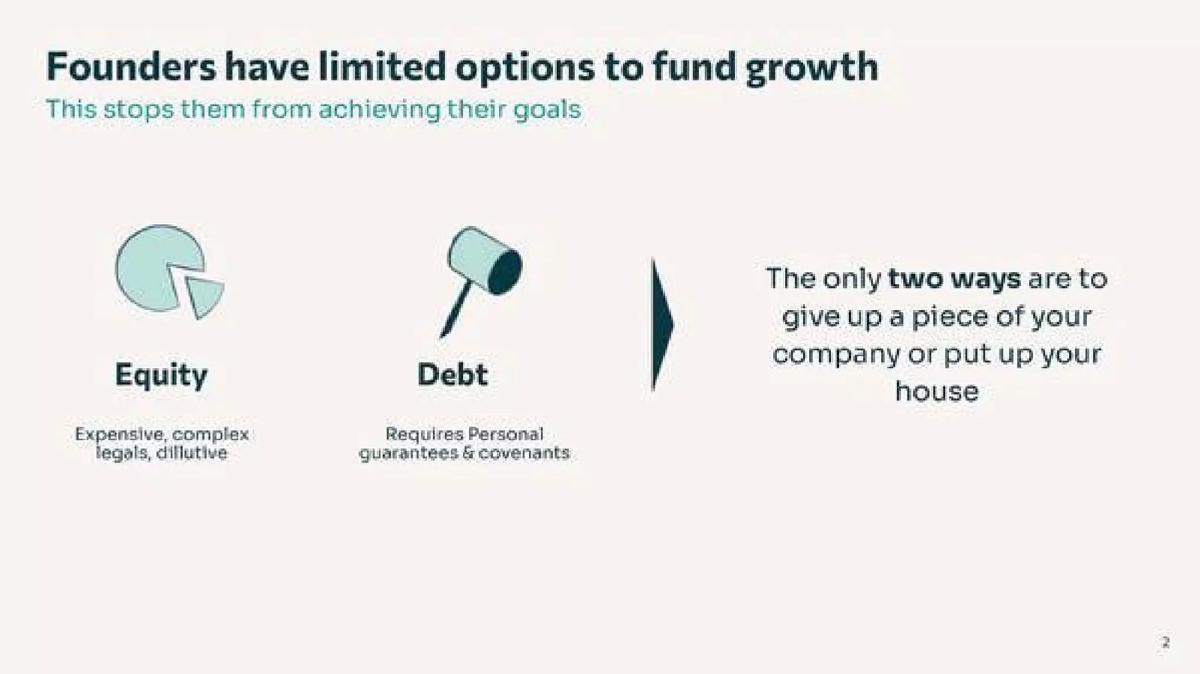
- The deck positions revenue-based financing as a superior alternative to the 'only two ways' of equity or debt (Slide 2).
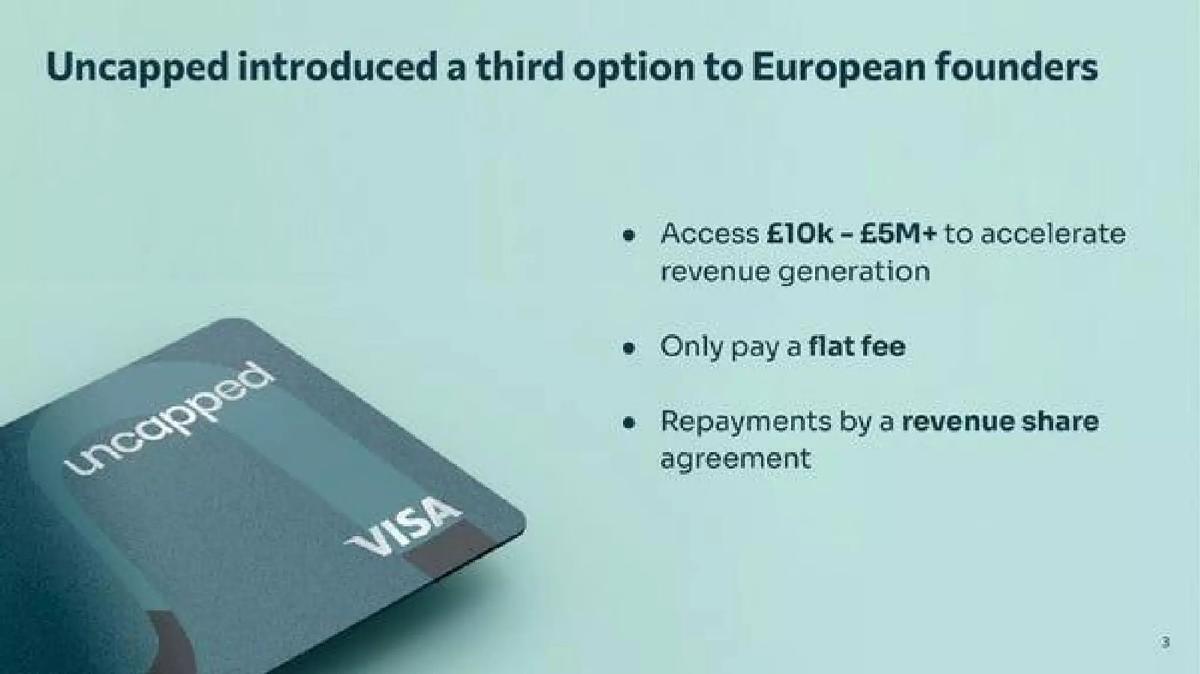
- Uncapped offers capital ranging from £10k to £5M+ with no personal guarantees or equity loss (Slide 3 and 8).
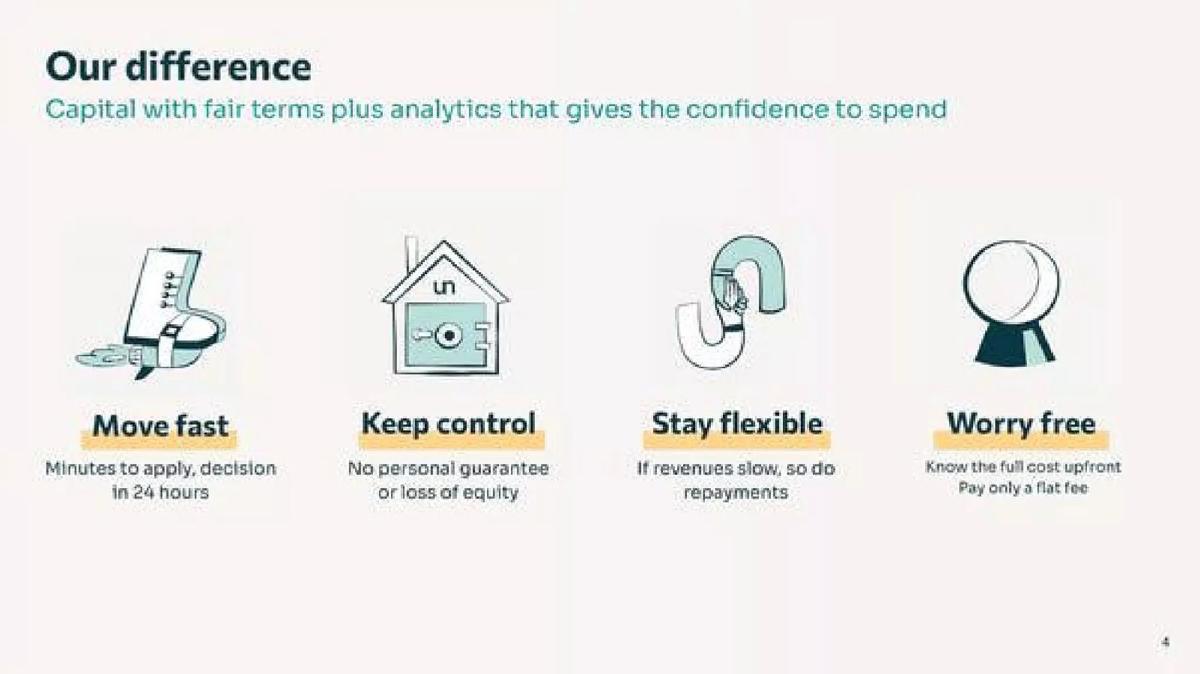
- The application process is designed for speed, promising a funding decision within 24 hours (Slide 4).
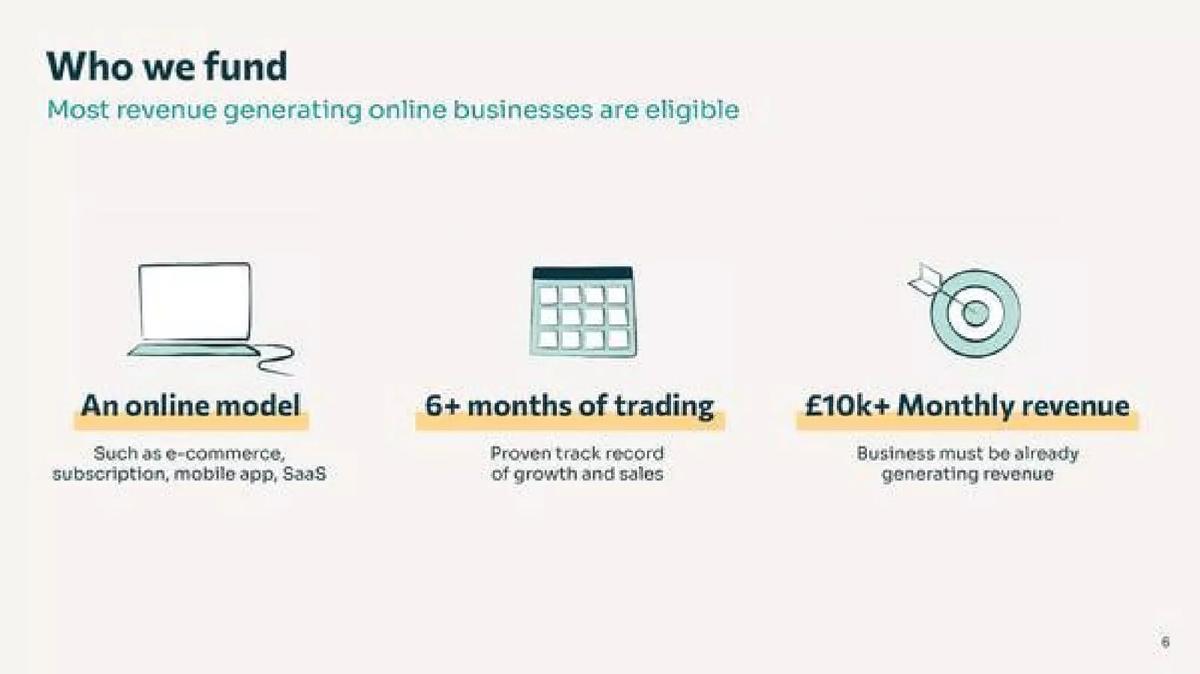
- Eligibility is clearly defined: businesses must have an online model, 6+ months of trading, and £10k+ monthly revenue (Slide 6).
- Pricing is transparently disclosed as a flat fee of 6-12%, depending on how the funds are used (Slide 8).
- Repayment is flexible, with customers choosing a revenue share between 1-20% of daily sales (Slide 9).
- A detailed case study shows a fashion brand achieving 1160% revenue growth and a 227% ROI using Uncapped funds (Slide 11).
- The market opportunity is quantified at 2 million ecommerce businesses in Europe representing a €25B revenue opportunity (Slide 13).
Introduction: The 'Third Way' of Growth Capital
Uncapped entered the market in 2019 with a clear mission: to provide a middle ground between venture capital and traditional bank debt. This 14-slide deck is a focused pitch on why revenue-based financing (RBF) is the future of funding for digital businesses. It relies heavily on simplifying complex financial concepts into founder-friendly benefits.
The Problem and the Solution (Slides 1-4)
Slide 1 sets the stage with the tagline "Banking for Digital Entrepreneurs." The branding is clean, featuring Uncapped-branded Visa cards, immediately signaling that this is a financial services product. Slide 2 identifies the primary pain point for founders: "limited options to fund growth." It frames the current landscape as a binary choice between Equity (expensive, complex, dilutive) and Debt (requires personal guarantees and covenants). This creates a logical vacuum that Uncapped intends to fill.
Slide 3 introduces Uncapped as the "third option." It lists three core pillars: access to £10k - £5M+, a flat fee, and repayments via revenue share. This is a classic 'Solution' slide that directly addresses the negatives of the previous slide. Slide 4 expands on the competitive advantages, using four icons to represent speed (24-hour decisions), control (no equity loss), flexibility (repayments slow with revenue), and transparency (upfront flat fee).
Traction and Eligibility (Slides 5-6)
Slide 5 is titled "And founders loved it," but the content is almost entirely redacted with a large "Confidential" block. While the slide claims "Funding growing rapidly" and "Huge traction with small team," the lack of visible data makes it difficult to verify these claims in the public version of the deck. However, the header suggests that the original deck contained impressive loan issuance figures in GBP millions.
Slide 6 is one of the most useful slides in the deck for potential customers and investors alike. It clearly defines the Ideal Customer Profile (ICP). To be eligible, a business needs an online model (SaaS, e-commerce), 6+ months of trading history, and at least £10k in monthly revenue. By setting these boundaries early, Uncapped qualifies its lead funnel and demonstrates a disciplined approach to risk.
Product Mechanics and Pricing (Slides 7-9)
Slide 7 explains the user journey in three steps: Signup (under 5 minutes), Connect accounts (Stripe, Shopify, Amazon, etc.), and Receive offers (within 24 hours). This emphasizes the technology-driven nature of their underwriting process, which uses a "revenue prediction engine" rather than manual loan officers.
Slide 8 dives into the pricing model. It specifies that the flat fee ranges from 6% to 12%. Interestingly, the fee is tied to the use of funds: 6% for marketing, 9.5% for inventory, and 12% for cash. This tiered pricing suggests that Uncapped views marketing spend as a lower-risk, higher-return activity that they want to encourage. The slide also features a testimonial from Reshma at Seedcamp, providing significant institutional social proof.
Slide 9 uses a graph to illustrate the revenue share model. It shows two curves—one for daily sales and one for repayments. When sales dip, the repayment line dips accordingly. This visual representation is crucial for explaining why RBF is 'friendlier' than a bank loan with fixed monthly installments.
Market Comparison and Case Study (Slides 10-11)
Slide 10 is a comparison matrix. Uncapped stacks itself against Bank Loans, VC/Equity, and Venture Debt across four categories: Speed, Cost, Risks, and Accessibility. Uncapped claims the 'win' in every category, notably listing its risk as "None" (which is a bold claim in finance, though likely referring to the lack of personal liability for the founder). This slide serves to reinforce the 'Third Way' narrative established at the beginning of the deck.
Slide 11 provides a deep dive into a success story: the fashion brand Hēdoïne. It provides specific, impressive metrics: a £50k advance led to 1160% revenue growth and a 227% Return on Investment. Mentioning that the flexible model was a "big comfort during the pandemic" adds a layer of emotional resonance and timely relevance to the pitch.
Future Vision and Summary (Slides 12-14)
Slide 12 is a placeholder for "Digital banking," suggesting that Uncapped intends to expand beyond simple financing into a full-stack financial platform for entrepreneurs. Slide 13 provides a TL;DR summary. It quantifies the market opportunity: 2 million e-commerce businesses in Europe and a €25B revenue opportunity. It also reiterates that they have a "Track record of delivering ahead of plan." Slide 14 is a simple contact slide with the company's email address.
What Works
Clarity of Product: The deck does an excellent job of explaining a relatively new financial product (RBF) in simple terms. The use of graphs and icons makes the mechanics of the 'flat fee' and 'revenue share' easy to grasp. · Founder-Centric Messaging: Every slide is framed around the founder's benefit—saving time, keeping equity, and reducing personal risk. · Specific Eligibility: By stating the £10k monthly revenue and 6-month trading requirements, the deck avoids ambiguity about who the product is for. · Strong Case Study: The Hēdoïne example (Slide 11) is data-rich and provides a concrete example of how the capital is actually used to drive growth.
What is Missing
Team Slide: This is the most glaring omission. In fintech, the 'who' is often as important as the 'what.' Investors need to see the background of the founders in credit risk, engineering, and scaling financial products. · The Ask: The deck does not explicitly state how much money the company is looking to raise or the specific milestones they intend to hit with the new capital. · Unit Economics: While the pricing for the customer is clear, the deck doesn't show Uncapped's own margins, default rates, or cost of capital. · Competitor Landscape: While they compare themselves to 'types' of funding (Slide 10), they don't mention direct RBF competitors like Wayflyer or Clearco, which were active during the same period.
What a Founder Should Copy
The Comparison Matrix: Slide 10 is a perfect example of how to position your startup against 'the old way' of doing things. It’s simple, visual, and persuasive. · The 'How it Works' Slide: Slide 7 uses logos of integrations (Stripe, Shopify) to explain a complex technical process in seconds. This builds immediate credibility. · Tiered Pricing Transparency: If your pricing varies based on use case, Slide 8 shows how to present that clearly without confusing the reader. · The TL;DR Slide: Ending with a summary slide (Slide 13) ensures that even if an investor skimmed the deck, they leave with the four most important takeaways.
Frequently asked questions
- What is the core value proposition of Uncapped?
- Uncapped provides revenue-based financing, which they market as 'Banking for Digital Entrepreneurs.' The core value is providing growth capital without requiring founders to give up equity or sign personal guarantees. Repayments are tied to a percentage of daily sales, meaning if revenue slows down, the repayment amount also decreases, offering more flexibility than traditional bank loans.
- How does Uncapped make money?
- Uncapped charges a flat fee on the capital provided. According to Slide 8, this fee ranges from 6% to 12%. Specifically, it is 6% when funding is spent on marketing, 9.5% for inventory, and 12% for general cash needs. There are no interest charges or hidden costs beyond this flat fee.
- What are the requirements for a startup to get funded by Uncapped?
- As stated on Slide 6, a business must meet three criteria: it must have an online model (e-commerce, SaaS, mobile app, etc.), it must have at least 6 months of trading history, and it must be generating at least £10k in monthly revenue.
- How does the repayment process work?
- Repayment is automated through a revenue share agreement. Uncapped takes a fixed percentage of the company's daily sales (chosen by the customer between 1% and 20%) until the original capital plus the flat fee is repaid. This means there is no fixed repayment date, as shown on Slide 9.
- What is missing from this pitch deck?
- The most notable omission is a team slide. For a fintech company, demonstrating the founders' expertise in finance, risk, and technology is vital. Additionally, the deck lacks a specific 'Ask' slide detailing how much they are raising and how they will use the funds, and several traction slides are redacted.