Uncaged Innovations utilized a 12-slide deck to secure a $5.6M Seed round in 2024, targeting the biotech and fashion sectors from their North American headquarters. The presentation centers on their 'bio-interfusion' technology, which uses grain proteins to create a 1-to-1 replacement for animal collagen, purportedly avoiding the performance trade-offs of carbohydrate-based alternatives like mushrooms. The deck highlights significant environmental gains, including a 95% reduction in greenhouse gases and 100% biodegradability. While the deck provides a clear five-step acquisition strategy and…
Key takeaways
- The company positions its 'bio-interfusion' technology as a superior alternative to mushroom-based leathers by using structural proteins rather than carbohydrates (Slide 3).
- Uncaged claims its material is a 100% biodegradable, 1-to-1 replacement for animal leather (Slide 4).
- Environmental metrics are a core selling point, citing 95% less GHG, 93% less water, and 72% less energy compared to traditional leather (Slide 4).
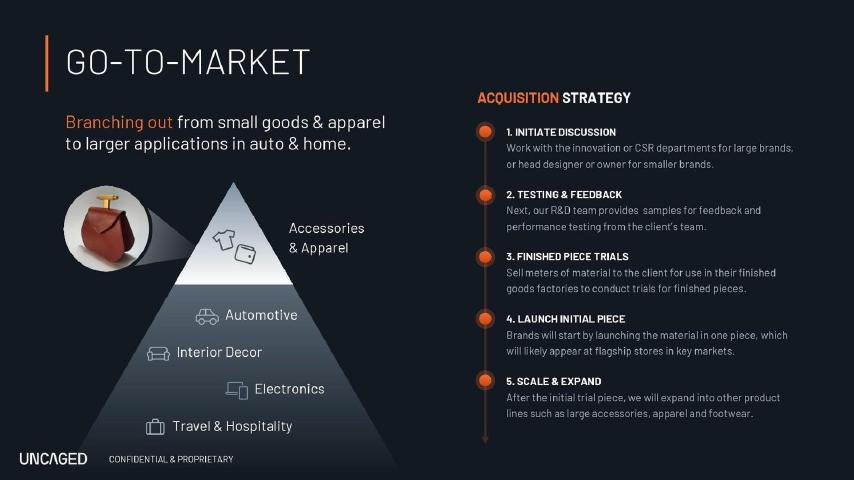
- The go-to-market strategy follows a five-step acquisition process, beginning with innovation departments and moving to flagship store launches (Slide 5).
- Market expansion is tiered, starting with Accessories & Apparel before moving into Automotive, Interior Decor, and Electronics (Slide 5).
- The deck explicitly asks for $4M in seed funding, despite publisher reports indicating a final raise of $5.6M (Slide 6).
- Previous funding includes $2.3M in VC funding, $440k in grants (including NSF SBIR), and $275k in founder investment (Slide 6).
- The use of funds is heavily weighted toward Manufacturing & R&D at 50%, with 20% each for Sales/Marketing and G&A (Slide 6).
Uncaged Innovations: A Deep Dive into the Grain-Based Bio-Leather Pitch
Uncaged Innovations operates at the intersection of biotechnology and sustainable fashion. Their pitch deck for a 2024 Seed round focuses on solving the environmental and ethical dilemmas of the leather industry. By utilizing grain-based proteins, they aim to provide a plastic-free alternative that matches the performance of animal hides. This teardown examines the 12-slide deck that helped secure $5.6M in funding.
Slide 1: Title and Branding
The opening slide is minimalist, featuring the company name 'UNCAGED' in a bold, sans-serif font. The subtitle 'REIMAGINING LEATHER' immediately establishes the sector and the company's mission. The background uses a soft orange-to-blue gradient, and the footer includes the company website and a 'Confidential & Proprietary' notice. It is a standard, professional entry point that focuses on brand identity rather than data.
Slide 2: The Problem Statement
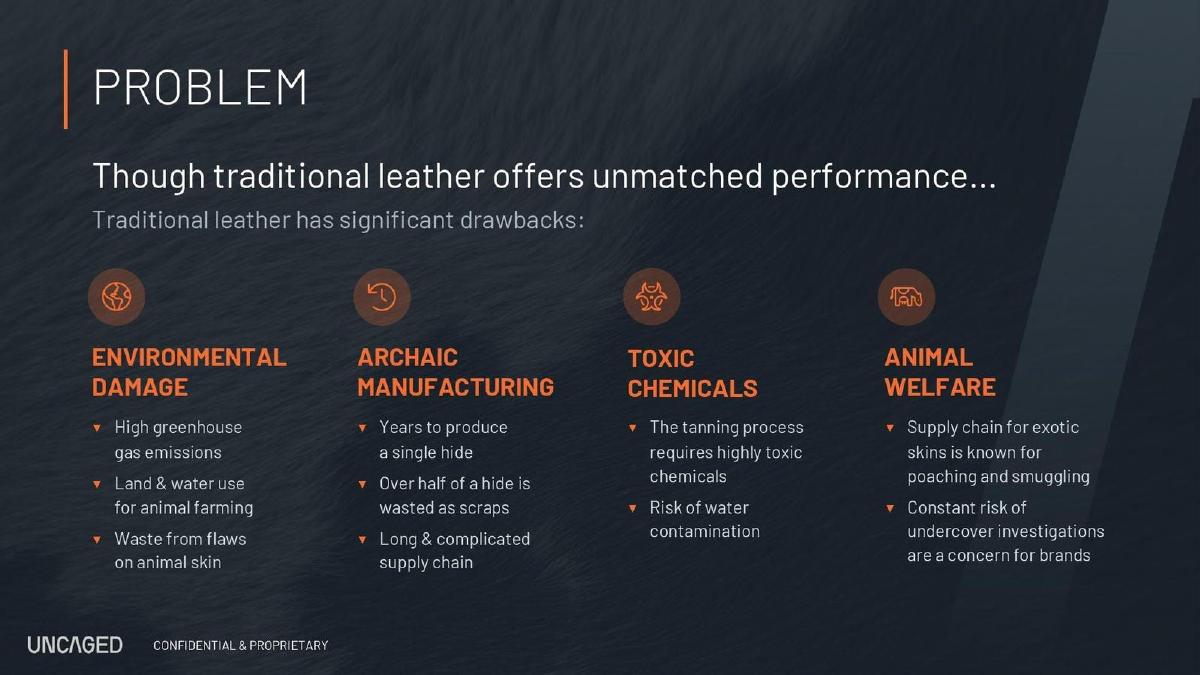
Slide 2 identifies the 'significant drawbacks' of traditional leather. The company acknowledges that traditional leather offers 'unmatched performance' but counters this with four pillars of concern: Environmental Damage, Archaic Manufacturing, Toxic Chemicals, and Animal Welfare. Specific pain points mentioned include high greenhouse gas emissions, a 'years-long' production cycle for a single hide, the use of toxic tanning chemicals, and the risk of poaching in exotic skin supply chains. By framing the problem through these four lenses, Uncaged appeals to both environmental ESG goals and supply chain efficiency.
Slide 3: The Technical Advantage
This is the 'moat' slide. Uncaged explains its 'bio-interfusion technology,' which uses structural proteins from grains to mimic the fibril structure of leather. The slide uses a three-step horizontal progression to differentiate itself from competitors. It claims that while others use carbohydrates (specifically mentioning mushrooms), these lack the molecular structure to behave like skin. Uncaged positions itself as the 'first & only 1-to-1 replacement' because it replaces animal collagen with similar structural proteins. This is a critical distinction for biotech investors who may be wary of the 'performance gap' often found in first-generation plant-based materials.
Slide 4: Sustainability Metrics
Slide 4 provides the quantitative 'why' for the product. It compares Uncaged Bio-Leather to traditional leather across four key metrics: 95% less GHG, 93% less water, 72% less energy, and 100% biodegradability. The use of large, bold percentages inside circles makes the data easily digestible. This slide is designed to be a 'leave-behind' fact sheet that internal champions at fashion brands or VC firms can use to justify the investment or partnership.
Slide 5: Go-To-Market and Acquisition Strategy
The go-to-market slide is split into two sections. On the left, a pyramid diagram shows the expansion strategy: starting with 'Accessories & Apparel' and moving down into 'Automotive,' 'Interior Decor,' 'Electronics,' and 'Travel & Hospitality.' On the right, a five-step 'Acquisition Strategy' outlines the sales process, from initiating discussions with CSR departments to scaling into multiple product lines. This slide demonstrates that the founders have thought through the long sales cycles typical of the fashion and automotive industries.
Slide 6: The Investment Ask
The final content slide details the funding request. It states they are 'Raising $4M seed funding' (notably less than the $5.6M eventually reported). A pie chart breaks down the use of funds: 50% for Manufacturing & R&D, 20% for Sales/Marketing, 20% for G&A, and 10% for CAPEX. The slide also lists 'Funding To-Date,' totaling over $3M from VCs, grants, and founders. The bottom of the slide features logos of current investors, including Jaguar Land Rover's InMotion and the National Science Foundation, providing significant social proof and institutional validation.
What Uncaged Innovations Does Well
The deck excels at technical differentiation. In a crowded 'alt-leather' market filled with mushroom (mycelium) and pineapple-based products, Uncaged makes a specific scientific argument for why grain proteins are superior. By focusing on the 'fibril structure' and 'structural proteins,' they move the conversation from 'it's sustainable' to 'it actually works like leather.' This is a vital shift for high-end fashion and automotive brands where durability is non-negotiable.
Furthermore, the inclusion of the National Science Foundation (NSF) logo and the mention of an SBIR grant provides a layer of technical due diligence that is often missing in early-stage biotech decks. It signals to VCs that the underlying science has already been vetted by federal experts, reducing the perceived technical risk.
What is Missing from the Deck
The most glaring omission is a Team Slide . In a Seed round, investors are primarily betting on the founders' ability to execute. Without seeing the backgrounds of the scientists and business leaders, it is difficult to assess if the team has the expertise to scale a manufacturing process. While the publisher summary mentions the company is biotech-focused, the deck itself doesn't highlight the specific PhDs or industry veterans behind the 'bio-interfusion' technology.
Additionally, there is a lack of Unit Economics . While the deck mentions 'selling meters of material' (Slide 5), it does not provide a target price per meter or a comparison to the cost of traditional leather. For a manufacturing-heavy startup, investors need to see a path to price parity or a justification for a premium price point. The deck also lacks a Competitor Matrix ; while it mentions 'others' using mushrooms, it doesn't name specific competitors like MycoWorks or Bolt Threads, which would help investors understand where Uncaged sits in the current landscape.
Founder Takeaways: Lessons to Copy
1. Use a 'Mechanism of Action' to Differentiate: If you are in a crowded space, don't just say you are better. Explain why at a molecular or structural level. Uncaged’s comparison of proteins vs. carbohydrates (Slide 3) is a masterclass in positioning a technical advantage.
2. Quantify Sustainability: Vague claims of being 'eco-friendly' no longer suffice. Uncaged provides specific, audited-style percentages for GHG, water, and energy (Slide 4). Founders should aim for this level of specificity, even if the numbers are projections based on pilot scales.
3. Map the Sales Cycle: Slide 5 doesn't just say 'we will sell to brands.' It outlines the five steps of the acquisition strategy, acknowledging that trials and flagship store launches are necessary precursors to full-scale expansion. This shows a realistic understanding of B2B enterprise sales.
4. Leverage Non-Dilutive Funding: Highlighting the $440,000 in grants (Slide 6) shows that the company is capital-efficient and has received external validation without giving up equity. This is a strong signal for Seed-stage investors.
5. Tiered Market Expansion: Start small and expand. By targeting accessories first (Slide 5), Uncaged shows they are going for the 'low-hanging fruit' with shorter development cycles before tackling the high-complexity automotive and interior decor markets. This reduces the perceived time-to-revenue.
Frequently asked questions
- What is the core technology behind Uncaged Innovations?
- Uncaged Innovations uses a proprietary 'bio-interfusion' technology. According to Slide 3, this process leverages proteins from grains as a backbone to fuse other bio-based elements. The goal is to mimic the fibril structure of leather by replacing animal collagen with structural proteins, which the company claims provides better performance and tunability than carbohydrate-based alternatives like mushrooms.
- How does the company plan to enter the market?
- The go-to-market strategy outlined on Slide 5 is a tiered approach. They intend to start with small goods such as accessories and apparel. Once established, they plan to branch out into larger applications including automotive interiors, home decor, electronics, and travel/hospitality. The acquisition strategy involves working with CSR departments of large brands to conduct trials and launch initial pieces in flagship stores.
- What are the specific environmental claims made in the deck?
- Slide 4 quantifies the sustainability benefits of Uncaged Bio-Leather compared to traditional leather. The claims include a 95% reduction in greenhouse gas (GHG) emissions, a 93% reduction in water usage, and a 72% reduction in energy expenditure. Additionally, the company states the material is 100% biodegradable, offering an 'ideal end of life' for the product.
- Who are the existing investors in Uncaged Innovations?
- As of the Seed deck, Slide 6 lists several current investors and partners. These include VegInvest, Jaguar Land Rover's InMotion Ventures, the National Science Foundation (NSF), Stray Dog Capital, Alwyn Capital, and GlassWall Syndicate. The slide also notes that the company had already secured $440,000 in grants, including an NSF SBIR grant.
- What was the funding ask versus the actual amount raised?
- Slide 6 of the deck shows a request for $4M in seed funding. However, publisher reports from Business Insider indicate that the company successfully raised $5.6M in its 2024 Seed round. This suggests the round was oversubscribed or the company increased the round size during the fundraising process.