Climate Startup Go-to-Market Slide Examples: 7 Real Pitch
How climate and sustainability startups explain how they will win customers: retail store counts by chain, trade-customer steps, named industrial prospects.
Climate Startup Go-to-Market Slide: Sell the Product, Count the Outlets, Name the Buyer
Climate and sustainability startups often lead with the problem they solve: plastic, emissions, flared gas, toxic paint. Investors accept the problem quickly. What they want from the go-to-market slide is the plain commercial answer: who buys, through which channel, and how many outlets or customers are already signed. This guide uses go-to-market slides from seven climate and sustainability companies, from a packaged-water brand that lists its store count chain by chain to a slide whose figures were blacked out before the deck was shared.
TL;DR
Give the buyer, the channel and a count of outlets or customers, and treat sustainability as a reason to buy rather than the plan itself. Flow Water lists each retailer with its store count: Target and Publix 900+ new locations each, Walgreens 300+, Circle K 682, Walmart 136, and an Avendra contract covering 8,500 locations, with 21% of US grocery, drug and mass stores already stocking it. Mynt shows 15 painting companies onboarded, a target of 100 and then 500+. Verdis names the oil companies that have shown interest. Tanbii claims 150+ partners but names brands its logos do not show, and Emitwise's figures are redacted.
Seven climate go-to-market decks
Strongest first, warning examples last. Each example quotes the slide and notes what an investor can and cannot learn from it.
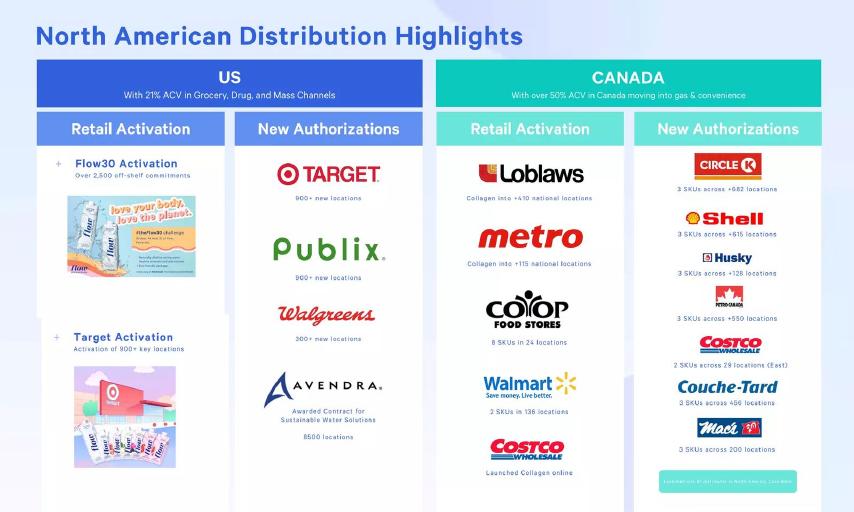
Flow Water go to market slide — slide 14
Boxed spring water sold as a plastic-bottle alternative. Slides titled "North American Distribution Highlights" and "Key Growth Pillars".
Flow Water deck, slide 14. Exact stored slide matched to this analysis.Flow Water deck, slide 13. Exact stored slide matched to this analysis.
Our analysis: Every chain listed with store count and products on shelf.
Evidence and limitation: Company figures; sales per store not given.
What a founder can adapt: Add sales per store per week to show demand, not just reach.
Supporting analysis
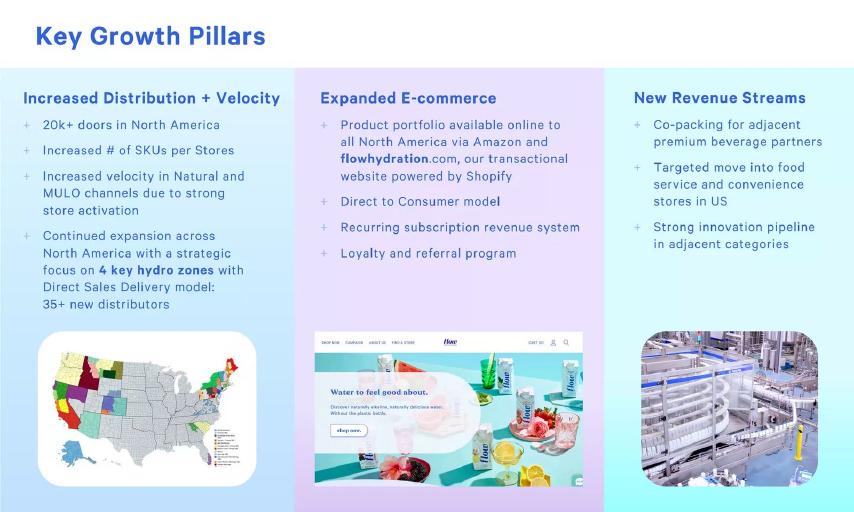
What the deck claims: US: "With 21% ACV in Grocery, Drug, and Mass Channels"; "Flow30 Activation: Over 2,500 off-shelf commitments"; "Target Activation: Activation of 900+ key locations"; Target "900+ new locations"; Publix "900+ new locations"; Walgreens "300+ new locations"; Avendra "Awarded Contract for Sustainable Water Solutions, 8500 locations". Canada: "With over 50% ACV"; Loblaws "Collagen into +410 national locations"; Walmart "2 SKUs in 136 locations"; Circle K "3 SKUs across +682 locations"; Shell 615; Petro-Canada 550; Couche-Tard 456. Growth pillars: "20k+ doors in North America"; "4 key hydro zones with Direct Sales Delivery model: 35+ new distributors".
Presentation choice: Investors can test each line and see the scale of distribution.
When it does not fit: Store counts with no sign of how fast the product sells.
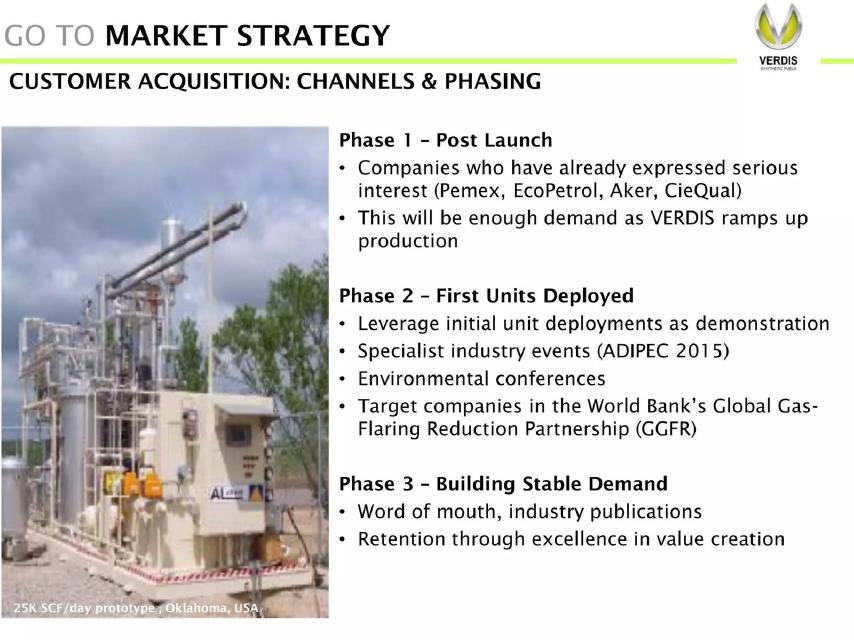
Units that turn flared gas into synthetic fuel. Slide titled "Go to Market Strategy – Customer acquisition: channels & phasing".
Verdis deck, slide 32. Exact stored slide matched to this analysis.
Our analysis: Named industrial prospects and a phased plan.
Evidence and limitation: Company claims; stage of each prospect not stated.
What a founder can adapt: Say what stage each prospect is at and how many units each could take.
Supporting analysis
What the deck claims: "Phase 1 – Post Launch: Companies who have already expressed serious interest (Pemex, EcoPetrol, Aker, CieQual). This will be enough demand as VERDIS ramps up production." "Phase 2 – First Units Deployed: Leverage initial unit deployments as demonstration; Specialist industry events (ADIPEC 2015); Environmental conferences; Target companies in the World Bank's Global Gas-Flaring Reduction Partnership (GGFR)." "Phase 3 – Building Stable Demand: Word of mouth, industry publications; Retention through excellence in value creation." Caption: "25K SCF/day prototype, Oklahoma, USA".
Presentation choice: For large units, a few named buyers matter more than any campaign.
When it does not fit: "Serious interest" with no definition.
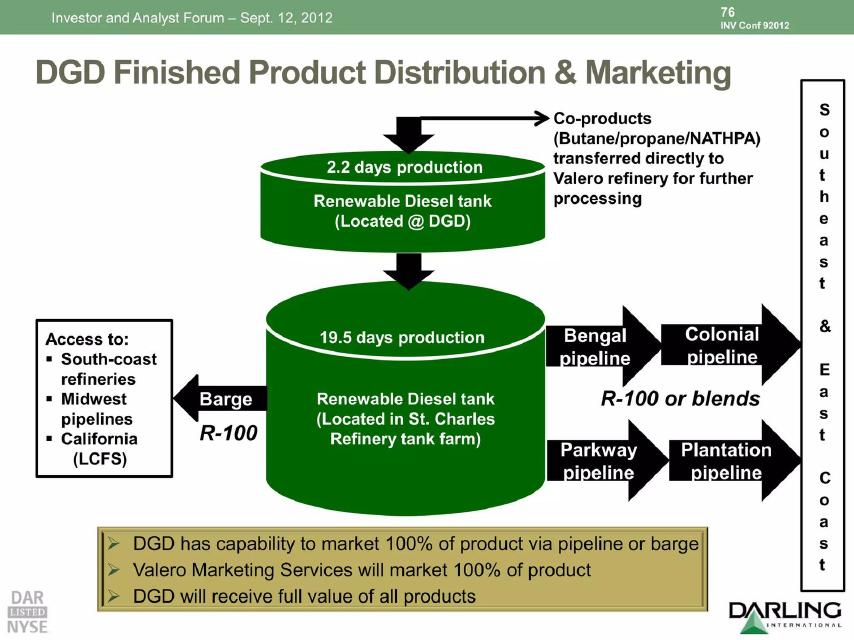
Established company presenting its renewable diesel joint venture at a 2012 investor forum. Slide titled "DGD Finished Product Distribution & Marketing".
Darling deck, slide 77. Exact stored slide matched to this analysis.
Our analysis: One offtake partner and named routes to market for all output.
Evidence and limitation: Company plan; read at low resolution.
What a founder can adapt: Show terms and what happens if the partner reduces volume.
Supporting analysis
What the deck claims: Storage: "2.2 days production, Renewable Diesel tank" and "19.5 days production, Renewable Diesel tank (Located at St. Charles Refinery tank farm)". Routes: barge, Bengal, Colonial, Parkway and Plantation pipelines, "R-100 or blends". "DGD has capability to market 100% of product via pipeline or barge"; "Valero Marketing Services will market 100% of product"; "DGD will receive full value of all products".
Presentation choice: A partner who markets everything answers the go-to-market question directly.
When it does not fit: Relying on one partner without addressing that risk.
App that plants a real tree for every virtual tree. Slide titled "Our Partnerships". Warning example on partner claims.
Tanbii deck, slide 12. Exact stored slide matched to this analysis.
Our analysis: A logo wall whose caption names brands it does not show.
Evidence and limitation: Company claims; partner type not stated.
What a founder can adapt: Say what a partner is and how many pay.
Supporting analysis
What the deck claims: "Reforestation Partners": Eden Reforestation Projects, "We Plant A Real Tree – For every virtual tree planted in our app". "Business Partners": logos of Amazon, Apple App Store, priceline, EarthHero, Disney+, SK-II. "150+ Sustainable Partners – Including Amazon, Nike, Adidas and other Gen Z preferred brands".
Presentation choice: Investors will read logos as commercial deals unless told otherwise.
When it does not fit: Naming brands in a caption that are absent from the logos.
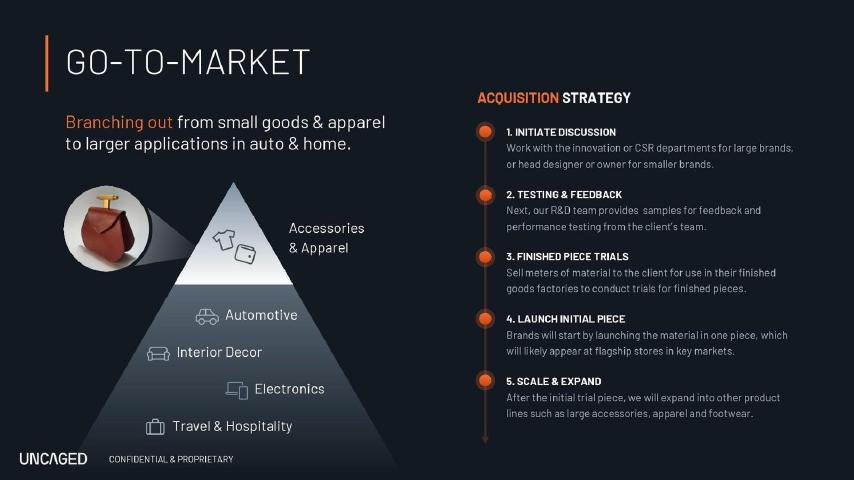
Leather alternative sold to brands. Slide titled "Go-to-Market". Warning example.
Uncaged Innovations deck, slide 9. Exact stored slide matched to this analysis.
Our analysis: A sensible sales process with nothing to measure.
Evidence and limitation: Company plan; no brands named or counted; read at low resolution.
What a founder can adapt: Show how many brands are at each step, and name any that allow it.
Supporting analysis
What the deck claims: "Branching out from small goods & apparel to larger applications in auto & home." "Acquisition strategy: 1. Initiate discussion … 2. Testing & feedback … 3. Finished piece trials … 4. Launch initial piece – Brands will start by launching the material in one piece, which will likely appear at flagship stores in key markets. 5. Scale & expand."
Presentation choice: Investors cannot tell whether any brand has passed step one.
When it does not fit: A process diagram with no count or date.
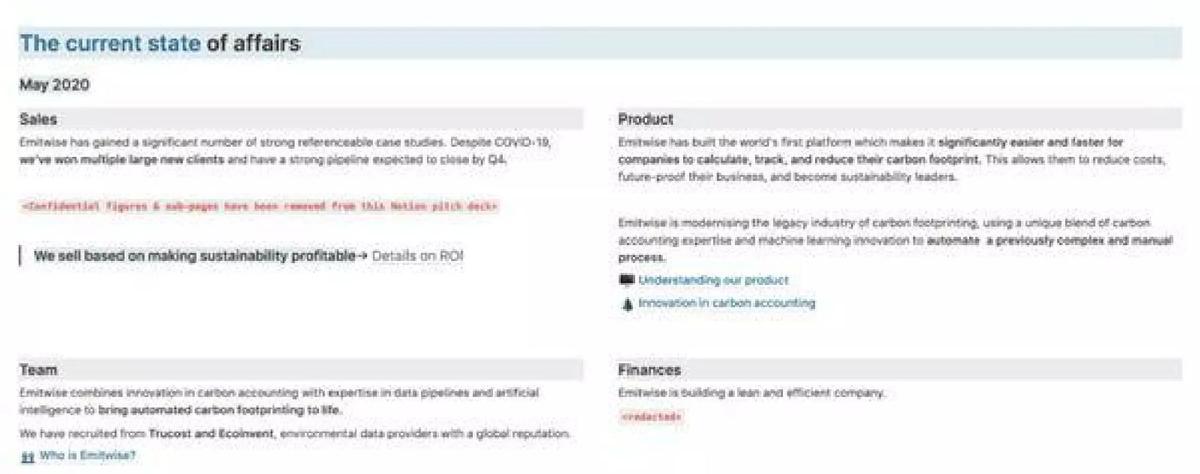
Carbon accounting software. Slide titled "The current state of affairs, May 2020". Warning example.
Emitwise deck, slide 2. Exact stored slide matched to this analysis.
Our analysis: The sales section reduced to a sentence.
Evidence and limitation: Figures removed from the shared deck; read at low resolution.
What a founder can adapt: Replace withheld figures with ranges or ratios.
Supporting analysis
What the deck claims: Sales: a note that confidential figures and sub-pages have been removed from the shared version; "We sell based on making sustainability profitable". Finances: "redacted".
Presentation choice: A redacted go-to-market slide gives investors nothing to assess.
When it does not fit: Sharing a deck with blanks where the numbers were.
Whether each slide names the buyer or channel, gives a count, and shows results.
Example
Buyer or channel
Count given
Results shown
Flow Water
Named retail chains and distributors
Stores per chain, 20k+ doors
Distribution, not sales
Mynt
Painting companies
15 onboarded, 100 next
Onboarding only
Verdis
Named oil companies
4 prospects
"Serious interest"
Darling
Valero as offtake partner
Days of storage
No
Tanbii
Logo wall
150+ partners
No
Uncaged Innovations
Large brands
None
No
Emitwise
Not shown
Redacted
No
Key Takeaways
Sustainability is why customers buy, not how you reach them.
Count outlets or customers, chain by chain.
Show what is done and what is next.
Say what "interest" or "partner" means.
Never send a go-to-market slide with its figures removed.
Build your climate go-to-market slide
Answer these before you design the slide.
Buyer. Who pays: a consumer, a store, a business or an industrial buyer?
Channel. Which chains, distributors or named buyers carry or take your product, and how many outlets each?
Stage. What is done, what is in progress and what is next, with a count at each step?
Demand. What does each outlet or customer buy per week, month or year?
Copyable framework: We sell to [buyer] through [channel]. Done: [count] [customers or outlets]. Now: [target]. [Customer or outlet] buys [amount] per [period]. Named buyers: [name, stage].
Illustrative example 1 — written by us
Before: Our sustainable product will be adopted by leading brands and partners worldwide.
After: We sell to facility managers through 3 regional distributors. Done: 42 office buildings. Now: 150 by June. Each building orders $1,900 a month; 90% reorder after 3 months. Named buyers: two property groups at signed pilot stage.
What improved: Our illustrative rewrite; all figures are invented for the example. It names the buyer and channel, counts what is done, sets a target and shows repeat demand.
What this guide adds
The general go-to-market guide covers any startup. Climate companies differ in three ways. Many sell a physical product, such as packaged water, paint or fuel, so distribution through stores, distributors or industrial buyers matters more than online ads. Many sell to large organizations, such as oil companies, retailers or refiners, where a single named buyer can be worth more than thousands of consumers. And many lean on their environmental story, which investors already believe, at the expense of the numbers they need. This guide shows how climate startups present those points, and where the story crowds out the plan.
How we read each slide
We read each stored slide image and quote the text on it. Flow Water (two slides), Mynt, Tanbii and Verdis were read at full size; Darling, Uncaged Innovations and Emitwise were legible at low resolution. For Mynt we also checked the deck's opening slides to confirm it sells sustainable paint. Flow Water is included as a sustainable consumer product: its slides sell water "without the plastic bottle" and its Avendra contract is for "Sustainable Water Solutions". We have not checked any company's store counts, customers or partners, and we make no claim that any slide affected a fundraising outcome.
Count the outlets, chain by chain
Flow Water's "North American Distribution Highlights" slide is the model for any climate company selling a physical product through retail. It splits the US and Canada. In the US it gives a share of stores reached, "21% ACV in Grocery, Drug, and Mass Channels", then lists new authorizations: Target "900+ new locations", Publix "900+ new locations", Walgreens "300+ new locations" and an Avendra contract for "Sustainable Water Solutions" covering "8500 locations". In Canada, with "over 50% ACV", it lists chain, product count and store count: Circle K 3 products across 682 locations, Shell 615, Husky 128, Petro-Canada 550, Couche-Tard 456, Mac's 200, Walmart 2 products in 136, Costco 2 products across 29 locations in the East.
Investors can test every line: the chain, the number of stores and the number of products on shelf. A companion slide, "Key Growth Pillars", adds the totals and the plan: "20k+ doors in North America", more products per store, a strategic focus on "4 key hydro zones" with a direct store delivery model and "35+ new distributors", plus online sales through Amazon and its own site.
What neither slide says is how fast the product sells once it is on shelf. Store counts show reach; sales per store per week show demand. Retail buyers drop slow products, so a single line on sales velocity would complete the picture.
Steps with what is done and what is next
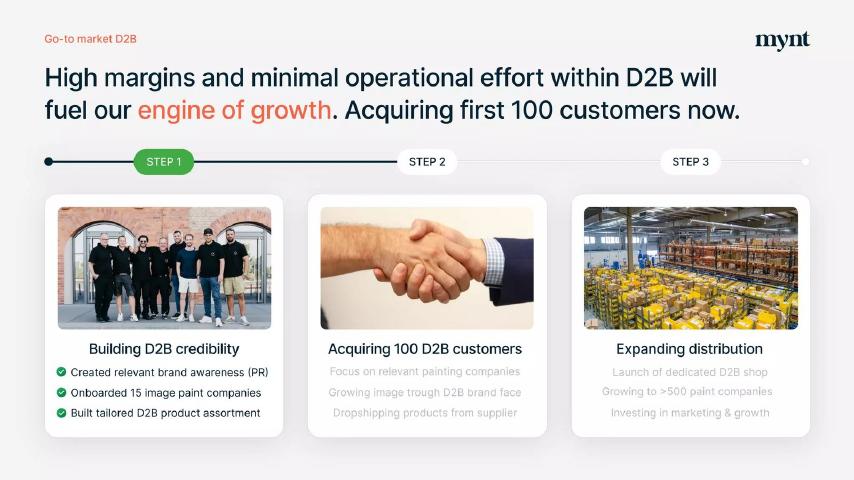
Mynt sells sustainable paint, and its go-to-market slide is headed "Go-to market D2B" (direct to business, meaning painting companies). It sets out three steps. Step 1, "Building D2B credibility", is marked done with three ticks: "Created relevant brand awareness (PR)", "Onboarded 15 image paint companies" and "Built tailored D2B product assortment". Step 2 is "Acquiring 100 D2B customers", and step 3, "Expanding distribution", plans a dedicated shop and "Growing to >500 paint companies".
The structure is clear: done, now, next, with a count at each step. The slide's headline also makes a claim it does not support: "High margins and minimal operational effort within D2B". A margin figure, an average order per painting company, or how often they reorder would turn the headline into evidence.
Name the buyer, and say what "interest" means
Verdis, which turns flared gas into synthetic fuel, sets out a three-phase plan. Phase 1 targets "Companies who have already expressed serious interest (Pemex, EcoPetrol, Aker, CieQual)" and says "This will be enough demand as VERDIS ramps up production." Phase 2 uses the first units as demonstrations, specialist events ("ADIPEC 2015"), environmental conferences and companies in the World Bank's Global Gas-Flaring Reduction Partnership. Phase 3 relies on word of mouth and industry publications.
For a company selling large industrial units, four named prospects are exactly the right starting point. But "expressed serious interest" can mean anything from one meeting to a signed letter of intent. Saying which stage each prospect has reached, and how many units or how much gas each could take, would let investors judge whether those four really are "enough demand". The photo caption, "25K SCF/day prototype, Oklahoma, USA", gives scale that the plan itself does not.
Darling, an established company presenting at an investor forum, shows the same principle at industrial scale. Its slide on renewable diesel distribution traces product from storage tanks ("2.2 days production" and "19.5 days production") through named pipelines and barge routes, and states that "Valero Marketing Services will market 100% of product". A single offtake partner that buys everything is a clear go-to-market answer; the risk is that one partner holds all the volume.
Partner walls need a definition
Tanbii, an app that plants a real tree for every virtual tree, shows two kinds of partner: Eden Reforestation Projects for planting, and "150+ Sustainable Partners" for business. The caption says the partners include "Amazon, Nike, Adidas and other Gen Z preferred brands". The logos shown are Amazon, the Apple App Store, priceline, EarthHero, Disney+ and SK-II. Nike and Adidas are named but not shown, and the slide does not say what a partner is: an advertiser, an affiliate, a retailer or a brand whose products appear in the app.
A logo wall invites investors to assume a commercial relationship. If the relationship is an affiliate link or an app store listing, say so; if it is a paid deal, say how many partners pay and how much.
Steps with no figures, and figures with no content
Uncaged Innovations, which makes a leather alternative, gives a clear five-step acquisition process: initiate discussion with innovation or sustainability teams at large brands, test samples, run finished-piece trials, launch one initial piece in flagship stores, then scale and expand into other product lines. It is a sensible process for selling a new material to brands. But there is no brand named, no count of brands at each step and no timeline, so investors cannot tell whether any brand has passed step one.
Emitwise, which measures companies' carbon footprints, shared a deck in which the sales section reads "We sell based on making sustainability profitable" beside a note that confidential figures and sub-pages have been removed from the version shared. The finance section likewise shows "redacted". Removing sensitive numbers from a shared deck is common, but a go-to-market slide with its figures removed becomes a list of intentions. If figures must be withheld, replace them with ranges or ratios rather than blanks.
What to put on a climate go-to-market slide
Lead with the buyer and the channel, not the environmental case, which belongs on the problem slide. If you sell through retail or distributors, list chains or distributors with store counts and products on shelf, as Flow Water does, and add sales per store. If you sell to businesses, show what is done, what is next and how many customers at each step, as Mynt does. If you sell to large industrial buyers, name them and say what stage each has reached. Define what a partner is before showing a logo wall. If numbers are confidential, give ranges. Every claim about margins or demand needs the figure that supports it.
Common mistakes
Mission instead of plan. Keep the climate case on the problem slide.
Reach without demand. Add sales per store or per customer.
Undefined interest. Say what stage each prospect has reached.
Undefined partners. Say what a partner is before showing logos.
Claims without figures. Back up margins and demand with a number.
Redacted figures. Use ranges instead of blanks.
Diagnostic checklist
Buyer and channel named.
Outlets or customers counted.
Done, now and next shown.
Prospects' stage stated.
Partners defined.
No blank or redacted figures.
Frequently asked questions
What should a climate startup's go-to-market slide show?
Who buys, through which channel, and how many outlets or customers are signed. Flow Water lists each chain with its store count, such as Target with 900+ new locations and Circle K with 682.
Should the environmental impact go on the go-to-market slide?
Briefly at most. Investors already accept the problem; this slide needs to show how you reach paying customers.
How do I show prospects that have not yet signed?
Name them and give each one's stage. Verdis names Pemex, EcoPetrol, Aker and CieQual, but "expressed serious interest" does not say whether any has signed anything.
What if my sales figures are confidential?
Give ranges or ratios. Emitwise's shared deck shows its sales and finance figures removed, which leaves investors nothing to assess.
How we chose these examples
Corpus: published pitch deck teardowns on StartupFundraising.com. Founder-uploaded private decks are excluded.
Selection (2026-10-01): we searched extracted slide text for go-to-market, marketing, distribution, partnership and customer acquisition slides in decks from climate, clean energy and sustainable-product companies. We dropped slides already used in other guides and a milestones slide that is not a go-to-market slide, then kept 8 slides from 7 companies.
Review: stored slide images were read on 2026-10-01 against company, deck and slide number; Flow Water, Mynt, Tanbii and Verdis were read at full size, Darling, Uncaged Innovations and Emitwise at low resolution (editorial model review). No person has yet completed an editorial review of this page. We did not verify any company's store counts, customers or partners.