Climate Traction Slides: 6 Real Pitch Deck Examples
How climate and energy startups show traction: a dated milestone timeline with customer programs, deployments across 35 countries.
Climate Traction Slides: Real Pitch Deck Examples
Six traction slides from climate and energy decks (a battery materials company, an off-grid power supplier, a water analytics startup, a wastewater aeration company, a cement materials company and a fish-farm energy project), shown in full. Climate products often take years to reach revenue, so investors look for the steps in between: pilots, customer programs and installed units, each with a date and a named or clearly described buyer. The stronger slides give those; the weaker ones state that growth or customers exist without saying how many.
TL;DR
A climate traction slide should show the path from pilot to paying customer, with dates and counts. Besstech lays out 2010 to 2015 milestones ending in two customer programs with large companies. Clear Blue maps installations in 35 countries. Pluto AI names pilots with two of the ten largest water companies. Mapal claims proven installations and satisfied customers with no count. Progressive Planet claims quarter-over-quarter revenue growth with no figure. Koi Gardens lists the founder's past spending, not company traction, the weakest example here.
Climate traction slides
Each example shows the exact stored slide above its analysis and links to the full teardown. Stronger examples first. Claims and figures are as shown on the slides; we have not verified them.
Besstech traction slide — slide 5
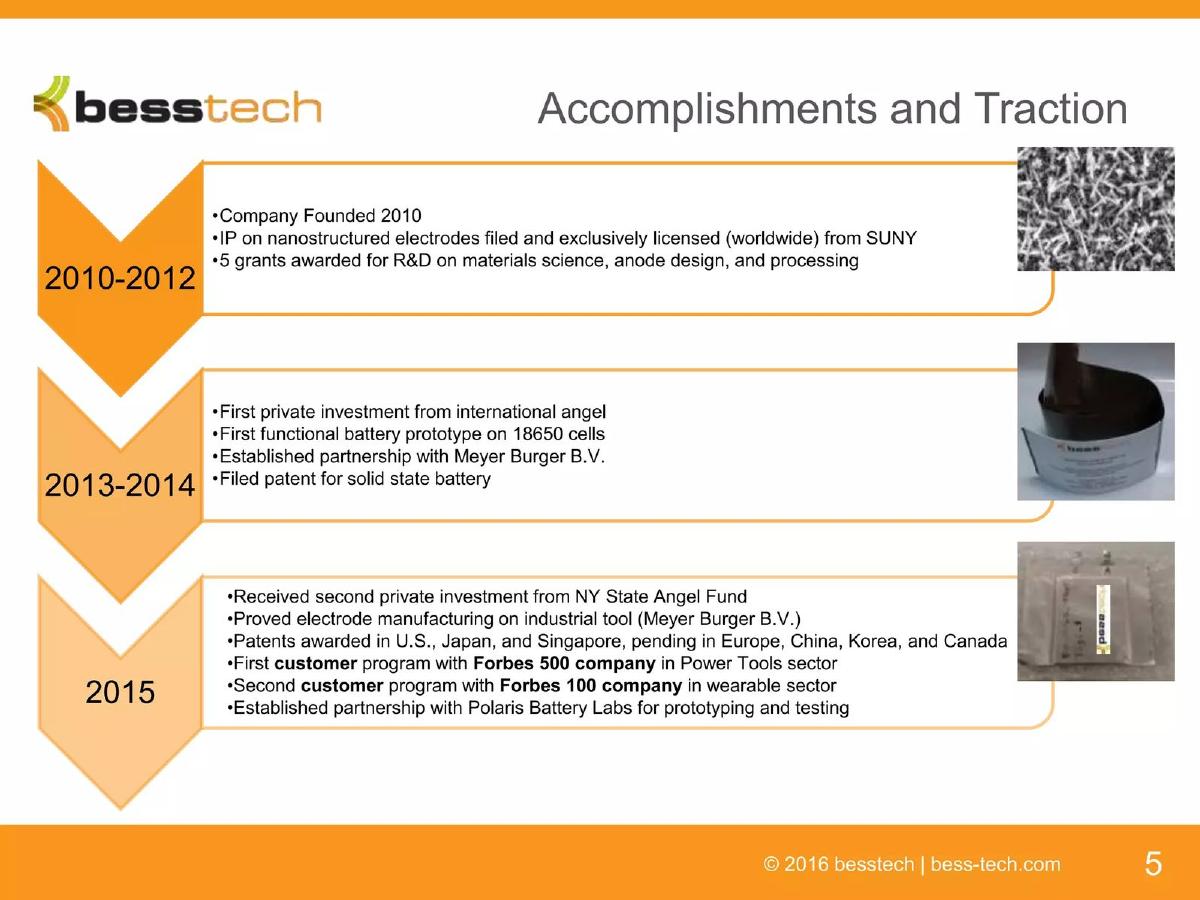
Seed (recorded, low confidence). Battery electrode materials. A three-step timeline, 2010-2012, 2013-2014 and 2015, with product photos.
Besstech deck, slide 5. Exact stored slide matched to this analysis.
Our analysis: The clearest story here: an investor can see how long each step took and that the latest step is customers. The "Forbes 500" label is vague.
Evidence and limitation: Dated milestones from licence to prototype to manufacturing proof to two customer programs; customers are described by size and sector but not named, and there is no revenue or program value.
What a founder can adapt: Keep the dated steps, and add what each customer program is (paid or unpaid, value, next stage).
Supporting analysis
What the deck claims: "Accomplishments and Traction." 2010-2012: "Company Founded 2010", "IP on nanostructured electrodes filed and exclusively licensed (worldwide) from SUNY", "5 grants awarded". 2013-2014: "First private investment from international angel", "First functional battery prototype on 18650 cells", "Established partnership with Meyer Burger B.V." 2015: "Proved electrode manufacturing on industrial tool (Meyer Burger B.V.)", "Patents awarded in U.S., Japan, and Singapore", "First customer program with Forbes 500 company in Power Tools sector", "Second customer program with Forbes 100 company in wearable sector".
Presentation choice: For deep-tech climate companies, proving manufacturing on an industrial tool and signing customer programs are the milestones that reduce risk before sales.
When it does not fit: Company size labels in place of a program description.
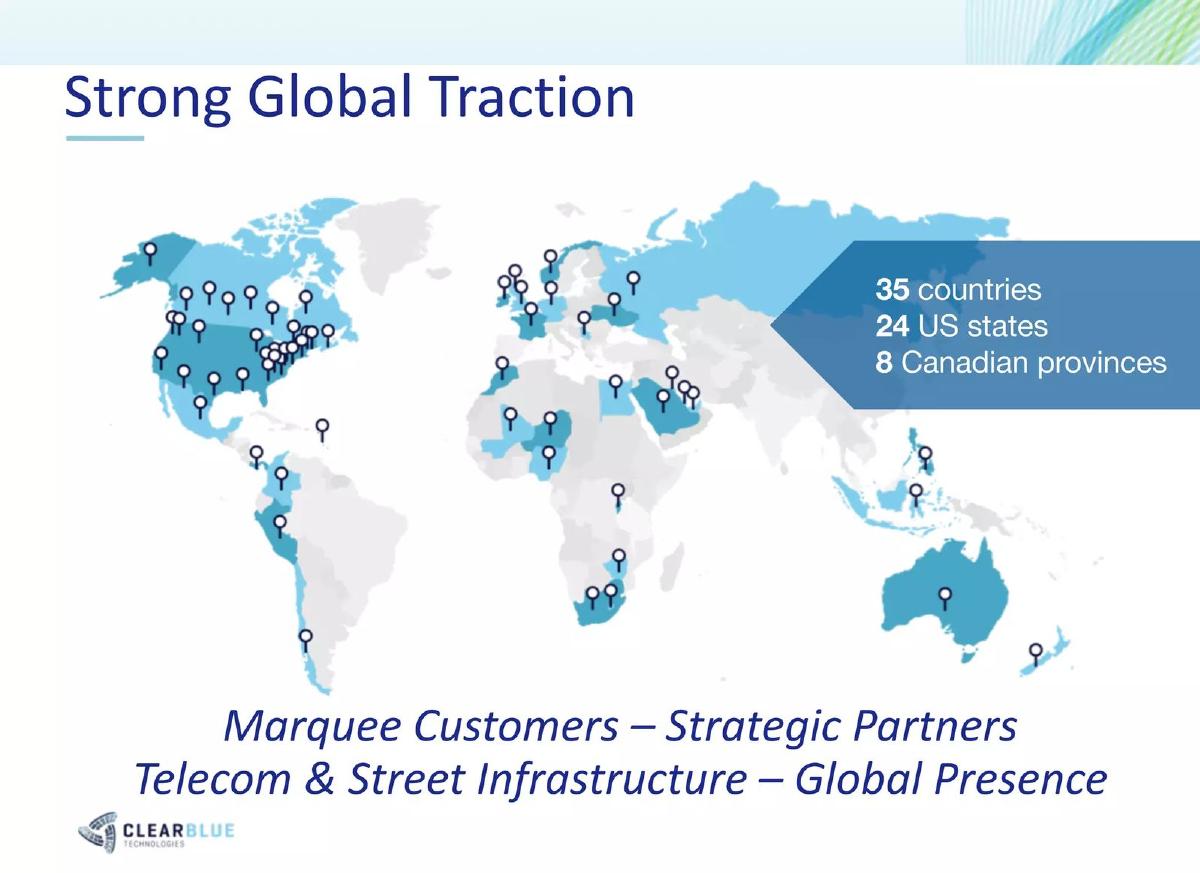
Growth (recorded, medium confidence). Off-grid solar power for telecom and street lighting. A world map with pins.
Clear Blue Technologies deck, slide 6. Exact stored slide matched to this analysis.
Our analysis: Shows real reach, but counts places, not installations or buyers; one pin could be one unit.
Evidence and limitation: Geographic spread of deployments; no count of installed units, customers, revenue or dates.
What a founder can adapt: Keep the map, and add installed units by year and the number of customers ordering more than once.
Supporting analysis
What the deck claims: "Strong Global Traction." "35 countries", "24 US states", "8 Canadian provinces". "Marquee Customers – Strategic Partners", "Telecom & Street Infrastructure – Global Presence".
Presentation choice: For infrastructure products, the number of installed units and repeat customers matters more than countries reached.
When it does not fit: "Marquee customers" with no names or logos.
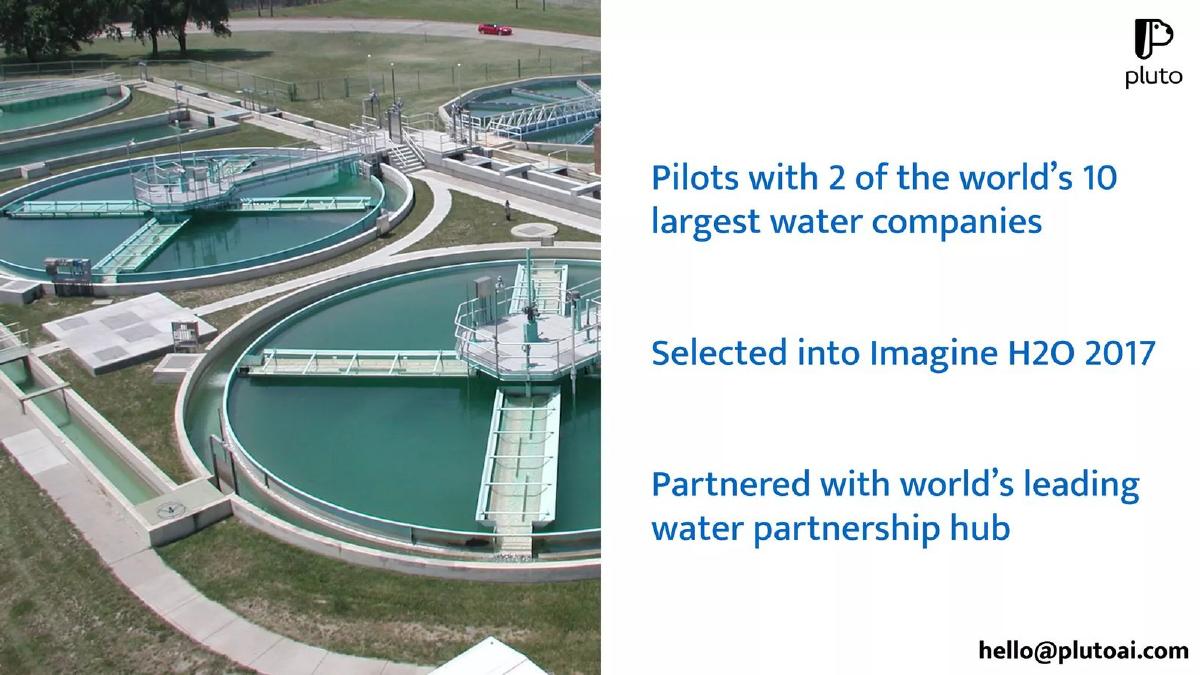
Seed (recorded, medium confidence). Analytics for water treatment plants. A plant photo with three lines of text.
Pluto AI deck, slide 6. Exact stored slide matched to this analysis.
Our analysis: A credible early signal, stated plainly, but a pilot is not yet a customer.
Evidence and limitation: Two pilots with large unnamed buyers, an accelerator place and a partnership; no pilot dates, sites, results or path to paid contracts.
What a founder can adapt: Add pilot start dates, number of plants, the result being measured and the conversion terms.
Supporting analysis
What the deck claims: "Pilots with 2 of the world's 10 largest water companies." "Selected into Imagine H2O 2017." "Partnered with world's leading water partnership hub."
Presentation choice: Pilots with the largest buyers matter in utilities because sales cycles are long; investors then ask what converts them.
When it does not fit: Listing accelerator selection at the same weight as customer pilots.
Series A (recorded). Floating aeration for wastewater plants. A company overview in seven bullets.
Mapal Green Energy deck, slide 5. Exact stored slide matched to this analysis.
Our analysis: After years of activity the company likely has figures to show, but this slide gives none.
Evidence and limitation: Claims of installations and customers with no count, names, countries or dates.
What a founder can adapt: Replace the claims with the number of plants installed, countries and one named reference site.
Supporting analysis
What the deck claims: "Mapal Company Overview." "Founded in 2007, actual activity started in 2010." "Mapal Green Energy UK Ltd., fully owned subsidiary." "Unique and Internationally Patented Technology - FFBA Floating Fine Bubble Aeration system." "Proven installations worldwide." "Track record of success and satisfied customers."
Presentation choice: Included for contrast: "proven installations" invites the question how many and where.
When it does not fit: "Satisfied customers" without a single customer or result.
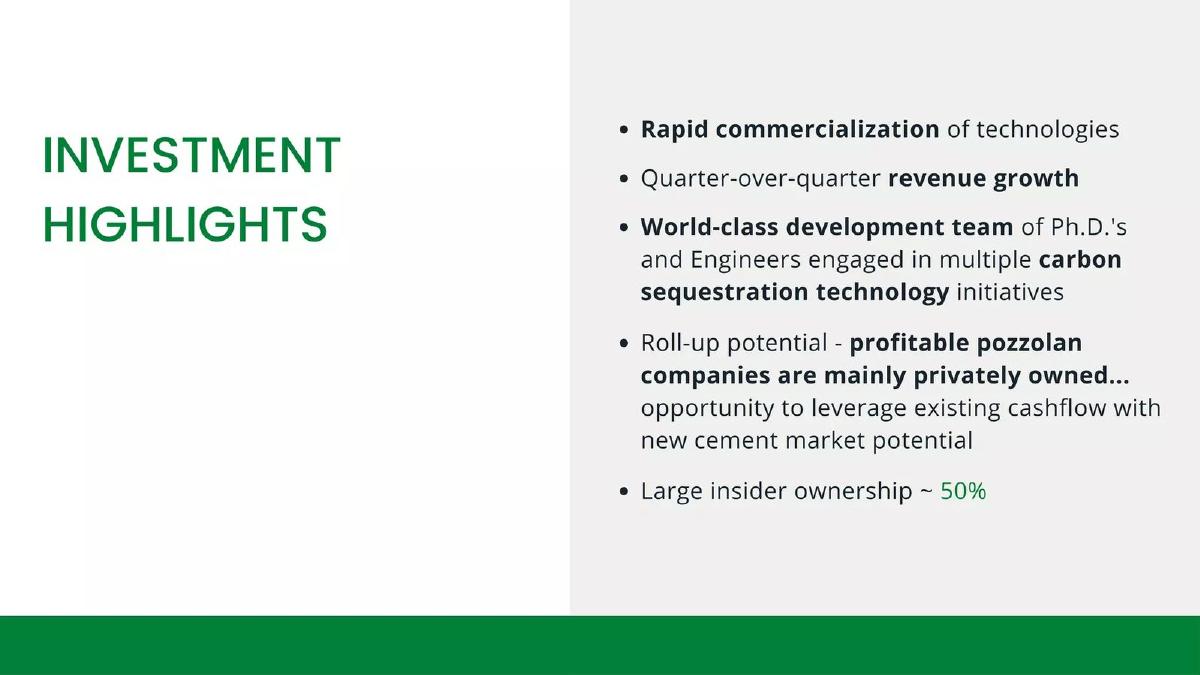
Seed (recorded). Cement and carbon sequestration materials. Five bullets headed "Investment Highlights".
Progressive Planet deck, slide 4. Exact stored slide matched to this analysis.
Our analysis: Claims growth but hides it; a reader cannot tell whether revenue is thousands or millions.
Evidence and limitation: A revenue growth claim with no amount, rate or period; the only number on the slide is insider ownership.
What a founder can adapt: Chart revenue for the last four to six quarters and name the first customers for the new cement product.
Supporting analysis
What the deck claims: "Rapid commercialization of technologies." "Quarter-over-quarter revenue growth." "World-class development team of Ph.D.'s and Engineers engaged in multiple carbon sequestration technology initiatives." "Roll-up potential - profitable pozzolan companies are mainly privately owned..." "Large insider ownership ~ 50%."
Presentation choice: Included for contrast; growth statements need the figures behind them.
When it does not fit: "Revenue growth" as a bullet with no number.
Seed (recorded, low confidence). Fish farm and energy project. One text box headed "Traction".
Koi Gardens Energy Ranch deck, slide 4. Exact stored slide matched to this analysis.
Our analysis: The weakest example: labelled traction, but it describes a related-party asset transfer and a personal use of funds.
Evidence and limitation: The founder's past spending and a planned sale of his land to the company; nothing the company has sold, built or signed.
What a founder can adapt: Show what the facility produces today (output, buyers, revenue) and move the land terms to the use-of-funds slide with full disclosure.
Supporting analysis
What the deck claims: "Mr. Hunt Has Previously Invested Six Million Dollars ($6M) in the Gulf Coast's Premiere Intensive Fish Farm Property." "Mr. Hunt Will Sell The Aquaculture Facility (Ponds, Wells, etc.) Land (about 55 Acres of 108 Acres) to Koi Gardens Energy Ranch for Founder's Equity and $1.4 Million to Pay off Ex-Wife".
Presentation choice: Included for contrast; investors read this as where their money would go, not as evidence of demand.
When it does not fit: Calling founder spending or asset transfers traction.
Whether each slide gives a count, dates, a described customer and revenue.
Example
Business
Count
Dates
Customer described
Revenue
Besstech
Battery materials
Two customer programs
2010 to 2015
By size and sector
No
Clear Blue
Off-grid power
35 countries
No
No
No
Pluto AI
Water analytics
Two pilots
No
Top-ten water companies
No
Mapal
Wastewater aeration
No
Founded 2007
No
No
Progressive Planet
Cement materials
No
No
No
Claimed, no figure
Koi Gardens
Fish farm energy
Founder's $6M
No
No
No
Key Takeaways
Date each milestone so the pace from lab to customer is visible.
Count pilots, customer programs and installed units separately.
Describe who the customer is, even when you cannot name them.
Put a number on any growth or customer claim.
Build your climate traction slide
Show each step from pilot to paying customer with a date and a count.
Milestones. Dated steps: prototype, manufacturing proof, first pilot, first paid order.
Pilots. Number of pilots, who they are with, start dates and conversion terms.
Deployments. Installed units or sites by year, and repeat customers.
Revenue. Revenue or contract value by quarter, even if small.
Copyable framework: [n] pilots with [customer type] since [date]; [n] converted to paid contracts worth [amount]. [n] units installed across [n] sites, up from [n] a year ago.
Illustrative example 1 — written by us
Before: Proven installations worldwide. Track record of success and satisfied customers.
After: [n] plants installed in [n] countries since 2010, including [named reference site]. [n] customers have ordered a second system.
What improved: Our illustrative rewrite; not Mapal's wording. Bracketed parts are placeholders to fill with real facts. It turns two claims into counts an investor can check.
What this guide adds
The library has climate problem, solution, market and product guides but no climate traction guide. This page looks at how long-cycle climate companies show progress before revenue is large: pilots, customer programs and deployments.
Sector labels come from the sector recorded for each published teardown (high confidence for Besstech, Clear Blue, Mapal and Koi Gardens; medium for Pluto AI; Progressive Planet as recorded). None of these six slides appears in another guide.
Three ways climate decks show traction
Milestone timelines (Besstech): research, prototype, manufacturing proof and customer programs, each dated.
Deployments and pilots (Clear Blue, Pluto AI): where the product is installed or being tested, and with whom.
Unquantified claims (Mapal, Progressive Planet, Koi Gardens): statements of success, growth or past investment with nothing to count.
Common mistakes
Claims with no count. "Proven", "satisfied" and "growth" need a number beside them.
Pilots presented as customers. Say whether a pilot is paid and what converts it.
Reach instead of volume. Countries reached tells less than units installed.
Founder spending as traction. Past investment belongs in the team or use-of-funds slide.
Diagnostic checklist
Milestones dated.
Pilots, customers and installs counted separately.
Each customer described or named.
Revenue or contract value shown.
Frequently asked questions
How we chose these examples
Corpus: published pitch deck teardowns on StartupFundraising.com. Founder-uploaded private decks are excluded.
Selection (2026-09-27): we took teardowns whose recorded sector is climate, with a stored slide image and slide text about traction, customers, pilots, installations, revenue or growth. We read the candidates and viewed eleven slide images, left out listed-company and large midstream energy decks, slides already used in other guides (Biopolynet, Waterplan, Tosheka Textiles), a roadmap slide with no results (Kraftblock) and a template deck, and kept six. Mapal, Progressive Planet and Koi Gardens are included as weaker examples for contrast. Hardware was considered first; its candidates were mostly listed-company or market slides.
Sector is the category recorded for each teardown (confidence given in the section above). Stages are shown as recorded, with confidence where it is not high.
Review: stored slide images were checked on 2026-09-27 and matched to company, deck and slide number, and quoted text was read from the images (editorial model review). No person has yet completed an editorial review of this page.
Claims and figures are as shown on the slides; we have not verified them. We make no claim that any slide caused a fundraising outcome.