Progressive Planet presents a compelling case for the decarbonization of the $652.7B cement and concrete industry. The deck identifies a critical supply gap in North America caused by the disappearance of fly ash—a coal byproduct traditionally used in concrete—and positions natural pozzolans and recycled glass (PozGlass™) as superior, sustainable replacements. With a pilot plant already generating revenue in British Columbia and a clear roadmap for North American expansion, the company leverages a high-caliber scientific advisory team to bridge the gap between industrial R&D and commercial sc…
Key takeaways
- The global cement and concrete industry is projected to reach $652.7B by 2022, according to a Berkshire Hathaway report cited on Slide 3.
- Fly ash, a key supplementary cementitious material (SCM), is disappearing in North America due to the decline of coal power, creating a market void (Slide 4).
- The company's PozGlass™ technology delivers nearly 1.0 tonne of carbon offset per tonne of recycled glass, significantly higher than standard recycling (Slide 5).
- Progressive Planet has secured ZS2 as a magnesium cement partner and identified calcium cement partners for its C-QUESTER™ innovation (Slide 6).
- A comminution pilot plant in British Columbia has been running 7 days per week since June 2021, generating revenue and maintaining a backlog of orders (Slide 7).
- Expansion plans target high-demand regions including Washington, Oregon, California, Nevada, and Eastern Canada where SCM shortages exist (Slide 8).
- The scientific advisory team includes Ph.D.s from Harvard and former CEOs with experience in carbon capture and materials science (Slide 9).
- Insiders maintain a high level of skin in the game, with approximately 50% ownership of the company stated on Slide 2.
Executive Summary and Vision
Progressive Planet’s August 2021 investor presentation is a focused industrial tech deck that targets a specific, massive niche: the decarbonization of cement. The presentation moves quickly from the macro-economic opportunity to the technical solution, emphasizing that the company is no longer just a research project but a revenue-generating entity with a functioning pilot plant. By positioning their product as a replacement for the 'disappearing' fly ash market, they create a sense of urgency and market pull that is often missing from purely 'green' pitches.
Slide 1: Title and Mission
The deck opens with a clear value proposition: 'Concrete Solutions for a Better Planet.' It explicitly states the focus is on 'Decarbonizing the Production of Cement Products.' The date, August 2021, provides a timestamp for the metrics and milestones that follow. The branding is professional, utilizing a green and white palette that reinforces the environmental mission without appearing amateurish.
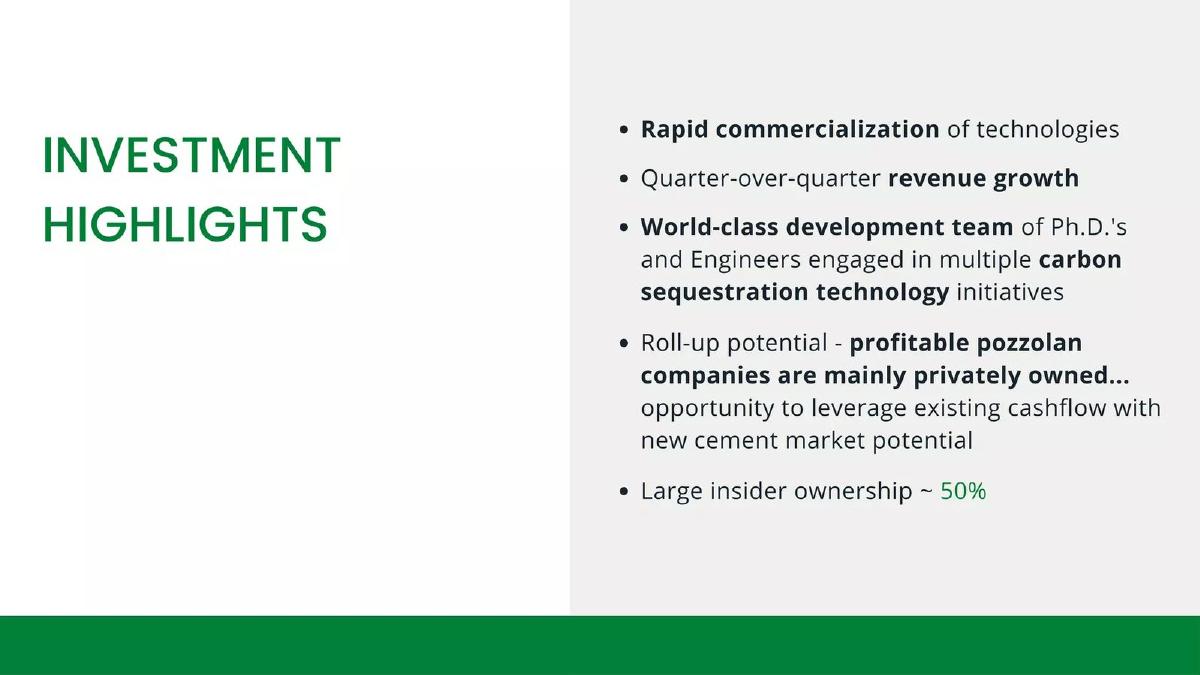
Slide 2: Investment Highlights
This slide serves as the 'TL;DR' for investors. It lists five key pillars: rapid commercialization, quarter-over-quarter revenue growth, a world-class development team of Ph.D.s, roll-up potential in the privately-owned pozzolan market, and a significant ~50% insider ownership . This last point is particularly strong for early-stage investors, as it signals high founder conviction and alignment of interests.
Slide 3: Industry Change and Market Size
Progressive Planet uses a Berkshire Hathaway report to peg the global cement and concrete industry at $652.7B by 2022 . The slide makes two bold claims: every tonne of concrete can be made more sustainable, and every tonne can sequester more CO2. By framing the problem as an 'Industry Change,' they suggest that adoption is not just optional but inevitable due to shifting global standards.
Slide 4: The Fly Ash Crisis
This is arguably the most important slide in the deck for establishing 'Why Now?' Fly ash is a byproduct of coal-fired power plants and a critical ingredient in modern concrete. As coal plants shut down across North America, the supply of fly ash is vanishing. Progressive Planet positions natural pozzolan as a direct replacement that 'does everything that fly ash does, but better.' This identifies a massive supply-chain gap that the company is ready to fill.
Slide 5: PozGlass™ and the Value of Recycled Glass
The deck introduces PozGlass™, a proprietary SCM (Supplementary Cementitious Material). The technical hook here is the efficiency of carbon offsetting. While standard glass recycling offers 0.1 tonne of offset per tonne, PozGlass™ delivers nearly 1.0 tonne of carbon offset per tonne of recycled glass. This 10x improvement in environmental ROI is a powerful metric for ESG-focused funds.
Slide 6: C-QUESTER™ Innovation
This slide covers the company's R&D efforts in carbon sequestration. It notes a trademark application from May 2020 and R&D initiatives starting in January 2021. Crucially, it highlights partnerships: ZS2 is secured as a magnesium cement partner , and calcium cement partners have been identified. This indicates that the company is building an ecosystem rather than trying to disrupt the entire supply chain alone.
Slide 7: BC Comminution Pilot Plant
To counter the risk of 'vaporware,' Slide 7 shows the actual hardware. The pilot plant in British Columbia has been running 7 days per week since June 2021 . It is already generating revenue by grinding rock phosphates and glacial moraine. The mention of a 'backlog of orders' is a critical validation point, proving that there is immediate demand for their processing capabilities.
Slide 8: PozGlass Expansion Roadmap
The expansion slide uses a map of North America to identify target growth regions. The strategy is to replicate the BC flagship plant in areas with known SCM shortages, such as the Pacific Northwest, California, and Quebec. This shows a logical, geographic-based scaling plan that follows the path of least resistance (i.e., where the supply gap is largest).
Slide 9: Scientific Advisors
The final slide in this selection focuses on the 'World-Class Development Team' mentioned earlier. It lists four Ph.D.s with impressive pedigrees: Dr. Roger Mah (former CEO of ZoraMat), Dr. Doug Brown (Carbon Engineering Group), Dr. Chad Vecitis (Harvard), and Dr. Greg Silverberg (Harvard). The inclusion of advisors with experience at LafargeHolcim and Carbon Engineering (which received investment from Bill Gates) adds significant institutional credibility to their technical claims.
What Works in This Deck
The deck excels at identifying a structural market failure (the disappearance of fly ash) and positioning a technical solution to solve it. Unlike many climate-tech decks that rely solely on 'doing good,' Progressive Planet emphasizes that their solution is 'better' and 'profitable.' The use of a revenue-generating pilot plant (Slide 7) significantly de-risks the investment by showing that the comminution process is already operational and in demand. Furthermore, the 50% insider ownership is a rare and powerful signal of commitment.
What Is Missing
Based on the nine slides provided, there are several notable omissions. First, there is no detailed financial slide showing historical revenue or projected margins for the full-scale PozGlass™ plants. Second, while the deck mentions 'quarter-over-quarter revenue growth,' it does not provide the actual numbers or the scale of that growth. Third, there is no specific 'Ask' slide in this selection—investors don't know how much capital is being raised or how it will be allocated between R&D and plant construction. Finally, while the advisors are impressive, the core executive management team (CEO, CFO, COO) is not detailed in this set of slides.
Founder's Playbook: What to Copy
Founders in the industrial or hardware space should take note of Slide 4. Instead of just saying 'we are sustainable,' Progressive Planet identifies a dying incumbent material (fly ash). This makes their product a 'must-have' for the industry to continue functioning, rather than a 'nice-to-have' for the environment. Additionally, the comparison of carbon offset efficiency (Slide 5) is a brilliant way to quantify value. If you can show your solution is 10x more effective than the current standard, the economic and environmental argument becomes much harder to ignore. Lastly, always show the 'dirt'—the photos of the pilot plant (Slide 7) prove that the company can actually build and operate machinery, which is the biggest hurdle for industrial startups.
Frequently asked questions
- What is the primary problem Progressive Planet is solving?
- The company addresses two major issues: the high carbon footprint of the cement industry and the disappearing supply of fly ash in North America. By using natural pozzolans and recycled glass, they provide a sustainable alternative that sequester CO2 while maintaining or improving the structural integrity of concrete.
- How does PozGlass™ differ from standard glass recycling?
- Standard glass recycling typically delivers about 0.1 tonne of carbon offset per tonne recycled. In contrast, using recycled glass as a supplementary cementitious material (PozGlass™) to replace Portland Cement delivers nearly 1.0 tonne of carbon offset per tonne, representing a 10x increase in environmental value.
- Is the technology currently operational or still in R&D?
- The company has moved into the pilot phase. As of June 2021, their British Columbia comminution pilot plant has been running seven days a week, generating revenue from rock powders and maintaining a backlog of orders from both new and existing customers.
- Who are the key partners mentioned in the deck?
- Progressive Planet has secured ZS2 as a partner for magnesium cement. They have also identified partners for calcium (Portland) cement and mention that their advisors have experience with major industry players like LafargeHolcim.
- What is the company's expansion strategy?
- The strategy involves replicating their BC flagship plant in regions showing acute SCM supply shortages. Target growth areas include the Pacific Northwest, California, Nevada, the Midwest (Kansas/Nebraska), and Eastern Canada (Quebec).