Suitables, a California-based company founded in 2014, aims to disrupt the toy and costume market with wearable cardboard kits. The deck leans heavily on the $9 billion Halloween spending market (Slide 7) and a strategy centered on securing licensing from giants like Disney and Nintendo (Slide 13). While the product features like 'sound enabled' and 'compact kit' (Slide 4) are clearly defined, the presentation lacks a team slide, specific unit economics, or a clear funding ask. The financial projections suggest a rapid scale-up to over $13 million in revenue by Year 5 (Slide 16), though the p…
Key takeaways
- The company was founded in 2014 in California to create unique cardboard product lines (Slide 4).
- Historical Halloween spending is used as the primary TAM indicator, peaking at $9.1B in 2017 (Slide 7).
- The product is positioned as a 'Compact Kit' with 'Simple Assembly' and 'Hi-resolution graphics' (Slide 4).
- Licensing is the core growth lever, with 'positive negotiations' claimed for Disney, Warner Bros, and Nintendo (Slide 13).
- Target demographics focus on households with >$100k income and children aged 2-7 (Slide 10).
- Financial projections show revenue growing from near-zero in FY1 to approximately $13M by FY5 (Slide 16).
- Expansion plans include adult costumes, pet products, and collectible playsets (Slide 19).
- The deck provides no information regarding the founding team, current traction, or the specific capital being raised.
Slide-by-Slide Analysis
Slide 1: Title Slide
The deck opens with the 'suitables' logo and the tagline 'building imagination.' It is labeled as an 'Investor Presentation' and marked 'Proprietary and Confidential.' The visual style is playful, utilizing bright orange and blue, which aligns with the toy industry aesthetic.
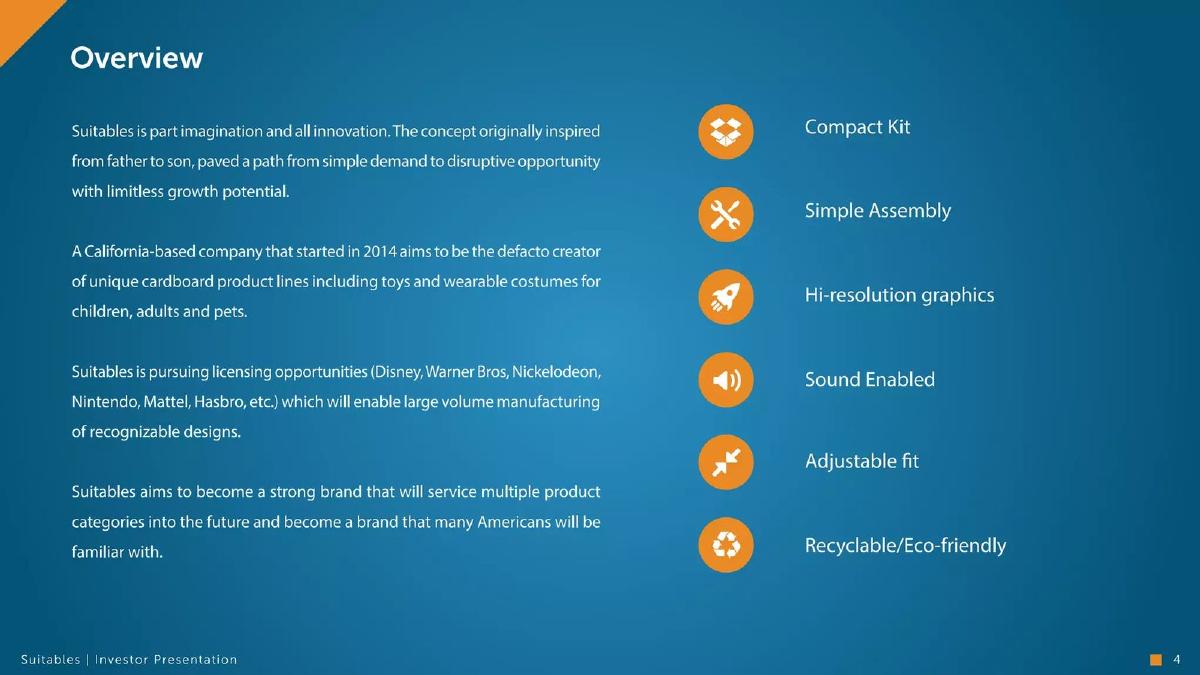
Slide 4: Overview
This slide establishes the company's origin and product value proposition. It states Suitables is a California-based company started in 2014. The core product is described as 'unique cardboard product lines including toys and wearable costumes for children, adults and pets.' Key features listed on the right include:
Compact Kit · Simple Assembly · Hi-resolution graphics · Sound Enabled · Adjustable fit · Recyclable/Eco-friendly
The slide also introduces the licensing strategy, mentioning Disney, Warner Bros, and others as targets to enable 'large volume manufacturing of recognizable designs.'
Slide 7: Seasonal Retail Market
Suitables uses a bar chart of 'Historical Halloween Spending' to define its Total Addressable Market (TAM). The data spans from 2010 ($5.8B) to 2018 ($9.0B). The use of rocket icons for bars emphasizes growth, though the data shows a slight dip from $9.1B in 2017 to $9.0B in 2018. This slide positions the company within a massive, recurring seasonal spending window.
Slide 10: Demographic
This slide breaks down the target customer profile into seven pillars. It identifies a 'Parent Market' aged 25-45 and focuses on 21 million households with an average income of over $100,000. Specific market penetration targets are cited:
Initial Demographic: Boys & Girls ages 2-7 (20M). · Growth Opportunity: Boys & Girls ages 7-12 (25M). · Average Costume Price: $45-$100. · 1% Market Penetration: 200k (ages 2-7) and 250k (ages 7-12). · Initial Market Value: ~$8M for the 2-7 age group and ~$12.5M for the 7-12 age group.
Slide 13: Licensing
Licensing is presented as the primary driver for 'maximum brand exposure and profitability.' The slide claims that 'positive negotiations have already been established' with a list of major brands: Disney, Warner Bros, Nickelodeon, Nintendo, Universal Studios, Mattel, and Hasbro. This is a high-stakes claim; in the toy industry, these licenses are expensive and difficult to secure, making this the 'make or break' slide of the deck.
Slide 16: Financial Projections
The bar chart shows a five-year outlook for Revenue, All Expenses, and Gross Profit (GP). Exact figures are not provided in a table, but the chart indicates:
FY1: Minimal revenue, expenses exceeding revenue. · FY2: Revenue jumps to ~$7,000,000. · FY3: Revenue exceeds $11,000,000. · FY4: Revenue reaches ~$13,000,000. · FY5: Revenue stabilizes just above $13,000,000 with GP appearing to be around $4,000,000.
The sudden jump from FY1 to FY2 suggests a planned major product launch or the activation of a significant retail/licensing partnership.
Slide 19: Next Steps
This slide outlines the roadmap for brand diversification. It highlights four areas for expansion:
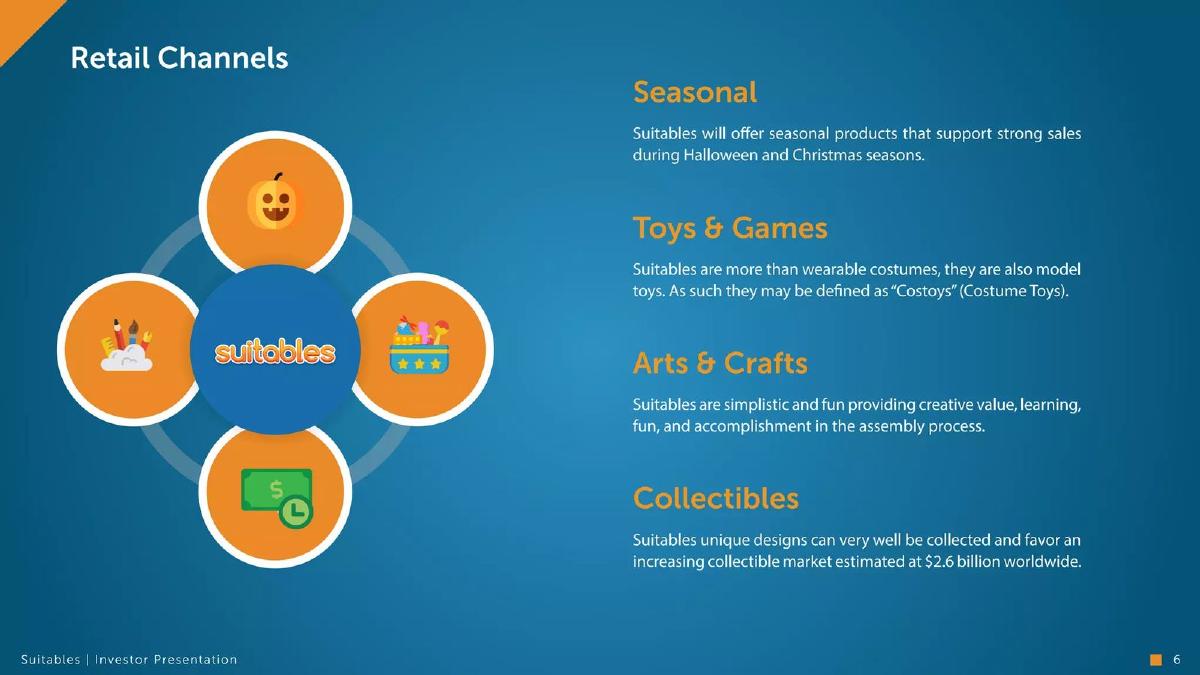
Suitables Collections: Turning products into collectibles (citing a $2.6 billion global toy and games collectibles market). · Suitables for Adults: Leveraging the fact that adult spending leads in costume retail sales. · Suitables for Pets: Noting statistical trends in pet-friendly products. · Suitables Playsets: Expanding into cardboard novelty staging and event production.
Slide 22: Closing Slide
A standard 'Thank You For Your Time' slide featuring the company logo and tagline. It lacks contact information, which is a common omission in public-facing versions of pitch decks.
What Suitables Does Well
The deck excels at visualizing the product's value proposition . By listing specific features like 'sound enabled' and 'adjustable fit' on Slide 4, the founders address common pain points with cardboard toys (durability and interactivity). The market sizing on Slide 10 is also quite specific; rather than just claiming a multi-billion dollar market, they narrow it down to a 1% penetration goal within a specific income bracket, which feels more grounded to an investor.
The licensing strategy is clearly the 'North Star' for the company. By listing specific, world-class partners on Slide 13, they signal an understanding that in the toy world, IP is the primary driver of volume. If those 'positive negotiations' are backed by letters of intent (LOIs), this becomes a very compelling narrative for a consumer goods investor.
What is Missing from the Deck
The most glaring omission is the Team Slide . Investors in early-stage companies are primarily investing in the founders' ability to execute. Without knowing who is running Suitables, it is impossible to judge if they have the manufacturing or licensing experience required to handle partners like Disney or Nintendo.
Additionally, there is no 'The Ask' slide . A pitch deck is a tool to raise capital, yet this deck fails to state how much money is being sought, what the valuation is, or how the funds will be allocated (e.g., $X for licensing fees, $Y for inventory, $Z for marketing). The Unit Economics are also absent; while we see total revenue projections, we don't know the cost to acquire a customer (CAC) or the manufacturing cost per unit versus the $45-$100 retail price.
What Other Founders Should Copy
Founders should emulate the clear demographic breakdown found on Slide 10. Many decks fail by being too broad. Suitables identifies a specific age range, a specific household income, and a specific penetration percentage. This allows an investor to check the math and see if the revenue projections on Slide 16 are realistic based on those assumptions.
The diversification roadmap on Slide 19 is also a strong inclusion. It shows that the founders are thinking about the 'second act' of the company. By identifying the pet and adult markets early, they demonstrate that Suitables isn't just a one-off Halloween toy, but a potential lifestyle brand for the 'imagination' category.
Final Thoughts
The Suitables deck is a clean, visually consistent presentation that makes a strong case for a licensing-led consumer product. However, the lack of team information and a clear funding request makes it feel more like a brand overview than a complete investment vehicle. For a successful raise, the founders would need to supplement these slides with deep-dive data on their manufacturing supply chain and the current status of their licensing agreements.
Frequently asked questions
- What is the primary product offered by Suitables?
- Suitables produces wearable cardboard costumes and toys. According to Slide 4, these are sold as compact kits designed for simple assembly. The products feature high-resolution graphics, are sound-enabled, have an adjustable fit, and are marketed as eco-friendly and recyclable. The goal is to move beyond generic cardboard boxes into recognizable, branded wearable designs.
- How does Suitables define its market opportunity?
- The company focuses on the seasonal retail market, specifically Halloween spending. Slide 7 tracks this market from $5.8 billion in 2010 to $9.0 billion in 2018. They further narrow their focus on Slide 10 to 21 million households with an average income over $100,000, targeting an initial demographic of 20 million boys and girls aged 2-7.
- What is the company's strategy for brand recognition?
- Suitables relies almost entirely on a licensing strategy to achieve 'maximum brand exposure.' Slide 13 lists several major entertainment and toy companies, including Disney, Warner Bros, Nickelodeon, Nintendo, Universal Studios, Mattel, and Hasbro, stating that positive negotiations have already been established to enable large-volume manufacturing of recognizable designs.
- What are the projected financials for the business?
- Slide 16 illustrates a five-year projection. Revenue is negligible in Year 1 but is projected to jump to over $7 million in Year 2, eventually exceeding $13 million by Year 5. Gross profit (GP) is shown as a fraction of revenue, appearing to settle at approximately 30% of total revenue by the fifth year, while expenses scale alongside growth.
- What information is missing from this pitch deck?
- This deck is missing several critical components required for an investment decision. There is no team slide detailing the founders' expertise, no slide explaining the current 'Ask' (how much money they want and at what valuation), no breakdown of unit economics (CAC/LTV), and no mention of existing sales or retail partnerships beyond the licensing 'negotiations.'