Productsup’s Series B deck is a masterclass in category creation. By coining the term 'Commerce Anarchy,' the company transforms the mundane problem of data feed management into a high-stakes strategic crisis for global brands. The deck successfully balances high-level narrative with aggressive growth metrics, reporting over 60% growth in net new ARR and a massive processing scale of 2 trillion monthly exports. While the deck leans heavily on external validation from Constellation Research, it lacks granular unit economics and a specific 'Ask' slide detailing the use of the $70M capital. Howe…
Key takeaways
- The deck introduces 'Commerce Anarchy' as a central narrative villain to create urgency for their P2C platform (Slide 4).
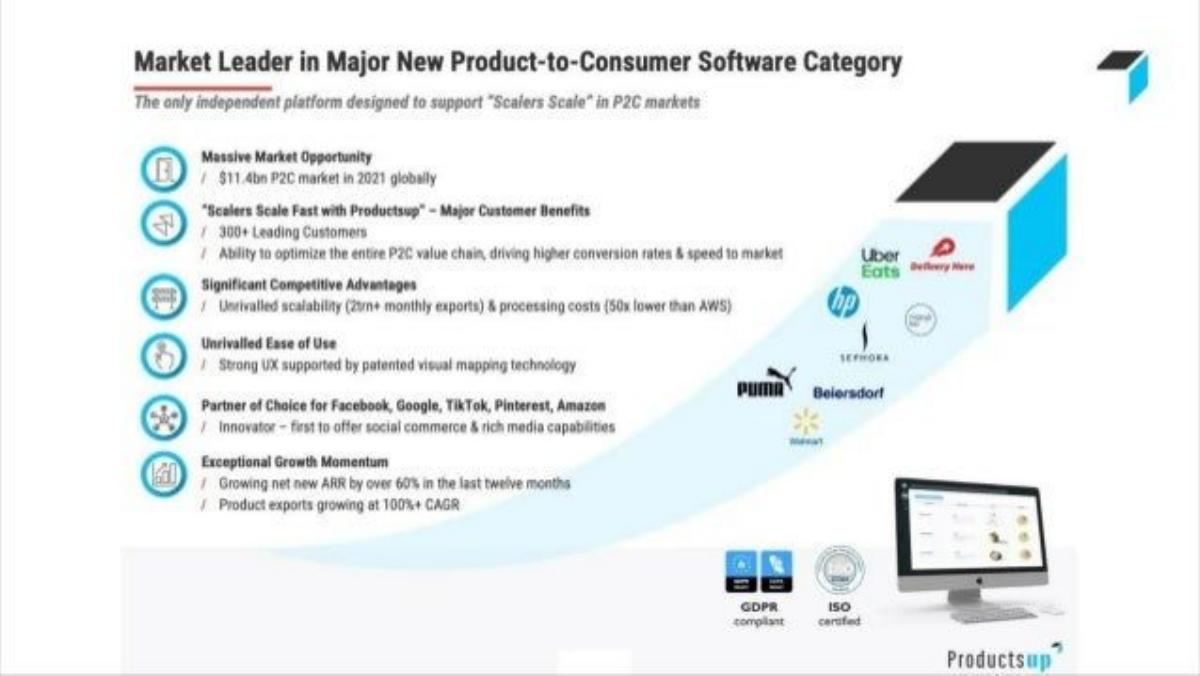
- Productsup claims a significant cost advantage, stating their processing costs are 50x lower than AWS (Slide 3).
- The company reports strong momentum with net new ARR growing by over 60% in the twelve months preceding the deck (Slide 3).
- Market sizing is calculated through a bottom-up approach by Constellation Research, totaling an $11.4bn P2C TAM (Slide 10).
- The platform handles massive scale, exporting over 2 trillion products each month (Slide 14).
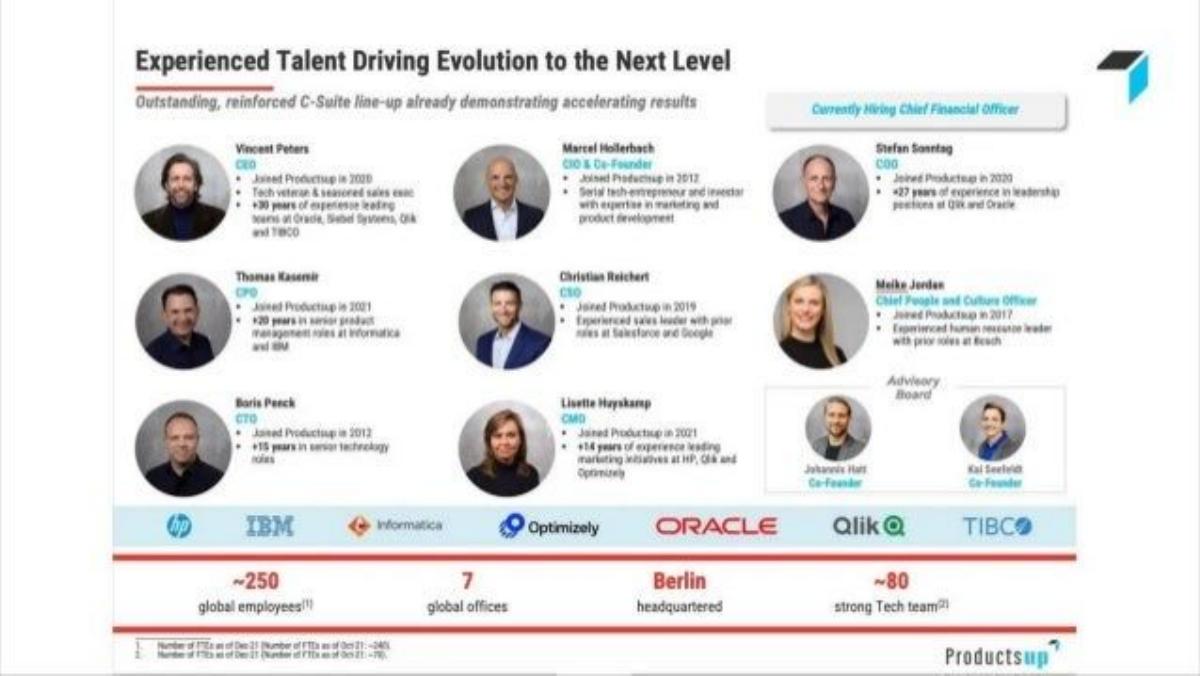
- The leadership team is highly experienced, featuring executives with tenures at Oracle, IBM, and Salesforce (Slide 2).
- The deck includes a speculative slide on NFT opportunities, reflecting the market trends of April 2022 (Slide 12).
- There is no explicit 'Ask' slide or breakdown of how the $70M Series B funds will be allocated.
Introduction: The Category Creation Playbook
Productsup’s April 2022 pitch deck is a definitive example of how a mature SaaS company uses a Series B round to cement its status as a category leader. Rather than competing in the crowded 'feed management' space, Productsup rebrands the entire sector as Product-to-Consumer (P2C) management. This teardown examines how they used this narrative to raise $70M.
Slide 1: Title Slide
The deck opens with a minimalist title slide featuring the Productsup logo and the date, April 2022. It is clean and professional, establishing the brand's visual identity immediately without distracting elements.
Slide 2: The Leadership Team
Slide 2, titled Experienced Talent Driving Evolution to the Next Level , is a heavy-hitter slide. It lists ten key individuals, including CEO Vincent Peters and several C-suite members who joined between 2019 and 2021. The slide emphasizes '30+ years of experience' for the CEO and '27+ years' for the COO. The bottom of the slide features logos from HP, IBM, Oracle, and Salesforce, signaling that this is an 'enterprise-grade' team. Notably, it mentions they are 'Currently Hiring Chief Financial Officer,' showing transparency about their organizational gaps. Key stats at the bottom: ~250 global employees and ~80 strong Tech team.
Slide 3: The Executive Summary
This slide acts as a 'Why Invest' summary. It hits six major points: a $11.4bn P2C market , a roster of 300+ Leading Customers (including Uber Eats, IKEA, and Sephora), and a massive technical claim of 2trillion+ monthly exports . Crucially, it notes that their processing costs are 50x lower than AWS . The growth momentum is quantified: 60% growth in net new ARR and 100%+ CAGR in product exports .
Slide 4-6: Defining the Villain - Commerce Anarchy
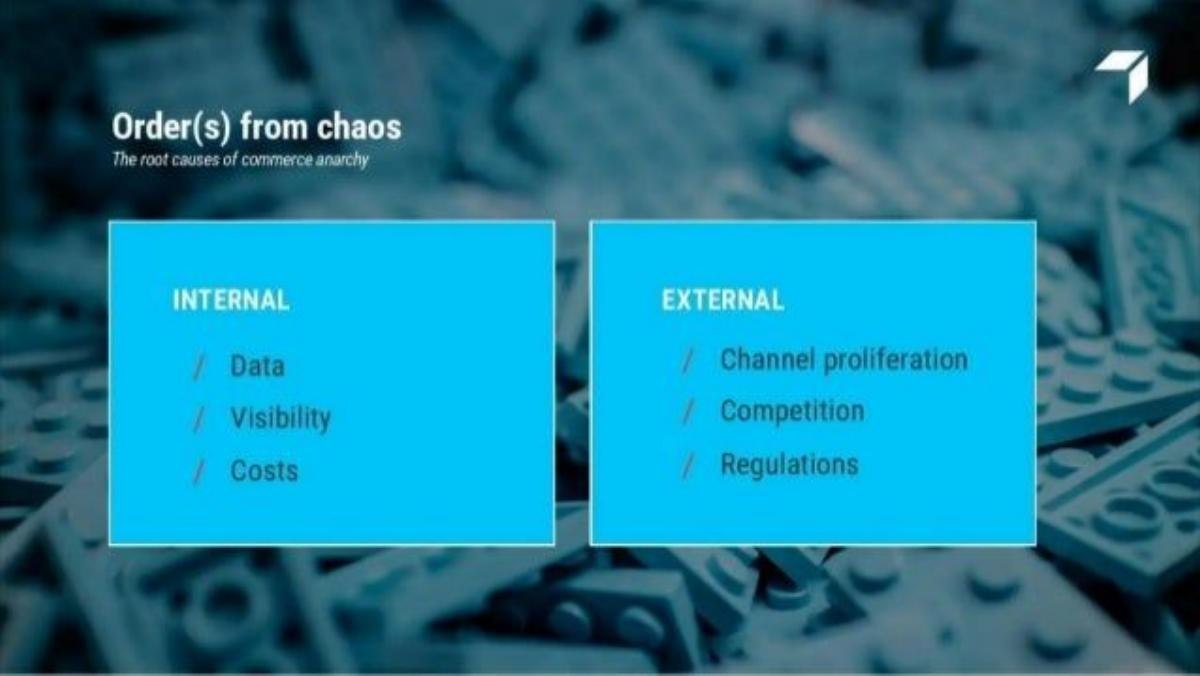
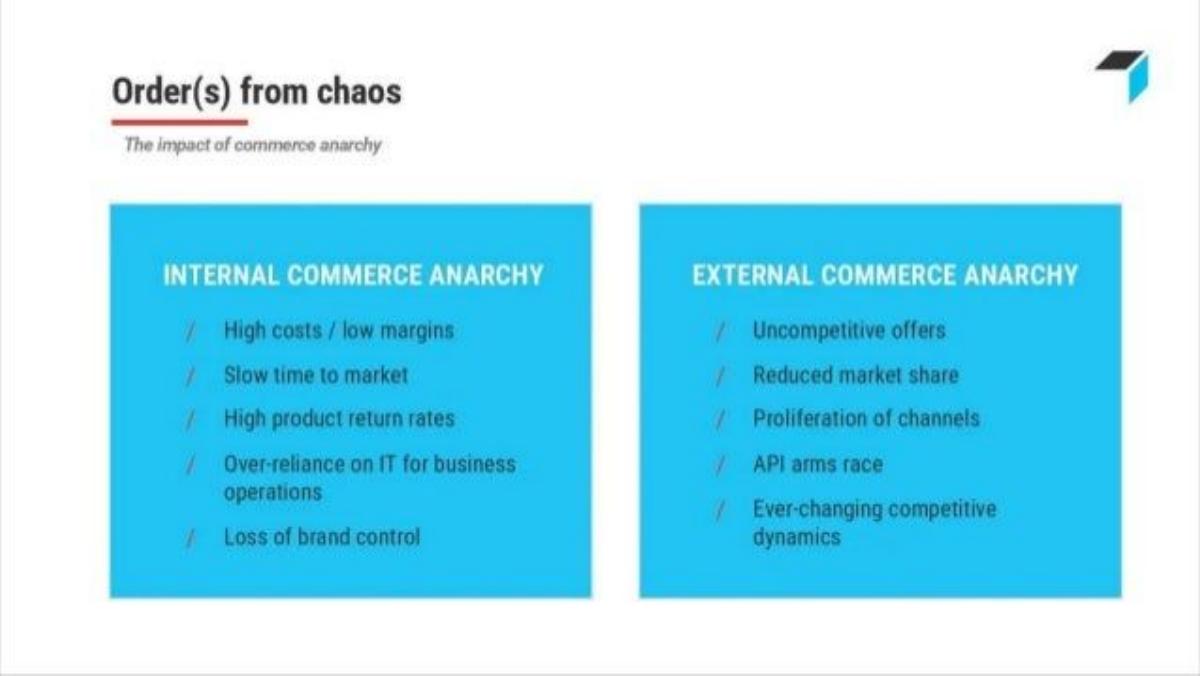
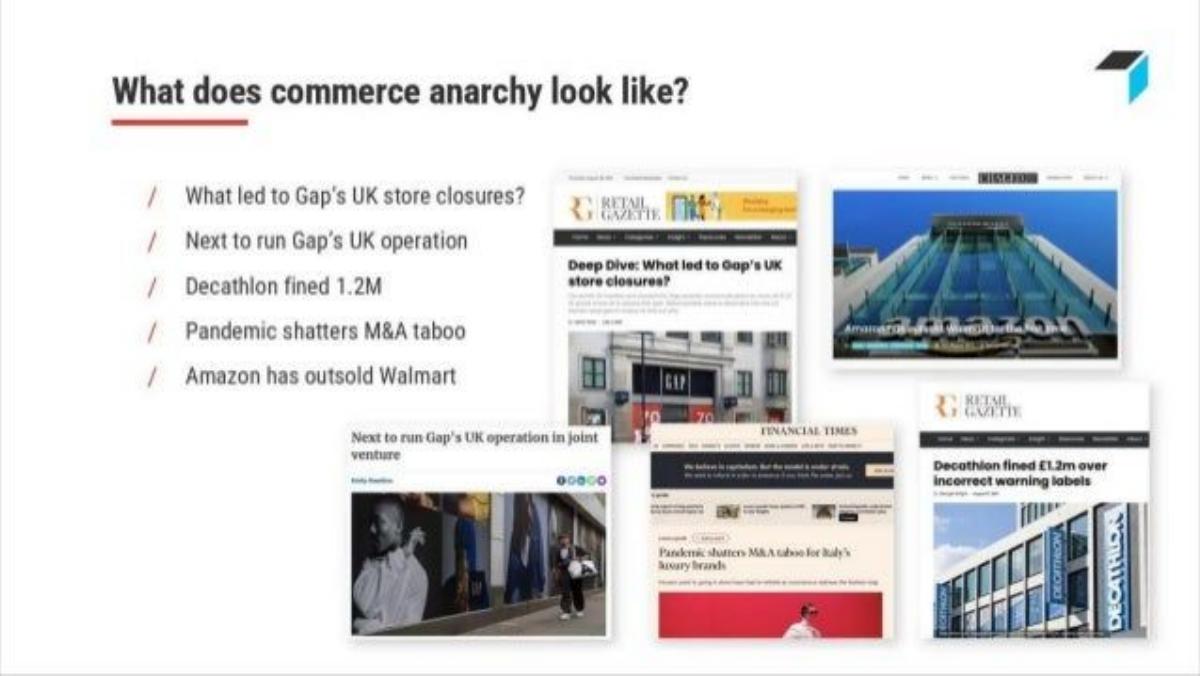
Slides 4 through 6 introduce the core narrative: Commerce Anarchy . Slide 4 breaks down the 'root causes' into Internal (Data, Visibility, Costs) and External (Channel proliferation, Competition, Regulations). Slide 5 details the impact, such as 'Slow time to market' and 'Loss of brand control.' Slide 6 uses real-world headlines—Gap store closures, Decathlon fines, and Amazon outselling Walmart—to ground these abstract problems in reality. This section effectively creates a 'burning platform' that necessitates a new solution.
Slide 7: The P2C Value Proposition
Slide 7 transitions from the problem to the solution. It uses a simple two-column format to explain what Productsup P2C 'delivers' (consistency, redefined experiences) and what it 'enables you to do' (take advantage of complexity, realize global potential). It is high-level and focused on business outcomes rather than features.
Slide 8-9: Third-Party Validation
Productsup leans heavily on Constellation Research . Slide 8 is a full-page quote calling P2C management 'most effectively realized by a platform designed from the ground up.' Slide 9 provides further snippets, calling Productsup 'one of the most comprehensive P2C management platforms in the market.' Using an external analyst firm adds significant credibility to their 'category creation' claim.
Slide 10: Market Sizing (TAM)
Slide 10 provides a granular breakdown of the $11.4bn P2C TAM . Instead of one large, unverified number, they show how P2C overlaps with existing categories like PIM ($11.2bn), MDM ($11.8bn), and E-Commerce ($7.5bn). They apply a percentage (e.g., 30% of the PIM market) to calculate the specific P2C opportunity. This 'bottom-up' logic is much more defensible to VCs than a top-down '1% of a trillion-dollar market' claim.
Slide 11: Product Architecture
Slide 11, Multiple Entry Customer Use Cases , finally shows the product's functional modules. It uses a triangular diagram to show five modules: Seller/Vendor Onboarding, Marketplace Experience, Product Feed Management, Product Content Syndication, and Performance Insights. It describes the platform as the 'World's First P2C Platform,' reinforcing the category leadership theme.
Slide 12: The NFT Opportunity
Slide 12 is a product of its time (April 2022). It discusses Productsup's NFT Opportunity , mentioning partnerships with Asics and marketplaces like OpenSea. While this may seem dated now, at the time of the raise, it served to prove that the platform could handle 'Generative Art' and smart contracts, positioning the tech as flexible enough for any future commerce trend.
Slide 13: Positioning Statement
This slide defines the company's Purpose, Vision, and Mission . The brand claim is 'Empowering commerce.' It is a standard corporate alignment slide that ensures investors understand the long-term 'reason for existence' beyond just software sales.
Slide 14: Why We Win
Slide 14 is the 'Moat' slide. It splits the competitive advantage into two buckets: Future-Proofed Platform and Enterprise Experience . It reiterates the 2 trillion+ monthly exports and the 2,500+ channel integrations. It also mentions 'Enterprise Security' (ISO and GDPR/CCPA compliance), which is a mandatory checkbox for the Series B stage.
Slide 15-16: Closing
The deck ends with a simple logo slide and a placeholder for a 'best pitch deck examples' advertisement from the source. There is no 'Ask' slide, no 'Use of Funds' breakdown, and no 'Financial Projections' slide in this public version of the deck.
What Productsup Does Well
Productsup excels at narrative framing . By coining 'Commerce Anarchy,' they stop being a utility and start being a strategic partner. The deck is also exceptionally strong on social proof . They don't just list logos; they provide deep analyst validation and specific technical scale metrics (2 trillion exports) that are difficult for competitors to hand-wave away. The TAM calculation is another highlight; by showing the overlap with established categories like PIM and MDM, they make a multi-billion dollar opportunity feel grounded and achievable.
What is Missing from the Deck
The most glaring omission is unit economics . For a Series B, investors typically want to see LTV (Lifetime Value), CAC (Customer Acquisition Cost), and Net Revenue Retention (NRR). While they mention 60% ARR growth, they don't show the efficiency of that growth. Additionally, there is no Ask slide . We know from external data they raised $70M, but the deck itself does not state how much they are looking for or how they plan to spend it (e.g., R&D vs. Sales expansion). Finally, a Competitive Landscape slide is missing; they claim to be the 'only' solution, but a comparison against legacy PIM or feed management tools would have helped clarify their specific differentiation.
Founder Tips: What to Copy
Name the Enemy: If you are in a crowded space, follow Productsup's lead and give the problem a name (like 'Commerce Anarchy'). It makes your solution the hero of a specific story. · Use Analyst Clout: If a firm like Gartner, Forrester, or Constellation has written about your space, dedicate entire slides to their quotes. It offloads the 'trust' requirement from you to a neutral third party. · Quantify Scale Early: Don't just say you are 'scalable.' Use a specific, massive number. '2 trillion monthly exports' is a figure that sticks in an investor's mind and sets a high bar for any competitor. · Segment your TAM: Don't just show one big bubble. Show the 'math' of how your market is composed of slices from other established industries. It shows you understand the flow of budget in your sector.
Frequently asked questions
- What is 'Commerce Anarchy' in the context of this deck?
- Productsup uses 'Commerce Anarchy' to describe the chaos caused by the proliferation of digital channels, data inconsistency, and complex regulations. By naming this struggle, they position their Product-to-Consumer (P2C) platform as the only organized solution to a systemic problem, moving the conversation from a simple tool to a strategic necessity for global brands.
- How does Productsup justify its $11.4 billion TAM?
- Instead of claiming a percentage of a vague market, Productsup uses a slide from Constellation Research that aggregates portions of existing categories. They sum percentages of the PIM ($11.2bn), MDM ($11.8bn), and E-commerce ($7.5bn) markets, among others, to arrive at an $11.4bn TAM specifically for P2C management.
- What are the key technical differentiators mentioned?
- The deck highlights two main technical advantages: unrivaled scalability and cost efficiency. Specifically, slide 14 claims the platform exports 2 trillion products monthly and operates at a cost 50x lower than standard AWS infrastructure. They also emphasize a no-code interface and patented visual mapping technology for ease of use.
- Is there a clear financial breakdown in the deck?
- No. While the deck mentions 60% ARR growth and 100%+ CAGR in product exports, it lacks a traditional financial slide. There are no details on Gross Margins, LTV/CAC ratios, or specific revenue figures. This is common in Series B decks where the focus shifts toward market dominance and category leadership.
- Why is the NFT slide included in a B2B SaaS deck?
- Slide 12, titled 'Productsup's NFT Opportunity,' was likely included to show the platform's adaptability to emerging commerce channels. In early 2022, NFTs were a major trend; Productsup used this to demonstrate they could handle 'Generative Art' collections and minting, proving their infrastructure is 'future-proof' regardless of the channel.