The Private Airline pitch deck, dated August 2017, presents a specialized aviation play focused on the Valais region of Switzerland. By operating 50-seat regional aircraft directly into Sion airport, the company aims to solve the 'last mile' problem for ski tourists who currently face 3.5+ hour transfers from Geneva. The deck highlights a clear competitive advantage in pricing and convenience, claiming a £155 one-way fare compared to £250 for easyJet and £415 for SWISS. Financially, the company projected a rapid scale-up to £31M in revenue by 2018 with a 15% EBITDA margin. The ask is £3M+ for…
Key takeaways
- The company identifies a specific geographic pain point: the 3.5+ hour transfer time from Geneva to Valais ski resorts (Slide 2).
- The solution involves operating 50-seat regional aircraft directly into Sion airport, claiming to be the first and only regular scheduled service there (Slide 3).
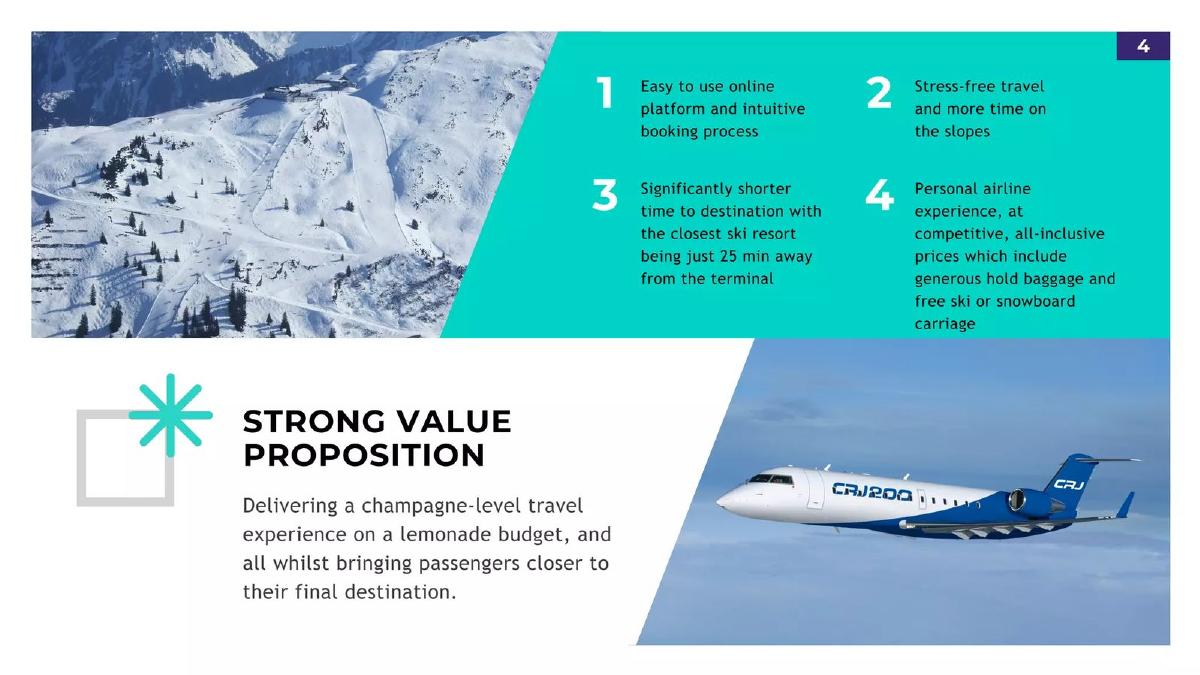
- Pricing is positioned as a 'lemonade budget' for a 'champagne-level' experience, with all-inclusive fares including free ski carriage (Slide 4).
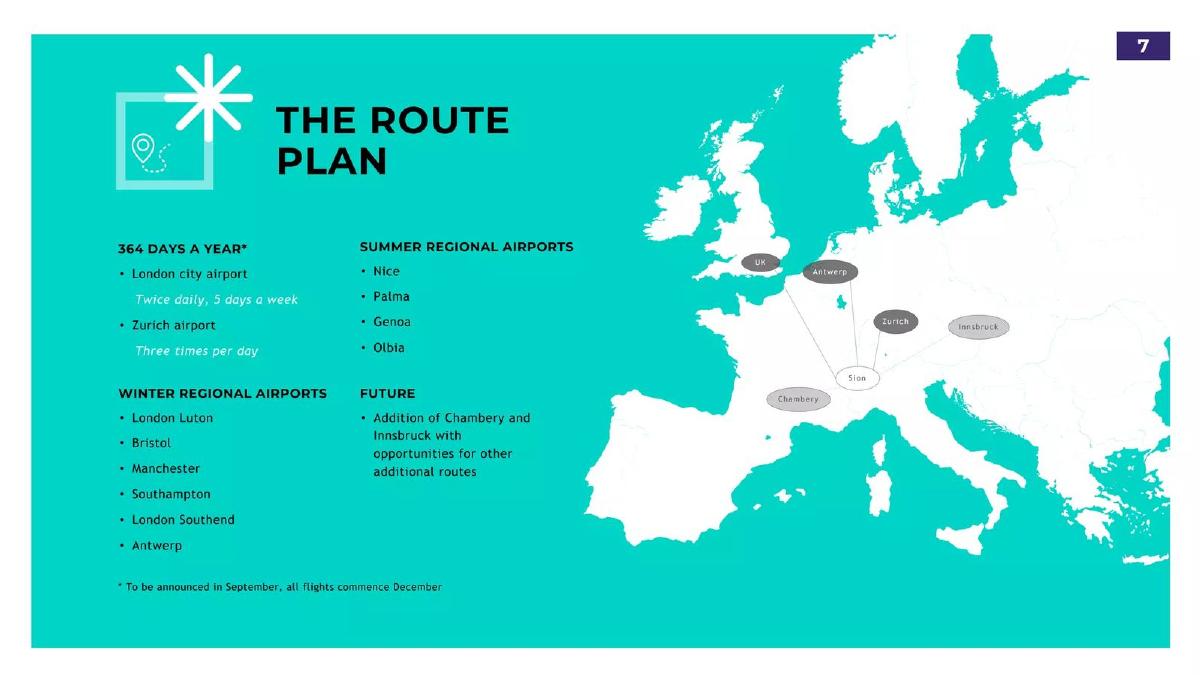
- The route plan includes year-round service to London City and Zurich, with seasonal expansions to regional UK and European airports (Slide 7).
- Competitive analysis shows a significant price advantage, with the company's £155 fare undercutting easyJet by £95 and SWISS by £260 (Slide 8).
- Financial projections estimate an average profit per seat of £15 and a total of 210,000 passengers by 2020 (Slide 9).
- Revenue is projected to jump from £2M in 2017 to £31M in 2018, maintaining a 14-15% EBITDA margin through 2020 (Slide 9).
- The funding ask is £3M+ in exchange for a 30% capital share, with 60% of funds allocated to advance payments on aircraft lease costs (Slide 10).
Executive Summary and Market Context
The Private Airline pitch deck, dated August 2017, outlines a specialized regional aviation strategy targeting the Swiss Alps. The core of the business model is bypassing the congestion and long transfer times of major international hubs like Geneva (GVA) by utilizing Sion Airport (SIR) as a direct gateway to the Valais region. This teardown examines the nine slides provided, which cover the problem, solution, route plan, competitive landscape, and financial projections.
Slide 1: Title and Positioning
The cover slide establishes the company's primary claim: "The first commercial airline to operate regular, scheduled flights direct to and from the Valais." It lists two placeholder names—Name 1 as Head of Strategy and Name 2 as CFO. The date is explicitly stated as August 2017. The imagery of a jet contrail against a blue sky is standard for the industry, but the subtitle immediately anchors the pitch in a specific geographic niche.
Slide 2: The Problem - The Geneva Bottleneck
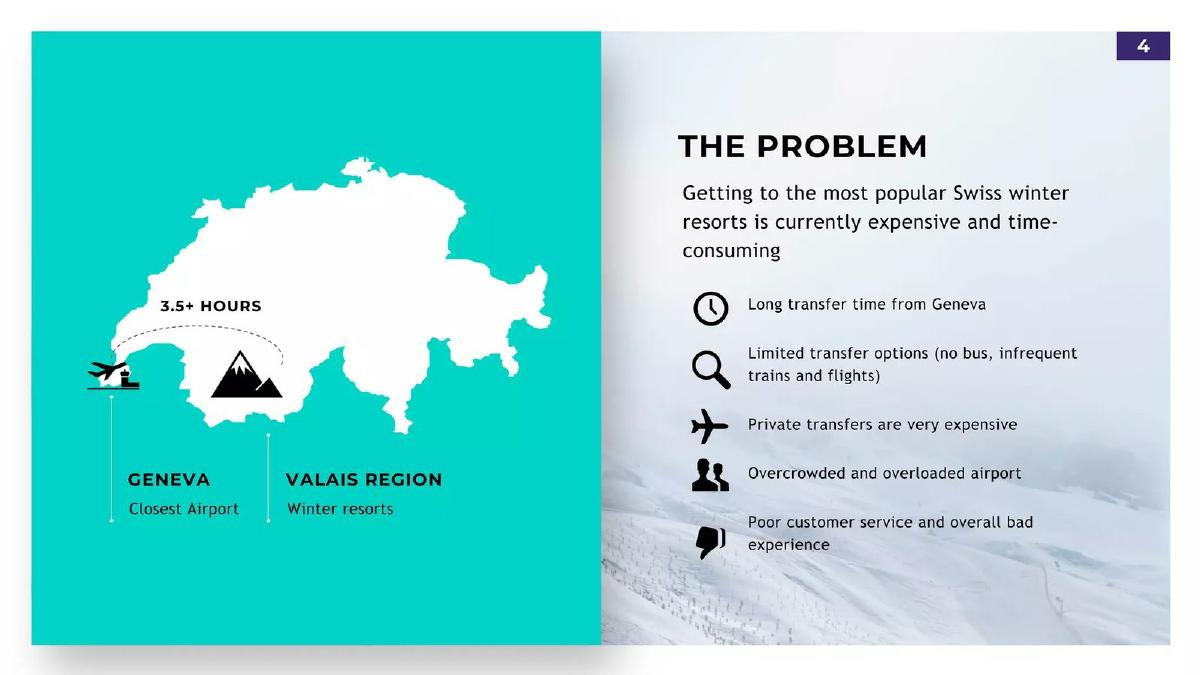
Slide 2 uses a map of Switzerland to illustrate the logistical hurdle for travelers. It highlights that the closest major airport, Geneva, requires a "3.5+ HOURS" transfer to reach the Valais region winter resorts. The slide lists five specific pain points: long transfer times, limited transfer options (citing no bus and infrequent trains), expensive private transfers, overcrowded airports, and poor customer service. This slide effectively establishes the "why" by focusing on traveler fatigue and high secondary costs.
Slide 3: The Solution - Direct to the Slopes
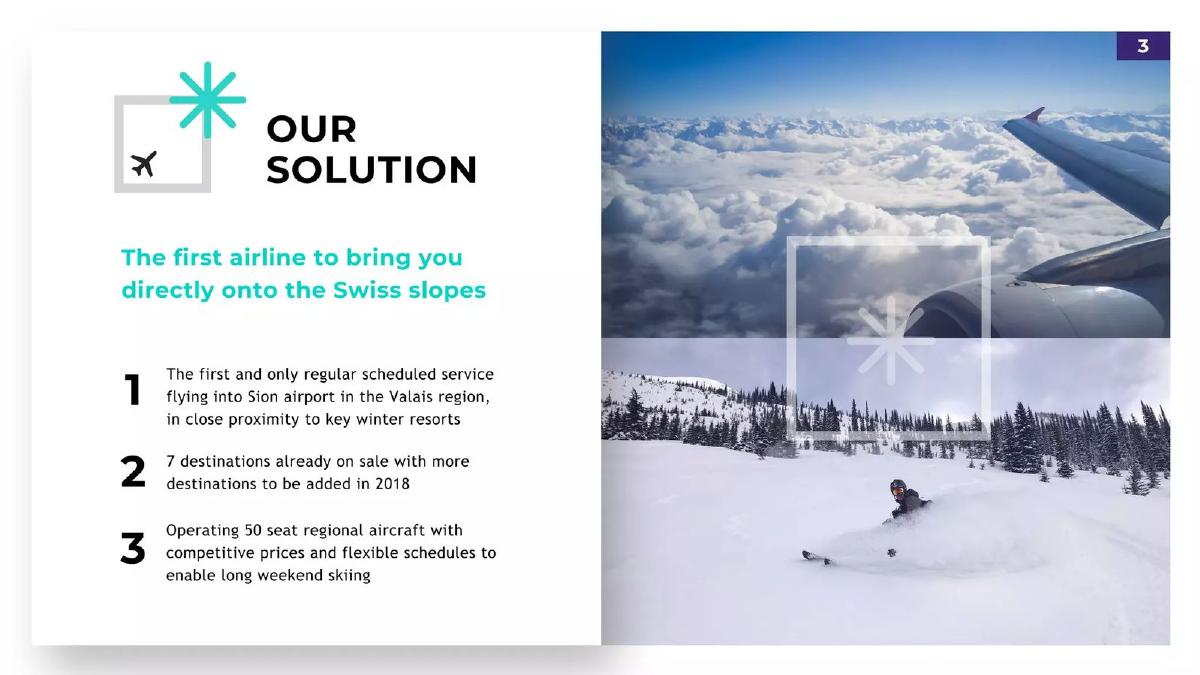
The solution is presented as a direct-to-slope service. The slide highlights three key pillars: being the "first and only regular scheduled service flying into Sion airport," having seven destinations already on sale for 2018, and operating 50-seat regional aircraft. The mention of "flexible schedules to enable long weekend skiing" suggests a target demographic of high-net-worth or time-poor professionals from major European financial centers.
Slide 4: Value Proposition and Experience
This slide expands on the user experience, promising a "champagne-level travel experience on a lemonade budget." It lists four benefits: an easy online booking process, stress-free travel, significantly shorter time to destination (25 minutes from terminal to resort), and a "personal airline experience" with all-inclusive prices. Notably, it mentions "free ski or snowboard carriage," which is a significant cost differentiator in the winter sports travel market. The slide features an image of a Bombardier CRJ200, suggesting the aircraft type intended for the fleet.
Slide 5: Market Validation and Testimonials
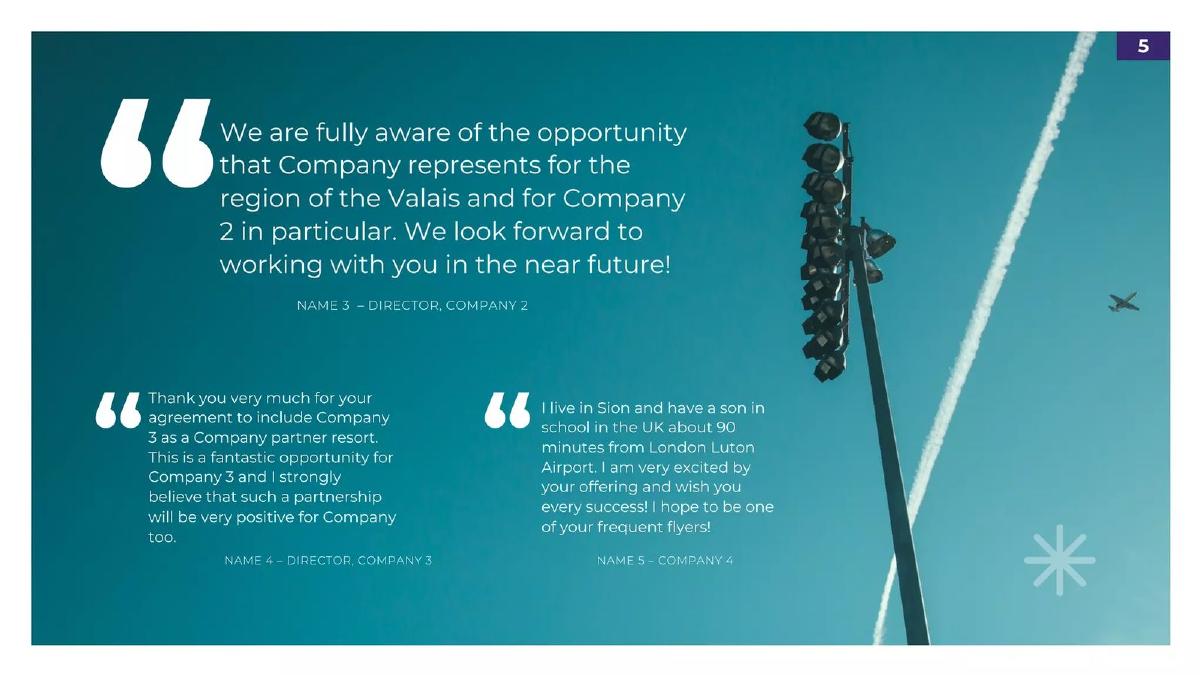
Slide 5 provides social proof through three quotes. The first is from a Director of "Company 2," expressing awareness of the opportunity for the Valais region. The second is from a Director of "Company 3," a partner resort. The third is a consumer testimonial from a resident of Sion who travels to the UK. While these quotes provide local validation, the use of placeholders (Company 2, Company 3, Name 3, etc.) indicates this version of the deck may have been a template or anonymized for broad distribution.
Slide 7: The Route Plan
The route plan (labeled as slide 7) details a two-tiered strategy. Year-round service ("364 days a year") is planned for London City airport (twice daily, 5 days a week) and Zurich airport (three times per day). Seasonal winter routes include regional UK airports like Bristol, Manchester, and Southampton. Summer routes pivot to Mediterranean destinations like Nice, Palma, and Olbia. This diversification is a standard tactic for regional airlines to mitigate the seasonality of ski demand. A map shows Sion as the central hub connecting these nodes.
Slide 8: Unique Competitive Advantage
This slide is a direct price and service comparison against easyJet and SWISS. It uses a specific use case: a one-way flight during peak dates in mid-February from London to Sion. The company claims a price of £155, which includes all extra costs such as checked luggage and transfer costs. This is compared to £250 for easyJet and £415 for SWISS. A checklist shows that only the "Company" offers affordable pricing, direct resort airport access, and flights outside busy weekend days simultaneously. This is the most compelling slide for an investor, as it quantifies the disruption.
Slide 9: Attractive Financial Forecast
The financial slide provides key metrics: an average revenue per seat of £113 and an average profit per seat of £15. It projects 210,000 passengers by 2020. The bar chart shows a dramatic revenue jump from £2M in 2017 to £31M in 2018, holding steady through 2020. The EBITDA margin is projected to swing from -11% in 2017 to +15% in 2018, before settling at 14% in 2019 and 2020. The rapid move to profitability is ambitious for a capital-intensive industry like aviation.
Slide 10: The Ask and Use of Funds
The final slide (labeled 10) presents the funding requirement: "£3M+ to fund working capital investments, marketing and operations in return for the 30% capital share." A donut chart breaks down the allocation: 60% for advance payments on aircraft lease costs, 15% for payroll and G&A, 8% for web development and marketing, 8% for aircraft deposits, 5% for licenses and approvals, and 4% for crew training. This implies a post-money valuation of approximately £10M.
What Works in This Deck
The deck excels at identifying a highly specific, high-value problem. The "Geneva Bottleneck" is a well-known issue for European skiers, and the solution of using Sion Airport is logically sound. The competitive comparison on Slide 8 is particularly strong because it accounts for the "total cost of travel," including transfers and baggage, rather than just the base airfare. This transparency helps justify the business model to an investor who might otherwise view a small regional airline as too risky compared to giants like easyJet.
The route plan also shows a sophisticated understanding of aircraft utilization. By planning summer routes to the Mediterranean, the company addresses the primary risk of a ski-focused airline: idle assets during the off-season. The focus on London City and Zurich—two major financial hubs—further aligns the service with a customer base that values time over the absolute lowest ticket price.
What Is Missing
The most glaring omission is a comprehensive Team slide. Aviation is one of the most operationally complex and heavily regulated industries in the world. Investors need to see a management team with deep experience in flight operations, regulatory compliance (EASA/CAA), and fuel hedging. Relying on placeholders for the Head of Strategy and CFO is a significant weakness that prevents an investor from assessing execution risk.
Furthermore, there is no mention of the regulatory status. Starting an airline requires an Air Operator Certificate (AOC). The deck does not state whether the company already holds an AOC, is applying for one, or intends to use a partner's certificate (a "virtual airline" model). Given that 5% of the funds are allocated to "licenses & approvals," it suggests they are in the early stages, which is a high-risk phase for a £3M investment. There is also no discussion of the competitive response; if this route is truly profitable, there is little to stop a competitor like Helvetic or CityJet from entering the same market.
What a Founder Should Copy
Founders should emulate the clear, map-based problem identification used on Slide 2. Visualizing a 3.5-hour journey versus a 25-minute journey is far more impactful than just stating the numbers in text. The use of a specific, real-world pricing comparison (Slide 8) is also a best practice. By picking a specific date and route, the founders move away from vague generalities and provide a concrete example of their value proposition.
The breakdown of the "Use of Funds" on Slide 10 is also well-executed. It clearly shows that the majority of the capital is going toward the heavy assets (aircraft leases), which gives investors confidence that the money is being used to build the core infrastructure of the business rather than being swallowed by overhead. Finally, the inclusion of partner testimonials, even if anonymized in this version, shows that the founders have done the legwork to build a local ecosystem of support before asking for capital.
Frequently asked questions
- What is the primary value proposition of this airline?
- The primary value proposition is time and cost efficiency for travelers heading to the Valais region of Switzerland. By flying directly into Sion airport, the airline reduces the transfer time to ski resorts to as little as 25 minutes, compared to the 3.5+ hours required when flying into Geneva. Additionally, the airline includes free ski and snowboard carriage in its pricing to compete with low-cost and legacy carriers.
- How does the airline plan to compete with established carriers like easyJet and SWISS?
- The airline competes on three fronts: location, price, and service. It flies to Sion, which competitors do not serve with regular scheduled flights. It claims a lower total cost of travel (£155 vs £250-£415) when including transfers and baggage. Finally, it offers a 'personal airline experience' with all-inclusive pricing, avoiding the hidden fees often associated with budget carriers.
- What are the projected financials for the first three years?
- The deck projects a significant revenue increase from £2M in 2017 to £31M in 2018, 2019, and 2020. The EBITDA margin is expected to turn positive in 2018 at 15% and stabilize at 14% in the following years. By 2020, the company expects to transport 210,000 passengers annually with an average profit per seat of £15.
- What is the specific funding ask and how will it be used?
- The company is seeking £3M+ in exchange for a 30% equity stake. The largest portion of this capital (60%) is earmarked for advance payments on aircraft lease costs. Other allocations include 15% for payroll and G&A, 8% for web development and marketing, 8% for aircraft deposits, 5% for licenses and approvals, and 4% for crew training and uniforms.
- What critical information is missing from this pitch deck?
- The deck lacks a dedicated team slide detailing the experience of the founders or management. While 'Name 1' and 'Name 2' are listed on the cover, there are no biographies to prove they can manage a complex aviation business. It also lacks a detailed breakdown of the fleet beyond mentioning '50 seat regional aircraft' and showing a CRJ200 in the imagery.