Preteckt’s 8-slide deck is a masterclass in brevity, focusing on the 'Big Data for Big Rigs' narrative. The presentation identifies a $10 billion industry loss caused by vehicle breakdowns and positions its hardware-software solution as the fix. Despite the lack of a formal 'Ask' slide or detailed financial projections within the slides, the deck relies heavily on the technical credibility of its founders—boasting backgrounds from CERN and Oak Ridge National Laboratory. The deck uses visceral imagery of truck accidents and clear logos of pilot partners like General Motors and Ozark Motor Line…
Key takeaways
- The deck identifies a total addressable market pain point of $10 billion lost in the industry due to breakdowns on slide 3.
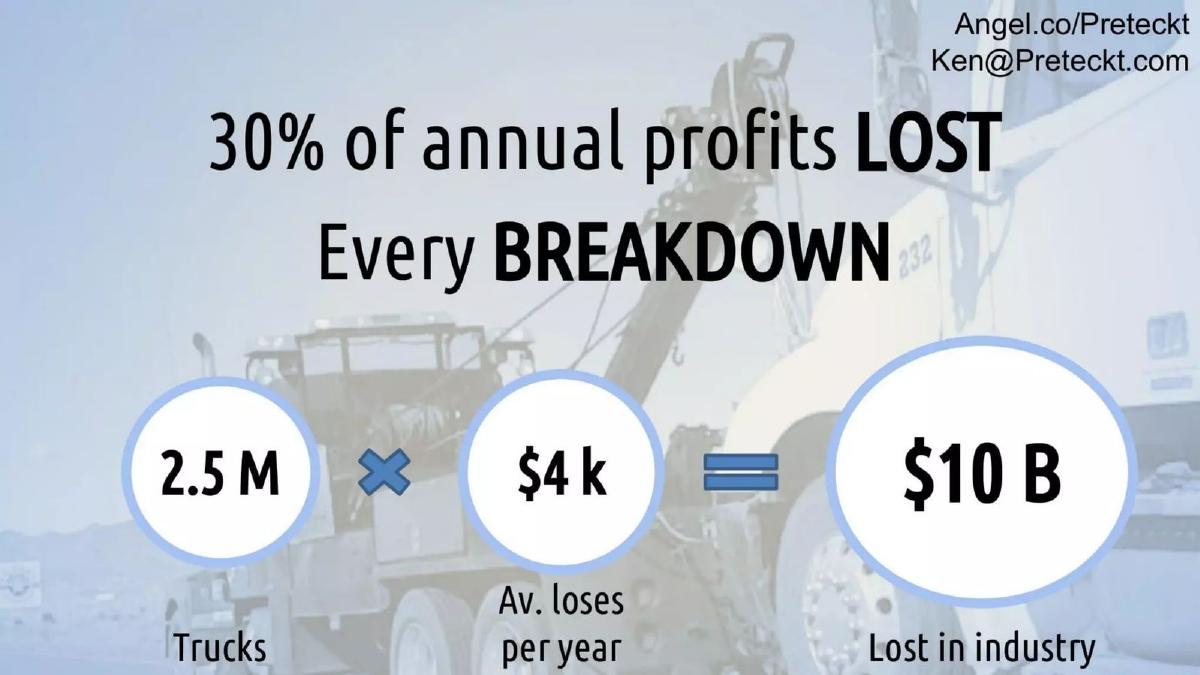
- Vehicle breakdowns account for a loss of 30% of annual profits for fleet operators, according to slide 3.
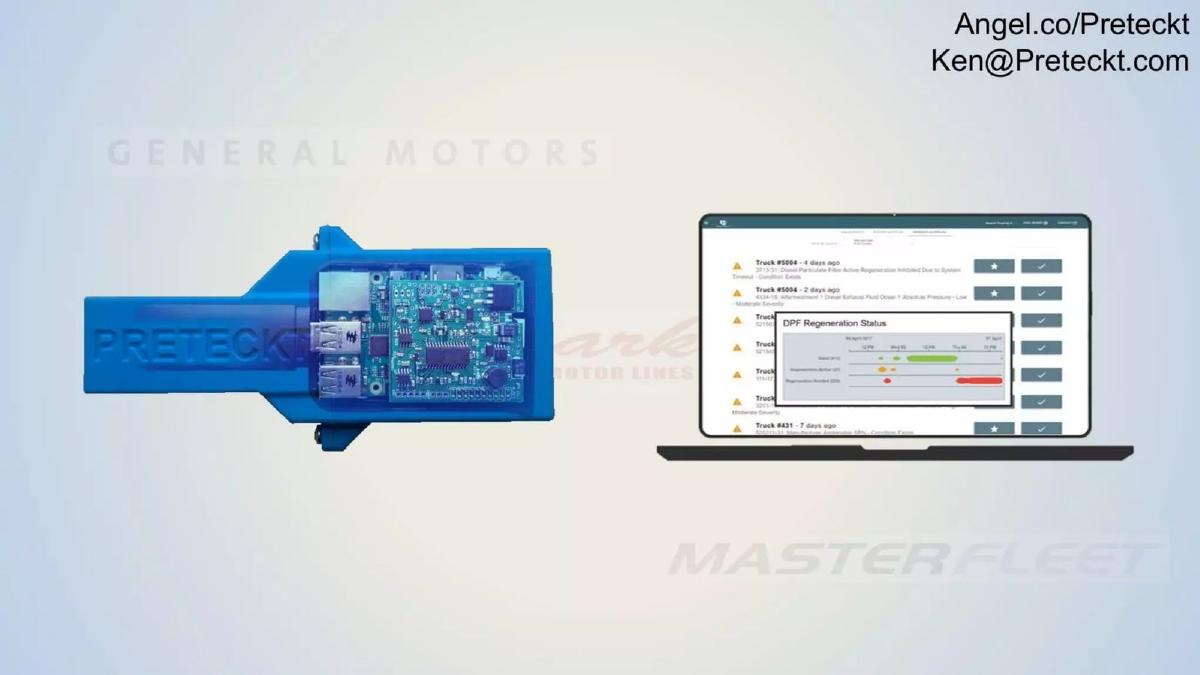
- The company utilizes a hardware-plus-software approach, showing a proprietary plug-in device and a dashboard on slide 5.
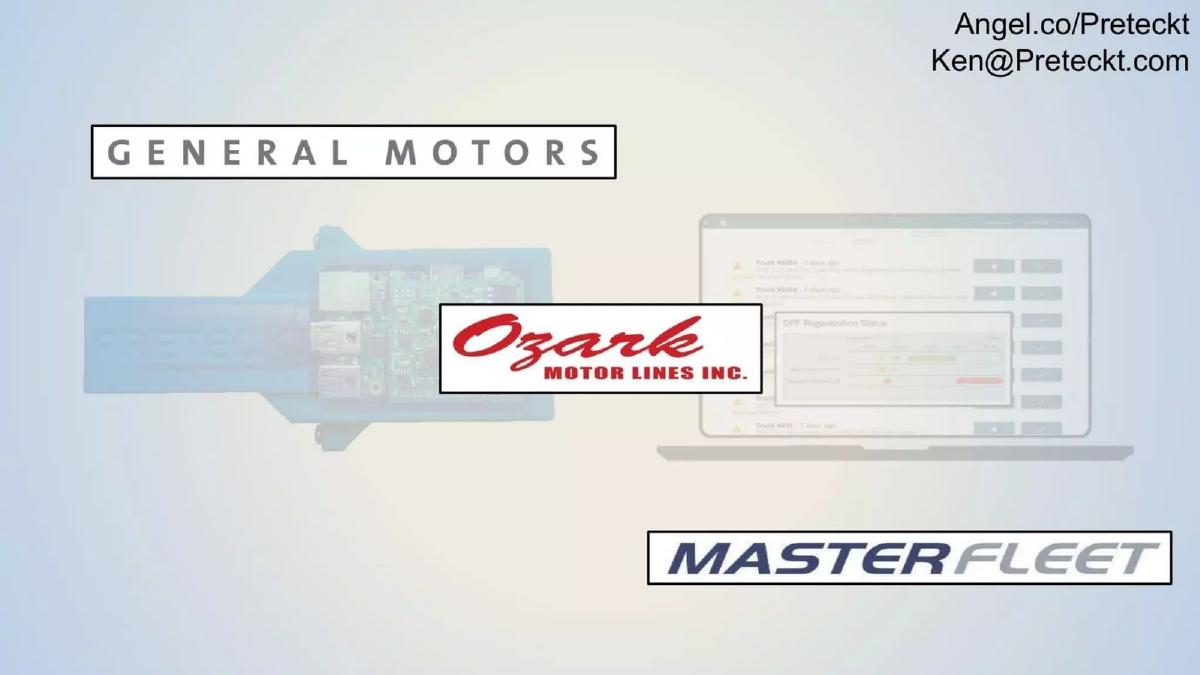
- Preteckt established early credibility through pilot programs with major entities like General Motors and Master Fleet, as shown on slide 4.
- The team has significant academic and research pedigree, with logos for CERN and Oak Ridge National Laboratory featured on slide 7.
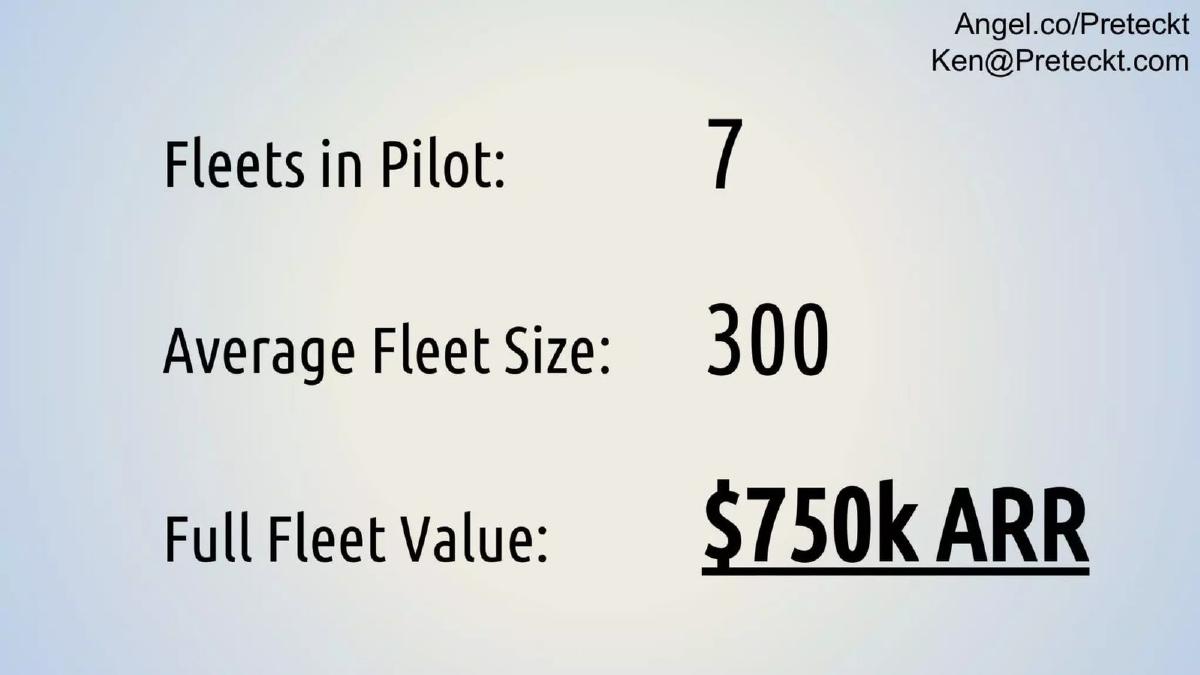
- At the time of the deck, the company had 7 fleets in pilot with an average size of 300 vehicles each, per slide 6.
- The projected 'Full Fleet Value' for their current pilots is stated as $750k ARR on slide 6.
- The deck completely omits a formal funding request, use of funds, or a detailed competitive landscape analysis.
The 8-Slide Narrative: Big Data for Big Rigs
Preteckt’s pitch deck is remarkably lean, consisting of only eight slides. In an era where decks often bloat to 20 or 30 pages, this presentation relies on high-impact visuals and the 'founder-market fit' of a highly technical team. The deck is designed to solve a very specific, expensive problem: the 30% of profits that trucking fleets lose to maintenance and breakdowns. By positioning themselves as 'Big Data for Big Rigs,' Preteckt moves the conversation away from simple telematics and into the realm of high-performance computing and predictive analytics.
Slides 1-2: The Hook and the Visceral Problem
Slide 1 is a standard title card featuring the Preteckt logo and the tagline: "Big Data for Big Rigs." It includes contact information for the CEO, Ken Sills, and a link to their Angel.co profile. This immediately establishes the sector and the scale of the technology being applied.
Slide 2 takes an aggressive approach to the 'Problem' slide. Instead of bullet points, it uses a full-bleed image of a catastrophic multi-truck pileup with a CNN-style overlay that reads: "BREAKING NEWS: POOR MAINTENANCE CAUSES HAVOC." This slide serves two purposes: it highlights the safety implications of their work and creates an emotional urgency for a solution that prevents mechanical failure before it happens.
Slide 3: Quantifying the Industry Pain
Slide 3 moves from the emotional to the financial. It presents a simple but effective equation to define the market opportunity. The slide states that "30% of annual profits LOST Every BREAKDOWN." It then breaks down the macro-opportunity: 2.5 M Trucks x $4 k Av. loses per year = $10 B Lost in industry. By using a $10 billion figure, Preteckt establishes that even a small percentage of efficiency gain represents a massive venture-scale opportunity. The math is easy to follow and provides a clear 'Why Now' for investors.
Slides 4-5: The Solution and Pilot Partners
Slide 4 introduces the company's early adopters. It features the logos of General Motors , Ozark Motor Lines Inc. , and Master Fleet . These logos are overlaid on a faded background of their hardware and software, signaling that the product is already in the hands of major industry players. This is a crucial 'de-risking' slide; it tells investors that the technology has already passed the initial scrutiny of a global OEM like GM.
Slide 5 provides a clearer look at the product. On the left, it shows a proprietary hardware device (a blue translucent casing revealing a circuit board) that appears to be an OBD-II or similar vehicle interface. On the right, a laptop displays the software dashboard . The dashboard shows specific alerts, such as "Truck #5004 - 2 days ago" and a detailed view of "DPF Regeneration Status." This slide confirms that Preteckt is a full-stack solution, combining data ingestion via hardware with actionable insights via SaaS.
Slide 6: Traction and Revenue Potential
Slide 6 is the 'Traction' slide, and it is refreshiongly data-dense compared to the rest of the deck. It lists three key metrics:
Fleets in Pilot: 7 · Average Fleet Size: 300 · Full Fleet Value: $750k ARR
This slide is clever because it distinguishes between current pilot activity and the 'Full Fleet Value.' It suggests that if the pilots convert to full-fleet deployments, the company has a clear path to nearly a million dollars in recurring revenue just from its existing pipeline. It demonstrates a scalable sales model where one 'win' results in 300 units of revenue.
Slide 7: The Technical Pedigree
Slide 7 focuses on the team, which is arguably the strongest part of the Preteckt pitch. The three principals are presented with their academic and research credentials:
Ken Sills (CEO): M.Sc. Astrophysics, M.Eng. Computer Engineering. · Sasha Kucharczyk (COO): M.Eng. Machine Learning, MBA Marketing and Strategy. · Rory Woods (Lead Data Scientist): PhD High Performance Computing.
To reinforce their expertise, the slide features logos for CERN , SciNet , Brookhaven National Laboratory , and Oak Ridge National Laboratory . This framing tells investors that this isn't just a group of 'app developers,' but a team of scientists capable of handling the '100x speed advantage' and 'zero false-positives' mentioned in their company description.
Slide 8: Conclusion
Slide 8 is a repeat of the title slide, serving as a backdrop for Q&A. It maintains the "Big Data for Big Rigs" branding and keeps the contact information front and center.
What Works in This Deck
The 'Scientist' Narrative: By highlighting backgrounds at CERN and Oak Ridge, the founders position themselves as uniquely qualified to solve the 'Big Data' part of the trucking industry. In 2015, when 'AI' and 'Machine Learning' were becoming buzzy, these credentials provided necessary substance.
Clear Value Proposition: The deck doesn't get bogged down in how the algorithms work. Instead, it focuses on the outcome: stopping the 30% profit leak caused by breakdowns. This is a language that both fleet managers and venture capitalists understand.
Pilot Transparency: Listing the number of fleets and the average fleet size (Slide 6) gives a clear picture of the company's current stage. It shows they are past the 'idea' phase and are actively testing in the real world.
What Is Missing
The Ask: There is no slide detailing how much money the company is raising or what the milestones for the next 18 months are. While the catalogue facts state they raised $6.4M, a potential investor viewing this deck in isolation would not know the terms or the goal of the round.
Competition: The deck assumes a vacuum. There is no mention of existing telematics giants (like Geotab or Trimble) or how Preteckt integrates with or replaces them. Investors usually want to see how a startup plans to defend its position against incumbents.
Unit Economics: While the deck mentions a $750k ARR potential, it doesn't explain the pricing model. Is it per truck per month? Is there a hardware fee? Understanding the margins on the hardware vs. the software is vital for a PaaS/SaaS hybrid model.
What a Founder Should Copy
The Equation Slide: Slide 3 is a perfect example of how to present a Market Size/Problem slide. It uses a simple multiplication formula that makes the $10 billion opportunity feel grounded in reality rather than a pulled-from-the-air 'TAM' figure.
Logo Placement: If you have pilots with major brands, put them front and center. Preteckt’s use of the General Motors logo on Slide 4 provides an immediate 'halo effect' that carries through the rest of the presentation.
Minimalist Design: This deck proves you don't need 20 slides to raise millions. If your team is elite and your problem is well-defined, a short, punchy deck can be more effective at securing a second meeting than a long, exhaustive one.
Frequently asked questions
- How much did Preteckt raise with this deck?
- According to the catalogue facts, Preteckt raised $6,400,000 in 2015. The deck itself does not state the amount being raised or the valuation, which suggests it may have been used as a supporting visual for a verbal pitch or a high-level teaser.
- What is Preteckt's core product?
- Preteckt provides a predictive maintenance (prognostics) solution for connected vehicles. As shown on slide 5, this involves a hardware device that plugs into the vehicle to collect data and a software dashboard that provides real-time alerts on engine health and maintenance needs.
- Who are the founders and what is their background?
- The team consists of Ken Sills (CEO, Astrophysics and Computer Engineering), Sasha Kucharczyk (COO, Machine Learning and MBA), and Rory Woods (Lead Data Scientist, PhD in High Performance Computing). Their backgrounds include work with prestigious institutions like CERN and Brookhaven National Laboratory (Slide 7).
- What traction did the company have at the time of the pitch?
- Slide 6 notes that the company had 7 fleets in pilot programs. With an average fleet size of 300, they estimated the full fleet value of these existing relationships to be $750,000 in Annual Recurring Revenue (ARR).
- Is there a competitive analysis in the deck?
- No. The 8-slide deck omits a competitive matrix or any mention of other telematics or predictive maintenance companies. It focuses entirely on the internal technology and the scale of the problem in the trucking industry.