Shiftee’s Pre-Series A deck from 2018 highlights a company perfectly positioned to solve a massive regulatory pain point: South Korea’s implementation of the mandatory 52-hour work week. The deck emphasizes a shift from manual oversight to an integrated HR system covering scheduling, attendance, leave, and payroll. The most compelling data points include a 90%+ paid conversion rate and a Daily Active User (DAU) count of 10,000. Despite having a team of only four people, Shiftee demonstrated significant scale, serving over 20,000 workplaces across 20 countries within 18 months of operation. Th…
Key takeaways
- The company positions itself as an integrated HR solution covering scheduling, attendance, leave, and payroll (Slide 1).
- A major market driver is the South Korean government's 52-hour work week mandate, which created an urgent need for precise labor tracking (Slide 13).
- Shiftee reports a high-efficiency sales funnel with a paid conversion rate exceeding 90% (Slide 21).
- At the time of the deck, the platform had reached 10,000 Daily Active Users (DAU) (Slide 21).
- The startup achieved significant reach with a lean team of 4 people operating for 1.5 years (Slide 29).
- The product is already used in over 20,000 workplaces across 20 different countries (Slide 29).
- The deck identifies India as a key expansion market, citing ZDNet research on the global outsourcing industry (Slide 25).
- The solution is framed as a response to the lack of systems for managing flexible work arrangements in companies with fewer than 300 employees (Slide 13).
Executive Summary: The Regulatory Tailwind
Shiftee’s 2018 Pre-Series A deck is a textbook example of how to pitch a company riding a massive regulatory wave. In 2018, South Korea introduced a mandatory 52-hour maximum work week, creating an immediate, non-negotiable need for businesses to track employee hours with precision. Shiftee positioned itself not just as a convenience tool, but as a compliance necessity. The deck balances this local urgency with impressive efficiency metrics, showing a lean team achieving global reach and high conversion rates.
Slide 1: Title and Core Value Proposition
The deck opens with a clear, minimalist title slide. The company name, Shiftee, is accompanied by the tagline: "Integrated HR Solution for Effective Personnel Management." It immediately lists the four pillars of the product: Work Scheduling, Attendance Records, Leave Management, and Payroll Calculation. This sets the stage for a comprehensive B2B SaaS tool rather than a single-feature utility.
Slide 5: The Problem - Employee-Led Scheduling
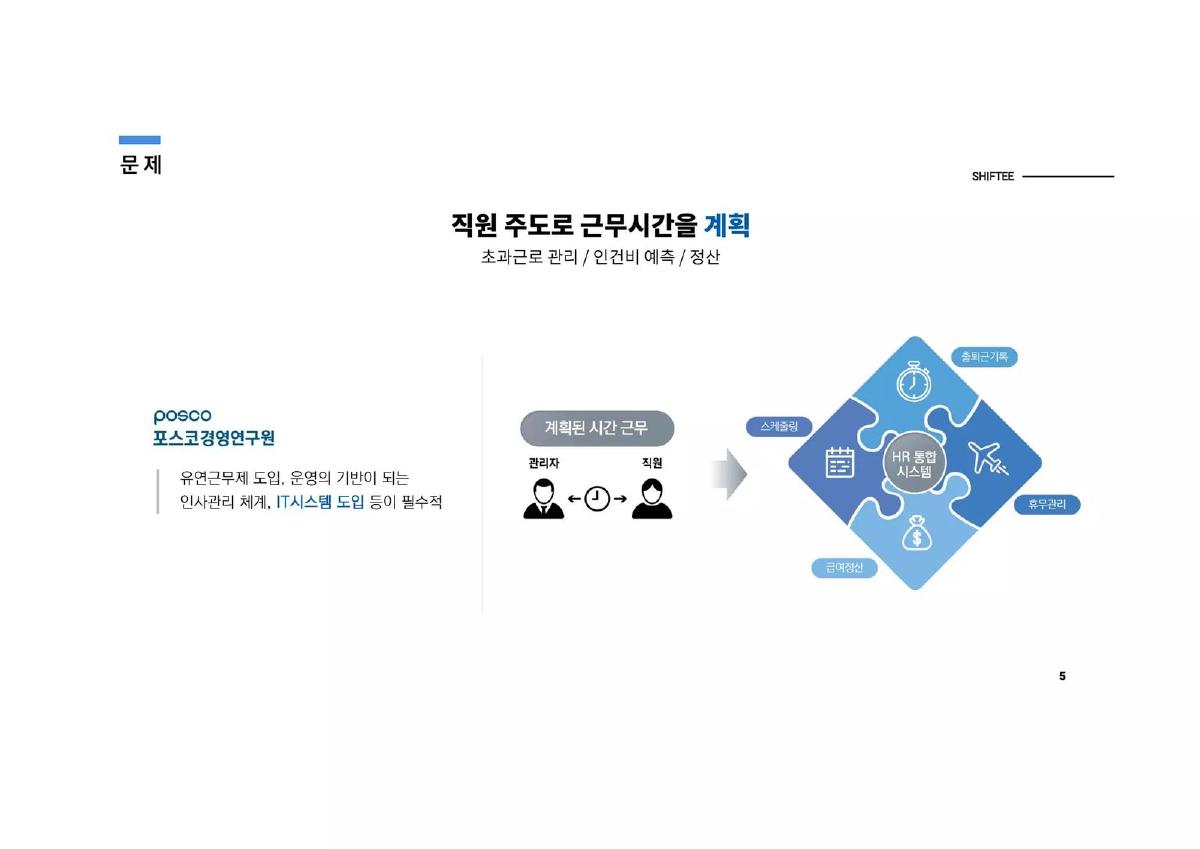
Slide 5 identifies the core operational challenge. It highlights a quote from the POSCO Research Institute stating that the introduction of flexible work systems requires an IT-based HR management system. The slide uses a puzzle-piece graphic to show how scheduling, attendance, leave management, and payroll must fit together into an "Integrated HR System." It emphasizes the shift from top-down management to a collaborative environment where managers and employees interact through a shared schedule.
Slide 9: Product Case Study
Slide 9 is a case study slide (though the specific content is redacted in this view). The use of case studies early in a deck is a strong move for Pre-Series A companies, as it proves the software works in a real-world environment. It moves the conversation from theoretical benefits to proven utility.
Slide 13: Market Drivers - The 52-Hour Work Week
This is the "Why Now?" slide, and it is the most important slide in the deck. It cites the South Korean government's implementation of the 52-hour work week. It notes that while large corporations are reacting, companies with fewer than 300 employees face a "serious" lack of systems to manage flexible work (selective, staggered, and discretionary work systems). Shiftee positions its scheduling-based attendance solution as the bridge between current chaos and regulatory compliance. The inclusion of news broadcast screenshots adds a sense of public urgency to the pitch.
Slide 17: Global Market Context
Shiftee shifts from the local Korean market to the global stage. Slide 17 describes the Workforce Management (WFM) and Time Tracking sector as an "attractive market" characterized by frequent M&A activity and the presence of giant corporations. This is a subtle signal to investors that there is a clear exit path through acquisition by a global player looking for a localized foothold in Asia.
Slide 21: Performance and Traction
The traction slide is exceptionally strong. It reports a Daily Active User (DAU) count of 10,000. More impressively, it claims a "Paid Conversion Rate of 90% or more." In the world of SaaS, a 90% conversion rate from trial to paid is nearly unheard of and serves as definitive proof that the product is solving a critical, painful problem that customers are willing to pay for immediately.
Slide 25: Expansion Strategy - India
Slide 25 focuses on international expansion, specifically targeting India. It cites a 2016 ZDNet article about India's dominance in the global outsourcing industry. By targeting India, Shiftee is looking at a market with a massive volume of shift-based workers, suggesting that their software is built for high-scale environments, not just small local offices.
Slide 29: The Team and Scale
The final slide in this set reveals the team's efficiency. With a "small team of 4 people" working for 1.5 years, Shiftee managed to serve over 20,000 workplaces across 20 countries. The team consists of a CEO, a Director, a Mobile/Web Developer, and a Content Designer. This slide demonstrates incredible capital efficiency and product-led growth; if four people can support 20,000 workplaces, the unit economics of the business are likely very attractive.
What Shiftee Does Well
Regulatory Alignment: The deck perfectly captures the "Why Now?" by tying the product's success to a specific change in labor law. This removes the need to convince investors that a market exists; the government created the market by mandate.
Efficiency Metrics: The 90% conversion rate is the star of the deck. It suggests that the product has achieved a level of product-market fit that most startups never reach. It also implies that the sales cycle is short and the product is easy to adopt.
Lean Operations: Showing that a team of four can manage 20,000 workplaces is a powerful testament to the scalability of the technology. It suggests that future investment will go toward growth and expansion rather than just maintaining the current user base.
What is Missing from the Deck
Financial Projections: While the deck mentions a high conversion rate, it does not provide specific revenue figures, Average Contract Value (ACV), or Lifetime Value (LTV) metrics. Investors would need to see how that 90% conversion translates into actual MRR (Monthly Recurring Revenue).
Competitive Comparison: While the deck mentions that the global market is attractive, it doesn't show a feature-by-feature comparison with local or global competitors like TSheets or Deputy. Explaining why Shiftee is better suited for the Korean (or Indian) market specifically would strengthen the case.
The Ask: The provided slides do not include a specific funding request or a breakdown of how the funds will be used. A standard IR deck should clearly state the amount being raised and the milestones that capital will help achieve.
Founder Takeaways
Identify the Catalyst: If your industry is being disrupted by a new law, a new technology standard, or a massive cultural shift, make that the centerpiece of your deck. It creates a sense of urgency that "better software" alone cannot. · Lead with Your Best Metric: Shiftee put their 90% conversion rate front and center. If you have one metric that is significantly above industry averages, don't bury it in the appendix. · Show, Don't Just Tell, Scalability: By listing their small team size alongside their large customer count, Shiftee proved their software is highly automated and scalable without needing to use the word "scalable" once.
Frequently asked questions
- What is the primary problem Shiftee solves?
- Shiftee addresses the complexity of managing employee work hours under strict labor regulations, specifically the 52-hour work week in South Korea. Slide 13 notes that many companies lack systems to manage flexible work arrangements, leading to severe management difficulties for firms with under 300 employees. Their solution automates scheduling, attendance recording, and payroll integration to ensure legal compliance and operational efficiency.
- How does Shiftee demonstrate product-market fit?
- The deck provides two powerful metrics: a Daily Active User (DAU) count of 10,000 and a paid conversion rate of over 90% (Slide 21). Converting 9 out of 10 trial users into paying customers is an exceptionally high benchmark for SaaS, suggesting that the pain point (regulatory compliance) is so acute that the software becomes a 'must-have' rather than a 'nice-to-have'.
- What is the competitive landscape for Shiftee?
- While specific local competitors aren't named in the provided slides, Slide 17 characterizes the global Workforce Management (WFM) and Time Tracking market as an 'attractive market where frequent M&A and giant corporations coexist.' This suggests Shiftee views itself as a potential acquisition target for global HR tech giants looking to enter the Asian market.
- How lean is the Shiftee team relative to their scale?
- The team is remarkably lean. Slide 29 reveals that the company reached 20,000+ workplaces and 20 countries with just 4 team members: a CEO, a Director, a Mobile/Web Developer, and a Content Designer. This indicates a highly scalable, product-led growth model where the software requires minimal manual intervention to onboard new clients.
- What is Shiftee's international expansion strategy?
- Shiftee looks beyond South Korea, specifically highlighting India as a target market (Slide 25). They cite India's dominance in the global outsourcing industry as a reason for expansion, suggesting that their time-tracking and scheduling tools are well-suited for large-scale service and BPO operations that require rigorous labor management.