Pressure BioSciences (PBIO) utilizes this 2017 investor presentation to position its Pressure Cycling Technology (PCT) as the essential standard for biological sample preparation. The deck focuses heavily on academic and clinical validation, citing partnerships with institutions like Cedars-Sinai and ETH Zurich to prove that their hardware—specifically the Barocycler line—outperforms traditional mechanical preparation methods. While the deck successfully establishes technical credibility through 100+ publications and a base of 275 installed systems, it lacks the standard financial projections…
Key takeaways
- The company identifies a multi-billion dollar market consisting of 500,000 scientists across 80,000 research labs worldwide (Slide 7).
- Pressure BioSciences claims to have a proven platform with approximately 275 PCT systems installed at roughly 150 sites (Slide 7).
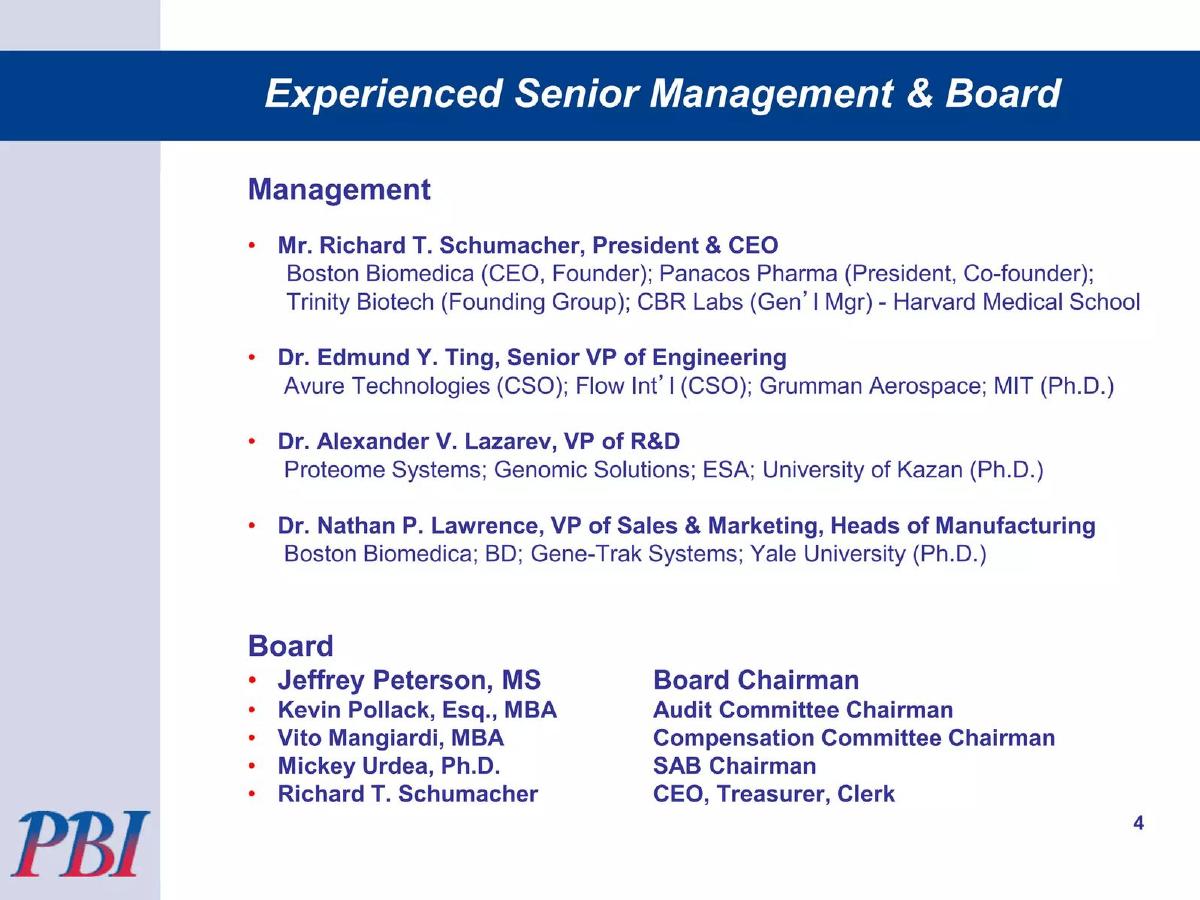
- The management team features significant academic and industry experience, including a CEO with history at Boston Biomedica and a VP of Engineering from MIT (Slide 4).
- The deck highlights the release of the Barocycler 2320 EXTREME as a core hardware offering alongside PCT-dependent kits and consumables (Slide 10).
- Clinical validation is a primary focus, citing research by Professor Jennifer Van Eyk on over 1 billion archived FFPE samples (Slide 13).
- The presentation emphasizes a high-profile alliance with the Children’s Medical Research Institute (CMRI) in Australia, linked to the US Cancer Moonshot (Slide 19).
- Technical superiority is claimed through 100+ publications that highlight the PCT platform's advantages over mechanical preparation methods (Slide 7).
- The deck omits standard financial metrics such as revenue growth, burn rate, or a specific capital raise amount, which are common in private equity pitches.
Pressure BioSciences: The 2017 Investor Deck Analysis
Pressure BioSciences, Inc. (OTCQB: PBIO) operates in the highly specialized niche of biological sample preparation. Their March 2017 investor presentation is a classic example of a life sciences deck that prioritizes technical validation and academic endorsement over the flashy growth metrics often seen in software pitches. The company aims to solve the 'bottleneck' of sample preparation, which they argue is the most critical step in the discovery of new biomarkers.
Slide 1: Title and Positioning
The cover slide establishes the company as a public entity (OTCQB: PBIO) and introduces the tagline: "Discovery Starts with Sample Preparation." This is a strategic choice; by positioning themselves at the very beginning of the research workflow, they argue that their technology is a prerequisite for all subsequent discovery work. The presentation is attributed to Richard T. Schumacher, the Founder, President, and CEO.
Slide 4: Experienced Senior Management & Board
This slide is heavy on credentials, which is vital for a biotech company. CEO Richard Schumacher’s history with Boston Biomedica and Trinity Biotech suggests a track record in the industry. The inclusion of Dr. Edmund Y. Ting (Senior VP of Engineering) is notable for his background at Avure Technologies and Flow International, companies known for high-pressure processing. The board section lists specific committee chairs (Audit, Compensation, SAB), signaling a structured corporate governance expected of a public company.
Slide 7: The Value Proposition
Slide 7 serves as the executive summary of the company's market thesis. It makes several bold claims:
Analysis of biomolecules is crucial to biomarker discovery, and quality depends on preparation. · The market is estimated at 500,000 scientists in 80,000 labs. · Current mechanical methods are labeled a "Bottleneck." · The platform is "Proven" with ~275 systems installed across ~150 sites. · 100+ publications support their claims.
This slide effectively combines the problem (inadequate preparation), the solution (PCT), and the traction (install base and publications) into a single view.
Slide 10: PCT Sample Preparation System
This is the product slide. It displays the hardware lineup, including the Barocycler NEP2320 and the "Just Released" Barocycler 2320 EXTREME. Crucially, it also shows the consumables: PULSE Tubes, MicroTubes, and PCT-dependent Kits. For an investor, this slide represents the revenue engine. The variety of tubes and kits suggests a recurring revenue model where the sale of one Barocycler leads to years of consumable purchases.
Slide 13: Biomarker Discovery Validation
To prove the efficacy of their high-pressure approach, the company uses a case study from Professor Jennifer Van Eyk at Cedars-Sinai Medical Center. The slide focuses on FFPE (formalin-fixed paraffin-embedded) samples, noting there are over 1 billion such samples archived. The "Conclusion" section states that the combination of heat and elevated pressure increased protein yield, making rare samples "invaluable" for discovery. This targets a specific, massive pain point in pathology: extracting usable data from old, preserved tissue.
Slide 16: Personalized Medicine and Proteome Maps
The deck moves from general research to the high-growth area of personalized medicine. Featuring Professor Ruedi Aebersold of ETH Zurich, the slide discusses "PCT-SWATH." The claim here is that the technology can convert tissue biopsies into "permanent quantitative digital proteome maps." By citing Nature Medicine (March 2015), the company leverages the highest level of peer-reviewed credibility to suggest that clinical adoption is the ultimate trajectory for the technology.
Slide 19: The CMRI Alliance and Cancer Moonshot
This slide provides a concrete example of large-scale commercial and clinical application. The alliance with the Children’s Medical Research Institute (CMRI) in Australia is linked to the US Cancer Moonshot initiative. The metrics provided are specific: CMRI will test 70,000 tumor samples and has purchased 3 Barocyclers plus consumables. The quote from Dr. Phil Robinson emphasizes that PCT allows for the analysis of samples as small as those provided by needle biopsies, which is a significant technical advantage in clinical settings.
What Works in This Deck
Third-Party Validation: The deck relies heavily on external experts. By featuring professors from Cedars-Sinai and ETH Zurich, Pressure BioSciences lets the customers do the selling. This is highly effective in scientific sectors where a founder's claims are viewed with skepticism until verified by the academic community.
Clear Problem Identification: Identifying sample preparation as a "bottleneck" (Slide 7) is a strong narrative hook. It frames the company not just as a hardware manufacturer, but as a solution to a systemic delay in the multi-billion dollar life sciences industry.
Product Breadth: Slide 10 clearly shows that this is a complete ecosystem. Investors can see the hardware, the specialized containers (PULSE tubes), and the chemical kits, which points toward a sustainable business model beyond one-off equipment sales.
What Is Missing from This Deck
Financial Transparency: As a public company, one might expect a summary of recent quarterly performance or a revenue growth chart. The deck is entirely silent on the company's actual financial health, revenue figures, or burn rate. While these are in SEC filings, their absence here makes it difficult to assess the business's commercial momentum.
Competitive Landscape: The deck mentions that current methods are "mostly mechanical," but it does not name competitors or provide a head-to-head comparison on cost, speed, or yield. Investors are left to wonder who else is trying to solve the sample prep bottleneck and how PBIO's patents hold up against them.
The "Ask": There is no slide detailing what the company is looking for from investors. Is this a pitch for a specific PIPE (Private Investment in Public Equity) deal? Is it a general awareness deck? Without a clear "Ask" or "Use of Funds" slide, the presentation feels more like a technical briefing than a fundraising tool.
Founder's Guide: What to Copy
The Case Study Format: Slides 13 and 16 are excellent templates for technical founders. Instead of just listing features, they show a photo of a high-profile user, list their credentials, state the specific problem they faced (e.g., low yield from FFPE samples), and provide the validated conclusion. This builds trust far faster than a list of specs.
Linking to Macro Trends: Slide 19 successfully hitches the company's wagon to a major government initiative (The Cancer Moonshot). If your startup aligns with a major national or global priority, make that connection explicit. It provides a sense of urgency and scale that internal metrics alone cannot convey.
Visualizing the Ecosystem: Slide 10 is a great example of how to show a complex product line. By grouping the main unit with its necessary accessories and consumables, the company visually communicates its entire value chain in one glance. Founders with a "razor/blade" model should always include a slide that shows both the razor and the blades together.
Frequently asked questions
- What is the core technology behind Pressure BioSciences?
- The core technology is Pressure Cycling Technology (PCT). According to Slide 7, this platform is used for the preparation of biological samples (DNA, RNA, proteins, and lipids). The company argues that current mechanical methods are a 'bottleneck' and that PCT provides higher quality results for biomarker discovery and personalized medicine.
- Who are the key members of the leadership team?
- As shown on Slide 4, the team is led by Founder, President, and CEO Richard T. Schumacher, who previously founded Boston Biomedica. Other key executives include Dr. Edmund Y. Ting (Senior VP of Engineering, formerly of Avure Technologies and Flow Int’l) and Dr. Alexander V. Lazarev (VP of R&D).
- What evidence of market traction does the deck provide?
- Traction is demonstrated through hardware placement and academic validation. Slide 7 notes approximately 275 PCT systems installed at 150 sites and over 100 publications. Slide 19 highlights a specific commercial alliance where the CMRI purchased 3 Barocyclers and consumables to test 70,000 tumor samples.
- How does the company address the 'Personalized Medicine' trend?
- The company positions its PCT-SWATH method as a bridge to clinical adoption. Slide 16 features Professor Ruedi Aebersold of ETH Zurich, stating that the technology allows for the conversion of tissue biopsy samples into permanent quantitative digital proteome maps, which is essential for personalized treatment.
- What is the business model based on the slides provided?
- While not explicitly detailed in a 'Business Model' slide, the product mix on Slide 10 suggests a 'razor and blade' strategy. The company sells high-end hardware (Barocycler 2320 EXTREME) and recurring consumables (PULSE Tubes, MicroTubes, and PCT-dependent Kits).