Pricecut is a web platform designed to aggregate deals and compare prices across major Indian e-commerce portals like Flipkart, Amazon, and Snapdeal. The deck identifies a clear consumer pain point—the 'fuss' caused by numerous shopping portals—and proposes a solution centered on saving time and money. While the deck provides specific market validation figures for the broader Indian e-commerce sector, such as 26 million unique visitors and 220cr daily GMV, it struggles to differentiate between these macro market stats and the startup's actual traction. The business model is highly granular, p…
Key takeaways
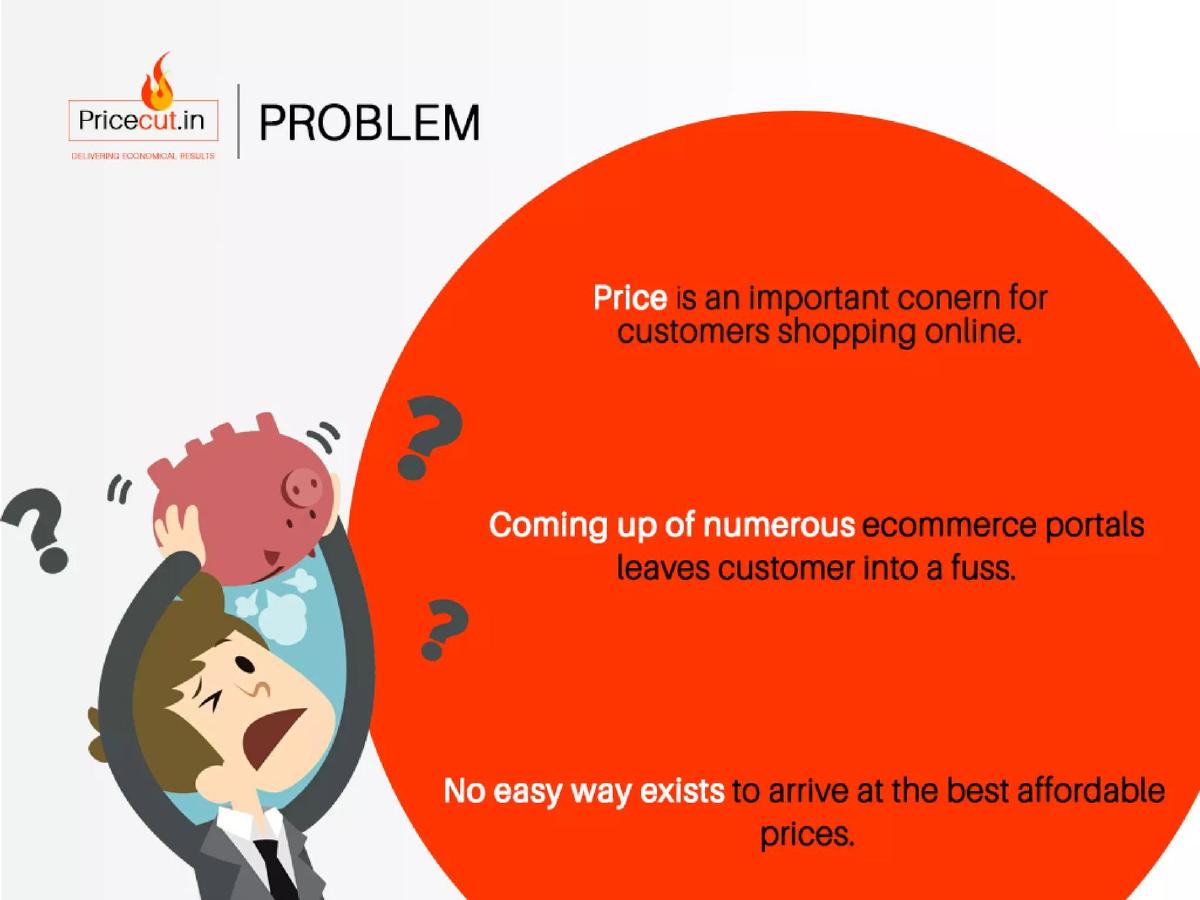
- The problem slide identifies that the proliferation of e-commerce portals leaves customers in a 'fuss' regarding price affordability (Slide 2).
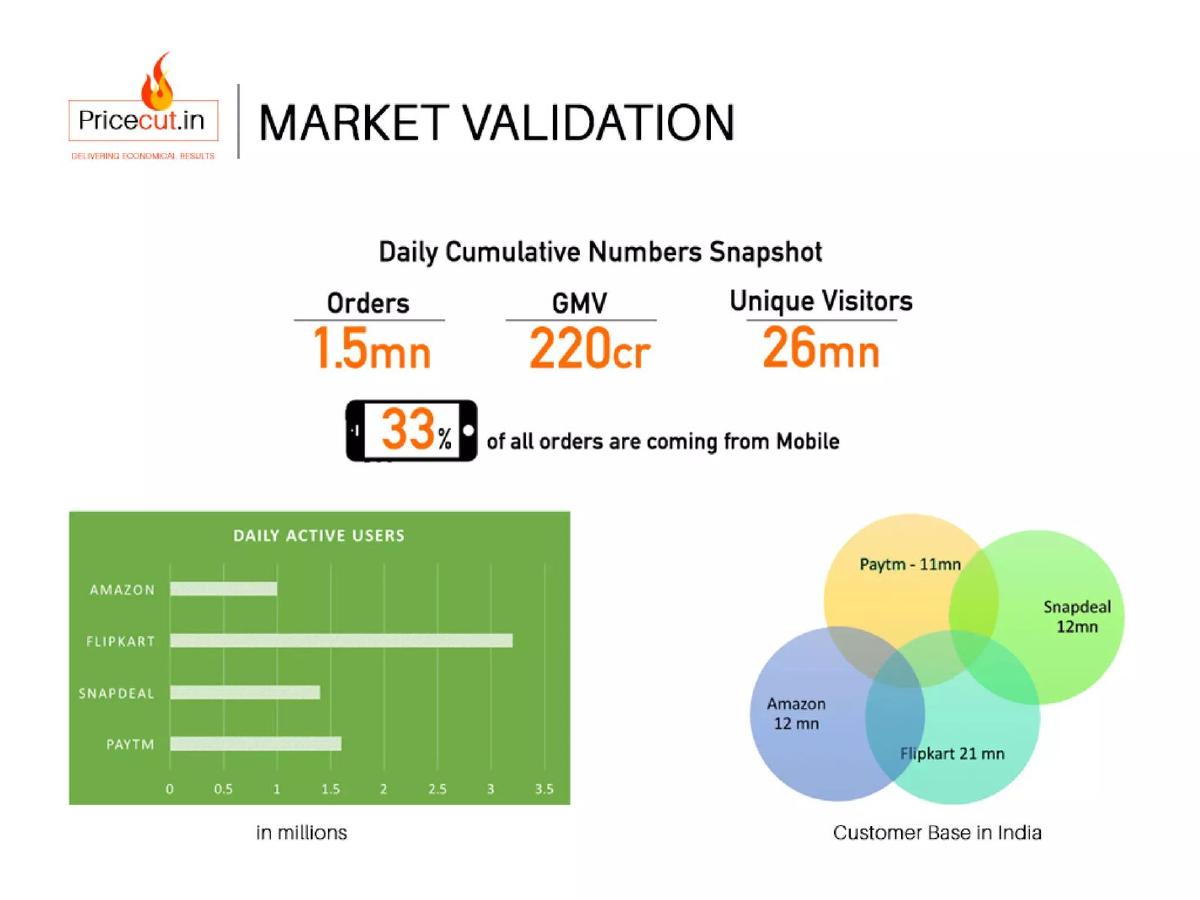
- Market validation data cites 1.5 million daily orders and 220cr daily GMV for the Indian e-commerce sector (Slide 4).
- The deck claims that 33% of all e-commerce orders in India are coming from mobile devices (Slide 4).
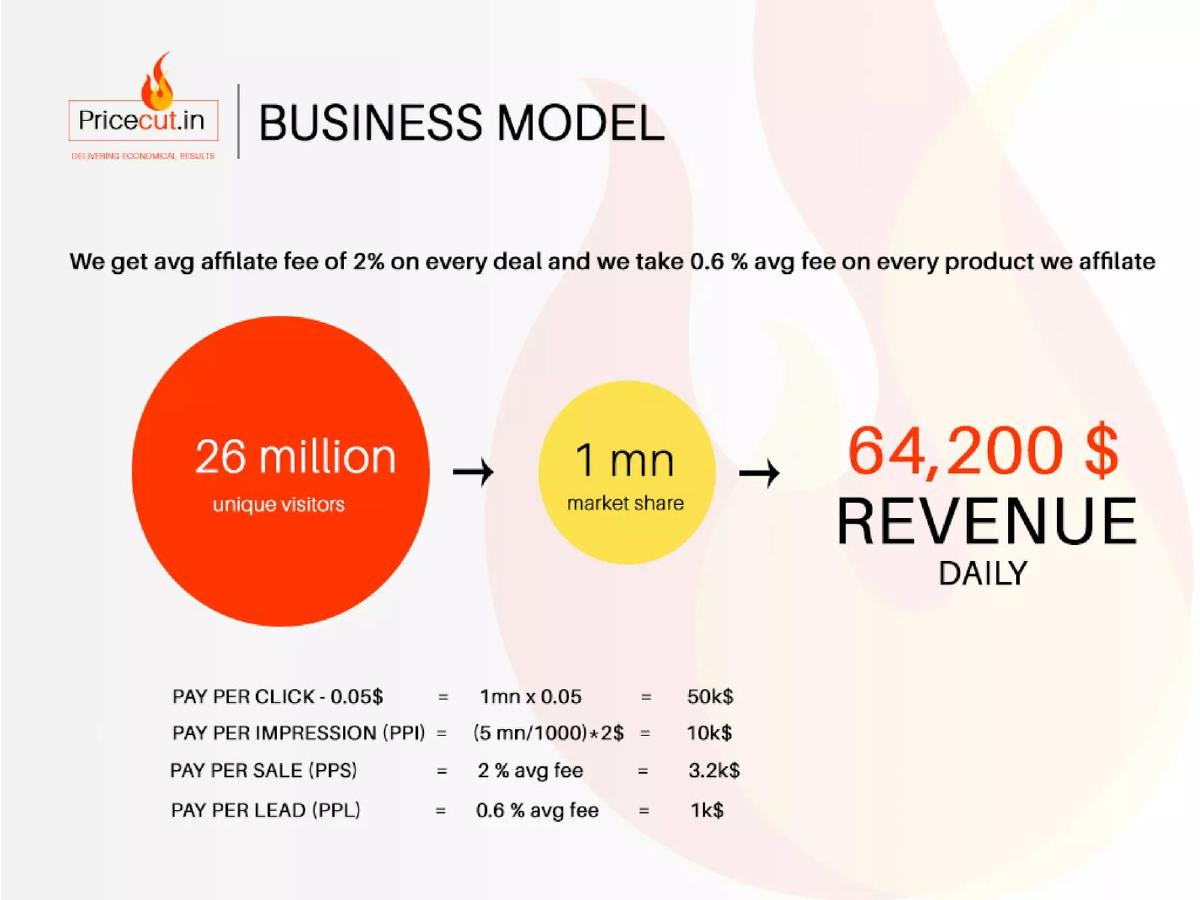
- The business model relies on four revenue streams: Pay Per Click, Pay Per Impression, Pay Per Sale, and Pay Per Lead (Slide 6).
- Daily revenue is projected at $64,200 based on achieving a market share of 1 million visitors (Slide 6).
- The Go-To-Market plan consists of a linear five-step process starting with social media and ending with accelerated traffic (Slide 7).
- The founding team is categorized by the 'Hustler, Hacker, Hipster' framework: Varun Satyam, Arun Kumar, and Jayanth (Slide 8).
- The deck completely omits a financial ask, use of funds, or current company traction metrics (Slides 1-9).
Pricecut Pitch Deck Analysis
Pricecut is a price comparison and deal aggregation platform targeting the Indian e-commerce market. The deck is brief, consisting of 9 slides that follow a standard, if somewhat dated, presentation flow. It relies heavily on large-scale market statistics to imply opportunity but lacks the specific company-level data required to prove product-market fit.
Slide 1: Title Slide
The cover slide features the Pricecut.in logo, which incorporates a flame icon. The tagline 'DELIVERING ECONOMICAL RESULTS' is positioned below the brand name. The use of a .in domain immediately signals a focus on the Indian domestic market.
Slide 2: The Problem
The problem slide uses a cartoon illustration of a frustrated consumer holding a piggy bank. It identifies three core issues: price as a primary concern for online shoppers, the 'fuss' created by the emergence of numerous e-commerce portals, and the lack of an easy way to find the most affordable prices. The slide uses the word 'conern,' which is a typographical error for 'concern.'
Slide 3: The Solution
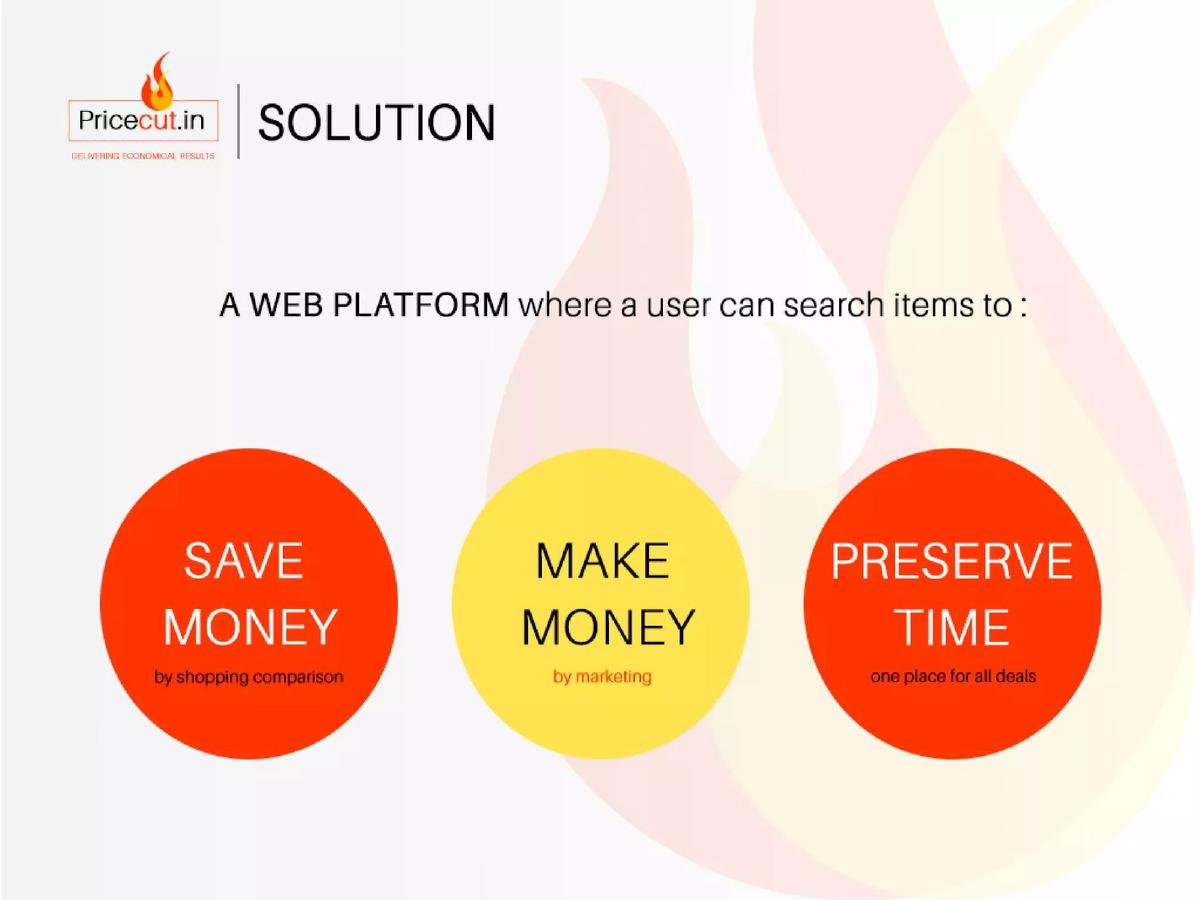
The solution is described as a 'WEB PLATFORM' where users can perform three actions: Save Money (comparison), Make Money (marketing), and Preserve Time (deal aggregation). The 'Make Money' aspect is mentioned but not explained in detail on this slide, leaving a gap in how the user actually earns income through the platform.
Slide 4: Market Validation
This slide provides macro-level data for the Indian e-commerce ecosystem rather than Pricecut's specific performance. It lists daily cumulative numbers: 1.5 million orders, 220cr GMV, and 26 million unique visitors. A bar chart shows Daily Active Users (DAU) for competitors, with Flipkart leading at over 3 million, followed by Paytm, Snapdeal, and Amazon. A Venn diagram illustrates the customer base overlap, though the specific intersection numbers are not provided. The slide also notes that 33% of orders originate from mobile devices.
Slide 5: Product Workflow
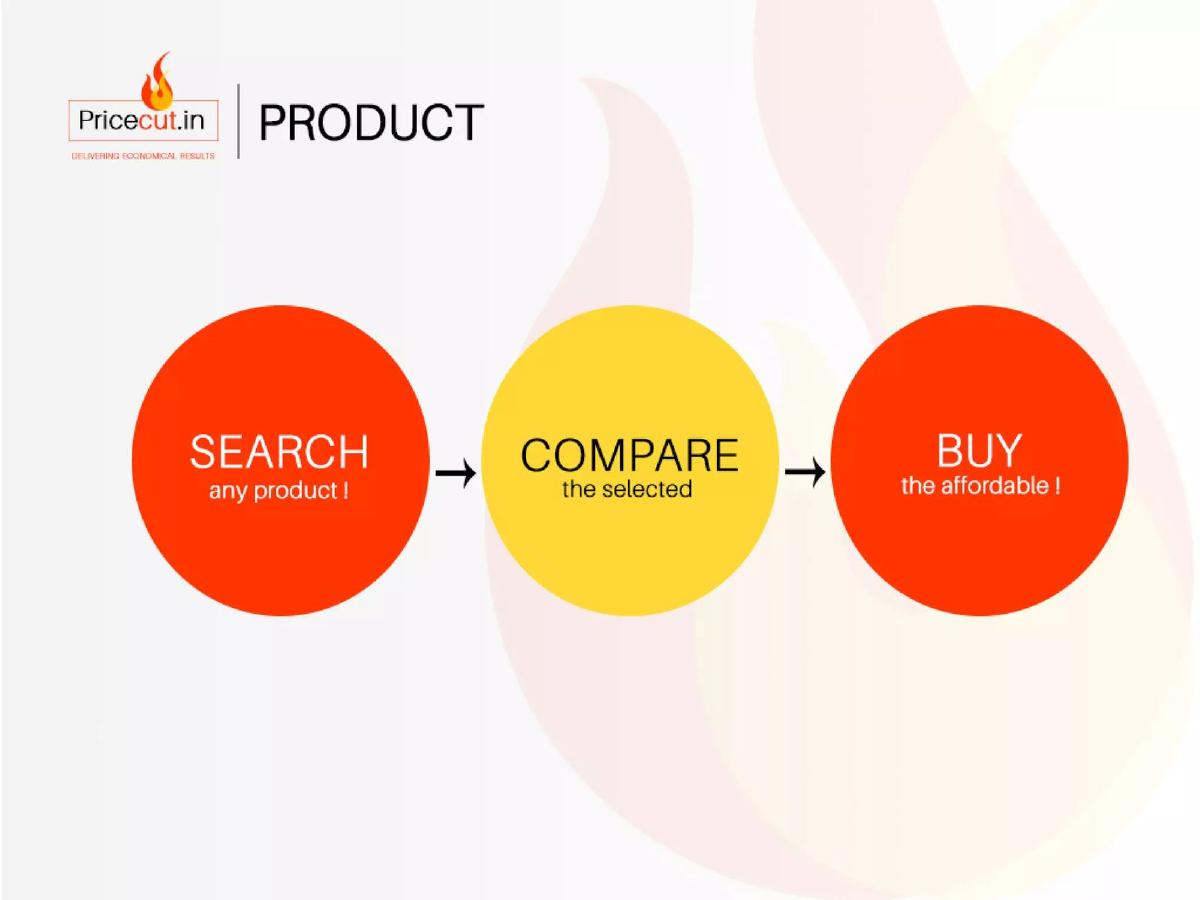
The product slide is highly simplified, showing a three-step linear process: Search (any product), Compare (the selected), and Buy (the affordable). There are no screenshots of the actual user interface or the technology backend, which makes it difficult to assess the maturity of the product.
Slide 6: Business Model
This is the most detailed slide in the deck, providing a breakdown of projected daily revenue. The company calculates a daily revenue of $64,200 based on a hypothetical 1 million visitor market share (out of the 26 million total visitors mentioned in Slide 4). The breakdown includes:
Pay Per Click (PPC): $50,000 (1mn x $0.05) · Pay Per Impression (PPI): $10,000 (5mn impressions at $2 CPM) · Pay Per Sale (PPS): $3,200 (2% average fee) · Pay Per Lead (PPL): $1,000 (0.6% average fee)
The slide also notes an average affiliate fee of 2% on deals and 0.6% on products.
Slide 7: Go To Market Plan
The GTM strategy is presented as a winding path with five steps: 1. Social Media Campaigns, 2. Search Engine Optimisation, 3. Get Market Response & Analyse, 4. Optimise & Add New Features, and 5. Accelarate Sales & Traffic. This is a generic roadmap that lacks specific channels, budget allocations, or timeline milestones.
Slide 8: Team
The team slide introduces Varun Satyam, Arun Kumar, and Jayanth. They are assigned the roles of 'Hustler,' 'Hacker,' and 'Hipster,' respectively. This is a common startup trope, but the slide fails to provide any professional credibility, such as past companies, technical expertise, or academic background.
Slide 9: Conclusion
The final slide is a simple 'THANK YOU' with the company logo and tagline. There is no contact information, website link, or call to action provided on this slide.
What Pricecut Does Well
The deck identifies a very real and growing pain point in the Indian market during the mid-2010s e-commerce boom. By focusing on price sensitivity, they are targeting the primary driver of consumer behavior in that region. The business model slide is also commendable for its specificity; even if the numbers are projections, it shows the founders have thought through the various levers of affiliate monetization (PPC, PPI, PPS, PPL).
What is Missing from the Deck
The most glaring omission is the lack of a funding ask. Investors need to know how much money is being raised and what milestones that capital will achieve. Additionally, there is no mention of current traction. Without knowing if the site has 10 visitors or 10,000, the $64,200 daily revenue projection feels like a 'spreadsheet exercise' rather than a realistic forecast. The deck also lacks a competitive landscape slide, which is essential in the crowded aggregation space, and the team slide provides no evidence that these three individuals are the right people to execute this vision.
Founder Takeaways
Avoid Macro-Data Confusion: Founders should never present market-wide statistics (like the 26 million visitors on Slide 4) in a way that could be confused with their own company's traction. Always clearly label what is 'Market Size' versus 'Current Performance.' Show the Product: A 'Product' slide that only contains three circles with the words 'Search, Compare, Buy' (Slide 5) adds no value. Investors want to see the UI/UX, the unique features, or the data scraping capabilities that make the tool better than a Google search. Professionalize the Team Slide: While the 'Hustler/Hacker/Hipster' labels are a fun internal shorthand, a pitch deck needs to highlight actual achievements. Mentioning that the 'Hacker' has five years of experience in Python or that the 'Hustler' previously grew a user base to 100k is far more persuasive than a creative title.
Frequently asked questions
- What is Pricecut's primary value proposition?
- According to Slide 3, Pricecut is a web platform that allows users to search items to save money via shopping comparison, make money through marketing, and preserve time by acting as a single destination for all deals. It aims to simplify the decision-making process for Indian online shoppers who are overwhelmed by the number of available e-commerce portals.
- How does the company plan to generate revenue?
- Slide 6 details a multi-pronged affiliate model. It projects $50,000 from Pay Per Click ($0.05 per click), $10,000 from Pay Per Impression ($2 per 1000 impressions), $3,200 from Pay Per Sale (2% average fee), and $1,000 from Pay Per Lead (0.6% average fee). This results in a total daily revenue target of $64,200.
- What market data does the deck use to justify the opportunity?
- Slide 4 provides a 'Daily Cumulative Numbers Snapshot' for the Indian market, showing 26 million unique visitors and a customer base distributed across major players: Flipkart (21mn), Amazon (12mn), Snapdeal (12mn), and Paytm (11mn). It also highlights that Flipkart leads in daily active users at over 3 million.
- Who are the founders of Pricecut?
- Slide 8 introduces three founders: Varun Satyam (labeled as the 'Hustler'), Arun Kumar (the 'Hacker'), and Jayanth (the 'Hipster'). The slide includes their photographs but does not provide any information regarding their previous work experience, education, or specific roles within the company beyond these archetypal labels.
- What is missing from the Pricecut pitch deck?
- The deck is missing several critical components for a professional fundraise. There is no 'Ask' slide indicating how much capital is being raised or how it will be spent. It lacks a competitive analysis against other price aggregators. Most importantly, it does not show current traction, making the $64,200 daily revenue figure appear purely theoretical.