Eco World’s deck, presented by Magic Turtle Holdings in 2015, outlines an ambitious plan to build the 'world’s first eco theme park.' Spanning 2,750 total acres, the project includes a theme park, animal sanctuary, and eco-village. While the deck successfully identifies a $290 billion LOHAS (Lifestyles of Health and Sustainability) market and leverages the concept of 'edutainment,' it suffers from significant structural flaws. The deck lacks a concrete team slide (using a template placeholder instead), provides no financial projections, and offers no specific funding ask. It relies heavily on…
Key takeaways
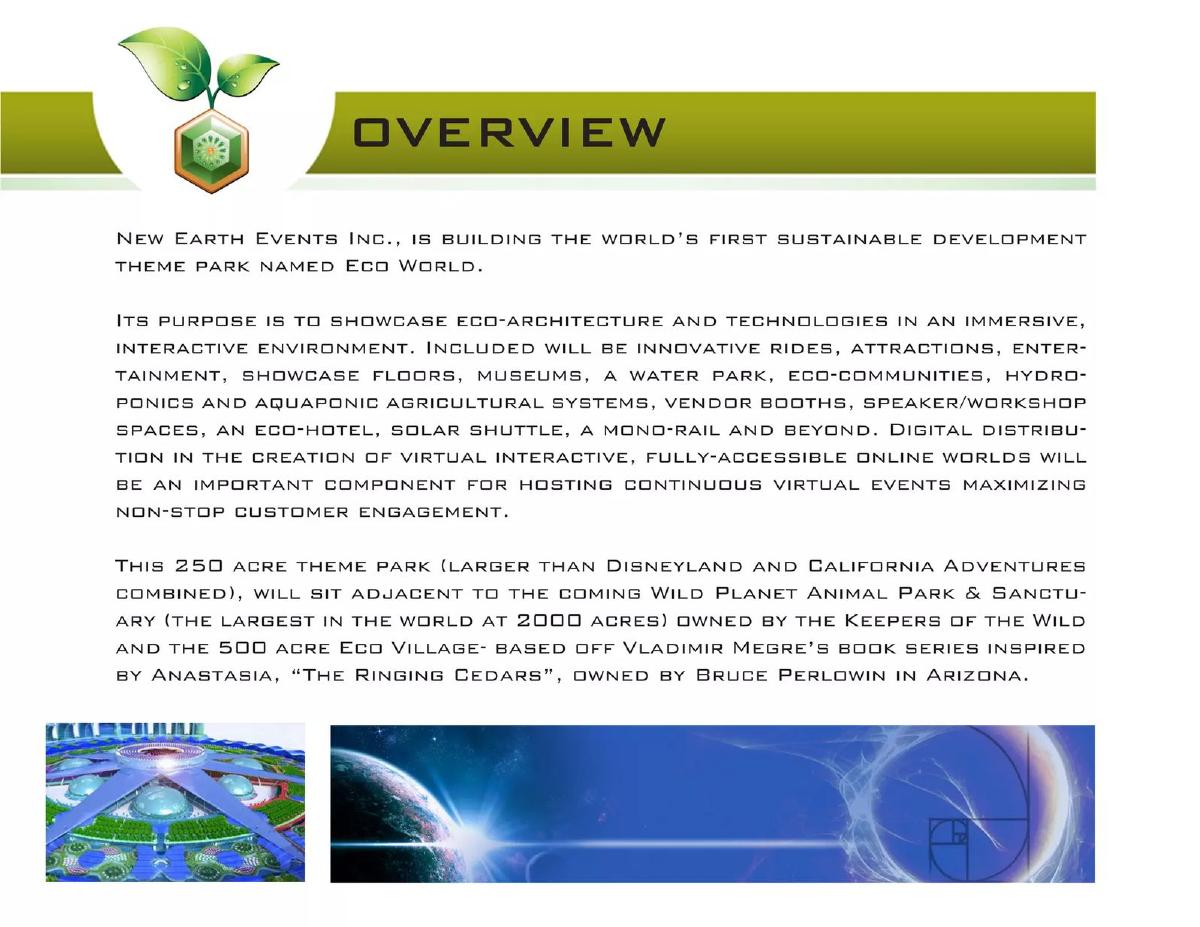
- The project scope is massive, proposing a 250-acre theme park, a 500-acre eco-village, and a 2,000-acre animal sanctuary (Slide 3).
- Eco World targets the LOHAS market, which it values at $290 billion in the U.S., specifically focusing on the $42 billion eco-tourism segment (Slide 4).
- The deck defines its core audience as 'Cultural Creatives,' a demographic estimated at 50 million people based on sociological research (Slide 4).
- The 'Team' slide is a placeholder containing instructional text rather than actual names or biographies of the founders (Slide 7).
- The development timeline spans from 2015 to 2020, including ambitious features like a 'Virsoa Space Ship' and 'Interactive Free Energy Sculptures' (Slide 10).
- The presentation includes images of E.P.C.O.T. and Disney’s Avatar attraction as competitive benchmarks rather than direct competitors (Slide 6).
- The deck proposes a 'Holocracy Model' for organizational structure but provides no details on how this applies to a construction-heavy project (Slide 7).
- There is a complete absence of financial data, including projected costs, revenue models, or a specific capital requirement (Omission).
Eco World: A Visionary Concept in Search of a Business Plan
The Eco World investor deck, dated August 28, 2015, and presented by Magic Turtle Holdings, represents a classic 'visionary' pitch. It attempts to bridge the gap between environmental activism and large-scale commercial entertainment. While the aesthetic is consistent and the market research is grounded in established sociological terms, the deck fails to address the fundamental questions of a real estate and infrastructure investment: cost, risk, and return.
Slide 1: Title and Branding
The cover slide introduces the company name, Eco World, with a logo featuring a faceted green sphere flanked by leaves and a gold-toned frame. It is explicitly labeled as a 'Phase 1 Investor Presentation.' Notably, the deck was designed by Davin Skonberg and presented by Magic Turtle Holdings. The date (8/28/15) places this project in a pre-pandemic era where large-scale physical 'experience' centers were seeing a surge in interest.
Slide 2: The Problem
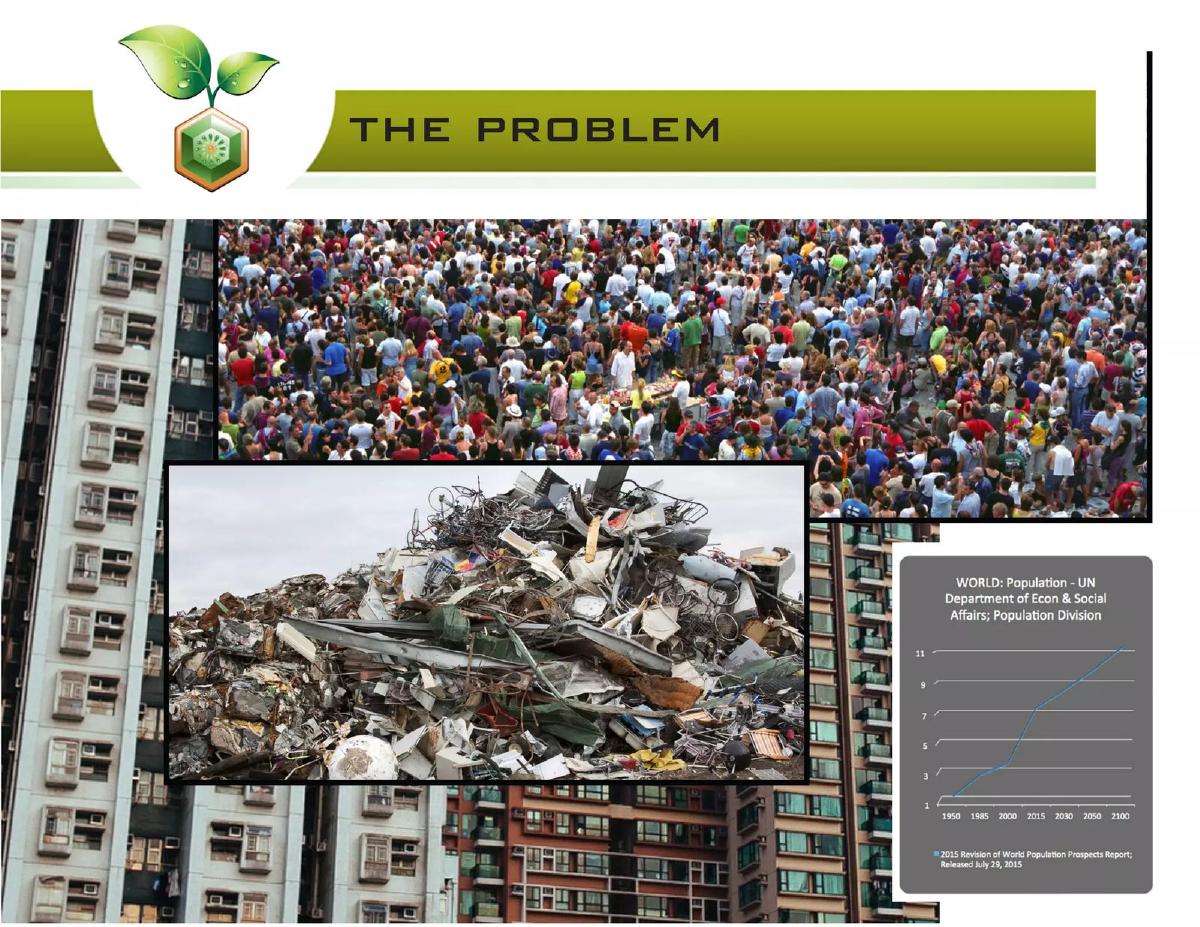
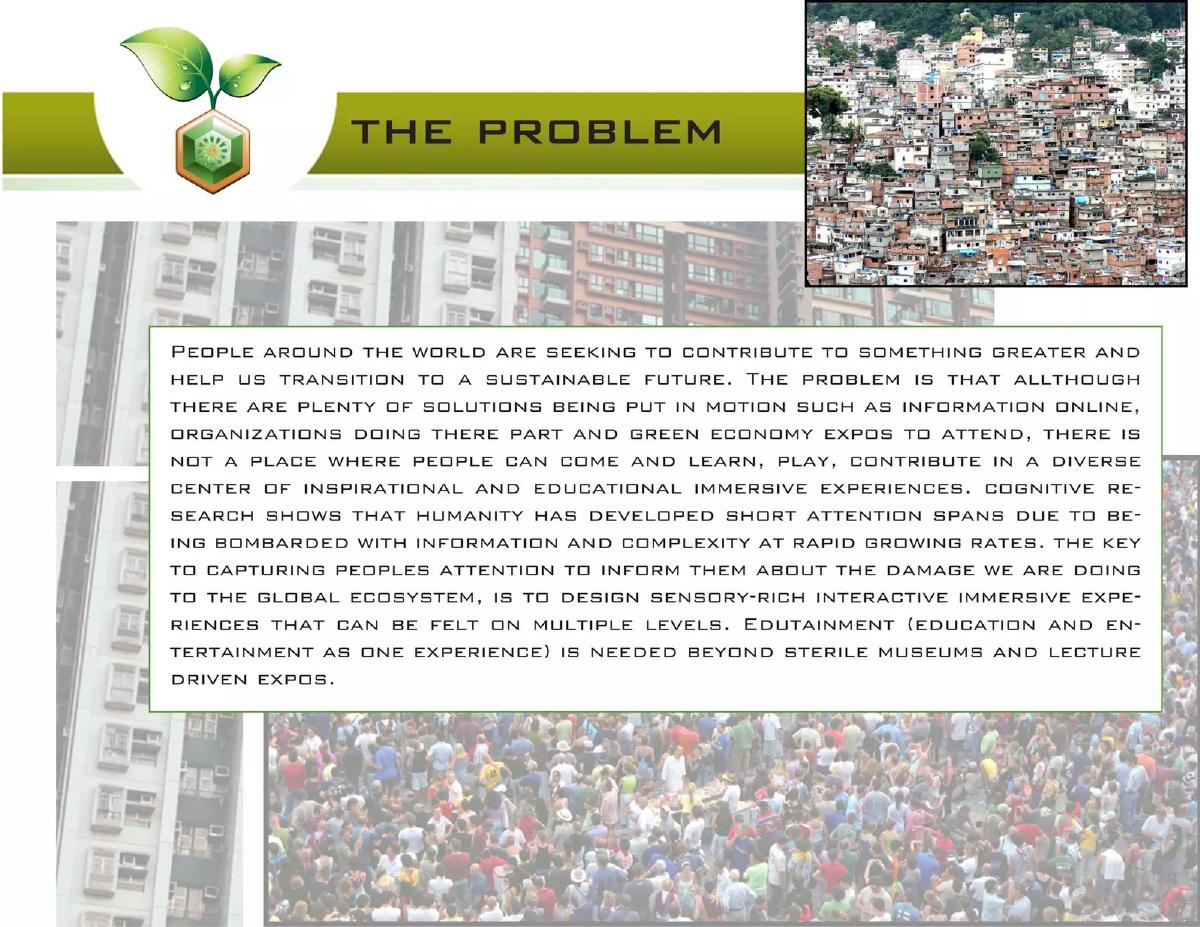
The problem statement is lengthy and philosophical. It argues that while people want to contribute to a sustainable future, there is 'not a place where people can come and learn, play, contribute in a diverse center of inspirational and educational immersive experiences.' The slide cites 'cognitive research' regarding short attention spans and argues that 'edutainment' is the solution to inform the public about ecosystem damage. The imagery contrasts a crowded urban favela with a dense crowd, highlighting the disconnect between modern living and nature.
Slide 3: The Value Proposition
This slide defines the physical scope of the project. It is an ambitious 2,750-acre proposal consisting of:
250 Acre Theme Park · 500 Acre Eco-Village & School · 2000 Acre Animal Sanctuary · Social Entrepreneur Academy · Theater & Conference Center · Hotel & Spa
The slide uses the phrase 'World’s First Eco Theme Park' to establish a unique selling proposition, focusing on 'Innovation, Solutions, and Hands on Demos.'
Slide 4: The Market Opportunity
Eco World leans heavily on the LOHAS (Lifestyles of Health and Sustainability) market segment. It quotes a $290 billion U.S. marketplace and identifies a specific $42 billion 'Eco Tourism' niche. The slide also references 'The Cultural Creatives,' a book by Paul H. Ray and Sherry Ruth Anderson, to segment their target audience into 'Core' and 'Green' subdivisions. This is the most data-driven slide in the deck, providing a clear demographic target for the proposed park.
Slide 5: Technology and Permaculture
This slide is a collage of concepts. It features a 'Permaculture' wheel covering Soil, Food, Shelter, Energy, Ethics, Climate, and Water. It also includes a diagram of 'Zero Energy or Waste Homes' and a futuristic graphic labeled 'Transmedia Storyworld.' The inclusion of a photo of the Biosphere 2 facility in Arizona suggests the architectural inspiration for the project, though it is not explicitly labeled as such.
Slide 6: Competitive Landscape
Rather than listing direct competitors, this slide lists 'inspirations.' It mentions E.P.C.O.T. Center as a 'Prototype City of Tomorrow' and Disney’s 'Avatar - Experience the Living World of Pandora.' The text suggests that Eco World will move from 'disparate competition to a unified understanding.' By citing Disney, the founders are setting a very high bar for execution and capital expenditure without explaining how they will achieve that scale.
Slide 7: The Team (Placeholder)
This is the most significant red flag in the deck. The slide titled 'The Team' contains only instructional text: 'Emphasize what YOU bring to the table,' 'Who’s on the team,' and 'Holocracy Model.' It appears the founders failed to fill out this slide before publishing or presenting. In fundraising, the team is often the most important factor; leaving this as a template suggests a lack of preparation or a lack of a formal team.
Slide 8: Development Phase 2
This slide shows photos of organic, dome-like architecture under construction. The images show rebar frameworks and finished concrete curves. These photos provide the only evidence that some form of physical prototyping or construction has taken place, though the location and scale of these structures are not disclosed.
Slide 9: Other Platforms
Eco World proposes additional revenue streams and functions, including an R&D Headquarters with a 'Fabrication Lab' for 3D and 4D printing, a 'Social Entrepreneur Academy' offering 2-week bootcamps, and a 'Communication Design & Consulting Team.' This suggests a multi-faceted business model that goes beyond ticket sales, though it risks appearing unfocused.
Slide 10: Development Phase 3: 2020
The final slide in this selection shows a complex honeycomb of attractions planned for 2020. These include a 'Virsoa Space Ship,' 'Mermaid Lagoon,' 'Volcano Sauna,' and 'Interactive Free Energy Sculptures.' A vertical timeline on the right side lists years from 2015 to 2020 but provides no text for the milestones achieved in those years. It concludes with a '20 Year Foresight' header that is left blank.
What Eco World Does Well
The deck is visually cohesive and successfully taps into a growing cultural trend toward sustainability and 'transformative travel.' By identifying the LOHAS market and 'Cultural Creatives,' the founders show they understand who their customer is. The use of 'edutainment' as a core concept is a strong way to differentiate a theme park from a traditional museum or a standard amusement park. The scale of the vision—2,750 acres—is certainly enough to capture an investor's imagination.
Critical Omissions and Red Flags
The omissions in this deck are catastrophic for a professional fundraise. First and foremost is the Team slide. Presenting a slide that still contains template instructions ('Emphasize what YOU bring to the table') is a disqualifying error. It signals to investors that the deck is unfinished or that the founders are not detail-oriented.
Second is the lack of a financial 'Ask.' There is no mention of how much money is being raised, the valuation, or how the funds will be used. For a project involving 2,750 acres and complex architecture, the capital requirements would be in the hundreds of millions, if not billions, of dollars. The absence of a budget or a 'Use of Funds' slide makes the project feel like a dream rather than a business.
Third is the lack of Unit Economics. How much does a ticket cost? What is the projected occupancy for the hotel? What is the cost per square foot for the eco-village? Without these numbers, the 'Market Opportunity' slide is just a collection of large numbers that have no direct connection to the business's potential profitability.
What Founders Should Copy
Founders can learn from the way Eco World segments its audience. Instead of saying 'everyone who likes the environment,' they used specific sociological research (Cultural Creatives) and a defined market segment (LOHAS). This allows for much more targeted marketing and partnership strategies. Additionally, the conceptual grouping of attractions (Slide 10) is a good way to visualize a complex product offering, even if the specific attractions in this deck are highly speculative.
Final Analysis
The Eco World deck is a 'Phase 1' concept piece that fails to transition into a viable investment vehicle. While the vision is grand and the market timing (in 2015) was appropriate, the lack of a team, a budget, and a clear path to revenue makes it unactionable. For a project of this magnitude, investors require a rigorous breakdown of land acquisition costs, zoning hurdles, and construction timelines—none of which are present here. The placeholder 'Team' slide remains the most glaring example of a pitch that was not ready for the room.
Frequently asked questions
- What is the primary product Eco World is selling?
- Eco World is proposing a large-scale physical destination described as the 'world’s first eco theme park.' According to slide 3, this includes a 250-acre theme park, a 500-acre eco-village and school, a 2,000-acre animal sanctuary, and a hotel and spa. The goal is to combine 'edutainment' with sustainable living demonstrations.
- Who are the 'Cultural Creatives' mentioned in the deck?
- As detailed on slide 4, 'Cultural Creatives' are a demographic subdivision identified by sociologist Paul H. Ray. The deck splits them into 'Core' (educated, leading-edge thinkers) and 'Green' (more secular and extroverted). Eco World views these 50 million individuals as their primary target market for eco-tourism.
- Does the deck provide a clear roadmap for construction?
- Slide 10 provides a high-level development timeline from 2015 to 2020. However, it lacks specific milestones. It lists various attractions like a 'Volcano Sauna' and 'Solar City' under 'Phase 3 : 2020,' but does not explain the logistical or financial steps required to reach these goals.
- What is missing from the Eco World team slide?
- Everything. Slide 7 is a template page that still contains the prompts: 'Emphasize what YOU bring to the table,' 'Who’s on the team,' and 'How do all team members contribute?' It lists no actual people, which is a critical failure for an investor presentation.
- How does Eco World plan to generate revenue?
- The deck implies revenue through tourism, a hotel/spa, and a 'Social Entrepreneur Academy' (Slide 3). Slide 9 also mentions a 'Communication Design & Consulting Team' and a 'Fabrication Lab' for consulting with other companies. However, there are no specific pricing models or revenue projections included in the slides.