EcoCompass presents a marketplace model designed to bridge the gap between residential/commercial consumers and the complex world of energy efficiency products and government incentives. The deck, likely produced around 2011 or early 2012, leans heavily on the regulatory tailwinds of the American Recovery and Reinvestment Act of 2009. While it identifies a clear pain point—market fragmentation—the presentation lacks a specific team slide or technical breakdown of its 'proprietary technology.' The financial projections are aggressive, targeting a jump from $597,256 in revenue in 2012 to over $…
Key takeaways
- The company identifies a fragmented market consisting of eight distinct groups, including installers, retailers, and government agencies (Slide 2).
- EcoCompass uses a 'power of scale' argument, claiming that one Energy Star bulb per US home saves enough energy to take 800,000 cars off the road (Slide 3).
- The business model is heavily reliant on government policy, specifically citing $46 billion in funding from the American Recovery and Reinvestment Act of 2009 (Slide 4).
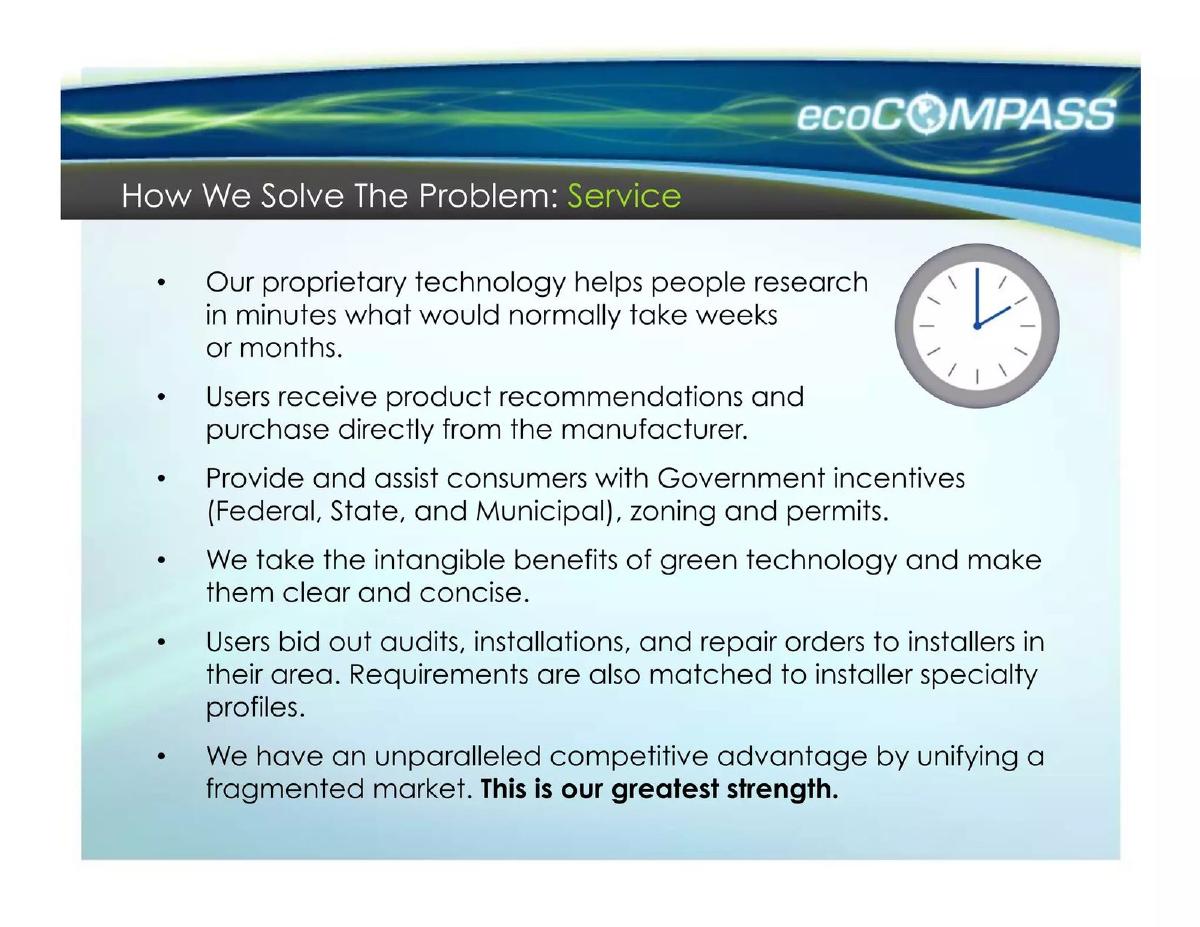
- The service aims to reduce research time from weeks to minutes while providing direct purchase links to manufacturers (Slide 5).
- Financial projections show a planned transition from an EBITDA loss of ($299,254) in 2012 to a profit of $11,138,667 by 2016 (Slide 6).
- Revenue is split between Residential and Commercial/Government sectors, with the latter projected to grow from $0 in 2012 to $5.8 million in 2016 (Slide 6).
- The sales model relies on a commission structure, with 6% on appliances and 9% on renewable energy products like solar and wind (Slide 7).
- The deck omits a team slide, specific competitive analysis, and a clear 'ask' regarding the amount of capital being raised.
EcoCompass Investor Presentation: A Detailed Teardown
Slide 1: Title Slide
The presentation opens with the EcoCompass logo, which features a compass rose integrated into the letter 'O,' with a small globe at the center. The subtitle is a generic 'Investor Presentation.' The visual style, utilizing blue gradients and glowing green lines, is characteristic of corporate design from the early 2010s. No specific value proposition or tagline is present on the cover.
Slide 2: A Fragmented Market
This slide introduces the problem statement. It uses a puzzle piece graphic to represent eight 'alienated' groups: Renewable Energy Products, Efficiency Products, Energy Rating & Auditing, Government & Other Incentives, General Online Retailers, Installers & Contractors, Certification & Training, and Green Non-Profit Orgs. The text states that the energy market is populated by these groups and that 'EcoCompass connects the pieces together.' This establishes the company as a horizontal marketplace or platform play.
Slide 3: The Power of Scale
Slide 3 attempts to quantify the impact of the company's mission using a lightbulb analogy. It claims that if every one of the 130 million homes in the US replaced just one bulb with an Energy Star rated bulb, it would save $600 million in energy costs and remove the equivalent of 800,000 cars from the road annually. This slide is designed to show the massive potential of small consumer changes when aggregated, though it does not explicitly state how EcoCompass will achieve this specific 130-million-home penetration.
Slide 4: Government Help
The company leans heavily on the regulatory environment of the time. It cites the American Recovery and Reinvestment Act of 2009, showing a pie chart of a 'Total 46 Billion' fund. Categories include energy efficiency, weatherization assistance, and advanced batteries. The slide also features a quote and photo of then-Vice President Joe Biden regarding federal actions to support the home energy efficiency retrofit industry, including the 'Home Energy Score' and 'PowerSaver' programs. This slide serves to de-risk the investment by showing a massive, government-backed tailwind.
Slide 5: How We Solve The Problem: Service
This slide outlines the value proposition for the user. Key points include: proprietary technology that reduces research time from weeks to minutes; direct purchase from manufacturers; assistance with government incentives, zoning, and permits; and a bidding system where users can send audit and installation orders to local contractors. The slide concludes by stating their 'greatest strength' is the 'unparalleled competitive advantage by unifying a fragmented market.'
Slide 6: Summary Financial Projections
The financial roadmap covers 2012 through 2016. In 2012, the 'Start-up Year,' the company projected $597,256 in revenue and an EBITDA loss of ($299,254). By 2016, they projected revenue to reach $21,808,760 with an EBITDA of $11,138,667. This represents a very high-margin business model, with operating expenses only growing from $896,510 to $10,670,094 over the same period. The revenue is split between Residential and Commercial + Government, with Residential providing the bulk of the early income.
Slide 7: The Market: Commercial + Government
This slide provides a granular breakdown of the sales model. It lists 'Quota Units per Sales Rep' across various categories like New Construction, Retrofits, and Direct Sales to Government/Non-Profits. It establishes pricing per unit (e.g., $1,000 for Major Appliances, $5,600 for Solar) and states the 'Net Commission to EcoCompass' as 6% for appliances and 9% for renewable energy. This is the most detailed slide in the deck regarding how the business actually generates cash flow.
Slide 8: Where To Go From Here
The final slide is a contact page. It provides an email address (investors@ecocompass.com), a physical address in New York City (12 W. 37th Street), and a phone number. It ends with an inspirational quote from John M. Richardson Jr. about 'making it happen.' Notably, there is no specific 'Ask' on this slide or anywhere else in the provided 8 slides—no mention of the round size, valuation, or use of proceeds.
What EcoCompass Does Well
The deck identifies a very specific and painful problem: the 'fragmentation' of the green energy sector. By mapping out the eight different stakeholders in the puzzle graphic on Slide 2, the founders show they understand the complexity of the ecosystem they are entering. The financial projections on Slide 6 and the commission breakdown on Slide 7 provide a clear, albeit ambitious, path to profitability. They aren't just selling 'green energy'; they are selling a transaction-based marketplace model.
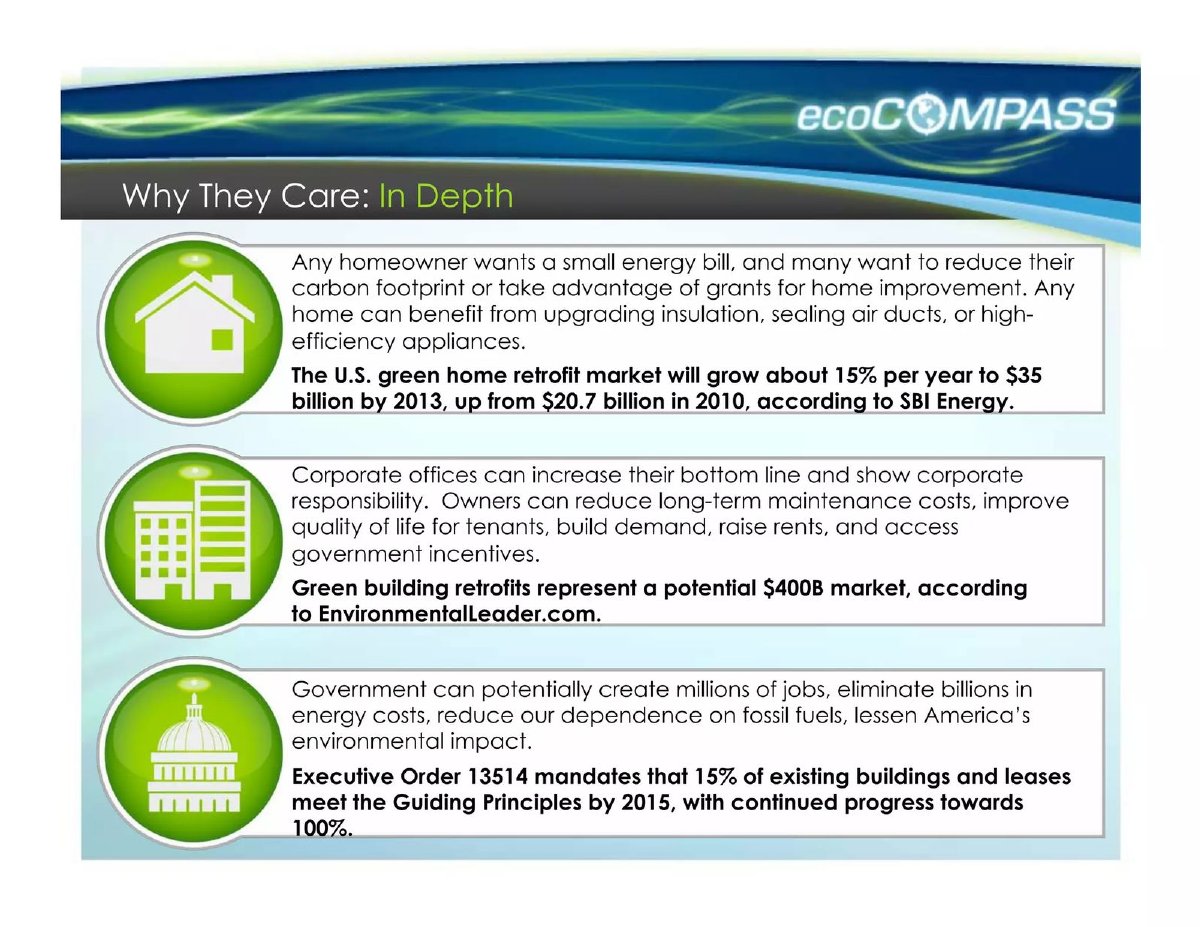
Furthermore, the use of the 2009 Recovery Act data on Slide 4 is a smart move for the era. It suggests that the company isn't just fighting for market share in a vacuum, but is riding a multi-billion dollar wave of government spending. This 'regulatory tailwind' is often a key factor in successful CleanTech investments.
What is Missing from the Deck
The most glaring omission is a Team Slide . In early-stage fundraising, investors are often betting more on the founders than the idea. Without knowing who is building the 'proprietary technology' or who has the sales experience to hit the quotas on Slide 7, it is difficult to assess the likelihood of success.
Additionally, there is no Competitive Analysis . The deck claims an 'unparalleled competitive advantage,' but does not list a single competitor or explain why a giant like Amazon or a specialized energy firm couldn't replicate their marketplace. The 'proprietary technology' mentioned on Slide 5 is also left as a black box; there are no screenshots of the platform or details on how the algorithm works.
Finally, the Ask is missing. A pitch deck is a tool to get a check. By failing to state how much capital is needed to reach the 2014 profitability milestone, the deck leaves the investor with an open-ended question rather than a call to action.
What Founders Should Copy
Founders should look at Slide 7 as a good example of unit economics and sales modeling . Instead of just saying 'we will make $20 million,' EcoCompass breaks down exactly how many units a single sales rep needs to move, what the price per unit is, and what the company's take-rate (commission) is. This level of granularity helps investors understand the 'levers' of the business.
The 'Power of Scale' slide (Slide 3) is also a classic pitch deck technique. It takes a complex, macro problem (carbon emissions) and boils it down to a simple, relatable action (changing one lightbulb). This helps bridge the gap between a high-level vision and a practical business application. If you are building a platform that relies on mass adoption, finding a 'single unit of impact' like this is a powerful way to communicate your potential.
Final Thoughts
The EcoCompass deck is a product of its time, focusing on the transition from government-subsidized energy projects to a consumer-facing marketplace. While the financial projections are highly optimistic—projecting a 50% EBITDA margin by year five—the underlying logic of unifying a fragmented market remains a relevant strategy in many industries today. However, the lack of team and competitive context makes this a 'vision' deck rather than a complete investment case.
Frequently asked questions
- What is the core problem EcoCompass is trying to solve?
- According to Slide 2, the core problem is a 'Fragmented Market.' The energy sector is populated by 'numerous, though largely alienated, groups' such as renewable energy product manufacturers, energy auditors, government incentive programs, and green non-profits. EcoCompass positions itself as the 'compass' that connects these disparate pieces into a single ecosystem for the consumer.
- How does EcoCompass plan to make money?
- Slide 7 details a commission-based revenue model. The company earns a 'Net Commission to EcoCompass' of 6% on appliances (major appliances, light appliances, efficiency products, and water products) and 9% on renewable energy products (solar and wind). These commissions are applied to sales generated through wholesale channels, new construction, retrofits, and direct sales to government and corporate entities.
- What are the projected financial milestones for the company?
- Slide 6 outlines a five-year plan starting in 2012. The company projected total revenue to grow from $597,256 in its 'start-up year' (2012) to $21,808,760 by 2016. While they expected to operate at a loss for the first two years, they projected reaching EBITDA profitability in 2014 ($1,046,636) and scaling significantly thereafter.
- What role does the government play in their business strategy?
- Government involvement is a pillar of their strategy. Slide 4 highlights the American Recovery and Reinvestment Act of 2009, specifically $46 billion in funding for energy efficiency and renewables. Slide 5 notes that their service helps consumers navigate 'Government incentives (Federal, State, and Municipal), zoning and permits,' suggesting they act as a facilitator for public-funded energy programs.
- What critical information is missing from this pitch deck?
- The deck is missing several standard components: a Team slide (essential for evaluating execution risk), a Competition slide (to show market awareness), and a specific 'Ask' slide (detailing how much money is being raised and how it will be spent). Additionally, there is no mention of current traction, existing partnerships, or a technical deep-dive into their 'proprietary technology.'