EchoMe 2 positions itself as the 'Music Social Network,' aiming to solve the isolation of individual streaming by allowing users to broadcast their music to others in real-time. The deck highlights a proprietary 'Independent Network Synchronization' technology that claims to sync audio within 10 milliseconds across unlimited devices. Their business model is notably diverse, combining $0.99 to $3.99 monthly subscriptions with a $6.67 CPM advertising model and sponsored brand stations. While the deck shows ambitious user growth projections reaching over 1.5 million users by month 24, it lacks c…
Key takeaways
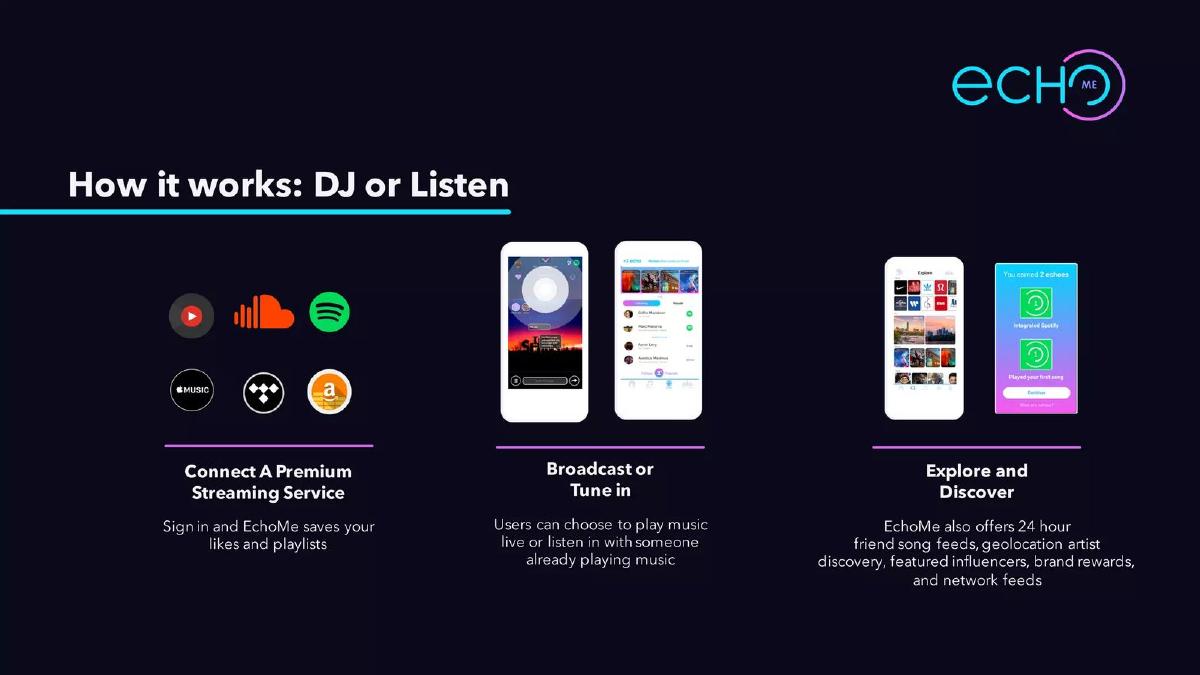
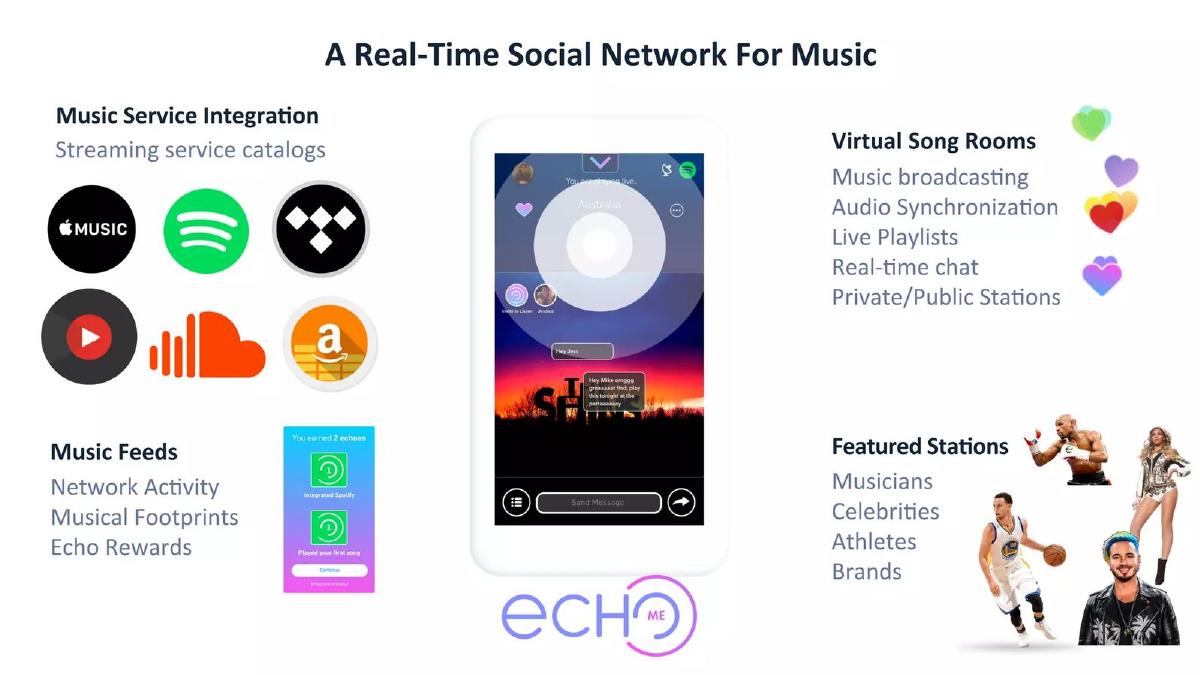
- The platform relies on integrating with premium services like Spotify, Apple Music, and Tidal to handle base music delivery (Slide 2).
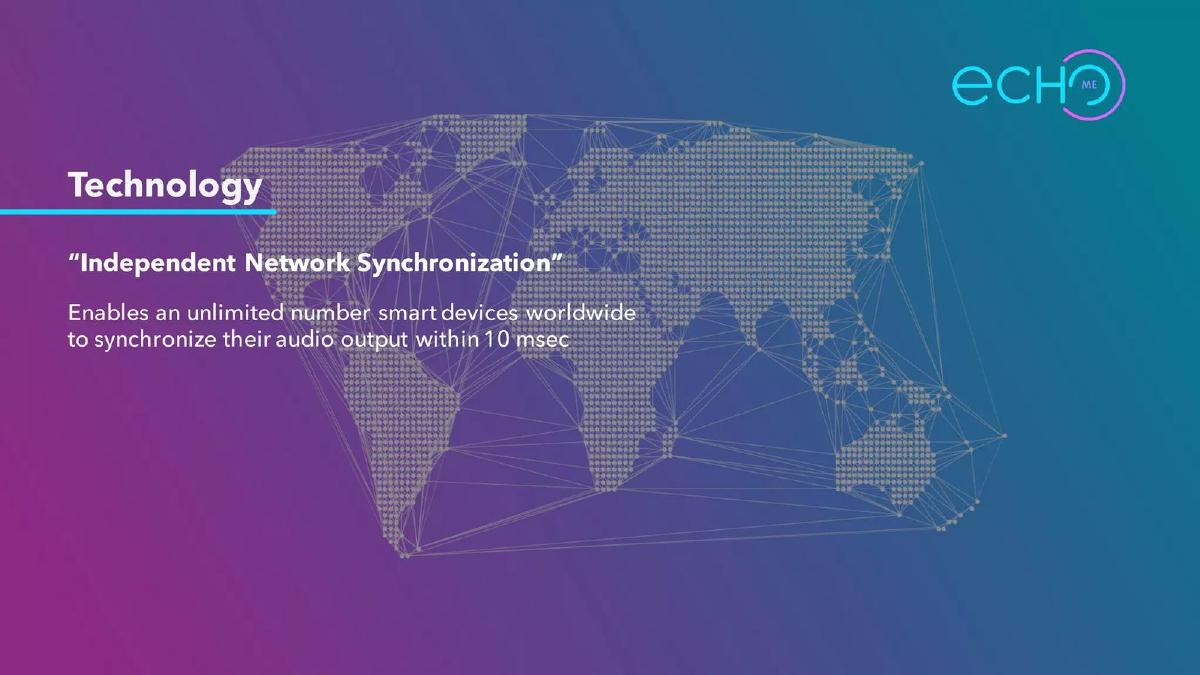
- Proprietary technology claims to synchronize audio output across unlimited global devices within a 10-millisecond window (Slide 3).
- Revenue is split between low-cost premium subscriptions ($0.99-$3.99) and a $6.67 per 1,000 views advertising rate (Slide 4).
- The deck targets a specific niche of 'music fans' estimated at 27% of the market for celebrity station bundles (Slide 4).
- A competitive matrix positions EchoMe as the only service offering the combination of live broadcasting, communal listening, and on-demand access (Slide 5).
- User growth projections show a steep 'hockey stick' curve, aiming to outperform the 90th percentile of startups by reaching ~1.7 million users in two years (Slide 6).
- The deck omits a dedicated team slide, failing to showcase the technical or industry expertise behind the synchronization technology (General Omission).
- There is no 'Ask' slide detailing how much capital is being raised or how the funds will be allocated (General Omission).
EchoMe 2: The Social Layer for Digital Audio
EchoMe 2 presents a vision for a 'Music Social Network' that bridges the gap between passive streaming and active social engagement. The deck focuses on the transition from solitary listening to a broadcast-style communal experience. While the visual design is consistent and modern, the content leans heavily on feature descriptions and future projections rather than historical performance or team pedigree.
Slide 1: Title Slide
The opening slide establishes the brand identity with a dark, lifestyle-oriented background featuring two individuals listening to music. The logo is prominent, utilizing a neon blue and purple aesthetic. The tagline is clear and descriptive: "The Music Social Network." This slide succeeds in immediately identifying the sector and the core value proposition without unnecessary jargon.
Slide 2: How it works: DJ or Listen
This slide breaks down the user journey into three distinct steps. First, "Connect A Premium Streaming Service." The slide displays logos for YouTube, SoundCloud, Spotify, Apple Music, Tidal, and Amazon Music. It notes that signing in allows EchoMe to save likes and playlists. Second, "Broadcast or Tune in." This section explains that users can choose to play music live or listen in with others. Third, "Explore and Discover." This step highlights additional features such as 24-hour friend song feeds, geolocation artist discovery, featured influencers, and brand rewards. The inclusion of 'brand rewards' hints at the monetization strategy detailed later in the deck.
Slide 3: Technology
EchoMe highlights its technical moat under the heading "Independent Network Synchronization." The slide claims the technology "Enables an unlimited number smart devices worldwide to synchronize their audio output within 10 msec." This is a bold technical claim, as 10 milliseconds is generally considered below the threshold of human perception for audio lag, which would be necessary for a true 'silent disco' style experience over a cellular or Wi-Fi network. The background features a global mesh network graphic, reinforcing the 'worldwide' scale of the ambition.
Slide 4: Revenue Model
This is one of the most detailed slides in the deck, outlining three revenue streams. The "Premium Subscription" tier offers enhanced features for "$0.99/MONTH" and celebrity station bundles for "$3.99/MONTH." The slide specifically targets "27% of the music fan" for these bundles. The "Advertising" section quotes "Competitive pricing, $6.67 / 1,000 VIEWS of a 5-6 second ad." Finally, "Sponsored Stations" suggests partnerships with brands like Nike, NFL, NBA, and Red Bull, comparing the approach to "snapchat's model." The slide uses a variety of brand logos to illustrate potential partners, though it does not explicitly state these partnerships are currently active.
Slide 5: Radio Comparison
The competitive matrix compares EchoMe against Spotify, Beats 1 Radio, OVO Sound Radio, AM/FM Radio, Pandora, and Soundcloud. EchoMe is the only entity with checkmarks across all categories: Live, Any DJ, Streaming Royalties, Communal Listening, Live Playlist, Live Fan Chat, and On Demand. The text below the chart emphasizes that "Any user, college student, athlete, music artist, influencer can broadcast music and DJ right from their smart phone." It also addresses the legal side, stating that "every stream is accounted for and paid out by our partner streaming services."
Slide 6: EchoMe vs 90th Percentile
This slide presents a growth chart titled "Number of Users." It compares the projected growth of EchoMe against a "90th Percentile" benchmark. The EchoMe curve shows a significant inflection point around Month 15, eventually reaching approximately 1,700,000 users by Month 24. The 90th percentile line remains much lower, ending around 250,000 users. It is important to note that this appears to be a forecast rather than a report of actual growth, as the months are numbered 1 through 22+ rather than specific calendar dates.
Slide 7: Contact Slide
The final slide provides contact information for "Christian Nicholson | CEO" with an email address at "echome.fm." The visual style maintains the neon grid 'synthwave' aesthetic established in the earlier slides. This slide serves as the call to action for "Investing or Partnerships."
What EchoMe 2 Does Well
The deck is visually cohesive and does an excellent job of explaining a relatively complex product interaction (social broadcasting via third-party APIs) in simple terms. The revenue model is diversified, which shows the founders have thought about multiple paths to sustainability beyond just 'getting big and figuring it out later.' By explicitly stating they use premium streaming services for the actual music delivery, they address the immediate investor concern regarding the massive cost and legal hurdle of music licensing.
What is Missing from the Deck
The most glaring omission is a Team Slide . In a startup relying on a specific technical claim like 10ms global synchronization, investors need to see the engineering pedigree of the founders. Furthermore, there is no Ask Slide . A pitch deck is a fundraising tool; failing to state how much money is being raised and what the milestones for that capital are is a significant oversight. The deck also lacks Traction Data . While the growth chart is impressive, it is purely theoretical. There are no mentions of current beta users, retention rates, or early revenue. Finally, the deck does not address the Terms of Service risks associated with 'partner' streaming services. Most consumer streaming licenses (like Spotify's) specifically prohibit public performance or broadcasting, and the deck does not explain how EchoMe bypasses or complies with these restrictions at scale.
Founder Takeaways
Address the 'Elephant in the Room': If your business relies on other platforms (Spotify, Apple), you must explain the stability of that relationship or the legality of your integration. · Show, Don't Just Tell, Growth: Projections are easy to draw; historical data is what sells. If you have 100 users, show their engagement rather than a graph of 1.7 million future users. · Humanize the Tech: A 'Technology' slide with big claims needs a 'Team' slide to back it up. Who built the 10ms sync? Why are they the best in the world to do it? · Be Clear on the Ask: Never leave an investor wondering what you want. Include a slide that states the round size, the valuation (or cap), and the 18-month roadmap for that cash.
Frequently asked questions
- How does EchoMe handle music licensing?
- According to Slide 2 and Slide 5, EchoMe does not host the music itself. Instead, it requires users to 'Connect A Premium Streaming Service' like Spotify or Apple Music. Slide 5 claims that 'every stream is accounted for and paid out by our partner streaming services.' This suggests EchoMe acts as a social controller for existing licensed accounts rather than a standalone broadcaster.
- What is the primary technical advantage claimed by the company?
- The core technical claim, found on Slide 3, is 'Independent Network Synchronization.' The company asserts this technology allows an unlimited number of smart devices worldwide to synchronize their audio output within 10 milliseconds. This is intended to facilitate a seamless 'communal listening' experience where all participants hear the exact same moment of a song simultaneously.
- What are the different ways EchoMe plans to make money?
- Slide 4 outlines a three-pronged monetization strategy. First, a 'Premium Subscription' at $0.99/month for enhanced features or $3.99/month for celebrity station bundles. Second, 'Advertising' with a competitive price of $6.67 per 1,000 views for 5-6 second ads. Third, 'Sponsored Stations' involving partnerships with brands like Nike, Red Bull, and the NBA.
- Who does EchoMe consider its primary competition?
- Slide 5 lists several major incumbents: Spotify, Beats 1 Radio, OVO Sound Radio, AM/FM Radio, Pandora Radio, and Soundcloud Radio. EchoMe differentiates itself by claiming to be the only one that offers 'Live' broadcasting by 'Any DJ' combined with 'Communal Listening' and 'Live Fan Chat.'
- Is there evidence of current market traction in the deck?
- Slide 6 provides a 'Number of Users' graph, but it is presented as a comparison of 'EchoMe vs 90th Percentile' over a 24-month period. Because the x-axis is labeled simply 'Months' and the curve starts at zero, it appears to be a projection or a goal rather than a report of historical data. The deck does not list current active user counts or revenue generated to date.