The eBay acquisition of Skype in 2005 remains one of the most debated M&A deals in tech history. The presentation deck, totaling 79 slides, frames Skype not just as a VOIP tool, but as the missing communication layer for eBay’s marketplace. By comparing Skype’s user growth to early eBay and PayPal trajectories, the deck argues for a 'Power of Three' ecosystem. It highlights a massive market opportunity in categories requiring high-touch communication, such as used cars and real estate, which represented a combined $2.3 billion advertising market at the time. Despite the eventual divestment, t…
Key takeaways
- Skype's user growth outpaced the early trajectories of eBay, PayPal, and Yahoo, reaching roughly 15 million registered users within 25 months (Slide 17).
- The 'Power of Three' strategy aimed to create a flywheel where Skype drives users to eBay, and eBay drives transactions to PayPal (Slide 61).
- eBay identified 5 million email messages initiated daily between buyers and sellers as a friction point that Skype could solve (Slide 25).
- The acquisition targeted high-value categories like Real Estate ($1.8B) and Used Cars ($0.5B) that require significant communication (Slide 33).
- Skype’s peer-to-peer architecture was touted for its 'Low CapEx' and lack of a 'single point of failure' (Slide 49).
- At the time of the deal, there was only a 1% overlap between Skype and eBay US users, representing a massive cross-selling opportunity (Slide 65).
- The business model was pitched as having 'high operating leverage' with no inventory or warehouse requirements (Slide 69).
- Revenue streams were divided into free services, premium services (SkypeIn/Out), and new eBay opportunities like voice services for classifieds (Slide 73).
The Strategic Logic of the eBay-Skype Merger
The 2005 acquisition of Skype by eBay for $2.5 billion is often cited as a cautionary tale of corporate M&A, but the pitch deck used to justify the deal reveals a deeply calculated attempt to own the entire e-commerce stack. This teardown analyzes the core components of that 79-slide presentation, focusing on how eBay framed a communication tool as a transactional catalyst.
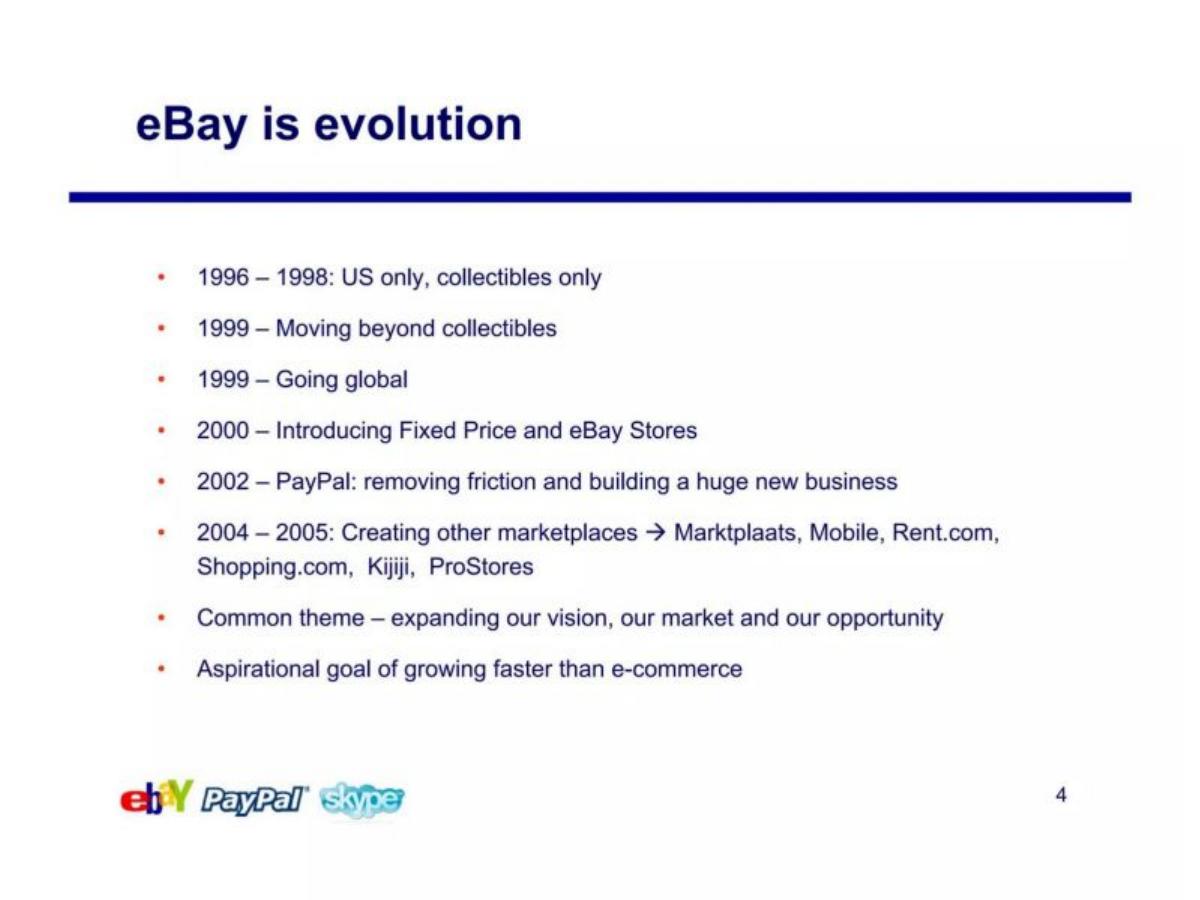
Slide 1-5: The High-Performance Context
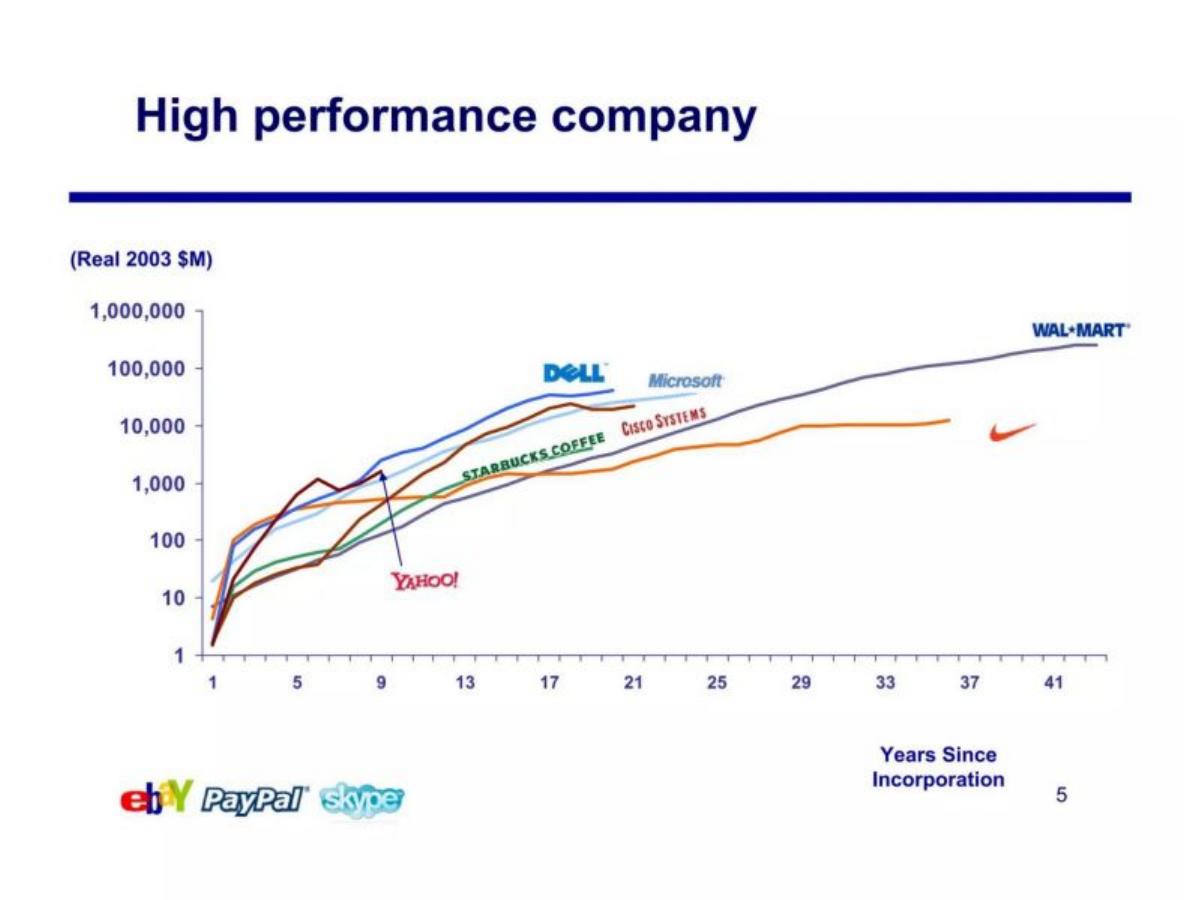
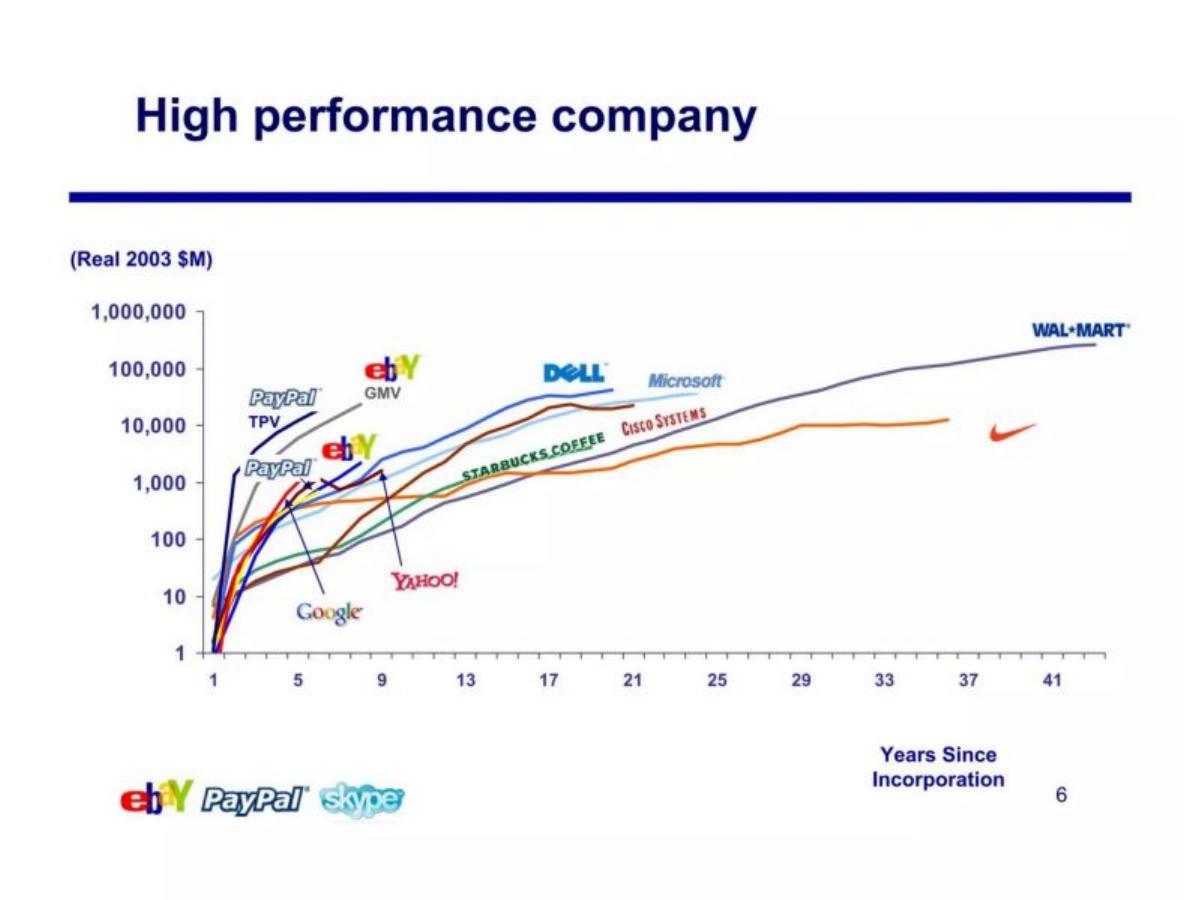
The deck opens by positioning eBay, PayPal, and Skype as a unified trio. Slide 5, titled High performance company , uses a logarithmic scale to compare the revenue growth of eBay against titans like Wal-Mart, Microsoft, and Dell. By placing the eBay/PayPal/Skype logos at the bottom of this chart, the presentation establishes a narrative of inevitable, hyper-scale growth. It sets the stage that eBay isn't just buying a startup; it is acquiring a peer in terms of growth velocity.
Slide 9-13: Product Simplicity and Accessibility
Slide 9, Simply powerful , uses basic clip-art style diagrams to explain the VOIP concept: two users connected via the 'Internet' for free. This simplicity is echoed in Slide 13, Easy to set up and use . It breaks the user journey into three steps: download, add buddies, and start talking. For a 2005 audience, where VOIP was still a technical novelty, emphasizing the low barrier to entry was critical to proving that Skype could reach eBay's mass-market user base.
Slide 17: The Traction Benchmark
This is perhaps the most important slide in the first half of the deck. Historic success compares Skype's registered user growth against eBay, PayPal, Yahoo, and AOL. The chart shows Skype reaching approximately 15 million users in 25 months, a trajectory that visibly eclipses the early days of eBay and PayPal. The data, attributed to company data and Merrill Lynch estimates, serves as the primary justification for the $2.5 billion price tag—eBay was buying the fastest-growing user network in history.
Slide 21-29: The E-commerce Synergy
The agenda shifts on Slide 21 to Expanding eBay's share of e-commerce . Slide 25, Communication is key to e-commerce , provides the 'Why.' It notes that 5 million email messages are initiated per day between eBay buyers and sellers, and 30% of bids occur in the final two hours. The implication is that email is too slow for the 'closing' phase of an auction. Slide 29, Accelerating e-commerce , argues that Skype will 'Remove a key friction' and 'Create a new way to monetize' by moving these conversations from asynchronous email to real-time voice.
Slide 33: New Category Expansion
Slide 33, Communications enables expansion into new categories , identifies specific markets where eBay was underperforming due to communication barriers. It lists a total advertising market of $2.3 billion across Real Estate ($1.8B), Services ($0.7B), Travel ($0.5B), and New/Used Cars ($0.5B). The deck argues that these categories 'require significant communication' and are 'less suited to transaction-based monetization.' Skype was intended to be the bridge that allowed eBay to capture these high-value leads.
Slide 37-45: Market Penetration and Team
Slide 41, Increasing penetration , shows global broadband subscribers projected to reach 317.3 million by 2009. It specifically forecasts 30 million VOIP households in the US by 2009. This macro trend supports the timing of the acquisition. Slide 45, Strong team , highlights the pedigree of founders Niklas Zennström and Janus Friis, noting they created Kazaa and were executives at Tele2. The slide also mentions a management team drawn from Microsoft, Yahoo, and OpenWave, signaling that the startup had 'grown up' leadership.
Slide 49-57: Technology and Integration
Slide 49, Advanced technology , focuses on the P2P architecture. The key selling point here for eBay shareholders was 'Low CapEx.' Because Skype leveraged the end-user's hardware, eBay wouldn't need to invest billions in infrastructure to support the growing call volume. Slides 53 and 57, both titled Many great applications , show mockups of Skype integrated into the Internet Explorer toolbar, Outlook, and a 'Voice Marketplace' for language learning and tutoring. This demonstrated that Skype was a platform, not just a feature.
Slide 61-65: The Power of Three
Slide 61 introduces the Power of three flywheel: Skype users invite more users, sellers go where buyers are (eBay), and more buyers/sellers use PayPal. Slide 65, The power of three: synergistic opportunities , reveals a staggering statistic: there was only a '1% overlap between Skype and eBay US users today.' This was used to argue that the acquisition wasn't just about servicing existing eBay users, but about acquiring a completely new demographic that could then be funneled into the eBay and PayPal ecosystems.
Slide 69-77: Financials and Summary
Slide 69, Strong Business Model , summarizes the financial appeal: 'No inventory or warehouses,' 'High operating leverage,' and 'Outstanding cash generation.' Slide 73, Skype revenues , breaks down the monetization into Free, Premium (SkypeOut/In), and New eBay Opportunities (Classifieds, Shopping.com). Finally, Slide 77, Summary , reiterates the 'Power of 3' and the goal to 'Create entirely new businesses.'
What Works in This Deck
Comparative Growth: Using eBay and PayPal's own historical growth as a benchmark for Skype (Slide 17) was a brilliant way to speak the language of the board and investors. · Friction Identification: Quantifying the 5 million daily emails (Slide 25) turned a vague 'synergy' argument into a concrete operational problem that Skype was uniquely positioned to solve. · Macro-Micro Alignment: The deck successfully balances huge macro trends (broadband growth on Slide 41) with specific micro-opportunities (real estate leads on Slide 33).
What Is Missing
Integration Complexity: The deck glosses over the technical and cultural difficulty of merging a P2P communication tool with a centralized marketplace. · Competitive Response: There is no mention of how Google (Google Talk) or Microsoft (MSN Messenger) might respond to this consolidation. · Unit Economics: While Slide 69 mentions 'high operating leverage,' the deck lacks a detailed breakdown of the cost-per-call or the specific margins on SkypeOut at scale.
Lessons for Founders
The 'Platform' Argument: If you are pitching an acquisition, show how your product solves a specific, quantified friction in the acquirer's core business (like the 5 million emails on Slide 25). · Network Overlap: Highlighting a low overlap between user bases (Slide 65) is a powerful way to argue for 'new' growth rather than just 'cannibalized' growth. · Scalability via Architecture: Highlighting 'Low CapEx' (Slide 49) is essential when pitching to a large public company that is sensitive to margin compression.
Frequently asked questions
- Why did eBay believe Skype was worth $2.5 billion in 2005?
- eBay viewed Skype as a strategic infrastructure play rather than just a software purchase. As shown on Slide 25, eBay buyers and sellers were sending 5 million emails daily, and 30% of bids happened in the final two hours of an auction. eBay believed that real-time voice communication would accelerate these transactions, reduce friction, and allow them to capture a larger share of the $2.3 billion advertising market for cars and real estate.
- What was the 'Power of Three' mentioned in the deck?
- The 'Power of Three' (Slide 61) was eBay’s vision of a closed-loop ecosystem. Skype would provide the communication and user acquisition, eBay would provide the marketplace for trade, and PayPal would handle the payments. The goal was to have each platform feed the others, increasing the total lifetime value of a user across the entire suite of services.
- How did Skype's growth compare to other tech giants at the time?
- Slide 17 provides a direct comparison of registered users over the first 25 months of operation. Skype’s growth curve was significantly steeper than eBay, PayPal, Yahoo, and AOL. By month 25, Skype had nearly 15 million users, whereas eBay and PayPal were closer to the 10 million mark at the same stage in their respective histories.
- What were the primary revenue drivers for Skype according to the deck?
- Slide 73 outlines a three-pronged revenue strategy. First, 'Free services' to drive user scale at zero marginal cost. Second, 'Premium services' including SkypeIn, SkypeOut, hardware royalties, and expressive content (ringtones). Third, 'New eBay Opportunities,' which included monetizing communication in new categories like services, classifieds, and cross-border trade.
- What technical advantages did Skype claim over competitors?
- Slide 49 highlights Skype's 'Advanced technology' based on a virtual, peer-to-peer (P2P) architecture. This was marketed as 'massively scalable' with 'Low CapEx' because the users' computers provided the processing power and bandwidth, rather than eBay having to build massive centralized server farms. It also featured 'better firewall tunneling' to ensure higher call completion rates.