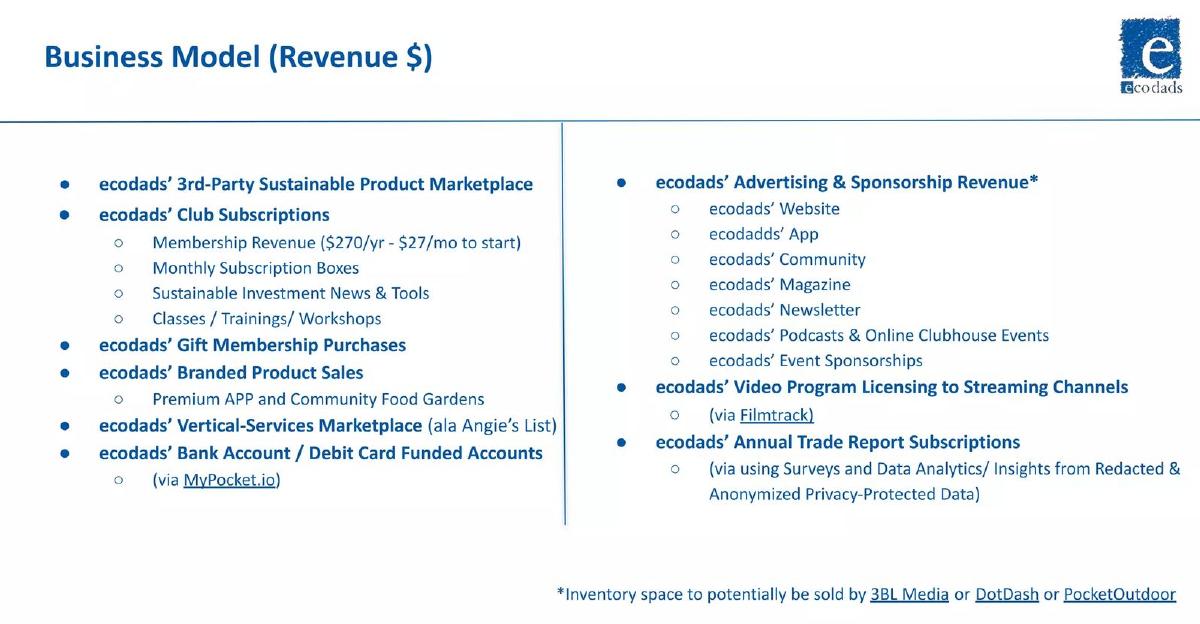
Ecodads is positioned as a comprehensive lifestyle platform for fathers focused on sustainability, described on slide 2 as a 'Climate Parenting Movement.' The deck outlines a complex business model that includes a private social network, a sustainable product marketplace, a subscription box service, and even a branded debit card. While the mission is clear, the operational scope is vast for a pre-seed stage company, proposing simultaneous launches in content, physical goods, and fintech. The financial projections on slide 6 are exceptionally aggressive, forecasting a jump from $5,000,000 in Y…
Key takeaways
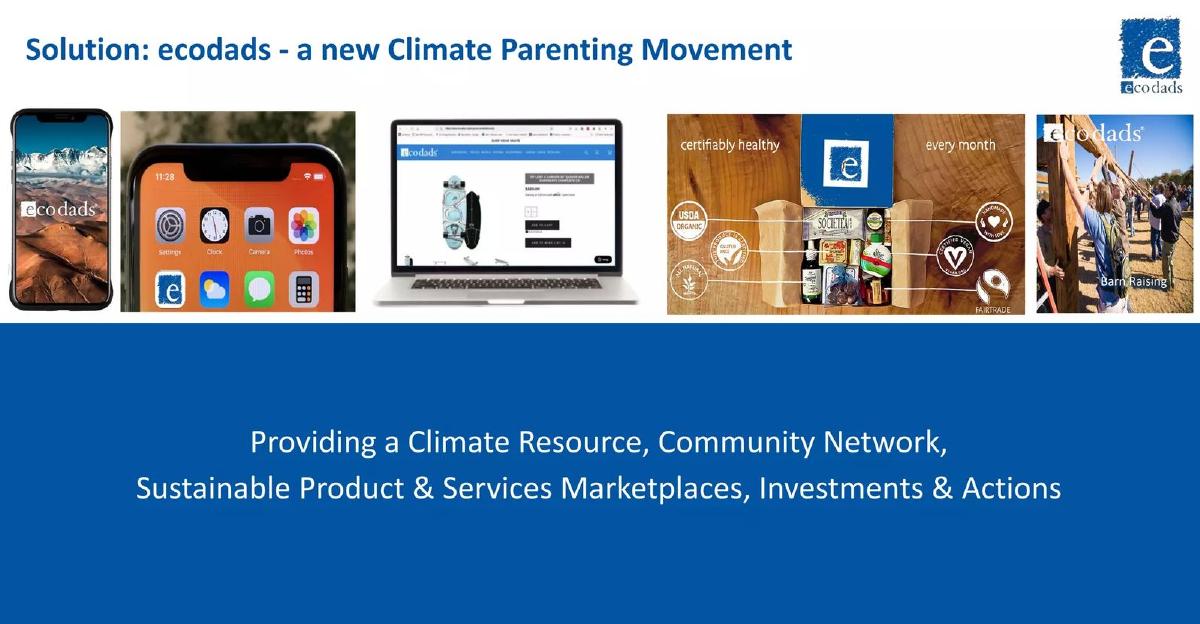
- The company defines itself as a 'Climate Parenting Movement' providing resources, community, and marketplaces (Slide 2).
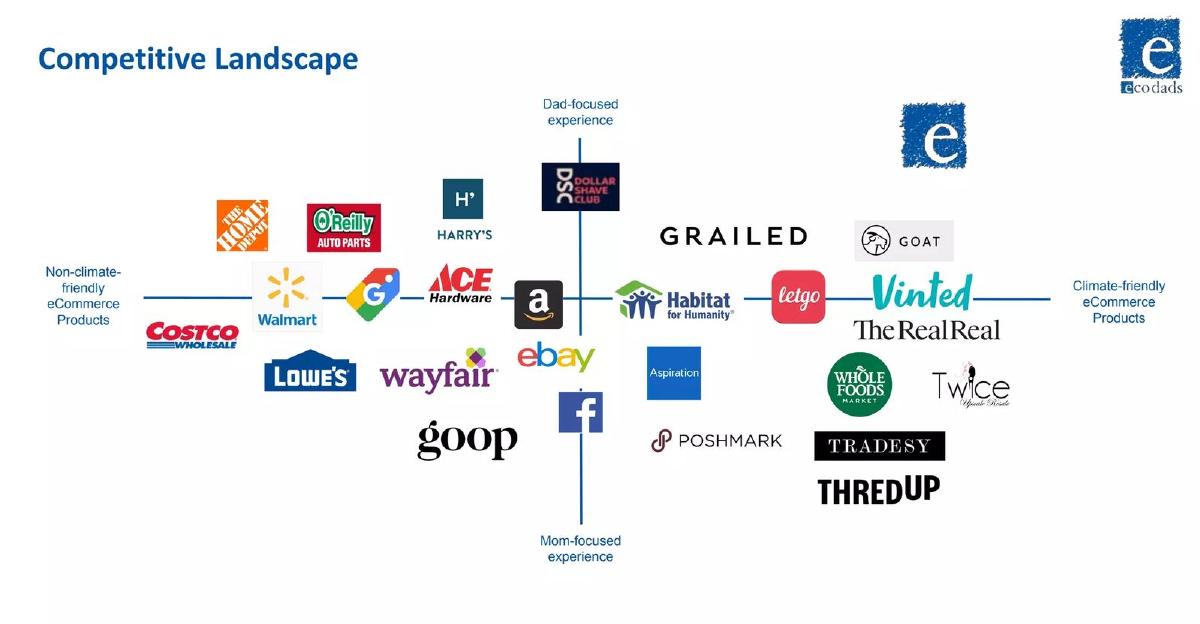
- The competitive landscape identifies a gap for 'Dad-focused' and 'Climate-friendly' experiences, contrasting with 'Mom-focused' platforms like Goop or Poshmark (Slide 3).
- Initial product offerings include a mobile app, a sustainable welcome box, and a 'Community Garden-in-a-Box' (Slide 4).
- The business model is highly diversified, listing six revenue streams: membership, subscription boxes, product marketplace, services marketplace, finance/debit cards, and advertising (Slide 6).
- Financial projections assume a constant $1,000 average annual spend per customer across a five-year period (Slide 6).
- Revenue is projected to scale from $5 million to $500 million in five years, requiring a customer base of 500,000 members (Slide 6).
- The venture operates alongside Ecodads.org, a non-profit foundation that holds equity in the for-profit entity (Slide 5).
- The deck omits a dedicated team slide, though Michael Leifer is listed as the primary contact on the final slide (Slide 7).
Slide-by-Slide Analysis
Slide 1: Title Slide
The deck opens with a high-resolution lifestyle photograph of a father and child in a natural setting. The tagline, "It's our kids' future. Let's act like it," establishes the emotional and moral foundation of the brand. The Ecodads logo, a stylized 'e' in a blue square, is positioned in the bottom left. This slide focuses entirely on sentiment and brand identity rather than defining the business model immediately.
Slide 2: The Solution
Slide 2 defines the company as "ecodads - a new Climate Parenting Movement." It lists four primary pillars of the business: a Climate Resource, a Community Network, Sustainable Product & Services Marketplaces, and Investments & Actions. Visuals include mockups of a mobile app, a laptop showing an e-commerce interface, a subscription box filled with organic goods, and a photo of a 'Barn Raising' event. This slide signals that the company intends to be a horizontal platform covering content, commerce, and community simultaneously.
Slide 3: Competitive Landscape
This slide uses a standard 2x2 matrix to position Ecodads. The Y-axis ranges from "Mom-focused experience" to "Dad-focused experience," while the X-axis ranges from "Non-climate-friendly" to "Climate-friendly eCommerce Products." Ecodads places itself in the extreme top-right corner. Notable competitors or adjacent companies listed include Goop, Poshmark, and The RealReal on the 'Mom' side, and Dollar Shave Club or Harry's on the 'Dad' side. The slide argues that while sustainable commerce exists for women, a dedicated, climate-focused community for men is a market gap.
Slide 4: Initial Branded Products
This slide provides specific details on the launch offerings, dated "avail 4/1/2022." It breaks the product down into three categories:
The ecodads' App: Includes a private social network, a 'Sustainable Product Shopping Guide Tool' for scanning UPC codes, a marketplace, and a content stream (podcasts, classes, etc.). · The ecodads' Sustainable Welcome Box: Contains a magazine/catalog ('magalog'), apparel, a reusable bag, and a "bank account / debit card application." · The ecodads' Community Garden-in-a-Box: A physical kit with wood, soil, and seeds, plus a 'Master Gardener Training Day.'
The inclusion of a debit card application at this stage indicates an ambitious fintech play integrated into a physical goods business.
Slide 5: Partnerships and Ecosystem
This slide outlines a complex web of relationships. It introduces Ecodads.org , a non-profit foundation that reportedly has partnerships with the CA Board of Ed, CalRecycle, and the US Dept of Renewable Resources. The non-profit holds equity in the for-profit company. It also mentions Magical Threads (a content agency) and guerilla PR , both of which are providing services at reduced rates or cost in exchange for options. The slide is visually dense, featuring dozens of logos from major corporations (Sony, Microsoft, Coca-Cola), though it is unclear if these are active partners or examples of the agencies' past work.
Slide 6: Financial Projected Milestones
The financial slide presents a five-year growth plan. The revenue is split across six categories: Membership, Subscription Boxes, Product Marketplace, Services Marketplace, Finance/Debit Card, and Advertising. The figures are as follows:
Year 1: $5,000,000 revenue from 5,000 members. · Year 2: $25,000,000 revenue from 25,000 members. · Year 3: $50,000,000 revenue from 50,000 members. · Year 4: $250,000,000 revenue from 250,000 members. · Year 5: $500,000,000 revenue from 500,000 members.
The "Customer Avg Year Spend" is held constant at $1,000 across all five years. The slide also notes a COGS of 70% , resulting in a Total Net of $150,000,000 by Year 5. These are exceptionally round numbers, suggesting high-level modeling rather than bottom-up calculations.
Slide 7: Contact and Closing
The final slide returns to the sun-drenched sky imagery. It includes a call to action: "Take this opportunity to amplify your legacy." The primary contact listed is Michael Leifer , with a phone number and an ecodads.com email address. There is no mention of other founders, advisors, or the specific terms of the investment round.
What Ecodads Does Well
The deck excels at niche identification . By framing the business as a 'Dad-focused' climate movement, it carves out a specific psychological space that differentiates it from the broader 'green' market which is often marketed toward women. The use of the term 'Movement' rather than just 'App' or 'Store' helps build a brand narrative that could drive high user loyalty and organic community growth.
The multi-channel approach to engagement is also a strength. By combining a digital app with physical products like the 'Garden-in-a-Box,' Ecodads creates tangible touchpoints in the customer's home. This hybrid model can be more effective for community building than a purely digital social network.
What is Missing from the Deck
The most glaring omission is a Team Slide . While Michael Leifer is the contact person, investors need to see the backgrounds of the people building the technology, managing the supply chain for the physical boxes, and navigating the regulatory requirements of the 'Finance/Debit Card' component. A pre-seed deck is primarily an investment in people, and this deck leaves those people anonymous.
There is also a lack of Unit Economics . While the deck projects a $1,000 annual spend per customer, it does not explain the Customer Acquisition Cost (CAC) or how that $1,000 is distributed across the six revenue streams. Achieving a $1,000 annual spend from 500,000 people requires a massive amount of trust and utility, which is difficult to validate without early pilot data or a more granular breakdown.
Finally, the Funding Ask is missing. The deck does not state how much money is being raised, what valuation is being sought, or what specific milestones the investment will fund. Without this, the deck functions more as a brand presentation than a formal investment proposal.
Founder's Guide: What to Copy and What to Avoid
Copy the Competitive Matrix: The way Ecodads identifies a 'white space' on Slide 3 is excellent. They didn't just list competitors; they used axes (Gender Focus vs. Climate Focus) to show exactly why their company needs to exist. This is a persuasive way to demonstrate market opportunity.
Avoid 'Everything-at-Once' Scope: For a pre-seed company, Ecodads is attempting to launch a social network, a magazine, a subscription box, a retail marketplace, a services marketplace, and a fintech product simultaneously. This is a red flag for most investors as it suggests a lack of focus. It is usually better to master one 'wedge' (e.g., the subscription box) before expanding into five other business models.
Avoid Static Financial Projections: The financial table on Slide 6 uses perfectly round numbers and a static $1,000 spend. Real-world data is never this clean. Founders should show how revenue per user grows over time as the platform matures, or how COGS might decrease with scale. Using identical multiples and spend figures can make the projections look like placeholders rather than a calculated business plan.
Final Thoughts
Ecodads is a mission-driven concept with a clear target demographic. The deck successfully communicates the 'Why' and the 'What,' but struggles with the 'How' and the 'Who.' To move from a 'movement' to a venture-backable business, the founders would need to narrow their initial focus, introduce their leadership team, and provide a more grounded financial roadmap that accounts for the high costs of customer acquisition in the crowded e-commerce and fintech sectors.
Frequently asked questions
- What is the core product of Ecodads?
- Ecodads is not a single-product company but a platform ecosystem. According to slide 4, the core offerings include a mobile app featuring a social network and a sustainability shopping guide, a physical 'Sustainable Welcome Box' that includes a branded debit card application, and a 'Community Garden-in-a-Box' which provides materials and instructions for neighborhood gardening.
- How does Ecodads plan to generate revenue?
- The revenue model is extremely broad. Slide 6 lists six distinct pillars: membership fees, subscription box sales, a product marketplace, a services marketplace, financial services via a branded debit card, and traditional advertising. This multi-pronged approach suggests a strategy to capture a high percentage of a household's 'green' spending.
- What is the relationship between the for-profit and non-profit arms?
- Slide 5 explains that Ecodads.org is an ecological literacy non-profit foundation. It holds a percentage of equity in the for-profit ecodads.com. The non-profit handles community relations, education, and partnerships with government bodies like the CA Board of Education, while the for-profit entity manages the commercial marketplaces and products.
- Are the financial projections realistic for a pre-seed startup?
- The projections on slide 6 are highly optimistic. The company forecasts reaching $500 million in annual revenue by Year 5 with a 30% net margin ($150 million). This assumes they can acquire 500,000 customers who each spend exactly $1,000 per year, every year, which represents a very high level of wallet-share and retention for a new brand.
- Who is the target audience for this platform?
- The target audience is climate-conscious fathers. Slide 3 places Ecodads in the top-right quadrant of a competitive matrix, specifically targeting the intersection of 'Dad-focused experience' and 'Climate-friendly eCommerce products,' a space they claim is currently underserved compared to 'Mom-focused' sustainable brands.