Ecommerce Tech is positioning itself as a neutral third-party advisor in the increasingly complex world of ecommerce software. The deck identifies a dual problem: merchants struggle to vet tools, and tech providers struggle to demonstrate their unique value proposition. Their solution relies on a content-led 'Exploits' strategy, targeting low-competition keywords like 'vs' and 'pricing' to capture high-intent traffic. The business model is purely commission-based, projecting a $12.8 million Serviceable Obtainable Market (SOM) based on a 20% commission rate and 20% market penetration. While th…
Key takeaways
- The company identifies a 'Time Sink' problem where both merchants and tech providers waste energy vetting each other for fit (Slide 3).
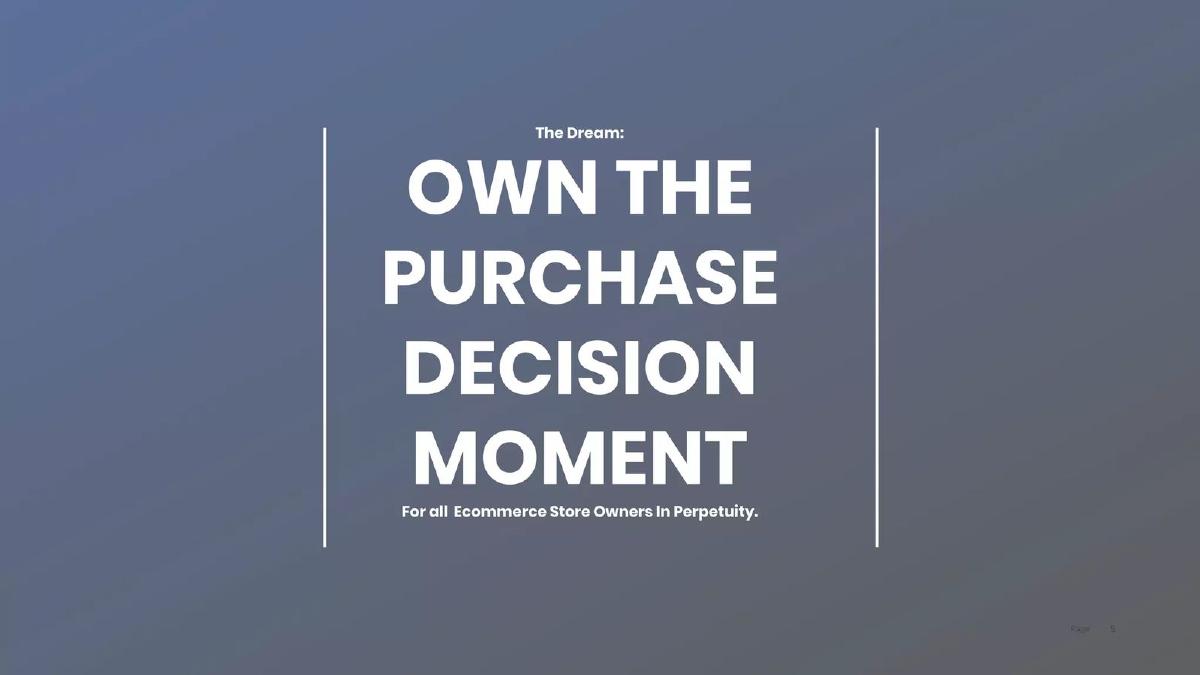
- The core mission is stated as 'Own the Purchase Decision Moment' for ecommerce store owners in perpetuity (Slide 5).
- The business model relies on an average commission of 20% from tech providers (Slide 7).
- The Serviceable Obtainable Market (SOM) is calculated at $12.8 million, assuming a 20% penetration of a $64 million commission pool (Slide 7).
- The strategy involves performing hundreds of demos to become the 'most knowledgeable resource in the ecosystem' (Slide 9).
- The company plans to leverage SEO by targeting 'low-volume, low-competition keywords' centered around comparisons and pricing (Slide 9).
- The founders, Shana and Derric Haynie, bring experience from digital agencies and ecommerce tech backgrounds (Slide 11).
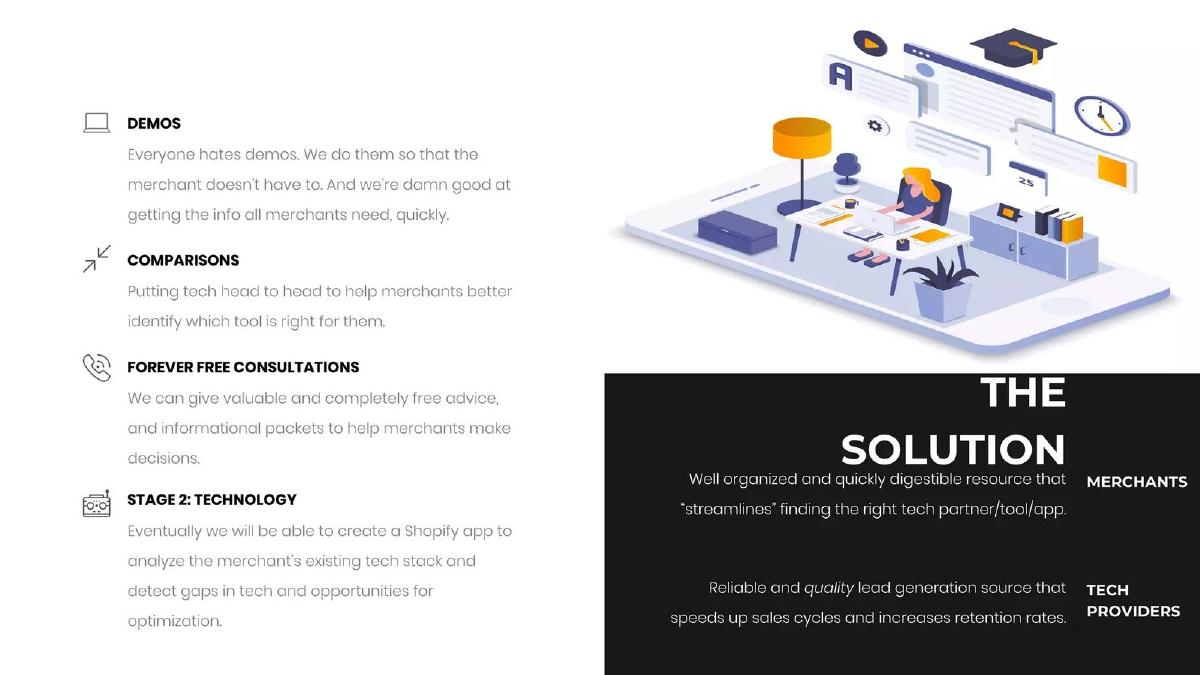
- The deck omits a traditional 'Solution' slide showing a software interface, focusing instead on the strategic 'Exploits' of the market (Slide 9).
Executive Summary
Ecommerce Tech is a strategic intermediary designed to bridge the gap between ecommerce merchants and the software providers that serve them. The deck outlines a business model that capitalizes on the friction of software procurement. By positioning themselves as a transparent, unbiased resource, the founders aim to capture a significant share of the affiliate commissions generated when merchants sign up for new tools. The deck focuses heavily on market dynamics and SEO strategy rather than proprietary software development.
Slide 1: Title Slide
The deck opens with a clean title slide featuring the Ecommerce Tech logo—a shopping cart filled with colorful spheres. It identifies the co-founders as Shana and Derric Haynie. The presentation is explicitly labeled as a 'Pitch Deck.' The visual style is minimalist, using a white background that persists through much of the deck.
Slide 3: The Problem x2
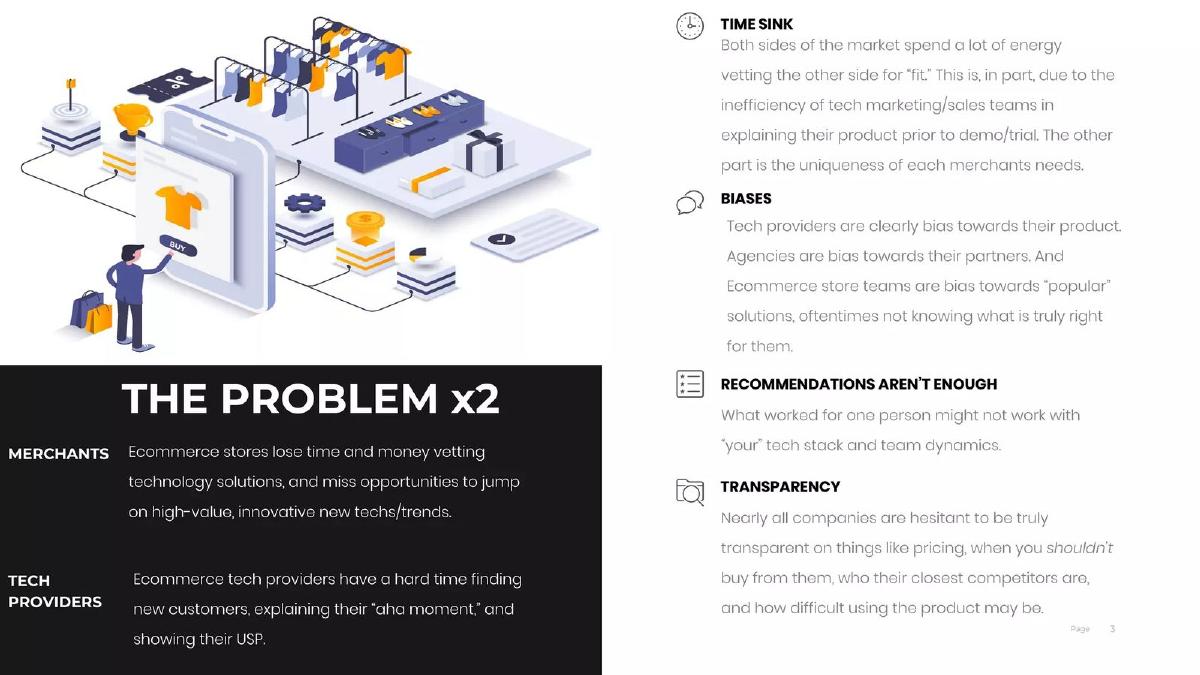
This slide breaks down the 'Problem' into two distinct categories: Merchants and Tech Providers. For merchants, the issue is 'Time Sink' and 'Biases.' They lose time vetting solutions and often rely on biased recommendations from agencies or popular trends rather than what fits their specific tech stack. For tech providers, the struggle is customer acquisition and the inability to clearly communicate their 'aha moment' or USP. The slide also highlights a lack of transparency in the industry regarding pricing and competitor comparisons. A 3D isometric illustration of a retail environment accompanies the text, though it is decorative rather than informational.
Slide 5: The Dream
Slide 5 serves as the company's vision statement. In large, bold text, it states the goal: 'OWN THE PURCHASE DECISION MOMENT For all Ecommerce Store Owners In Perpetuity.' This indicates an ambition to become the definitive starting point for any ecommerce business looking to expand its software stack, effectively becoming the 'Gartner' or 'G2' specifically for the Shopify and ecommerce ecosystem.
Slide 7: Business Model - SOM
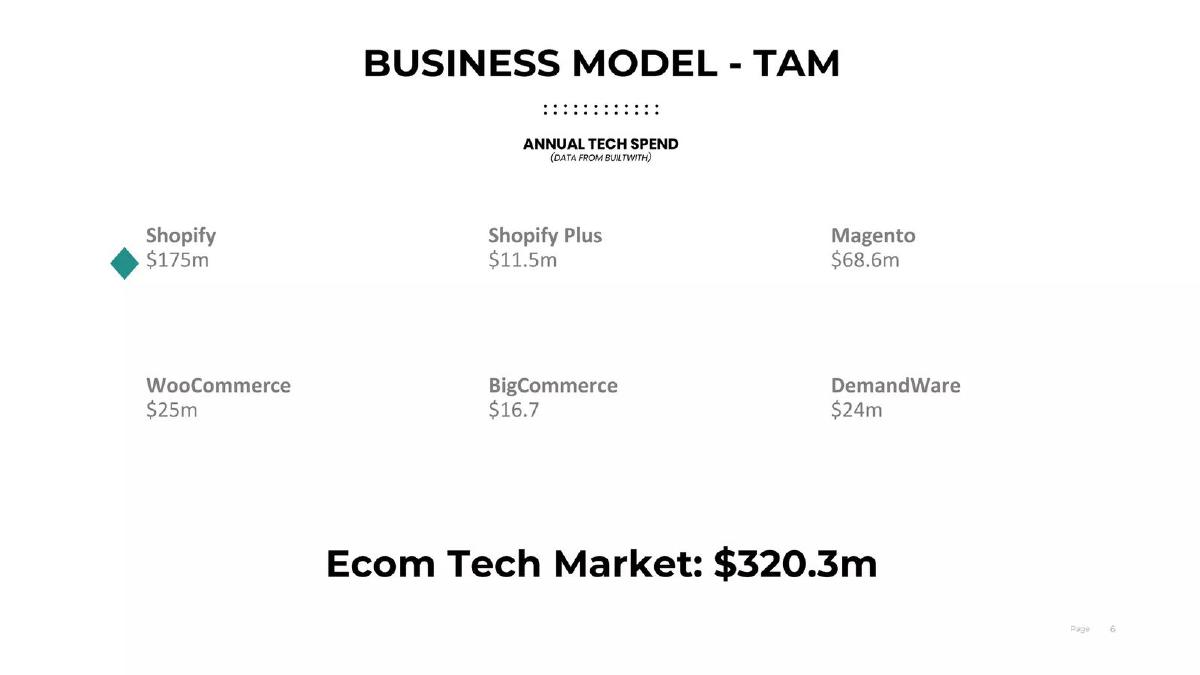
The business model is presented as a linear flow of market capture. It starts with a figure of $320.3m (presumably the total addressable commission pool, though the source of this number is not cited on the slide). Applying an 'Average Commission: 20%' results in a $64m figure. The slide then applies a 'Reasonable Penetration: 20%' to arrive at a Serviceable Obtainable Market (SOM) of $12.8m . Below the flow chart, the text states the market is 'GROWING AT 50%+ ANNUALLY.' This slide is critical as it defines the venture as a commission-based business rather than a SaaS platform.
Slide 9: Exploits
This slide functions as the 'Strategy' or 'Go-to-Market' slide, titled 'EXPLOITS.' It lists eight tactical advantages the company intends to use. Key points include leveraging existing partner programs with 'generous commissions,' filling the 'Marketing Gap' for tech companies that cannot showcase their own products well, and building a 'Knowledge-Based Network Effect' by performing hundreds of demos. Point 6 is particularly specific, stating they will tackle 'low-volume, low-competition keywords centered around "vs," "comparison," and "pricing."' This confirms a heavy reliance on an SEO-driven content strategy. Point 8 mentions their ability to outreach to Shopify stores because they are not an official partner, allowing them to bypass certain Shopify Terms of Service restrictions.
Slide 11: Team
The team slide features the two co-founders. Shana Haynie , the COO, is described as 'The Glue,' with a background as a co-founder of Vulpine Interactive and a specialist in inbound marketing and project management. Derric Haynie , the Chief Ecommerce Technologist, is labeled 'The Visionary.' His credentials include being a 'Five time founder, ex-high stakes poker pro, author, [and] former digital marketing agency CEO.' His experience spans working in-house for ecommerce stores and tech providers. Both profiles include social media icons for Twitter, YouTube, and LinkedIn, emphasizing their roles as industry influencers.
What Works in This Deck
Clear Problem Identification: The 'Problem x2' approach is effective. By showing how the current ecosystem fails both the buyer and the seller, the company justifies its existence as a necessary middleman. The mention of 'Biases' in agency recommendations is a specific pain point that resonates with merchants who feel they are being pushed toward software based on kickbacks rather than merit.
Specific GTM Strategy: The 'Exploits' slide is refreshingly honest about how they intend to win. Instead of vague 'social media marketing' goals, they specify the types of keywords they will target ('vs,' 'comparison') and the specific regulatory loophole they are using (not being a Shopify partner to allow for direct outreach). This gives investors a clear picture of the operational playbook.
Realistic Revenue Math: While the starting number of $320.3m isn't sourced, the logic of the SOM calculation is easy to follow. Using a 20% penetration rate as a 'reasonable' goal shows a level of conservatism that is often missing in early-stage decks that claim 100% market dominance.
What Is Missing
Product Visualization: The most significant omission is the 'Solution' slide. We know how they will get traffic and how they will make money, but we don't know what the user actually interacts with. Is it a directory website? A consultancy service? A proprietary software tool that automates vetting? Without screenshots or a product description, the venture looks like a high-end affiliate blog rather than a scalable technology company.
Traction Metrics: There are no slides indicating current progress. There is no mention of current revenue, number of demos completed, website traffic, or existing partnerships. For a business model so dependent on SEO and '100s of demos,' showing that they have already started this process is vital for proving execution capability.
Competitive Landscape: The deck mentions that tech companies fear talking about their competitors, but the deck itself fails to map out the competitive landscape for Ecommerce Tech. They do not address how they differ from established review sites like G2, Capterra, or specialized ecommerce agencies that offer tech stack auditing.
The Ask: The attached slides do not include a funding ask. There is no mention of how much capital is being raised, the valuation, or how the funds will be allocated (e.g., hiring writers, developers, or sales staff).
Founder Takeaways
Target the 'Comparison' Intent: If you are building a content-led business, follow this deck's lead by identifying high-intent, low-competition keywords. Users searching for 'Product A vs Product B' are at the bottom of the funnel and ready to buy, making them the most valuable leads for an affiliate model. · Bifurcate the Problem: If your business sits in the middle of a marketplace, always explain the problem from both the supply side and the demand side. It doubles your perceived value proposition. · Define Your 'Exploits': Move beyond a generic 'Marketing Plan' slide. List the specific market inefficiencies or 'loopholes' you are exploiting. It demonstrates a deeper level of industry expertise. · Humanize the Team: Using nicknames like 'The Glue' and 'The Visionary' alongside specific past achievements helps build a narrative around the team's chemistry and suitability for the specific problem they are solving.
Frequently asked questions
- What is the primary revenue driver for Ecommerce Tech?
- According to Slide 7, the revenue model is based on affiliate commissions. They project an average commission of 20% from tech providers. By acting as a vetted intermediary that helps merchants choose their tech stack, they capture a percentage of the software spend. Their SOM calculation of $12.8 million is directly derived from these commission percentages rather than software subscriptions or service fees.
- How does the company plan to acquire customers?
- The strategy is heavily focused on organic search and partnership loops. Slide 9 details their 'Exploits,' which include targeting comparison-based keywords (e.g., 'Tool A vs Tool B') and leveraging the audiences of their tech partners. They also mention reaching out to Shopify stores directly, noting that as a non-partner, they are not bound by the same restrictive terms of service as official Shopify partners.
- What specific problem are they solving for tech providers?
- Slide 3 notes that tech providers have a hard time finding new customers and explaining their 'aha moment.' Ecommerce Tech aims to solve this by acting as an outsourced vetting and demonstration layer, helping these companies show their Unique Selling Proposition (USP) to qualified merchants who are already looking for solutions.
- Is there a product or platform described in the deck?
- The deck is notably light on product specifics. There are no screenshots of a dashboard or a platform interface. Instead, Slide 9 suggests the 'product' is the knowledge gained from doing '100s of demos.' This implies the business may function more as a content site or a consultancy that uses data and reviews to drive affiliate conversions rather than a standalone software tool.
- Who are the founders and what is their background?
- Slide 11 introduces Shana Haynie (COO) and Derric Haynie (Chief Ecommerce Technologist). Shana is a co-founder of Vulpine Interactive and a digital marketing specialist. Derric is described as a five-time founder and former digital marketing agency CEO with experience working in-house at ecommerce stores and tech companies. Their background is rooted in agency operations and inbound marketing.