EVERY’s Series C deck is a concise, visually-driven argument for the superiority of precision fermentation in the alternative protein market. Rather than focusing on the ethical 'why,' the deck leans heavily into the functional 'how,' demonstrating that their animal-free proteins are molecularly identical to traditional eggs but offer better solubility and lower production costs. By highlighting a $200B+ market opportunity and showcasing a 'lean, partner-driven model,' the company successfully positioned itself as a platform technology rather than just a food brand. The deck culminates in rea…
Key takeaways
- The company identifies a $200B+ market opportunity for egg-based ingredients on slide 3.
- EVERY claims their production costs can undercut the mass animal protein market on slide 3.
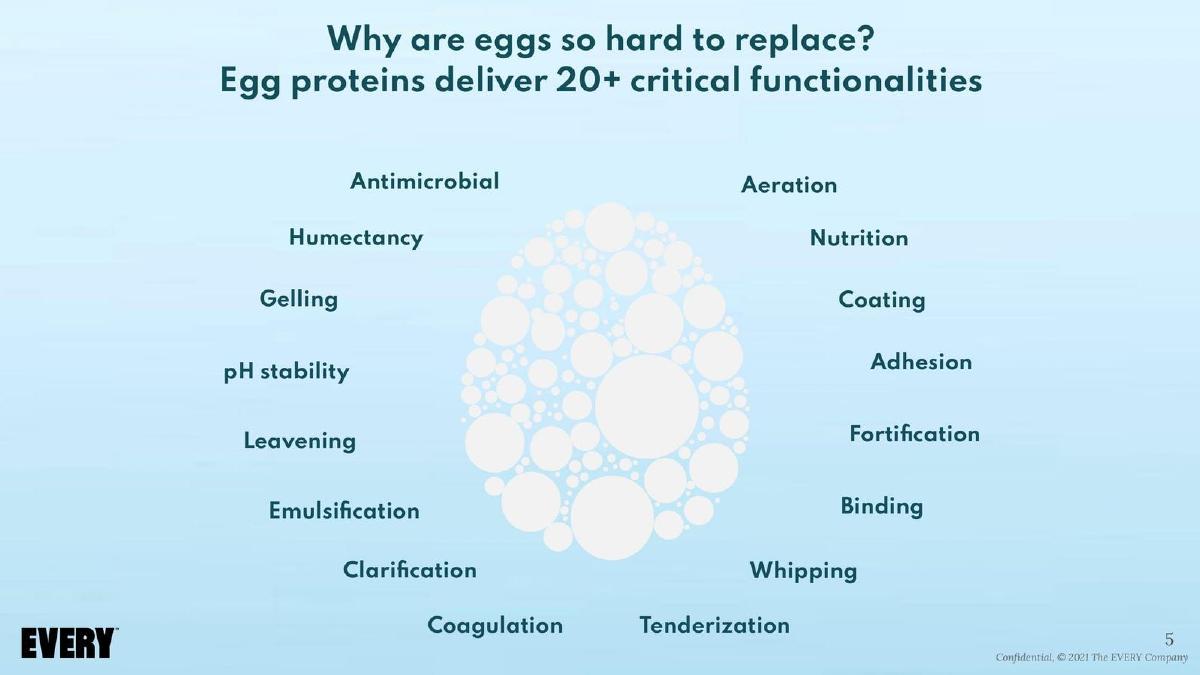
- The deck lists over 20 critical functionalities of egg proteins, such as leavening and emulsification, that they aim to replicate (slide 5).
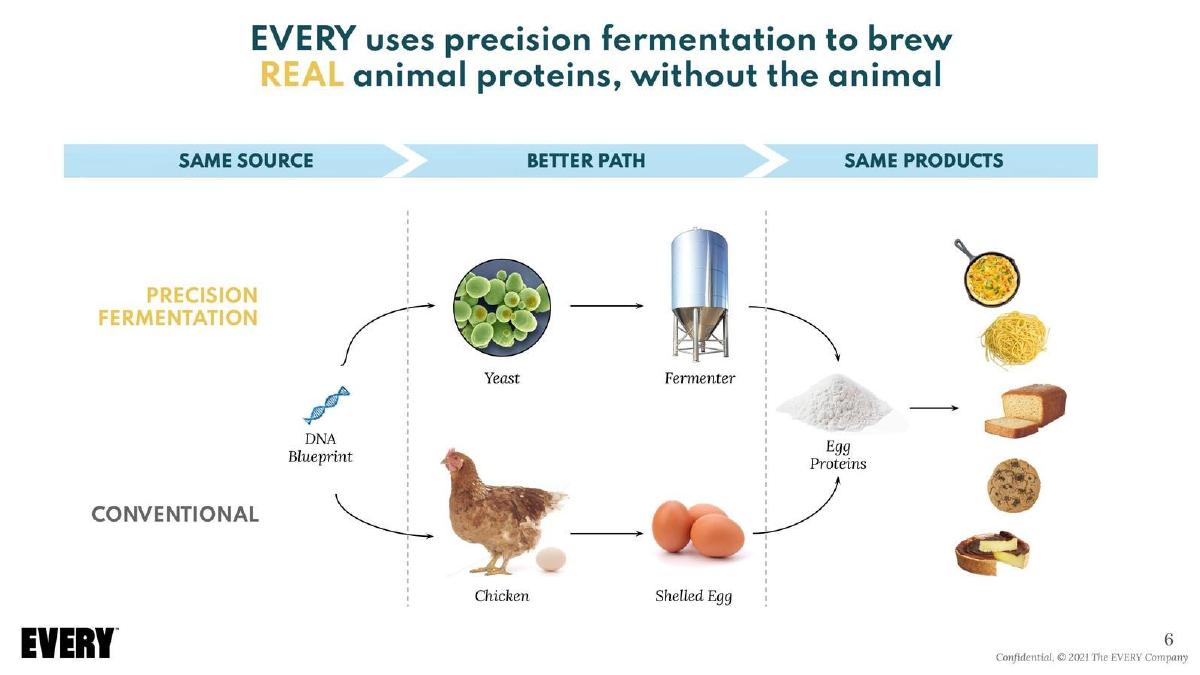
- Precision fermentation is presented as a 'Better Path' that uses the same DNA blueprint as a chicken but skips the animal (slide 6).
- The company has already achieved commercial scale, selling animal-free pepsin across three continents (slide 7).
- EVERY's protein demonstrates superior solubility compared to soy, pea, and whey in visual test-tube comparisons (slide 8).
- The deck highlights a specific target protein that costs $10,000+ per kg to extract from natural eggs, which EVERY can produce more efficiently (slide 8).
- A partnership with Pressed Juicery serves as the primary proof of concept for their animal-free protein beverage (slide 9).
Executive Summary: The Power of Functional Biotech
EVERY (formerly known as Clara Foods) is a biotech company that has successfully navigated the transition from a laboratory concept to a commercial-scale ingredient provider. This 9-slide deck, used for their $175M Series C, is a masterclass in B2B storytelling. It avoids the common pitfalls of alternative protein pitches—which often focus too much on environmental guilt—and instead focuses on the technical and economic superiority of their product. By the time an investor reaches slide 9, the case for EVERY is built on three pillars: a massive existing market, a superior functional product, and a scalable manufacturing process.
Slide 1 & 2: Branding and Legal Guardrails
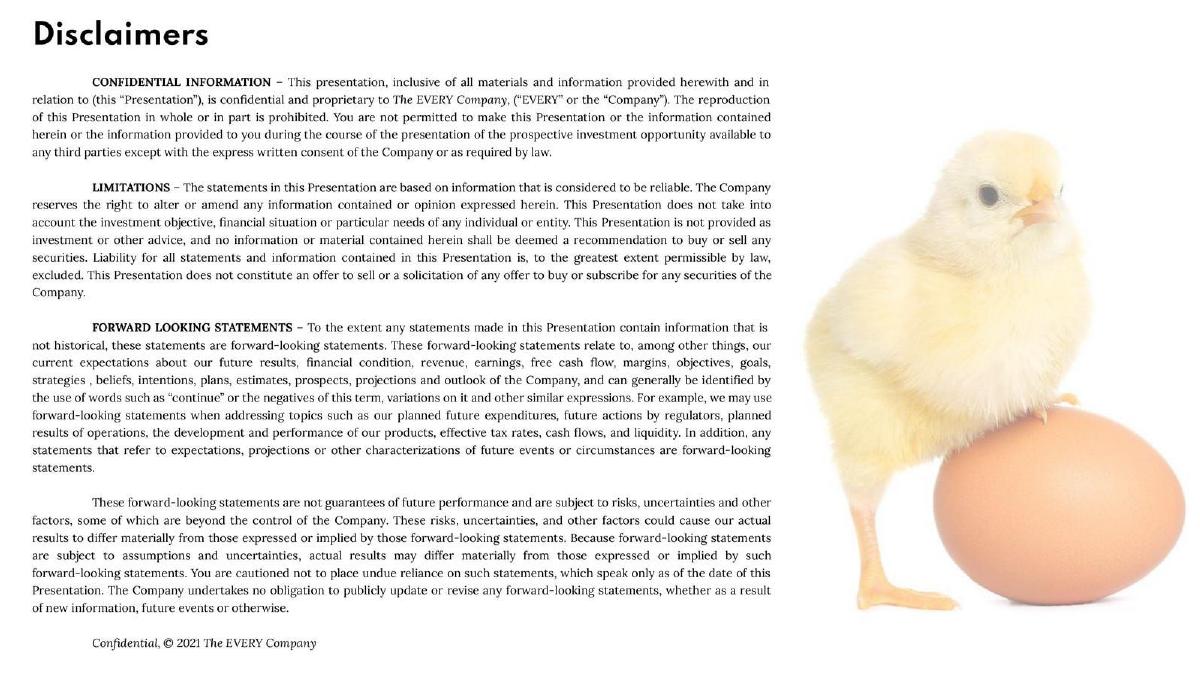
The deck opens with a minimalist title slide featuring the EVERY logo and the mission statement: "Accelerating the world’s transition to animal-free protein." This is followed immediately by a standard, albeit dense, Disclaimers slide. While founders often overlook the legal slide, in a Series C biotech raise, it is essential. It covers forward-looking statements and the confidential nature of the proprietary fermentation processes discussed later. The use of a chick standing on an egg on slide 2 is a subtle nod to the 'chicken or the egg' dilemma, which their technology effectively bypasses.
Slide 3: The High-Level Value Proposition
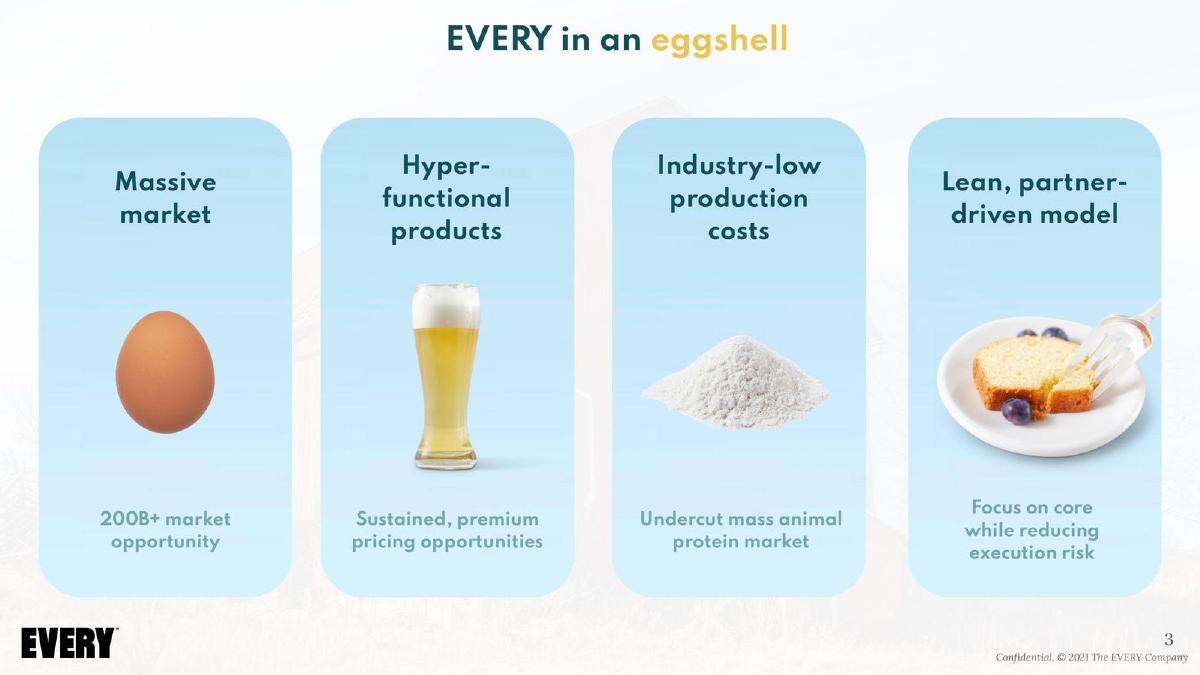
Slide 3, titled "EVERY in an eggshell," serves as the executive summary. It breaks the business down into four quadrants: Massive market ($200B+ opportunity), Hyper-functional products (sustained premium pricing), Industry-low production costs (undercutting mass animal protein), and a Lean, partner-driven model . This slide is critical because it addresses the four main concerns of a Series C investor: TAM, margin, cost-competitiveness, and execution risk. By stating they can 'undercut' the mass market, they are signaling that they aren't just a luxury vegan alternative, but a direct threat to industrial egg production.
Slide 4 & 5: The Ubiquity of the Egg
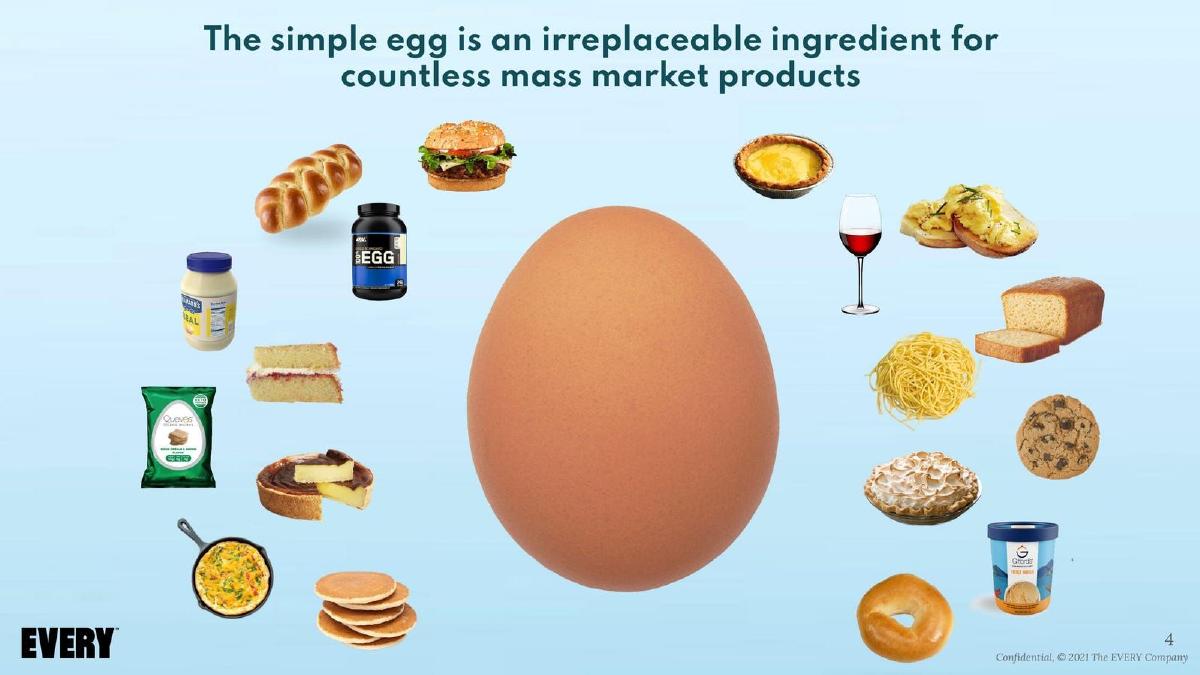
Slide 4 visualizes why the egg is the 'holy grail' of food tech. It surrounds a central egg with images of bread, burgers, wine, pasta, cookies, and ice cream. The headline calls it an "irreplaceable ingredient for countless mass market products." Slide 5 then explains why it is irreplaceable, listing 20+ functionalities including Antimicrobial, Gelling, Leavening, Emulsification, and Coagulation . This is a brilliant move; it educates the investor on the complexity of food science while setting the stage for why plant-based proteins (which often lack these traits) have failed to fully replace eggs.
Slide 6: The Technology Bridge
This is the 'how it works' slide. It compares the "Conventional" path (Chicken -> Shelled Egg -> Egg Proteins) with the "Precision Fermentation" path (DNA Blueprint -> Yeast -> Fermenter -> Egg Proteins). The key phrase here is "REAL animal proteins, without the animal." By emphasizing that the DNA blueprint is the 'Same Source,' EVERY distances itself from 'synthetic' foods and positions its product as bio-identical. This is a crucial distinction for regulatory approval and consumer acceptance.
Slide 7: Commercial Validation (Pepsin)
To prove their platform works, EVERY highlights their first commercial product: "World’s first animal-free pepsin." Slide 7 lists the value to the company: selling across three continents, greater purity than animal-derived versions, and full Kosher/Halal/Vegan certification. Most importantly, it notes the "Demonstrate platform scalability from Pilot -> Commercial." For a Series C, showing that you have already successfully scaled one enzyme is the best way to de-risk the scaling of the next one (egg protein).
Slide 8: The Competitive Moat (Solubility)
Slide 8 is the most technical and perhaps the most persuasive. It shows four test tubes containing Soy, Pea, EVERY, and Whey proteins. The EVERY tube is crystal clear, while the others are cloudy. The slide also mentions "Unlocking Trace Proteins" that make up less than 1% of the egg and are "infeasible to extract from nature." They cite a specific figure: "Egg protein that traditionally costs $10,000+ per kg using eggs." This suggests that EVERY isn't just making eggs cheaper; they are making high-value specialty proteins accessible for the first time.
Slide 9: The Proof of Concept
The deck concludes with a real-world application: the "World’s first animal-free protein beverage." It features a product from Pressed Juicery and a quote from their Product Development Director: "The best vegan protein I’ve worked with in my 20 years in the industry." Ending on a customer testimonial from a recognized brand is a classic 'closing' move. It moves the conversation from 'what if' to 'what is.'
What EVERY Got Right
Functional Focus: They didn't lead with 'saving the planet.' They led with 'our protein is clearer, more soluble, and cheaper to produce.' In B2B, functionality wins. · Visual Proof: The test tube comparison on slide 8 is worth more than ten slides of data. It immediately communicates the product's superiority to any non-technical observer. · Platform Play: By showing the pepsin success on slide 7, they proved they aren't a one-trick pony. They are a fermentation platform that can produce a variety of high-value ingredients. · Market Context: Slide 4 does a great job of showing that their customer isn't the person buying a carton of eggs, but the industrial food manufacturer buying egg powder by the ton.
What is Missing from the Deck
The Team: There is no mention of the founders, scientists, or leadership team. In a $175M raise, the pedigree of the technical team is usually a major selling point. · Financials: There are no charts showing revenue growth, burn rate, or projected paths to profitability. While these are likely in the data room, their absence in the pitch deck makes the 'business' side of the company feel opaque. · The Ask: The deck does not specify how much they are raising or what the funds will be used for (e.g., building a new facility, expanding the sales team, R&D). · Competition: There is no competitive landscape slide. While they compare themselves to 'Soy' and 'Pea,' they don't mention other precision fermentation competitors like The Perfect Day or Geltor.
Founder Lessons
1. Sell the 'Unfair Advantage': EVERY didn't just say they make egg protein; they said they make the 1% of egg proteins that are too expensive to get from real eggs. Find the one thing your technology does that is physically impossible for the incumbent to do, and make that a centerpiece of your deck.
2. Use 'Same Source' Logic: If you are in biotech, the 'synthetic' label is a hurdle. EVERY’s slide 6 is a perfect example of how to frame bio-identical products. By showing the DNA blueprint comes from the same source, they make the fermenter seem like a more efficient 'oven' rather than a scary lab.
3. The Power of the B2B Testimonial: If you are an ingredient or platform company, your brand doesn't matter as much as your customers' brands. The Pressed Juicery slide is the most important slide for proving that there is actual demand for the product.
4. Keep it Lean: This deck is only 9 slides. For a Series C, that is incredibly short. It shows a high level of confidence. If your metrics and technology are strong enough, you don't need 40 slides to convince an investor.
Frequently asked questions
- What is the core technology behind EVERY?
- EVERY uses precision fermentation. As shown on slide 6, they take a DNA blueprint—the same source used by a chicken—and insert it into yeast. This yeast is then brewed in a fermenter to produce real egg proteins without the need for animal farming. This allows them to create 'animal-free' proteins that are molecularly identical to those found in nature.
- How does EVERY justify its market size?
- On slide 3, EVERY cites a $200B+ market opportunity. They support this on slide 4 by visualizing the 'simple egg' as an essential ingredient in a vast array of mass-market products, including bread, burgers, wine, pasta, cookies, and ice cream. They position themselves as a B2B ingredient supplier for these global industries.
- What is the main competitive advantage mentioned in the deck?
- Functionality and solubility. Slide 8 shows a side-by-side comparison where EVERY’s protein is completely clear in a test tube, whereas soy and pea proteins are opaque and sediment-heavy. This 'enhanced solubility' is a key selling point for beverage manufacturers who want to add protein without affecting the texture or clarity of the drink.
- Does the deck show any existing revenue or traction?
- While specific revenue figures are omitted, slide 7 notes that their animal-free pepsin is already 'selling across three continents.' Additionally, slide 9 features a testimonial and product shot from the Product Development Director at Pressed Juicery, indicating that their protein is already being used in commercial consumer products.
- What are the biggest risks missing from this pitch?
- The deck is very light on execution details. It mentions a 'lean, partner-driven model' to reduce risk (slide 3), but it does not name these partners or explain the unit economics of their fermentation process. There is also no mention of the regulatory landscape or the specific timeline for reaching price parity with conventional eggs.