Unflow’s 2019 Seed deck is a masterclass in product-led storytelling. By raising $2.2 million, the team successfully communicated a technical value proposition—Server Driven UI (SDUI)—to a non-technical audience. The deck avoids dense text, opting instead for a 'show, don't tell' approach with 10 of the 17 slides dedicated to product interfaces, use cases, and technical workflows. While the deck is noticeably light on market sizing, financial projections, and a specific 'Ask' slide, it compensates with strong social proof, citing industry giants like Airbnb and Lyft as pioneers of their metho…
Key takeaways
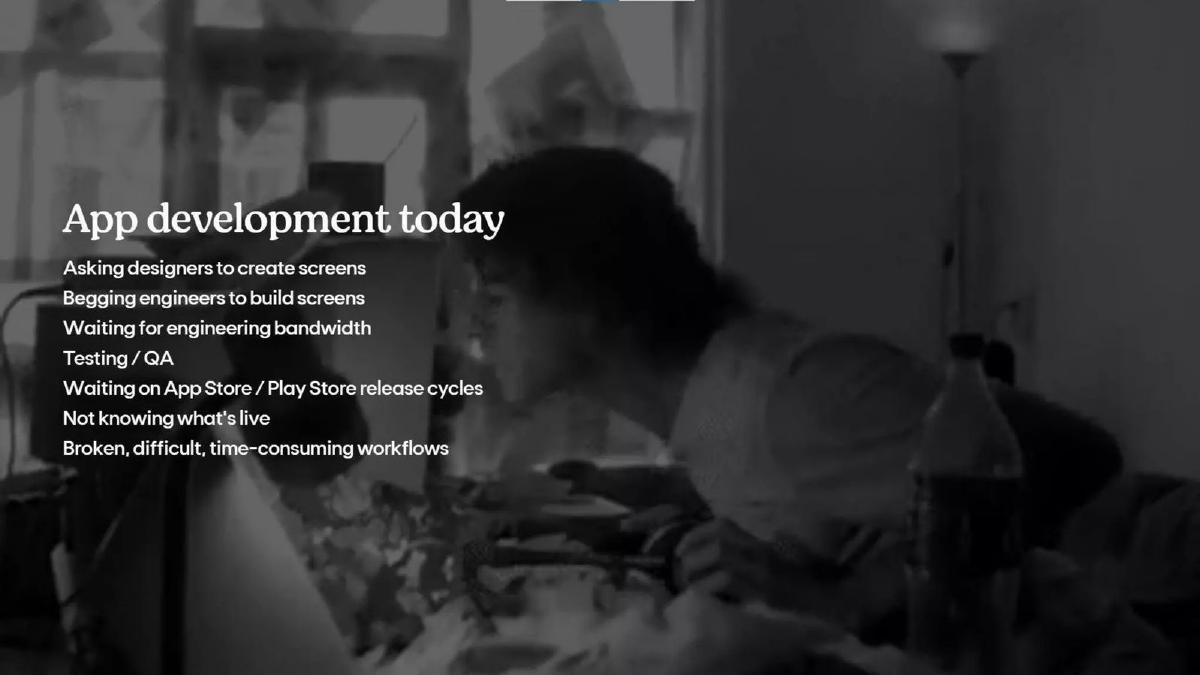
- The deck defines the problem as a broken workflow involving begging engineers for bandwidth and waiting on App Store release cycles (Slide 2).
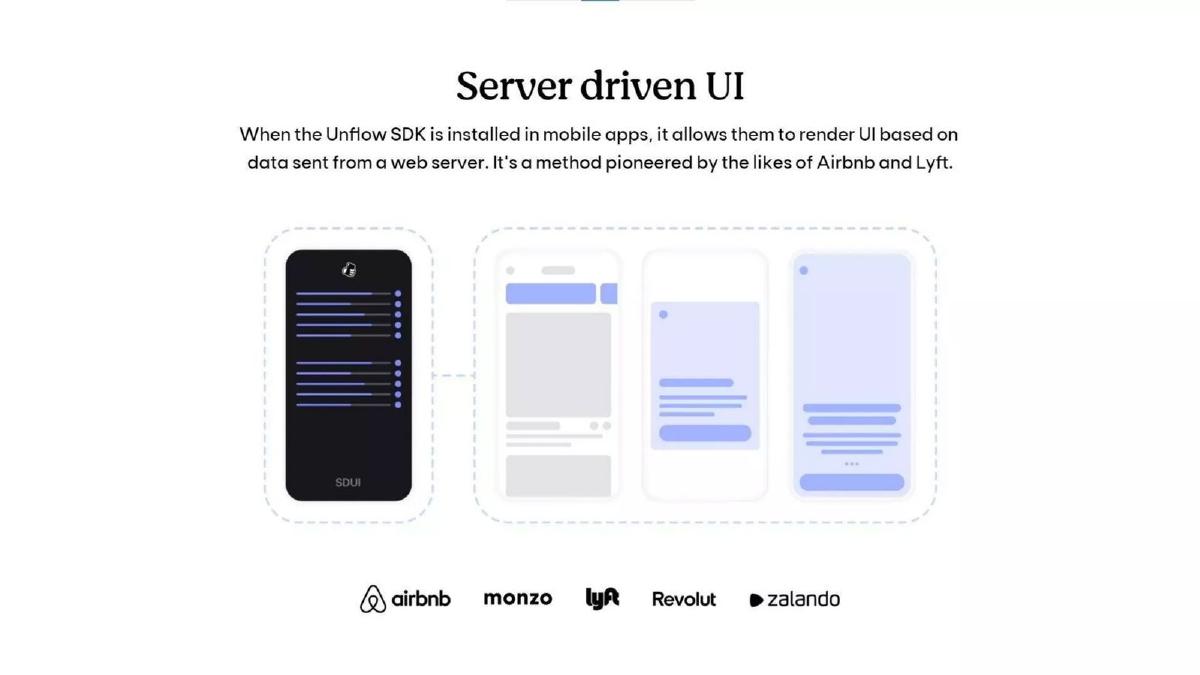
- Unflow utilizes the concept of Server Driven UI (SDUI) to explain how their SDK renders content based on web server data (Slide 4).
- Social proof is established early by listing Airbnb, Monzo, Lyft, Revolut, and Zalando as companies already using similar SDUI methods (Slide 4).
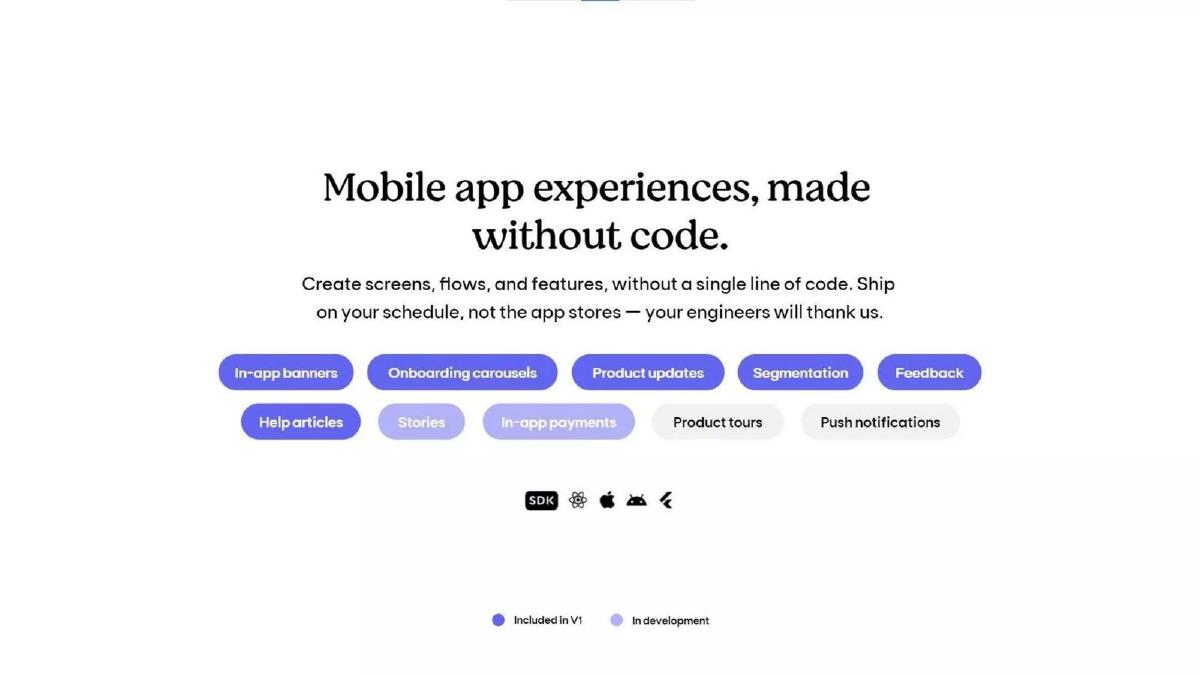
- The product roadmap is clearly segmented into 'Included in V1' features like banners and onboarding, and 'In development' features like in-app payments (Slide 5).
- A dedicated 'Unflow Mirror' app slide demonstrates how developers can preview screens instantly via QR code (Slide 9).
- The deck showcases advanced targeting capabilities, allowing users to segment by iOS version, plan type, and specific events like 'Visited Purchase Page' (Slide 10).
- The team slide emphasizes experience at high-growth environments including Intercom, Monzo, and Xero, though individual names are not listed on the slide (Slide 15).
- The deck lacks a traditional 'Ask' slide, omitting the specific funding amount, valuation, or use of proceeds (Slide 16).
The Vision: No-Code for Native Mobile
Unflow’s pitch deck is a clean, visually-driven presentation that focuses on solving the bottleneck of mobile app development. In 2019, the 'no-code' movement was gaining significant steam, but most tools focused on web applications. Unflow identified a specific pain point: the rigid, slow process of updating native mobile apps. By raising $2,200,000, they proved that investors were hungry for solutions that bypassed the traditional App Store gatekeepers.
Slides 1-3: The Problem and The Promise
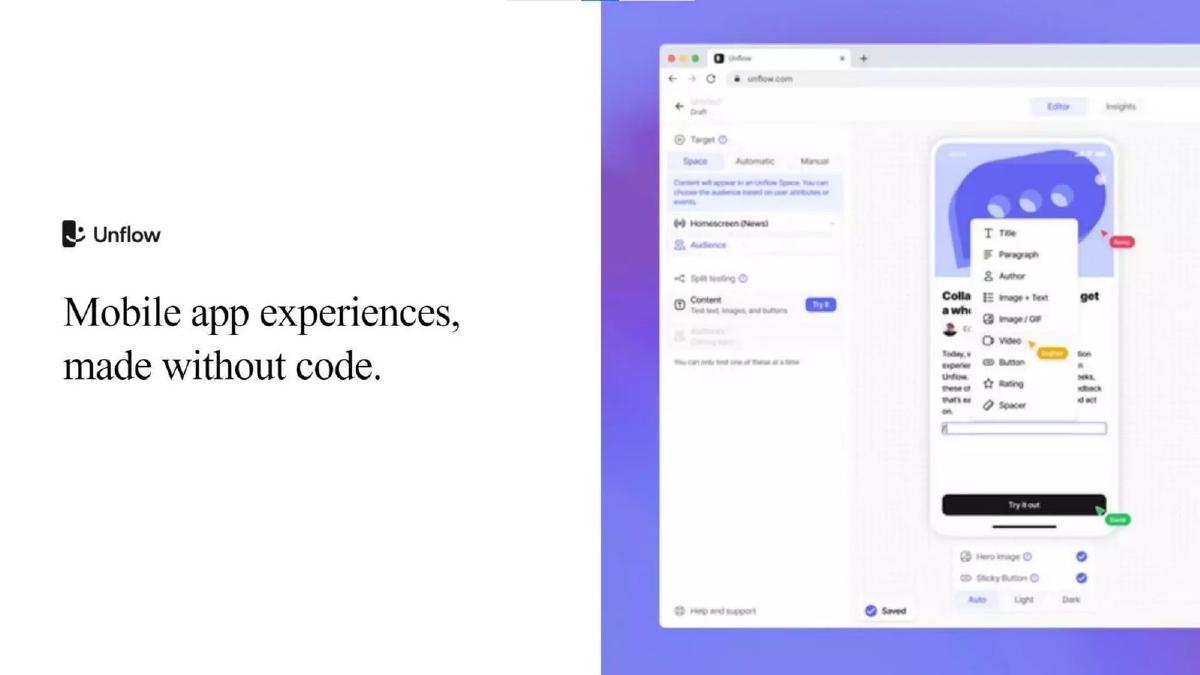
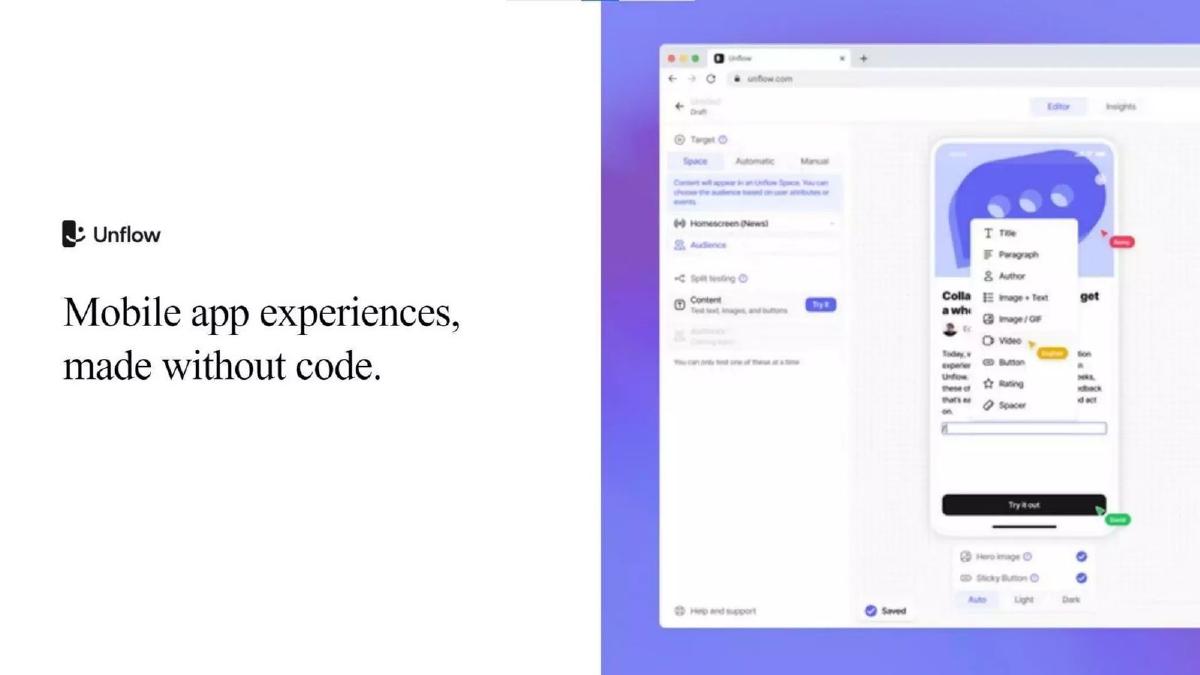
The deck opens with a simple value proposition on Slide 1 : "Mobile app experiences, made without code." This is accompanied by a high-fidelity screenshot of a web-based editor, immediately establishing that this is a functional SaaS product, not just a concept. Slide 2 , titled "App development today," lists the grievances of the status quo: begging engineers for bandwidth, waiting for QA, and the dreaded App Store release cycles. It frames the current workflow as "broken, difficult, and time-consuming."
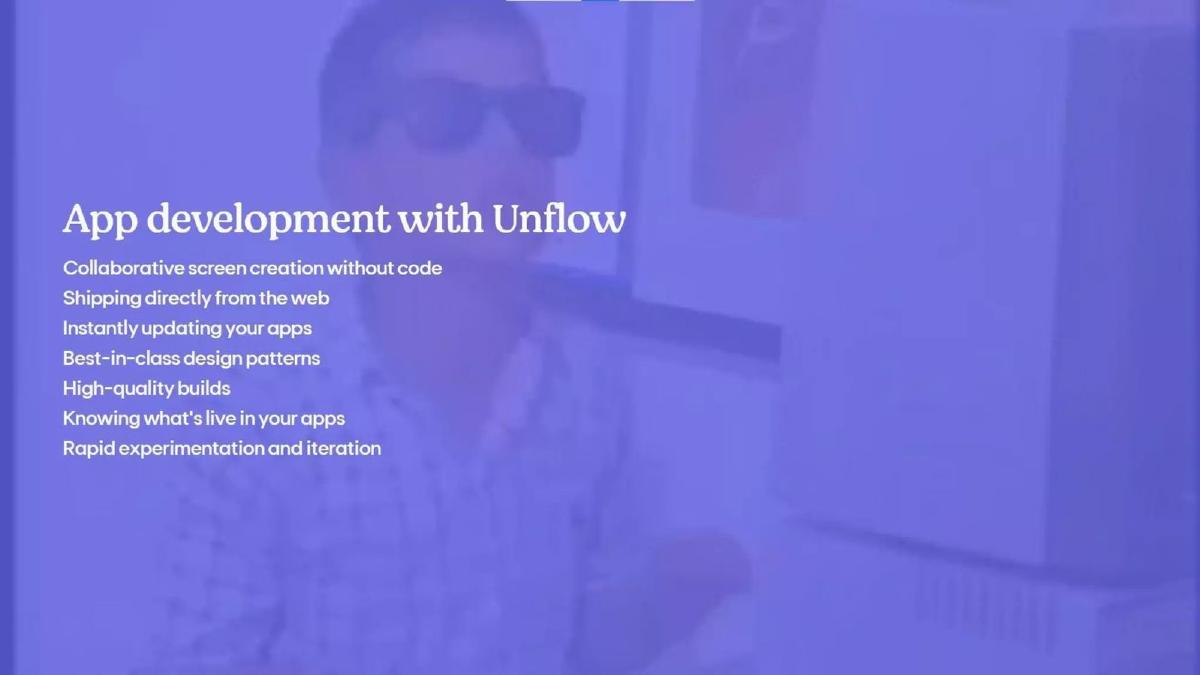
Slide 3 provides the direct antithesis. "App development with Unflow" promises collaborative screen creation, shipping directly from the web, and rapid experimentation. By mirroring the bullet points of the problem slide, the founders create a clear 'before and after' narrative that is easy for any stakeholder who has worked in a product org to understand.
Slides 4-6: The Technical Foundation and Social Proof
Slide 4 is perhaps the most important slide for technical validation. It introduces "Server driven UI" (SDUI). Rather than trying to explain the code, it uses a diagram showing a server pushing data to multiple device types. Crucially, it name-drops Airbnb and Lyft as pioneers of this method. Below the diagram, logos for Monzo, Revolut, and Zalando are displayed. This is a clever use of social proof; even if Unflow doesn't have these customers yet, it aligns their technology with the world's most successful engineering organizations.
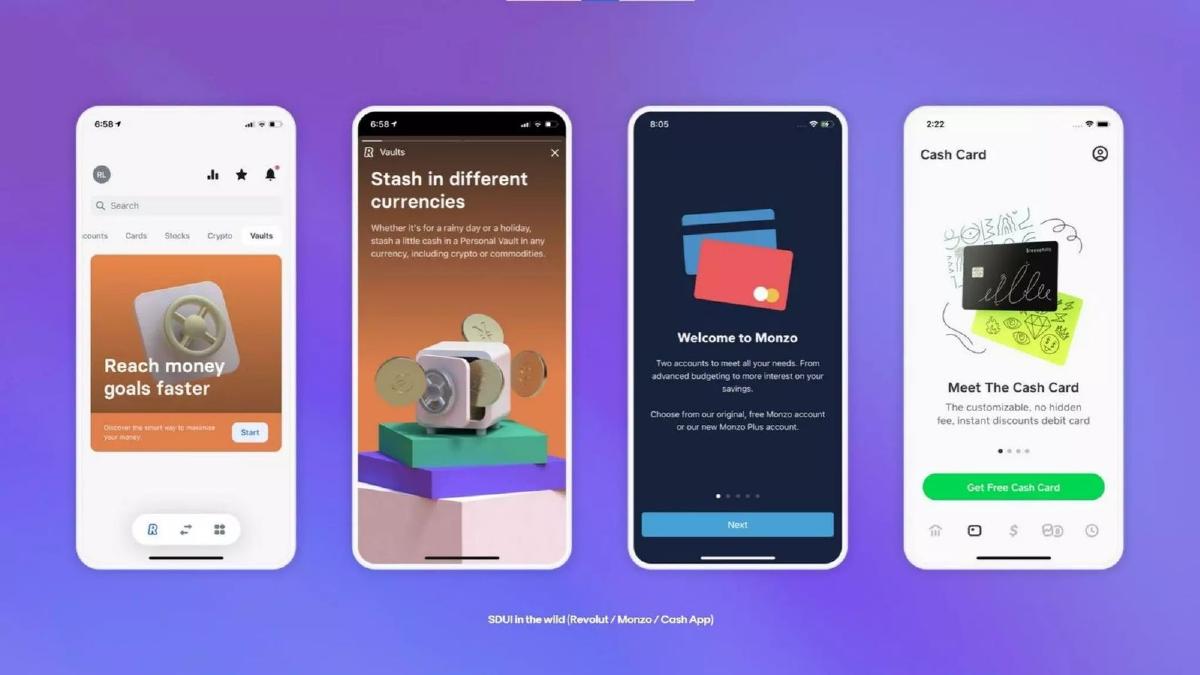
Slide 5 breaks down the product scope. It lists features "Included in V1" such as in-app banners, onboarding carousels, and segmentation. It also shows "In development" items like in-app payments and product tours. This gives investors a sense of the current utility versus the long-term platform potential. Slide 6 shows "SDUI in the wild," using screenshots from Revolut, Monzo, and Cash App to show what these experiences look like to an end-user, further demystifying the technical concept.
Slides 7-12: The Product Deep Dive
The middle section of the deck is a heavy product walkthrough. Slide 7 shows the mobile UI made with Unflow, emphasizing high-quality aesthetics. Slide 8 returns to the visual editor, showing a 'drag-and-drop' style interface with elements like Title, Paragraph, and Video. Slide 9 introduces "Unflow Mirror," a tool for developers to preview their work instantly by scanning a QR code. This addresses the 'testing/QA' pain point mentioned in the problem slide.
Slide 10 focuses on "Advanced targeting." The screenshot shows a logic builder where users can target specific iOS versions or users who have "Visited Purchase Page" more than three times. This moves the product from a simple design tool to a powerful marketing automation engine. Slide 11 shows the flow builder, illustrating how Unflow screens can link to native app screens (e.g., a 'Create account' button in Unflow triggering a native login flow). Slide 12 covers A/B testing, showing a split-test between two variants to "fine tune your results."
Slides 13-17: The Wrap-Up and The Team
Slide 13 is a collage of various features, reinforcing the "set and forget installation" which allegedly takes only 20 minutes. This slide acts as a summary of the technical and functional value propositions. Slide 14 lists the investors. While the logos are stylized, the text mentions they are backed by investors behind Calm, Wise, and Revolut. This is a high-signal slide that replaces the need for a long traction slide at the Seed stage.
Slide 15 introduces the team. It describes them as a "small but ambitious team" with experience at Intercom, Monzo, and Xero. Interestingly, the slide does not include the names or specific titles of the five people pictured, relying instead on the collective pedigree of their former employers. Slide 16 is a Q&A slide that reiterates how the product works and offers an email for early access. The deck concludes on Slide 17 with the closing tagline: "Make apps smarter, with Unflow."
What Works in This Deck
Visual Clarity: The deck is beautiful. It uses a consistent color palette and high-resolution screenshots that make the product feel 'finished' and premium. · Analogy-Driven Selling: By comparing their tech to the internal tools built by Airbnb and Lyft, they bypass the need to explain complex SDK architecture. They sell the result of the tech, not the tech itself. · Focus on Workflow: The deck spends a lot of time showing the editor and the targeting logic. This proves that the founders understand the daily life of a Product Manager or Marketer, not just the code. · Clear Scope: Slide 5 does an excellent job of defining what the product is (and isn't) today, which manages investor expectations regarding the 'V1' build.
What is Missing from This Deck
The Ask: There is no mention of how much money is being raised, the valuation, or what the milestones for the next 18 months look like. This information was likely handled in the email or the meeting, but its absence makes the deck feel like a product brochure rather than a financial instrument. · Market Size: There is no attempt to quantify the TAM. How many mobile apps could use this? What is the total spend on mobile development that Unflow could capture? · Business Model: The deck never explains how Unflow makes money. Is it per-seat, per-MAU (Monthly Active User), or a flat enterprise fee? · Competition: There is no mention of other no-code mobile tools or existing marketing clouds (like Braze or Leanplum) that offer similar in-app messaging features.
What a Founder Should Copy
The 'Problem/Solution' Mirror: Use Slide 2 and 3 as a template. List specific pains in one, and specific feature-based cures in the other. It’s the most efficient way to communicate value. · The Preview Tool: If you are building a developer tool or a B2B SaaS, showing how the user 'previews' or 'tests' their work (like Slide 9) builds immense trust in the product's usability. · Pedigree by Association: If you don't have 10,000 users yet, show the logos of the companies that use the same methodology as you. It validates your category even if it doesn't validate your specific startup yet. · Feature Roadmap: Use the 'Included' vs 'In Development' format from Slide 5. It shows you have a vision for the future without lying about what the product can do today.
Frequently asked questions
- What is the core technology Unflow is pitching?
- Unflow is pitching a no-code platform for mobile app experiences powered by Server Driven UI (SDUI). As explained on Slide 4, this involves an SDK that allows mobile apps to render user interfaces based on data sent from a web server. This technology enables teams to update app content and flows instantly without requiring a new submission to the Apple App Store or Google Play Store.
- Who is the target user for Unflow according to the deck?
- The deck identifies marketing teams as the primary users who design and deliver content, while positioning engineers as the secondary beneficiaries who are freed from 'begging' for bandwidth. Slide 16 explicitly states that the collaborative editor allows marketing teams to deliver engaging in-app content instantly without involving engineering for every update.
- How does Unflow handle the complexity of native app integration?
- Slide 11 demonstrates a visual flow builder where 'Unflow and native screens live in harmony.' This suggests the tool is not meant to build entire apps from scratch but rather to insert specific flows (like onboarding or referrals) into existing native applications, connecting them via native screen links.
- What metrics or traction are included in the deck?
- The deck is almost entirely devoid of company-specific traction metrics. There are no mentions of current revenue, number of customers, or user growth. Instead, it relies on 'SDUI in the wild' examples from companies like Revolut and Cash App (Slide 6) to prove the validity of the category rather than the specific success of Unflow's business to date.
- What is missing from this deck that a typical Seed investor would expect?
- This deck omits several standard components: a Market Size (TAM/SAM/SOM) slide, a Competitor Matrix, a Business Model/Pricing slide, and a formal 'The Ask' slide. It functions more as a product vision and technical feasibility document than a comprehensive business plan, suggesting it was likely used in a high-conviction or relationship-driven fundraising environment.