UNest’s pitch deck is a masterclass in identifying a massive, underserved niche within the fintech sector: the 529 college savings market. By framing student debt as a $1.6T national crisis, UNest positions its mobile-first UTMA and 529 accounts as the essential antidote to a complex, paper-heavy legacy system. The deck relies heavily on strong unit economics, citing a $30 blended CAC against an LTV of up to $2,000, and demonstrates impressive early traction with 20% week-over-week growth. While the deck lacks a specific 'Ask' slide regarding valuation or round size, it compensates with a hig…
Key takeaways
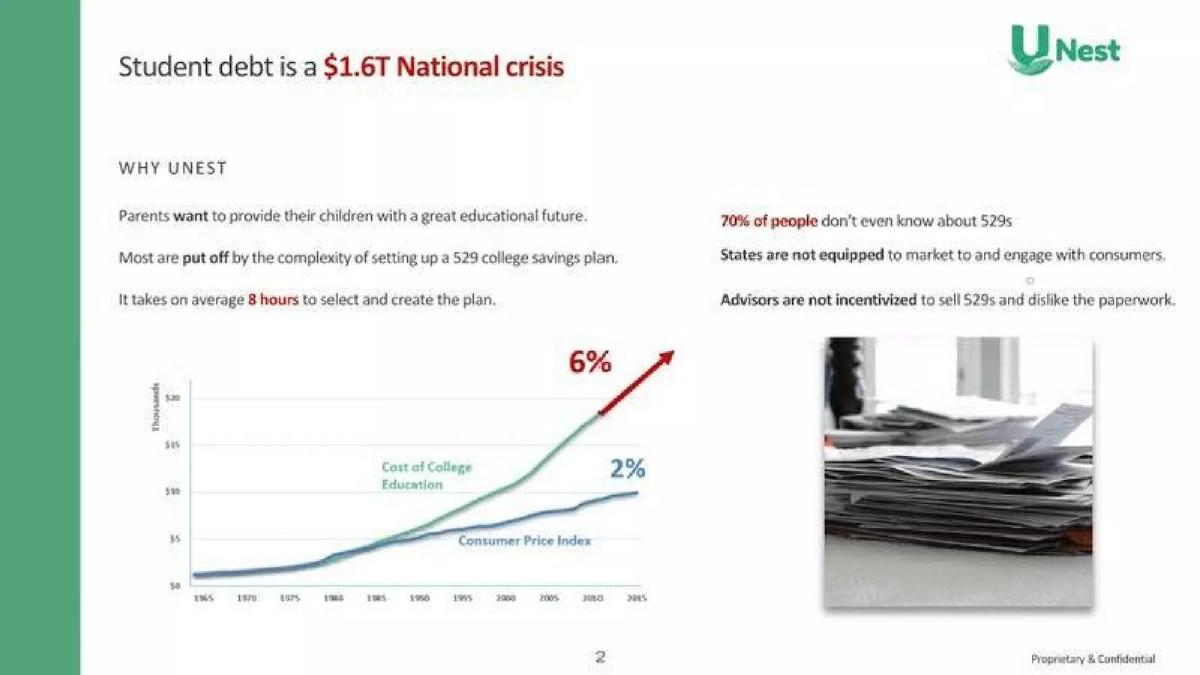
- The problem is quantified as a $1.6T national student debt crisis, with college costs rising at 6% compared to a 2% CPI (Slide 2).
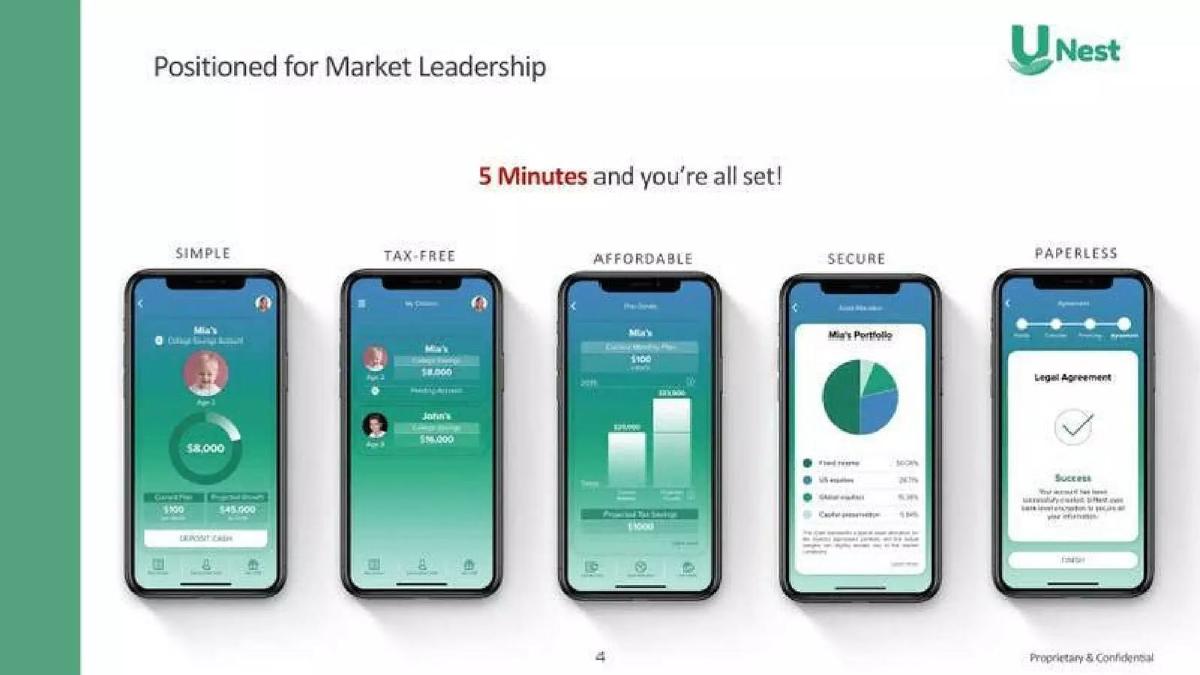
- UNest claims to reduce the 529 plan setup time from an 8-hour average to just 5 minutes (Slides 2 and 4).
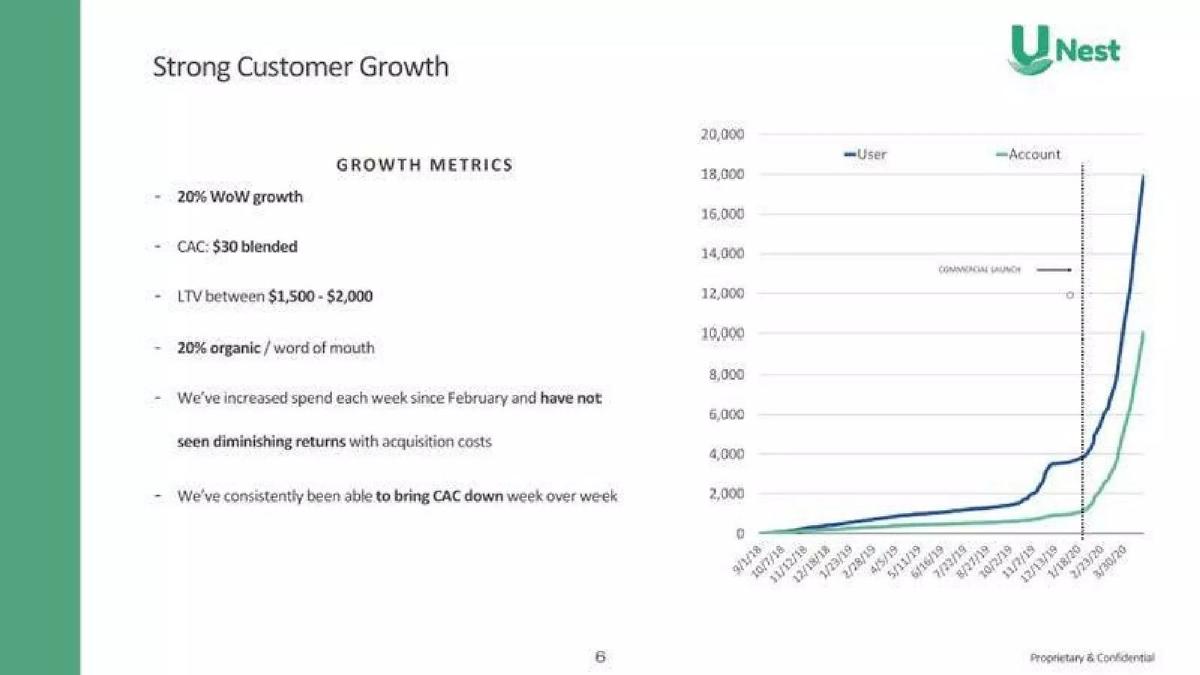
- The company reports strong unit economics with a $30 blended CAC and an estimated LTV between $1,500 and $2,000 (Slide 6).
- Traction is demonstrated by 20% week-over-week growth and a user base that reached approximately 18,000 by early 2020 (Slide 6).
- The revenue model is primarily a flat $3/month per child, with an additional 25 bps annually for accounts over $50k (Slide 11).
- The team features deep fintech expertise from Acorns, Wealthfront, and Marqeta, positioning them as industry insiders (Slide 5).
- Market expansion is projected to grow from a $1.8T potential market in 2018 to $3.6T by 2024 (Slide 7).
- The deck highlights a 'recession-proof' quality, noting that 529 plans have lower redemption rates (6%) compared to other investment products (20%) (Slide 11).
Executive Summary: Democratizing the 529 Plan
UNest entered the market with a clear mission: to simplify the archaic process of saving for a child's education. Founded in 2018 by Ksenia Yudina, the company raised $38.8 million through its Series B. This 15-slide deck focuses on the massive gap between the $1.6T student debt crisis and the underutilized 529 savings plans. By combining high-pedigree fintech leadership with aggressive growth metrics, UNest makes a compelling case for a mobile-first investment platform dedicated to families.
Slides 1-3: The Mission and the Macro Problem
Slide 1: Title Slide. The deck opens with a clean logo and the tagline: "Easiest way to save for your child’s education." It introduces the founder, Ksenia Yudina, noting her MBA and CFA credentials, which establishes immediate professional credibility in the financial sector.
Slide 2: The Problem. This slide frames the opportunity as a "$1.6T National crisis." It uses a stark line graph showing the cost of college education rising at 6% annually, significantly outpacing the Consumer Price Index at 2%. Crucially, it identifies the friction: 70% of people don't know about 529 plans, and those who do are deterred by an 8-hour average setup time and excessive paperwork.
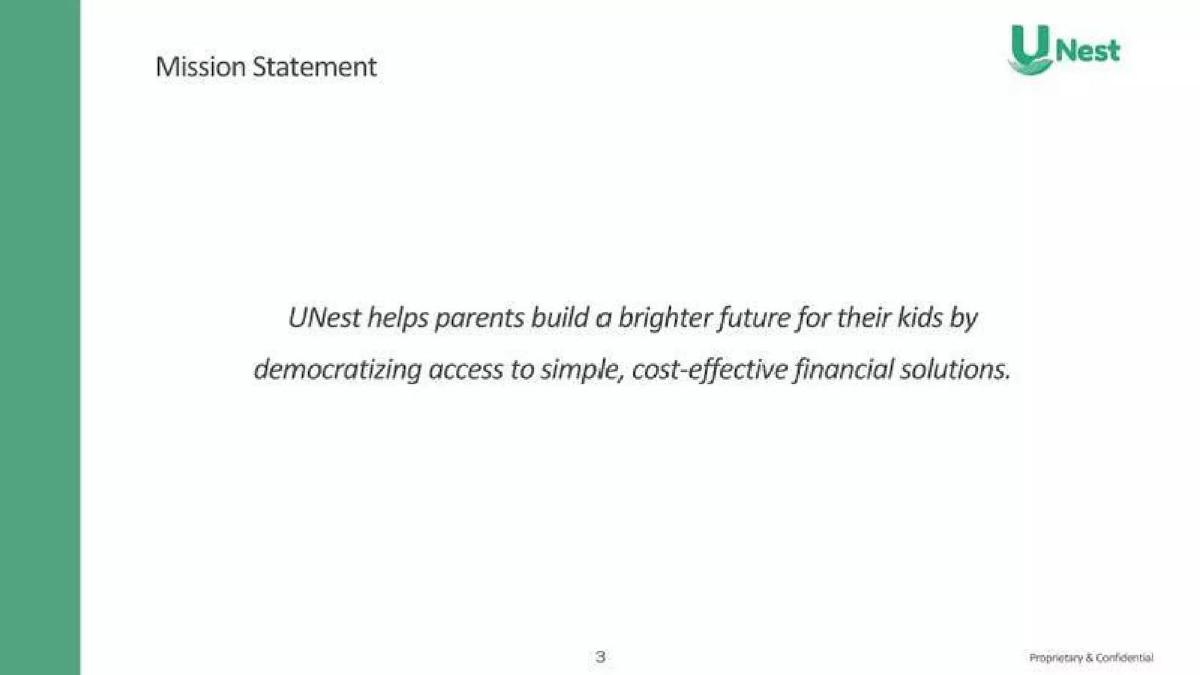
Slide 3: Mission Statement. A simple, high-level slide stating that UNest helps parents build a brighter future by democratizing access to simple, cost-effective financial solutions. It serves as a bridge from the macro problem to the specific UNest solution.
Slides 4-6: Product, Team, and Traction
Slide 4: The Solution. Titled "Positioned for Market Leadership," this slide uses five smartphone mockups to demonstrate the UI. It emphasizes five key pillars: Simple, Tax-Free, Affordable, Secure, and Paperless. The headline "5 Minutes and you're all set!" directly counters the 8-hour pain point mentioned on Slide 2.
Slide 5: The Team. This is a high-strength slide. It features CEO Ksenia Yudina (ex-Capital Group), CTO Steve Buchanan (15 years fintech experience), CMO Peter Mansfield (25 years experience, co-founder of Marqeta), and COO Mike Van Kempen (ex-Acorns). The inclusion of logos like Acorns, Wealthfront, and Marqeta signals to investors that the leadership has already built and scaled successful fintech companies.
Slide 6: Growth Metrics. This is the "meat" of the deck for Series B investors. It lists a 20% WoW growth rate and a $30 blended CAC. The LTV is estimated at $1,500–$2,000, which implies an exceptionally high LTV/CAC ratio. A dual-axis chart shows user and account growth accelerating sharply after the "Commercial Launch" in early 2020, reaching nearly 18,000 users by the time of the deck's creation.
Slides 7-10: Market Opportunity and Customer Insights
Slide 7: Target Market. UNest identifies Gen X and Millennials (ages 27-45) as their core demographic. It notes that 90% of this group uses mobile banking but 70% lack a financial advisor. The slide quantifies the 529 market as currently capturing only 17% of its $1.8T potential, with a forecast to reach $3.6T by 2024.
Slide 9: Press and Thought Leadership. (Note: Slide 8 is omitted in this sequence). This slide features logos from Forbes, Fortune, and Bankrate. It includes a photo of the CEO speaking with Jason Calacanis, providing social proof and industry validation.
Slide 10: Customer Learnings. This slide provides granular data on their user base: 75% iOS vs. 25% Android, and a 60/40 male-to-female split. It offers a fascinating psychological insight: "Dads react to numbers and the term 'investing'," while "Moms react to lifestyle images and the term 'saving'." This level of detail suggests a team that is highly attentive to marketing optimization.
Slides 11-13: Business Model and Competition
Slide 11: Business Model. UNest charges $3/month per child. They also earn 25 bps annually on accounts over $50k and collect origination fees from state plans. A key defensive point is made here: 529 plans have a 6% redemption rate compared to 20% for other products, making the AUM (Assets Under Management) much "stickier" during market downturns.
Slide 12: Competitive Advantages. Using a wheel diagram, UNest compares itself to Wealthfront, CollegeBacker, and traditional advisors. It claims superiority in onboarding speed (5 minutes), gifting features, and low entry points. It positions Wealthfront as having good UX but lacking the specific gifting and low-cost entry focus of UNest.
Slide 13: Company Roadmap. The timeline starts in March 2018. It highlights a Seed Round in October 2019 led by Anthos, Draper Dragon, and others. Future milestones include reaching 100,000 users in 2021 and international expansion by 2024.
Slides 17-21: Appendix and Fee Comparisons
Slide 17: Appendix. A transition slide marking the start of supplemental data.
Slide 20: 529 Plan Benefits. This slide uses a bar chart to show projected savings growth over 18 years. It compares a standard cash account ($43,200) to a 529 account ($97,071), highlighting the significant "Tax Advantage" as the primary driver of value for the end user.
Slide 21: Fee Structure Comparison. This final slide is a direct attack on traditional advisors. It compares "Share Class A" and "Share Class C" fees (which can include 5% front loads or 1% annual fees) against UNest’s flat $3/month fee. It illustrates that on a $10,000 account, a traditional advisor might take $100 in annual fees, whereas UNest remains a flat $36, regardless of account value.
What Works in This Deck
The LTV/CAC Story: For a Series B deck, the unit economics are the most important factor. By showing a $30 CAC against a $1,500+ LTV, UNest demonstrates a machine that is ready for capital injection to scale. The Team Pedigree: Listing founders and executives from Acorns and Marqeta immediately removes the "execution risk" question from investors' minds. Friction Reduction: The constant comparison between the "8-hour traditional process" and the "5-minute UNest process" clearly defines the product's value proposition.
What Is Missing
The Ask: There is no slide explicitly stating how much money is being raised in this specific round or how the funds will be allocated (e.g., 50% marketing, 30% engineering). Detailed Financial Projections: While growth is shown, a formal P&L forecast or a path to profitability is absent from these 15 slides. Regulatory Moat: Given that 529 plans are state-sponsored, more detail on the specific partnerships or regulatory hurdles the company has cleared would have strengthened the "Competitive Advantage" section.
What a Founder Should Copy
The Problem Framing: Start with a massive, undeniable macro trend (the $1.6T debt crisis) and then narrow it down to a specific, solvable friction point (the 8-hour paperwork). Psychological Marketing Insights: Including slide 10 (how moms vs. dads react to different keywords) shows investors that you aren't just buying ads; you are building a sophisticated, data-driven brand. Visual Fee Comparisons: Slide 21 is an excellent example of how to use a simple table to make your pricing look disruptively cheap compared to the status quo.
Frequently asked questions
- What is the primary problem UNest is solving?
- UNest targets the complexity and lack of awareness surrounding 529 college savings plans. Slide 2 notes that 70% of people are unaware of 529s and that setting one up traditionally takes 8 hours of paperwork. UNest digitizes this process to make it accessible for the 90% of Gen X and Millennials who use mobile banking.
- How does UNest make money?
- According to Slide 11, the revenue model consists of a $3 monthly fee per child (with an average of 2 kids per customer) and a 25 basis point annual fee for accounts exceeding $50,000. They also generate revenue through UNest Rewards and origination fees from state plans.
- What are the key growth metrics mentioned in the deck?
- UNest highlights a 20% week-over-week growth rate and a 20% organic/word-of-mouth acquisition rate. Their blended Customer Acquisition Cost (CAC) is $30, which they compare to a Lifetime Value (LTV) of $1,500–$2,000, suggesting a very healthy LTV/CAC ratio (Slide 6).
- Who are UNest's main competitors?
- Slide 12 identifies competitors across different categories: Wealthfront (Robo-advisors), CollegeBacker (Gifting/Social), and traditional state 529 plans or financial advisors. UNest differentiates itself through its 5-minute onboarding and mobile-first user experience.
- What is missing from this pitch deck?
- The deck lacks a formal 'The Ask' slide detailing how much capital is being raised in the Series B or the specific valuation. It also omits detailed financial projections beyond 2020, focusing instead on historical growth and high-level market forecasts through 2024.