UniPay’s 9-slide deck from 2012 is a concise, high-signal presentation that prioritizes team pedigree and market timing over granular financial projections. Operating in the early days of the mobile POS revolution, UniPay positioned itself as the Brazilian answer to Square. The deck leans heavily on the founders' previous successes at PagSeguro and Mentez to establish immediate credibility. While it lacks a detailed business model or unit economics, it successfully communicates a massive market opportunity (US$6 Billion) and a clear competitive advantage: local knowledge. By framing global co…
Key takeaways
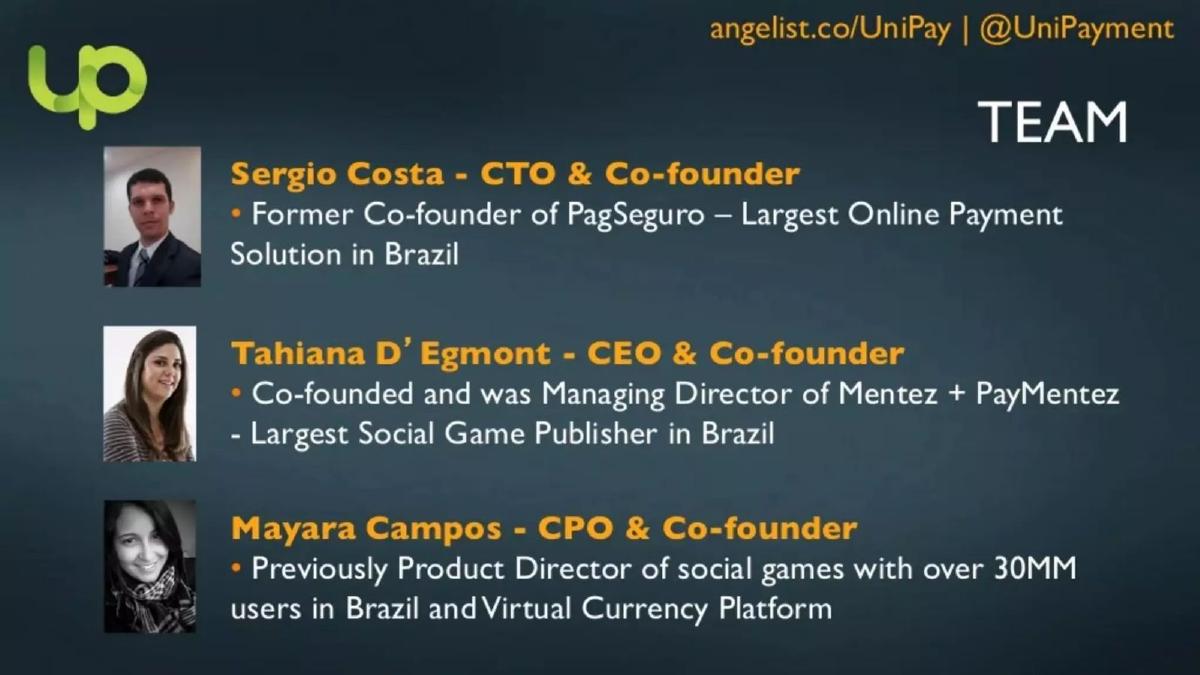
- The team slide is placed second, highlighting Sergio Costa’s background as a former co-founder of PagSeguro, Brazil's largest online payment solution (Slide 2).
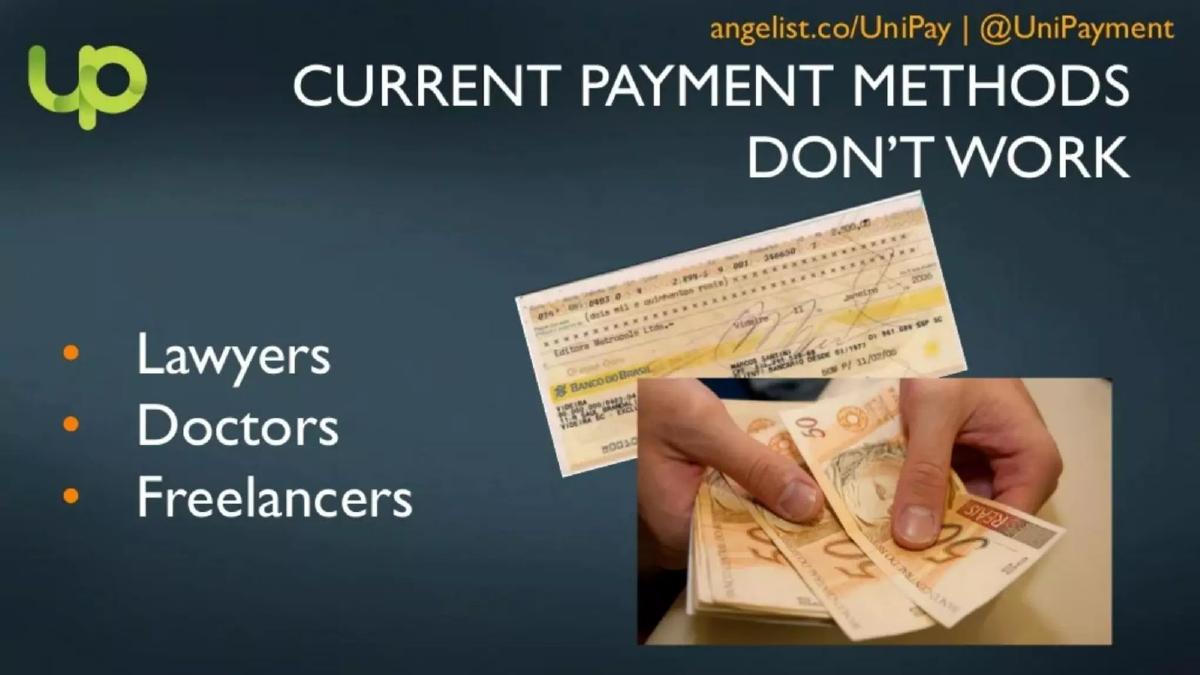
- The deck identifies lawyers, doctors, and freelancers as the primary segments underserved by current payment methods (Slide 3).
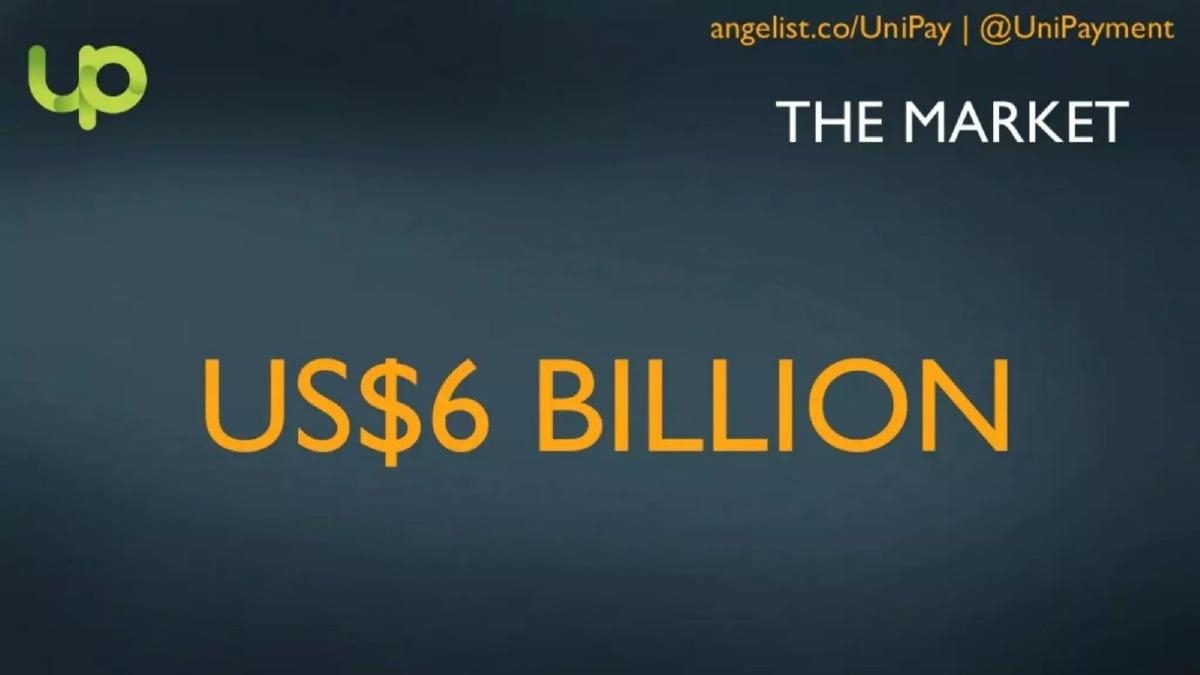
- The total addressable market is explicitly stated as US$6 Billion (Slide 4).
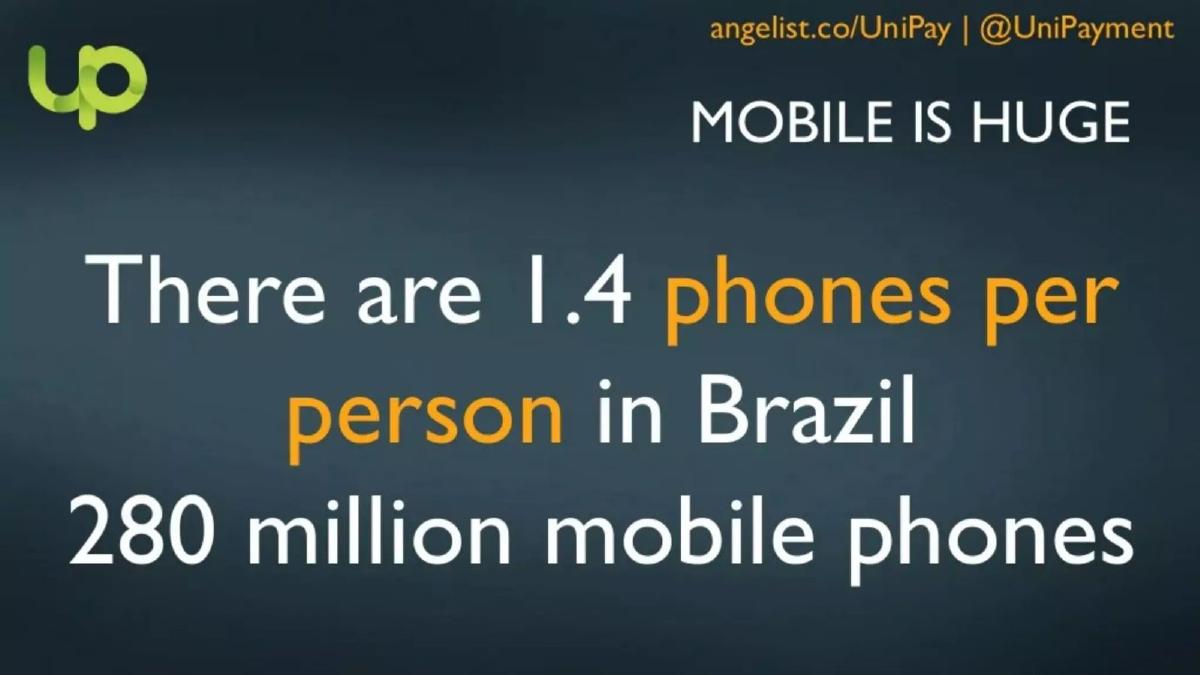
- Brazil's mobile density is a core pillar of the thesis, noting 1.4 phones per person and 280 million total mobile phones (Slide 5).
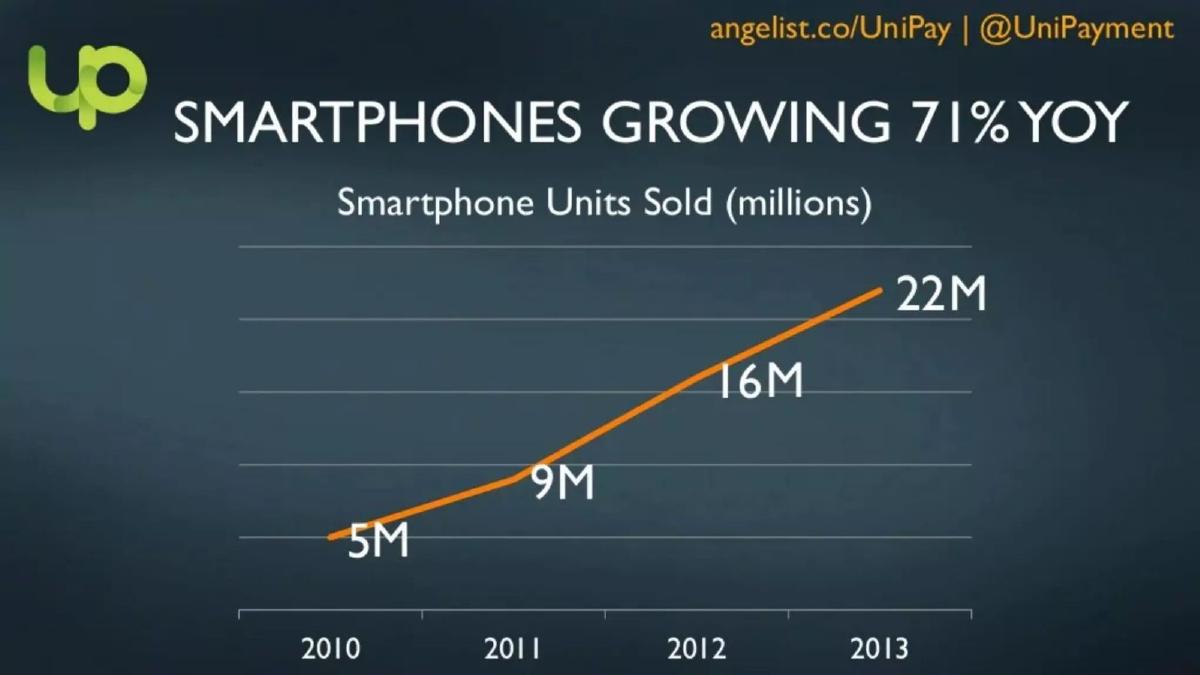
- Smartphone adoption is shown as a hockey-stick growth curve, rising from 5M units in 2010 to a projected 22M in 2013 (Slide 6).
- The product is defined as a system that turns smartphones into mobile Point of Sale systems enabling offline transactions (Slide 7).
- The competitive strategy is explicitly 'Local advantage,' claiming global competitors like Jack Dorsey do not understand the Brazilian market (Slide 8).
- The deck concludes by announcing a closed $500K round from industry experts at Credit Suisse, Buscapé, and BTG Pactual (Slide 9).
Introduction: The Local Hero Play
The UniPay pitch deck is a 9-slide document from 2012 that captures a specific moment in fintech history: the global race to replicate Square's mobile POS success in emerging markets. For UniPay, the narrative isn't just about technology; it is about geography and the 'home court advantage.' The deck is minimalist, focusing on the 'Who' and the 'Where' rather than the 'How' of the business model.
The Hook and the Team
Slide 1: Title The deck opens with a simple branding slide. The tagline 'Simples e Seguro' (Simple and Safe) and 'Mobile Payments for Brazil' immediately localize the product. The inclusion of an AngelList URL and a Twitter handle suggests a team that is plugged into the contemporary startup ecosystem.
Slide 2: Team UniPay makes a strategic choice to put the team slide second. In a market where execution and regulatory navigation are everything, the founders' pedigree is their strongest asset. Sergio Costa is listed as a former co-founder of PagSeguro, which the slide describes as the 'Largest Online Payment Solution in Brazil.' Tahiana D’Egmont (CEO) and Mayara Campos (CPO) bring experience from Mentez, a social game publisher with 'over 30MM users.' This slide establishes that the team has already built and scaled massive platforms in the exact market they are targeting.
The Problem and Market Opportunity
Slide 3: Current Payment Methods Don’t Work This slide uses visual cues—images of cash and a bank check—to highlight the friction in the current system. It identifies three specific personas: Lawyers, Doctors, and Freelancers. These are high-value service providers who traditionally struggled to accept card payments outside of a fixed office environment.
Slide 4: The Market The deck presents a single, bold figure: 'US$6 BILLION.' While it doesn't break down the SAM (Serviceable Addressable Market) or SOM (Serviceable Obtainable Market), the sheer scale of the number is intended to validate the venture-scale potential of the Brazilian payment space.
Slide 5: Mobile is Huge To justify the mobile-first approach, the deck provides two key stats: 1.4 phones per person in Brazil and a total of 280 million mobile phones. This establishes that the hardware infrastructure for their solution already exists in the pockets of the population.
Slide 6: Smartphones Growing 71% YOY This slide is the 'Why Now?' of the deck. It shows a clear growth trajectory for smartphone sales: 5M in 2010, 9M in 2011, 16M in 2012, and a projection of 22M in 2013. The 71% year-over-year growth rate indicates a rapidly closing window of opportunity to capture the market as users transition from feature phones to smartphones.
The Product and Competitive Edge
Slide 7: Our Product The product description is concise: 'We turn Smartphones into mobile Point of Sales Systems enabling offline transactions.' The accompanying image shows an iPhone running the UniPay app with a transaction approval screen. The mention of 'offline transactions' is a critical technical detail for the Brazilian market, where internet connectivity can be inconsistent.
Slide 8: Why Us? This is the most aggressive slide in the deck. It lists 'Deep payments experience' and 'Local advantage.' It explicitly calls out Jack Dorsey (founder of Square), stating that 'gringo’s like Dorsey don’t know Jack about Brazil.' This frames the competition not as a battle of features, but as a battle of local knowledge and regulatory expertise.
The Status and Traction
Slide 9: Experienced Investors The final slide serves as social proof rather than a call to action for a new round. It notes that UniPay has 'Closed $500K from Top Industry Experts' and displays logos for Credit Suisse, Buscapé, and BTG Pactual. The slide ends with a contact email for the founders, suggesting that while this round might be closed, they are open to building relationships with future investors.
What Works in This Deck
Founder-Market Fit: The team slide is exceptionally strong. Having a co-founder from the country's leading payment processor (PagSeguro) virtually eliminates the 'can they build it?' risk for investors. · Market Timing: Slide 6 uses a clear, upward-trending bar chart to show that the smartphone revolution in Brazil was hitting an inflection point in 2012. · Localization: By focusing on the specific needs of Brazilian professionals and the failures of local 'gringo' competitors, the deck carves out a defensible niche.
What is Missing
Business Model: There is no mention of transaction fees, hardware costs (if any), or how the company actually makes money. · Unit Economics: The deck lacks data on Customer Acquisition Cost (CAC) or Lifetime Value (LTV), which are standard for fintech seed rounds. · Go-To-Market Strategy: While the deck identifies target segments (Lawyers, Doctors), it doesn't explain how it plans to reach them or what the distribution strategy looks like. · The Ask: Since the deck mentions a closed $500K round, it’s unclear if they are seeking more capital or simply providing an update.
What a Founder Should Copy
The 'Why Now' Slide: Slide 6 is a perfect example of how to use a macro trend (smartphone growth) to create a sense of urgency. · Pedigree over Process: If you have a team with significant exits or relevant industry leadership, put them at the front of the deck. It changes how the investor views every subsequent slide. · Bold Competitive Positioning: Don't be afraid to explain why a global giant will fail in your specific market. UniPay’s 'Local Advantage' argument is a classic way for regional startups to win against better-funded international incumbents.
Frequently asked questions
- What is UniPay's core value proposition?
- UniPay enables independent professionals and on-the-go sellers in Brazil to accept credit card payments via their smartphones. According to the deck, the product turns mobile devices into Point of Sale (POS) systems that can handle offline transactions, solving the problem of cash and check dependency for lawyers, doctors, and freelancers.
- How does UniPay differentiate itself from global competitors like Square?
- The deck relies on 'Local Advantage.' On slide 8, the founders explicitly state that 'gringo’s like Dorsey don’t know Jack about Brazil.' This suggests that the regulatory, cultural, and technical nuances of the Brazilian payment ecosystem require a local team with deep regional experience to navigate successfully.
- What is the background of the founding team?
- The team has significant fintech and gaming pedigree. CTO Sergio Costa co-founded PagSeguro, the largest online payment solution in Brazil. CEO Tahiana D’Egmont and CPO Mayara Campos both held leadership roles at Mentez, a major social game publisher with over 30 million users.
- What market data does the deck provide to support its growth claims?
- The deck cites a US$6 Billion market opportunity. It supports this with mobile penetration stats (1.4 phones per person) and a 71% year-over-year growth rate in smartphone sales, projecting an increase from 5 million units in 2010 to 22 million units by 2013.
- Does the deck include a financial ask or use of funds?
- No. The final slide (Slide 9) mentions that they have already closed $500K from investors like Credit Suisse and BTG Pactual. It does not specify if they are currently raising more capital or how they intend to spend the previously raised funds.