Untangle Money presents a compelling case for a fintech platform designed specifically for the unique life trajectories of women. By contrasting the linear career path of men with the more volatile, event-driven path of women (maternity leave, part-time work, sabbaticals), the deck establishes a clear market need. The company seeks a $500,000 angel round to scale its tiered product offering, which ranges from a $90 'Mini' health check to a $350 full scenario planning tool. While the deck excels at defining the problem and the target persona, 'Sandra,' it relies heavily on high-level projectio…
Key takeaways
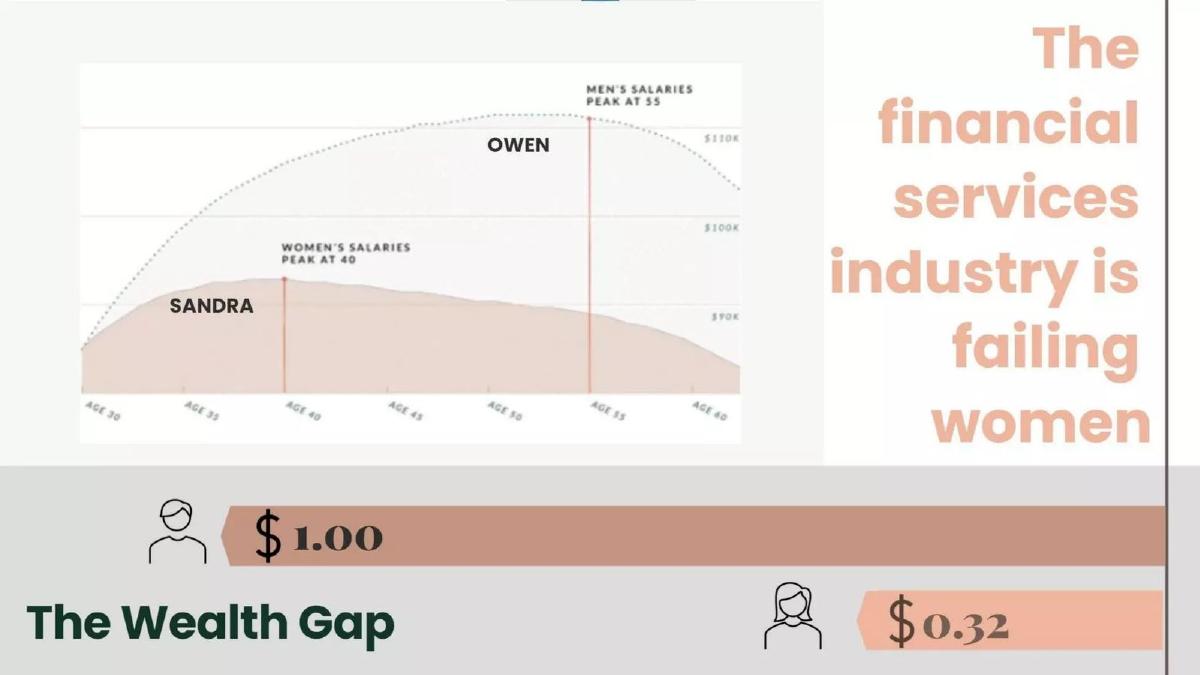
- The deck identifies a significant wealth gap where women hold $0.32 for every $1.00 held by men (Slide 3).
- Product differentiation is based on life-event modeling, accounting for maternity leave and part-time work that traditional tools often ignore (Slide 2).
- The business model uses a hybrid approach: one-time fees for planning ($90 to $350) plus a $5/month subscription for ongoing access (Slide 10).
- Market size is estimated at a $250 billion TAM globally, with a $2 billion SOM in Canada (Slide 9).
- Revenue projections are aggressive, scaling from $480,000 in Year 1 to $95.8 million in Year 5 (Slide 12).
- The founder, Kristine Beese, brings 10 years of experience from major institutions like RBC, BMO, and Scotiabank (Slide 16).
- The deck explicitly asks for a $500,000 Angel round in Q2 2022, followed by a $1.5M Seed and $5M+ Series A (Slide 11).
- Go-to-market relies on seminars with partners like Brookfield Properties and brand partnerships with companies like Indigo and Knix (Slide 11).
Untangle Money: A Fintech Approach to the Gender Wealth Gap
Untangle Money enters the fintech space with a specific focus on the underserved female demographic. The deck is structured to first prove that women have fundamentally different financial lives than men, and then demonstrate how existing financial tools fail to account for these differences. By using a mix of demographic data and clear product tiering, the deck attempts to justify a $500,000 angel round to capture a multi-billion dollar market opportunity.
The Problem and Vision (Slides 1-4)
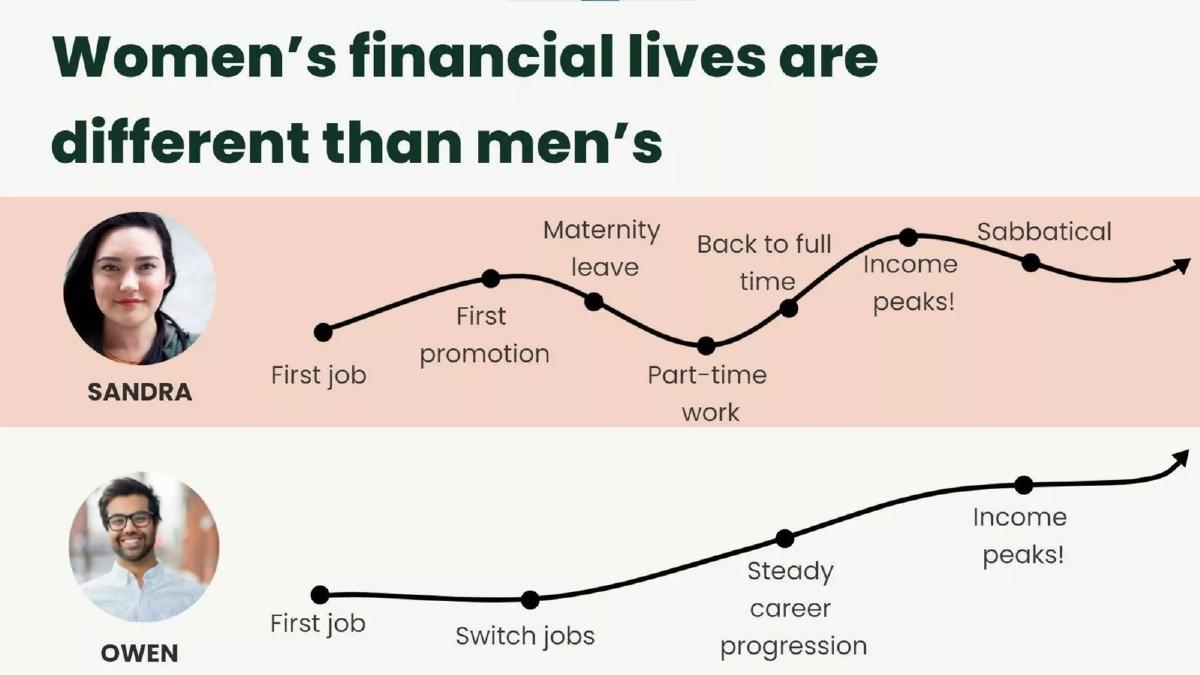
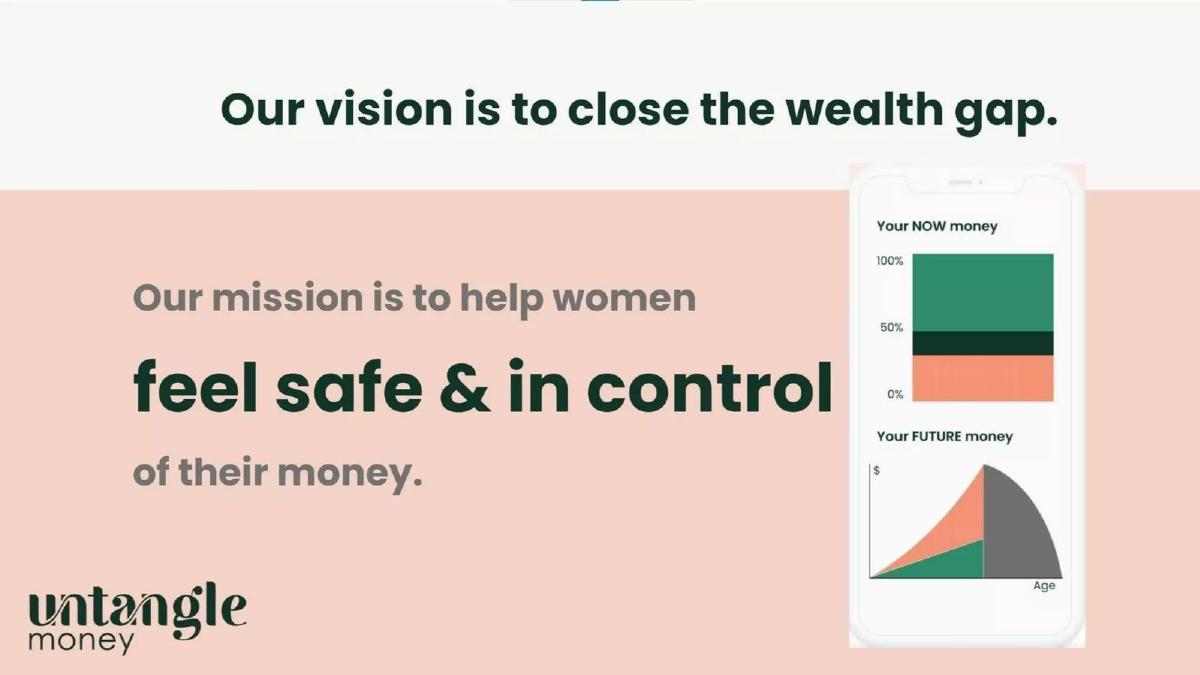
The deck opens with a clear value proposition: "Helping women understand their Now Money and their Future Money." Slide 2 is perhaps the most effective in the deck, providing a side-by-side comparison of two personas, "Sandra" and "Owen." It visually tracks their career paths, showing Sandra's fluctuations due to maternity leave, part-time work, and sabbaticals, contrasted against Owen's "steady career progression." This sets the stage for Slide 3, which presents the stark reality of the wealth gap: women's salaries peak at age 40 compared to age 55 for men, resulting in women holding only $0.32 for every $1.00 held by men. Slide 4 defines the mission as helping women feel "safe & in control" of their money, accompanied by a mobile app mockup showing "Now money" vs. "Future money."
The Solution and Competitive Landscape (Slides 5-8)
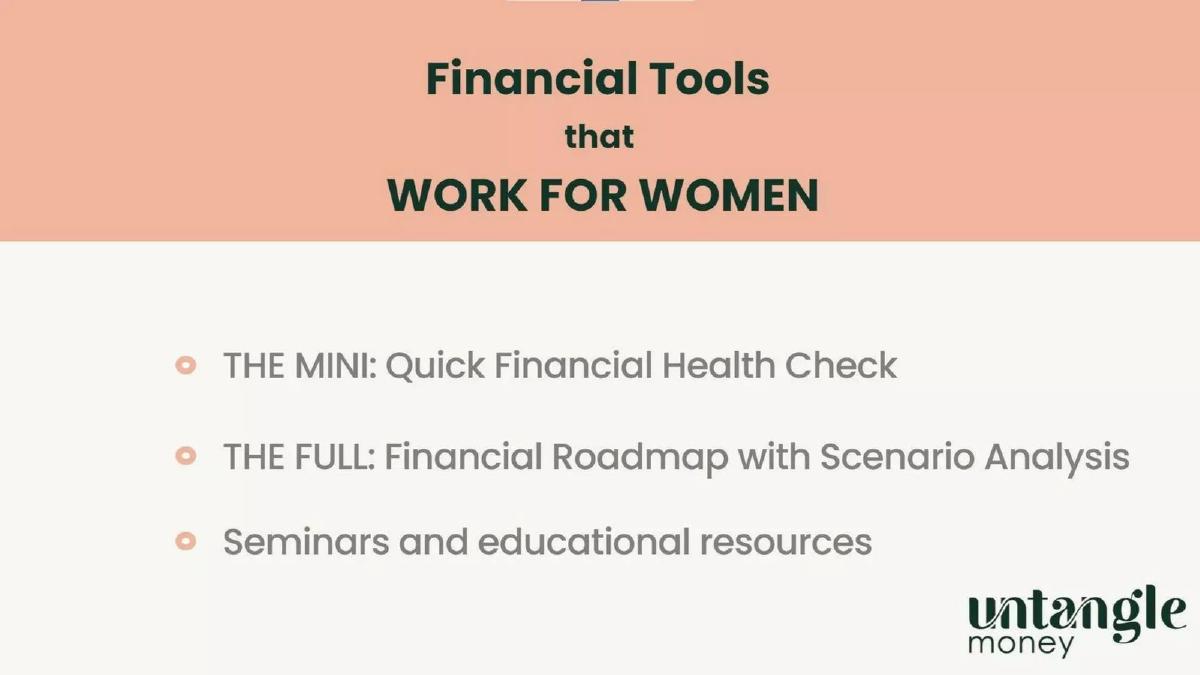
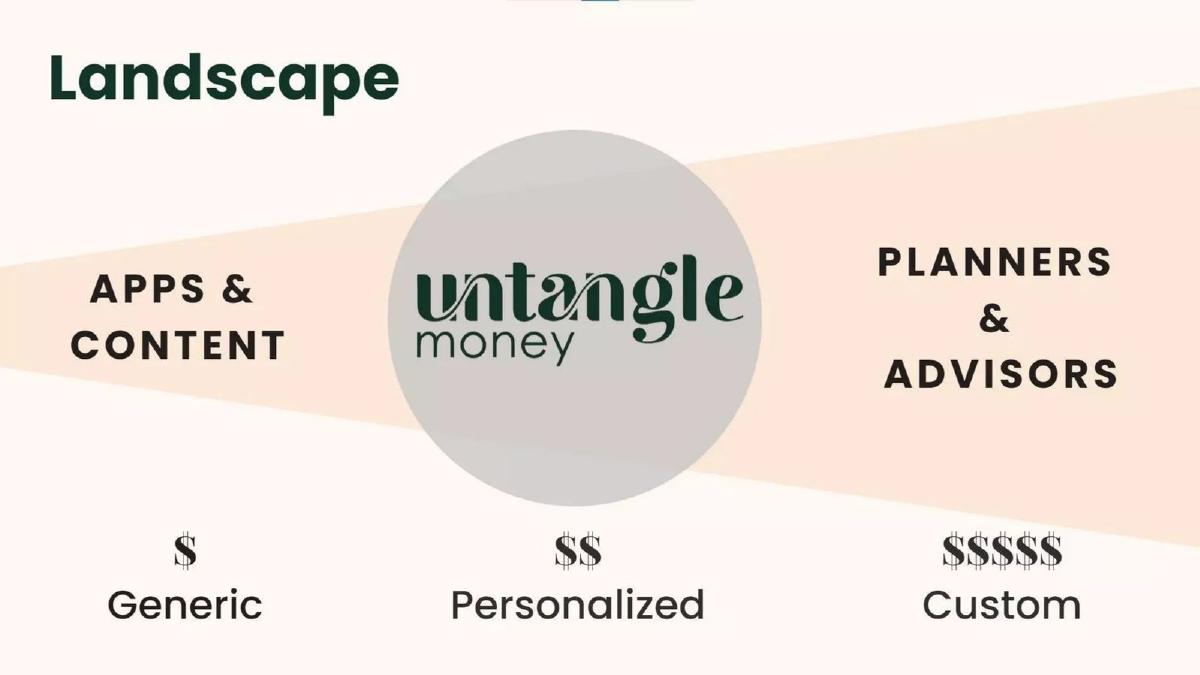
Slide 5 introduces the product suite, categorized into "The Mini," "The Full," and educational resources. The deck positions Untangle Money in the "Landscape" on Slide 6, placing it in the middle ground between generic, low-cost apps and expensive, custom financial planners. They claim a "Personalized" sweet spot ($$). Slide 7 further differentiates the brand by contrasting it with competitors. While competitors are labeled as "Unaffordable," "Judgmental," and "Sales Pitch," Untangle Money claims to be "Affordable," "Judgmental-free," and "Trustworthy." Slide 8 introduces the team, led by CEO Kristine Beese, and two advisors, Natalie Armata and Elena Torriani. The focus here is on establishing credibility through professional experience.
Market Opportunity and Business Model (Slides 9-10)
The market size slide (Slide 9) uses the standard TAM/SAM/SOM framework. It identifies a $250 billion global market, a $5 billion Canadian market, and a $2 billion Serviceable Obtainable Market (SOM) for their target demographic. Slide 10 details the revenue model, which is a hybrid of one-time fees and recurring subscriptions. The one-time fees are $90 for the Mini, $150 for the Mini+, and $350 for the Full. This is paired with a $5/month subscription for ongoing dashboard access and community features. This dual-revenue stream is designed to provide immediate cash flow while building long-term LTV.
Roadmap and Financial Projections (Slides 11-12)
Slide 11 provides a detailed Go-to-Market timeline. It shows an Alpha phase in Q2 2021, followed by seminars with partners like Brookfield Properties. The roadmap explicitly calls out the $500k Angel round in Q2 2022, leading to a Beta launch in Q3 and a full launch in Q4. Future funding needs are also projected: $1.5M Seed in Q1 2023 and $5M+ Series A in Q3 2023. Slide 12 presents aggressive revenue projections, starting at $480,000 in Year 1 and skyrocketing to $95,800,000 by Year 5. The slide notes this assumes a $148 per year spend per customer across 2.2 million women in Canada.
Traction and Social Proof (Slides 13-14)
Slide 13, titled "As Seen In," is a collage of logos and media appearances, including RBC Royal Bank, The Globe and Mail, and Brookfield Properties. This slide is intended to validate the brand's presence in the Canadian market. Slide 14 returns to the "Sandra" persona, showing a graph where her wealth increases over time despite income fluctuations, reinforcing the efficacy of the Untangle Money approach.
The Ask and Founder Deep-Dive (Slides 15-17)
The deck concludes with a clear call to action on Slide 15: a "$500k Angel round." Slide 16 provides a deeper look at Kristine Beese's background, highlighting her 10 years at RBC, BMO, and Scotiabank Capital Markets, as well as her engineering and MBA credentials. Slide 17 offers more detail on "The Full" product, noting a $350 first-time fee and a $200 anniversary renewal fee, which helps clarify the $148 average spend mentioned earlier in the projections.
Supporting Data (Slides 18-21)
The final four slides are data-heavy "Women & Financial Plans" slides. Slide 18 states that 73% of women feel on-track with a financial plan. Slide 19 claims a "30% Reduction in Financial Anxiety" with The Mini. Slide 20 notes that 73% of women are unsatisfied with the finance industry, and Slide 21 concludes that 87% of women want help with their finances. These slides serve as a statistical appendix to reinforce the problem-solution fit established at the beginning of the deck.
What Works in This Deck
Strong Problem Identification: The contrast between the male and female career trajectories on Slide 2 is a powerful visual argument. It moves the conversation from a generic "finance for women" pitch to a specific structural problem that existing tools fail to solve. By highlighting maternity leave and part-time work, the founders demonstrate a deep understanding of their user's pain points.
Founder-Market Fit: Kristine Beese's background (Slide 16) is perfectly aligned with the product. Ten years in capital markets at major Canadian banks gives her the necessary authority to build a financial planning tool. The inclusion of her engineering degree and Mensa membership further signals high competence to potential investors.
Clear Pricing Tiers: The business model (Slide 10) is transparent and easy to understand. By offering a low-friction entry point ($90) and a high-value full service ($350), the company creates a clear path for customer acquisition and upselling. The addition of a $5/month subscription ensures that the relationship with the customer continues beyond the initial planning phase.
What Is Missing
Unit Economics: While the deck projects massive revenue growth (Slide 12), it does not provide data on Customer Acquisition Cost (CAC) or Lifetime Value (LTV). For a subscription-based fintech, these metrics are critical. Investors will want to know how much it costs to acquire "Sandra" through the brand partnerships mentioned on Slide 11.
Product Depth: The deck shows mockups and high-level descriptions, but it lacks detail on the actual technology. Is the scenario planning automated? Does it integrate with bank APIs? Slide 17 shows charts, but it's unclear if these are static reports or a dynamic, interactive platform. A slide on the tech stack or the proprietary nature of their algorithms would strengthen the "moat" argument.
Detailed Use of Funds: The deck asks for $500,000 but doesn't specify how that money will be spent. A standard pie chart or list showing the allocation between product development, marketing, and hiring would provide more clarity on the immediate operational goals.
What a Founder Should Copy
The Persona Approach: Using "Sandra" throughout the deck makes the problem relatable. Instead of talking about abstract market segments, the founders talk about a specific person's life. This helps investors visualize the user and the impact of the product.
The Funding Roadmap: Slide 11 is an excellent example of how to show the long-term capital strategy. By listing the Angel, Seed, and Series A rounds alongside product milestones, the founders show that they are thinking several steps ahead and understand the capital requirements of scaling a fintech company.
Visualizing the Gap: The wealth gap graphic on Slide 3 is a masterclass in simplicity. It uses a single, striking data point ($0.32 vs $1.00) to justify the entire existence of the company. Founders should look for similar "anchor metrics" that define their market opportunity in a single glance.
Final Thoughts
Untangle Money has produced a professional, mission-driven deck that leverages the founder's industry expertise. The narrative is cohesive, moving from a structural societal problem to a specific, tiered product solution. While the financial projections are highly optimistic and the unit economics are absent, the clear identification of an underserved, high-value demographic makes a strong case for an angel-stage investment. The focus on "judgment-free" financial planning is a timely response to the traditional banking sector's shortcomings, and the strategic use of brand partnerships provides a plausible path to scale.
Frequently asked questions
- What is the core problem Untangle Money is solving?
- Untangle Money addresses the failure of the financial services industry to cater to women's unique career and life paths. Slide 3 notes that women's salaries peak at age 40, while men's peak at 55, contributing to a wealth gap where women own just $0.32 for every dollar men own. The platform provides tools that account for income fluctuations due to maternity leave, part-time work, and sabbaticals.
- How does the company plan to generate revenue?
- The business model is tiered. According to Slide 10, they offer 'The Mini' (Quick Financial Health Check) for $90, 'The Mini+' (Building Scenarios) for $150, and 'The Full' (Unlimited Scenarios) for $350. Additionally, they charge a $5/month subscription for ongoing dashboard access, community features, and goal tracking. Slide 17 notes that 'The Full' has a $200 renewal fee on the anniversary.
- Who is the target customer for this platform?
- The deck uses a persona named 'Sandra' to represent the target demographic. Slide 12 identifies a target of 2.2 million women in Canada who fit this profile. These are women who experience non-linear career paths and seek to feel 'safe and in control' of their money, moving away from 'judgmental' or 'sales-pitch' oriented traditional financial services.
- What is the founder's background and expertise?
- Founder and CEO Kristine Beese has significant financial sector credibility. Slide 16 highlights her 10 years of experience at RBC, BMO, and Scotiabank Capital Markets. She holds a P.Eng and an MBA from Ivey Business School, and is a member of Mensa. This professional pedigree is a key trust signal for a fintech startup.
- What are the company's funding requirements and milestones?
- As shown on Slide 11 and Slide 15, the company is raising a $500,000 Angel round. The roadmap includes a Beta launch in Q3 2022, a full launch in Q4 2022, and global expansion starting in 2023. They anticipate needing a $1.5 million Seed round in Q1 2023 and a Series A of $5 million or more by Q3 2023.