Unito's 12-slide deck for their $20M Series B round focuses heavily on technical differentiation and category expansion. By positioning the entire integration market as stuck in a 'primitive' 1-way trigger-action paradigm, Unito carves out a unique space for its 2-way 'SYNC' platform. The deck relies on a clear narrative arc: the market is shifting toward democratization, current tools are too brittle for complex workflows, and Unito has already proven its ability to scale beyond its initial niche of project management into CRMs and spreadsheets. While the deck is light on traditional financi…
Key takeaways
- The deck positions Unito as the leader of 'Wave 3' in integration, moving from IT-led deployments to no-code business user setups (Slide 3).
- Unito explicitly attacks the industry-standard 'if TRIGGER then ACTION' paradigm as primitive and brittle (Slide 4).
- A single 2-way flow in Unito is claimed to replace 16 separate 'zaps' in Zapier, highlighting a significant reduction in complexity (Slide 5).
- The company demonstrates technical depth by listing specific solved challenges like cycle/loop detection and lossless rich text formatting (Slide 7).
- Growth is shown to be compounding through category expansion, with CRMs growing at 33% MoM and Sheets at 34% MoM as of early 2022 (Slide 9).
- The competitive landscape slide uses a unique 'Depth of Integration' metric to differentiate from Zapier's high volume of shallow connectors (Slide 10).
- The team slide emphasizes culture and retention, citing a 5-star Glassdoor rating and 100% CEO approval (Slide 11).
- There is no specific 'Ask' slide detailing the exact dollar amount or use of funds within the 12-slide sequence (Slide 12).
Executive Summary
Unito's Series B deck is a product-centric narrative that seeks to redefine the integration category. Rather than competing on the sheer number of connectors—a race Zapier has arguably won—Unito competes on the depth and quality of those connections. The deck is structured to convince investors that the 'if-this-then-that' era is over and that the future belongs to seamless, 2-way data synchronization. With a team of 60+ based in Montreal, the company uses this deck to show how they have moved from a niche project management tool to a horizontal productivity platform.
Slide 1: Title Slide
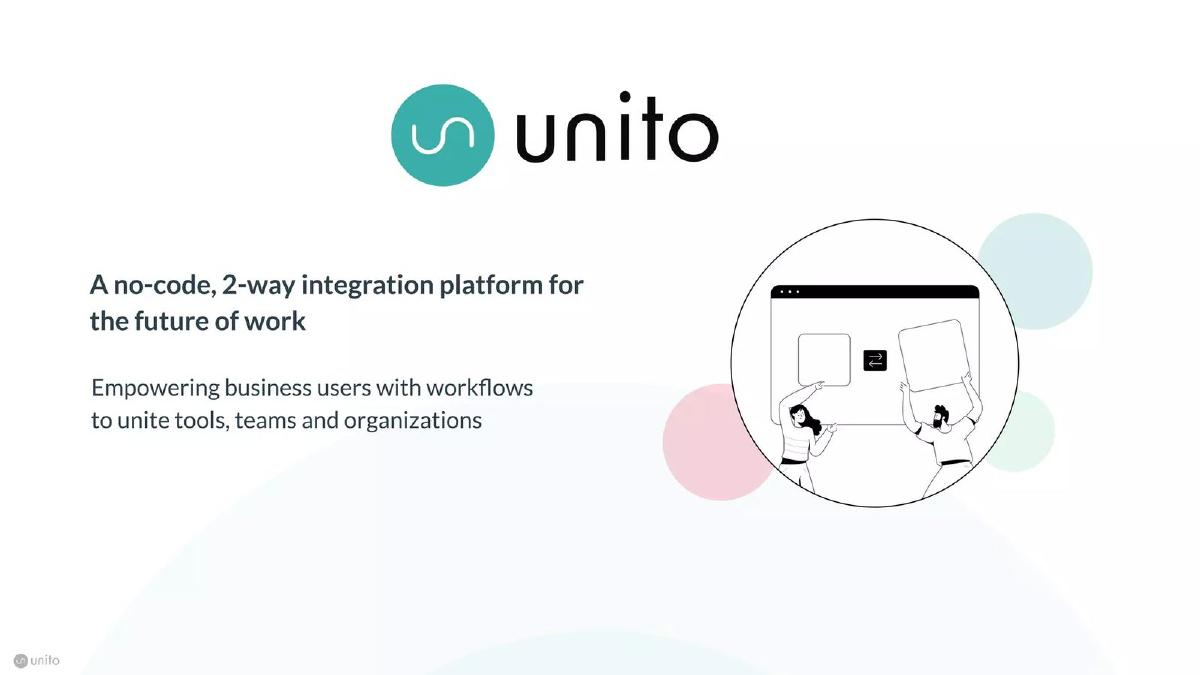
The deck opens with a clean, minimalist title slide. It defines Unito as a "no-code, 2-way integration platform for the future of work." The sub-headline emphasizes empowering business users to unite tools, teams, and organizations. The imagery is simple vector art showing two users interacting with a digital interface, reinforcing the 'no-code' and 'human-centric' nature of the product.
Slide 2: Unito Highlights
This slide serves as an executive summary. It lists four key pillars: a proven connector playbook, a "16x improvement over current offerings," a team of 65 in Montreal with high Glassdoor ratings, and the opportunity to lead the next integration market. This slide sets the stage for the technical and cultural arguments that follow.
Slide 3: The Market Evolution
Unito uses a 'Wave' chart to contextualize their position in the market history. Wave 1 (2000s) was On-Prem (IBM, TIBCO). Wave 2 (2010s) was SaaSification (MuleSoft, Workato). Wave 3, where Unito sits alongside Zapier, is "Democratization." The key differentiator for Wave 3 is that it integrates productivity SaaS for knowledge workers with no deployment time and $0 setup cost. Crucially, it notes that while others are 1-way, Unito is "1 way & 2 way."
Slide 4: The Problem with the Status Quo
This is a 'villain' slide. It lists nearly 20 competitors, including Zapier, Tray.io, and Microsoft, and claims they all use the same "primitive paradigm: if TRIGGER then ACTION." By labeling the industry standard as 'primitive,' Unito creates a gap in the market that only they can fill.
Slide 5: The SYNC Paradigm
This slide illustrates the technical advantage of 2-way sync. It shows a single flow between a Product Roadmap (Asana) and a Dev Backlog (Jira). The slide claims this single flow is equivalent to 16 zaps in Zapier (16 triggers + actions). A handwritten-style note adds that 1-way integrations are "brittle and unmaintainable" because of this complexity, positioning Unito as the 'Order of Magnitude' simpler solution.
Slide 6: Product in Action
Slide 6 provides a visual demonstration of the 'plug & play' nature of the tool. It shows a split screen of Asana and Jira, stating that a project manager and developer can collaborate "as if they were both in the same tool." The slide includes links to case studies and setup videos, which is a good practice for providing 'proof of work' in a static deck.
Slide 7: Technical Moat
To justify their Series B valuation, Unito highlights the "really hard technical challenges" they have solved. These include specialized algorithms for multi-tool work graphs, cycle/loop detection, and lossless rich text formatting. This slide is intended to ward off concerns that a larger competitor could easily replicate their 2-way sync functionality.
Slide 8: Category Expansion
This slide shows the transition from a niche player to a horizontal platform. Six months prior to the deck's creation, Unito "broke out of our niche" and started building connectors for CRMs, Service Desks, Spreadsheets, and more. The visual shows a central core of Project Management and Dev Tools surrounded by a wide array of new categories like E-commerce, Social Media, and Analytics.
Slide 9: Growth Evidence
Unito provides a growth chart showing compounding returns from new categories. The chart covers September 2021 to February 2022. It highlights that CRMs are growing at 33% MoM and Sheets & Tables are growing at 34% MoM . The note indicates that their original niche, which grew organically, is now being 'pulled up' by these new, faster-growing categories.
Slide 10: Competitive Positioning
This slide compares Unito against Zapier and Workato using three bar charts: Ease of Use, Depth of Integration, and Number of Connectors. While Zapier wins on the number of connectors (3000+ vs Unito's 35+), Unito claims a massive lead in Depth of Integration (2-way vs 1-way). This is a strategic way to frame a smaller connector library as a choice of quality over quantity.
Slide 11: The Team
The team slide features the CEO, CTO, VP Product, and CFO. It emphasizes experience (20-25 years in tech) and successful exits (Microsoft, Thales). A significant portion of the slide is dedicated to culture metrics : 60 staff members, a 5-star Glassdoor rating, and 100% CEO approval. This suggests a stable, well-managed organization capable of scaling.
Slide 12: Conclusion
The final slide summarizes the key points: a highly differentiated platform, a 16x improvement, and a proven expansion playbook. It ends with the call to action: "Let’s unite work across the entire digital productivity suite of business." Notably, there is no mention of the specific funding amount sought or the valuation.
What Works Well
Strong Narrative Arc: The deck follows a logical flow from market evolution to technical problem, to unique solution, to proven growth. · Clear Differentiation: The '16 zaps vs 1 flow' comparison is a powerful visual and mental model that makes the value proposition immediately understandable. · Focus on Technical Moat: By listing specific hard problems like 'cycle detection,' they move beyond marketing fluff and speak to the technical reality of data synchronization. · Honest Competitive Landscape: Acknowledging that Zapier has more connectors but arguing that Unito's are 'deeper' is a credible way to handle a dominant incumbent.
What is Missing
Financial Specifics: There is a total absence of revenue figures, burn rate, or unit economics. For a Series B, investors typically expect to see ARR and LTV/CAC ratios. · The Ask: The deck does not state how much money is being raised or how the funds will be allocated (e.g., hiring, marketing, R&D). · Go-To-Market Strategy: While growth is shown, the mechanism of that growth (PLG, sales-led, partnerships) is not detailed. · Customer Logos: While they mention Asana and Jira as integrations, the deck lacks a 'social proof' slide featuring recognizable enterprise customers using the platform.
Founder Takeaways
Reframe the Competition: If you are smaller than the market leader, don't compete on their terms. Unito didn't try to out-connector Zapier; they redefined what a 'good' connector looks like. · Use 'Wave' Thinking: Positioning your company as the natural successor to previous 'waves' of technology helps investors see your success as inevitable rather than accidental. · Quantify the Complexity: The '16x improvement' claim is backed by the specific example of replacing 16 zaps with one flow. Always try to find a metric that quantifies the 'pain' you are removing. · Culture as a Metric: In a tight talent market, showing 100% CEO approval and high Glassdoor ratings can be as important to a Series B investor as your growth chart, as it proves you can retain the talent needed to build the product.
Frequently asked questions
- What is Unito's primary value proposition compared to Zapier?
- Unito differentiates itself through 2-way synchronization rather than 1-way triggers. According to slide 5, a single Unito flow replaces 16 individual Zapier 'zaps.' This reduces the brittleness of integrations and allows users in different tools, like Asana and Jira, to collaborate as if they were in the same environment without manual data entry in both directions.
- How does Unito demonstrate its ability to scale?
- The deck uses a 'niche-to-platform' narrative. Slide 7 shows they battle-tested the technology in project management and dev tools. Slide 8 illustrates their expansion into 20+ other categories including CRM, E-commerce, and Analytics. Slide 9 provides the data, showing that new categories like CRMs and Sheets are growing at over 30% month-over-month.
- What technical moats does Unito claim to have?
- Slide 7 lists several 'really hard technical challenges' that Unito has solved, which serve as barriers to entry. These include multi-hop sync, cycle/loop detection, concurrent change resolution, and lossless rich text formatting across different markup languages. These features are necessary for true 2-way sync but are often absent in 1-way automation tools.
- Is there any financial data or unit economics in the deck?
- The deck is notably thin on traditional financial metrics. There are no mentions of Annual Recurring Revenue (ARR), Customer Acquisition Cost (CAC), or Lifetime Value (LTV). It focuses almost entirely on product architecture, category expansion, and percentage-based growth rates (Slide 9) rather than absolute dollar amounts or profitability margins.
- What is missing from this pitch deck?
- Beyond the lack of hard financials, the deck omits a clear 'Ask' slide detailing how much capital is being raised and how it will be deployed. It also lacks a detailed Go-To-Market (GTM) strategy, failing to explain how they acquire customers beyond 'organic' growth mentioned in the notes of Slide 9.