Unmind’s 14-slide Series B deck from 2021 is a masterclass in narrative-driven fundraising for the B2B SaaS healthcare space. The deck moves swiftly from the macro crisis—citing an $80-100bn annual cost to US employers on slide 2—to a specific philosophical shift: prevention over reaction. By positioning mental health as a 'whole person' and 'whole organization' challenge (slide 5), Unmind justifies its platform approach. The deck relies heavily on social proof, showcasing logos like Uber, Samsung, and Disney (slide 12) alongside a consistent revenue growth chart (slide 10). While it lacks a…
Key takeaways
- The deck frames the problem as an economic crisis, citing an $80-100bn cost to US employers pre-COVID-19 (Slide 2).
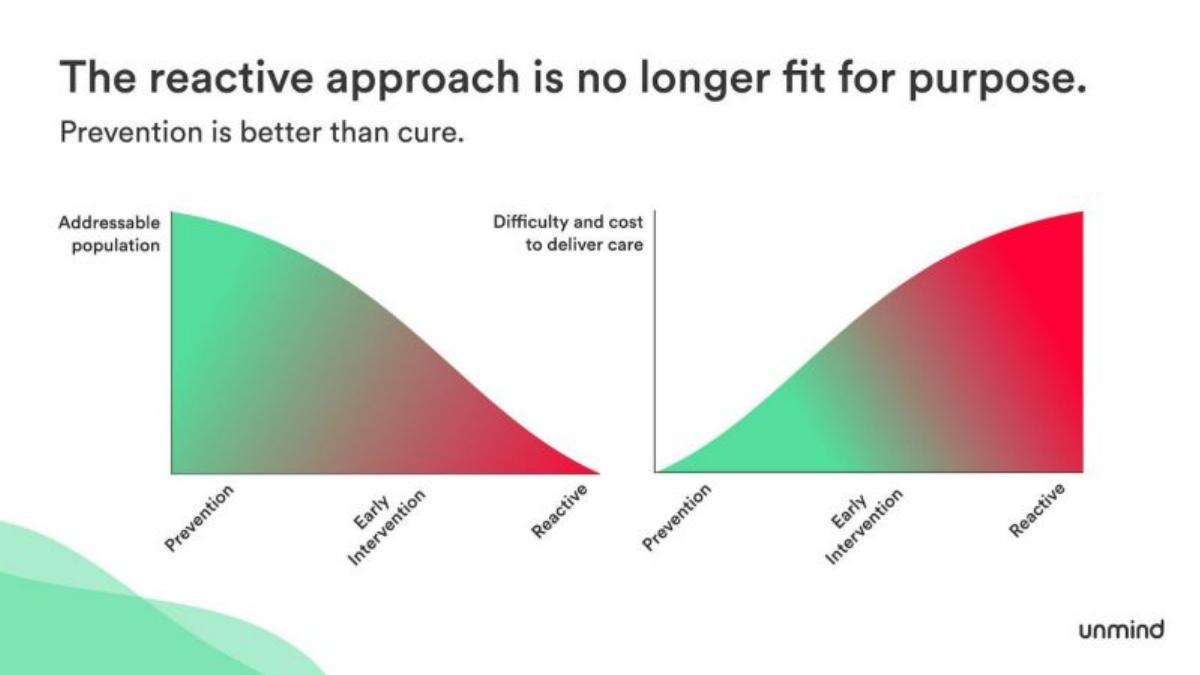
- Unmind differentiates itself by focusing on 'Prevention' rather than 'Reactive' care, arguing that reactive care is more difficult and costly to deliver (Slide 3).
- The platform targets two distinct stakeholders: the 'Whole Person' (employees) and the 'Whole Organisation' (employers) (Slide 5).
- Employee features include clinically-backed assessments, a daily mood diary, and expressions of gratitude (Slide 7).
- Employer features focus on data-driven insights and 'HR thought leadership' to drive wellbeing strategies (Slide 8).
- The company demonstrates strong market fit with a Buyer NPS of 78 and 92% of users reporting higher confidence in mental health (Slide 12).
- Global scale is a core theme, with users in 115 countries and new offices opened in 2020 (Slide 11).
- The deck omits a dedicated team slide, detailed unit economics, and a specific breakdown of the $47M Series B fund usage.
The Narrative of Preventative Care
Unmind’s Series B deck arrived at a pivotal moment in 2021. The workplace had been fundamentally altered by the pandemic, and mental health had shifted from a 'nice-to-have' benefit to a core business requirement. This deck doesn't just sell a product; it sells a shift in corporate philosophy. By moving the conversation from 'treating the sick' to 'keeping the healthy well,' Unmind creates a massive addressable market that includes every single employee in an organization, not just those currently in crisis.
Slides 1-4: The Macro Problem and the Preventative Pivot
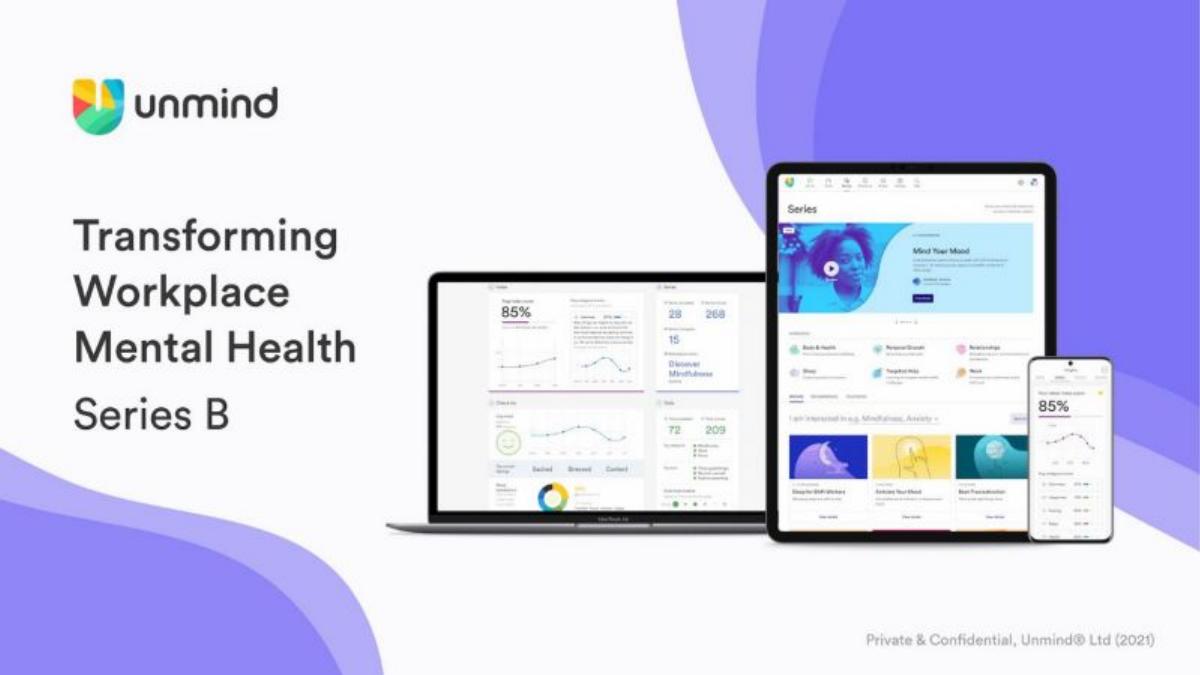
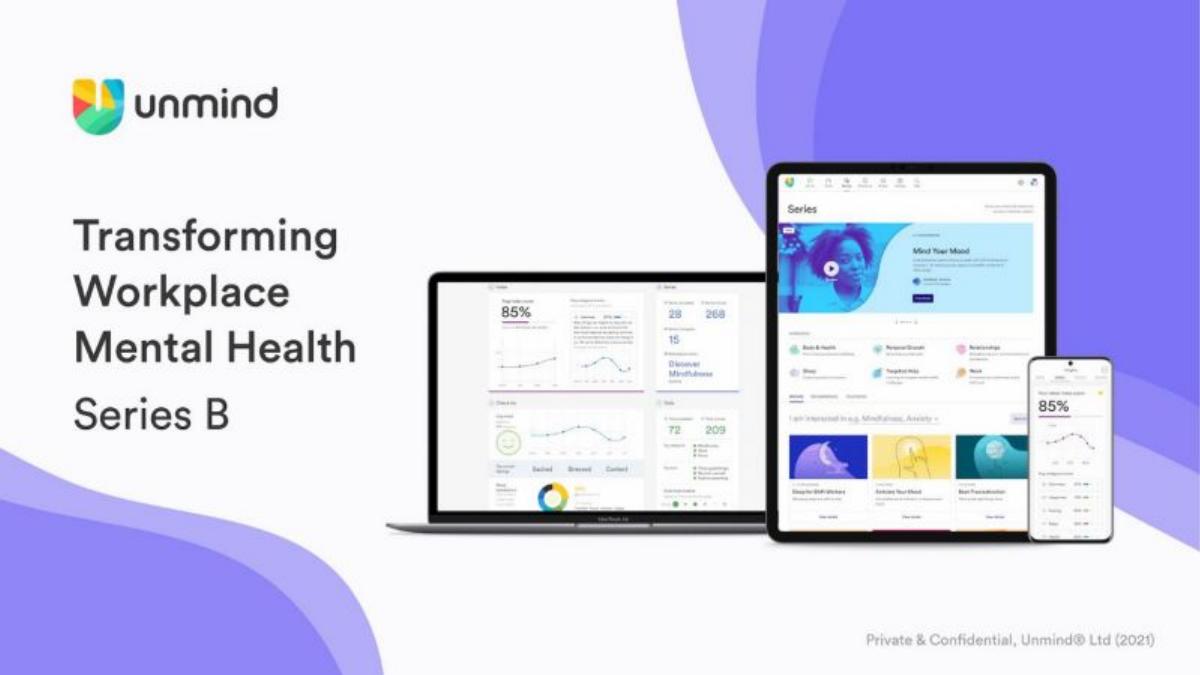
Slide 1: Title The deck opens with a clean, professional brand identity. The subtitle 'Transforming Workplace Mental Health' immediately identifies the sector and the target customer (the workplace). It is explicitly labeled as a 'Series B' deck, signaling to investors that this is a growth-stage opportunity.
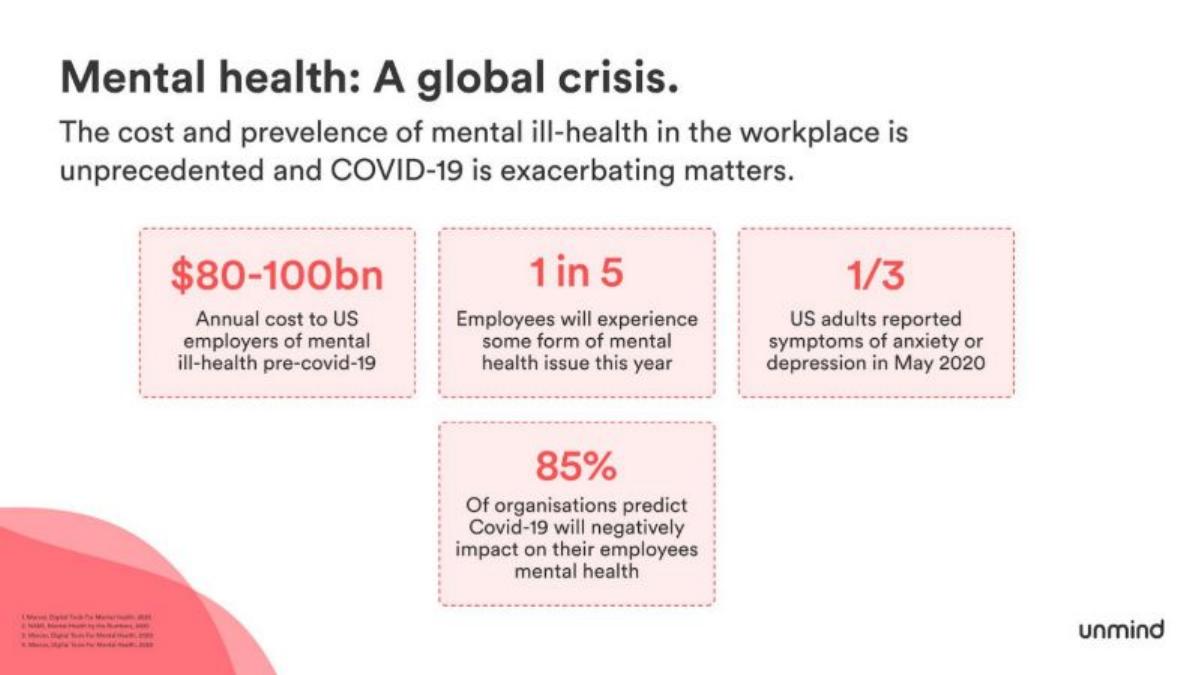
Slide 2: Mental health: A global crisis. Unmind establishes the stakes using four key data points. Most notably, it cites an $80-100bn annual cost to US employers for mental ill-health pre-COVID-19. It also notes that 1 in 5 employees will experience a mental health issue this year and 85% of organizations predict COVID-19 will negatively impact their employees. This slide validates the market size and the urgency of the problem.
Slide 3: The reactive approach is no longer fit for purpose. This is the most important conceptual slide in the deck. It uses two charts to show that while the 'Addressable population' is largest at the 'Prevention' stage, the 'Difficulty and cost to deliver care' is highest at the 'Reactive' stage. This visually argues that current employer strategies (which are usually reactive) are inefficient and expensive.
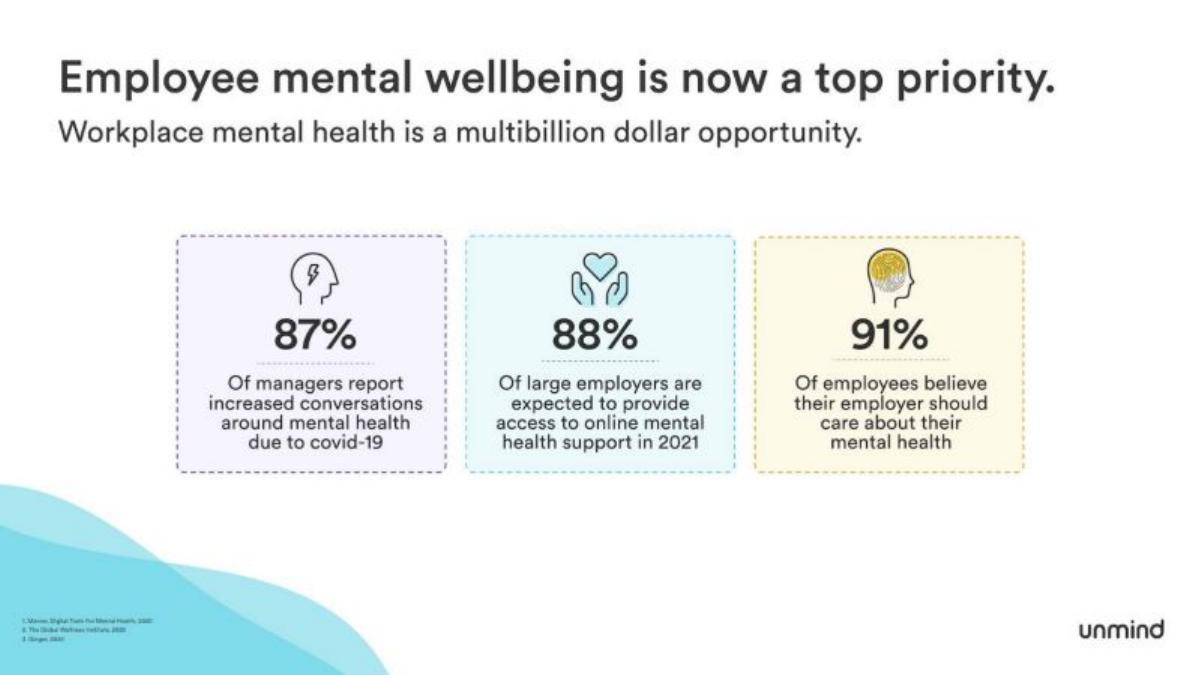
Slide 4: Employee mental wellbeing is now a top priority. This slide focuses on the 'Why Now?' factor. It cites that 88% of large employers are expected to provide access to online mental health support in 2021, and 91% of employees believe their employer should care about their mental health. This frames the product as an essential requirement for talent retention and recruitment.
Slides 5-9: The Solution and Product Experience
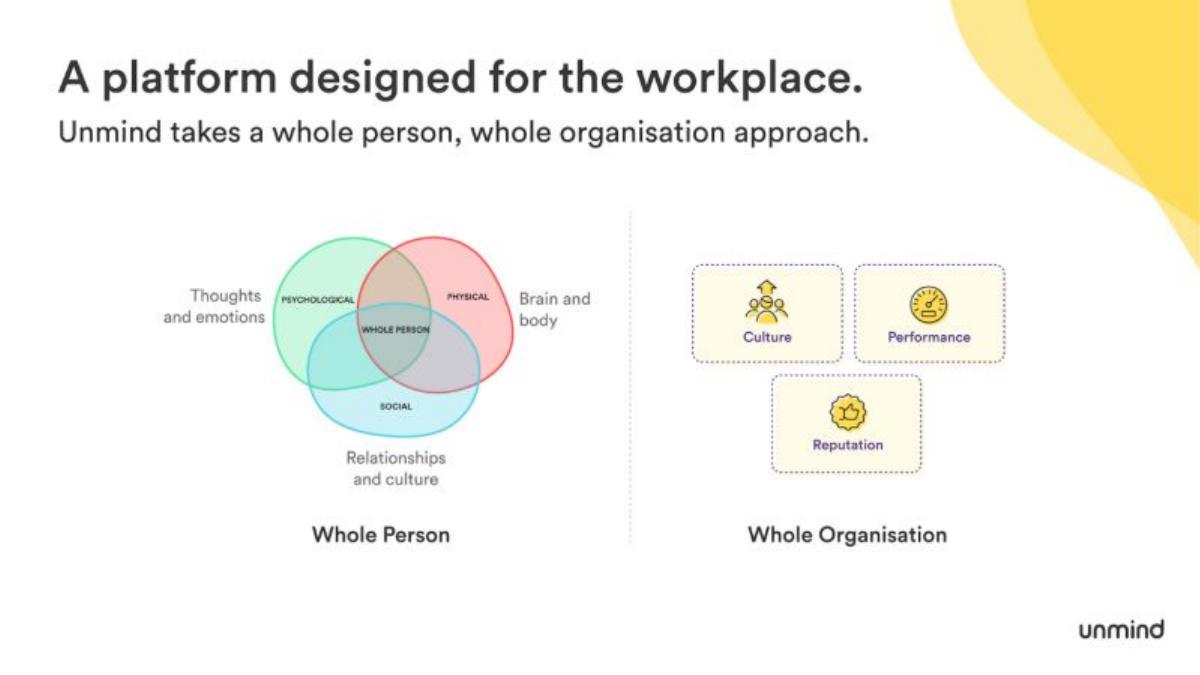
Slide 5: A platform designed for the workplace. Unmind introduces its 'Whole Person, Whole Organisation' framework. The 'Whole Person' side covers Psychological, Physical, and Social health. The 'Whole Organisation' side focuses on Culture, Performance, and Reputation. This dual-value proposition is key for B2B sales: it helps the individual while protecting the company's bottom line.
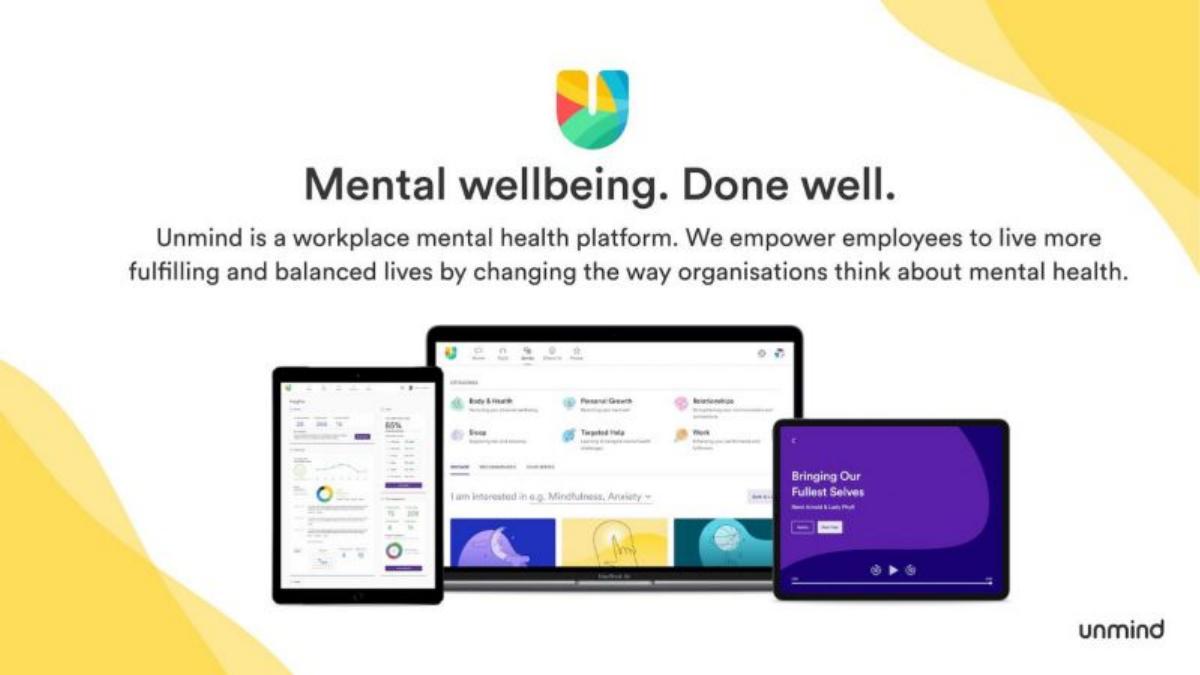
Slide 6: Mental wellbeing. Done well. This is a product showcase slide. It displays the Unmind interface across laptop, tablet, and mobile devices. The copy emphasizes 'empowering employees' and 'changing the way organisations think.' The UI shown includes categories like 'Body & Health,' 'Personal Growth,' and 'Relationships.'
Slide 7: Whole person - for employees. This slide breaks down the specific features available to users. It lists: Clinically-backed assessments, In-the-moment exercises, Supportive signposting (to therapy), Daily mood diary, Self-guided programs, and Expressions of gratitude. This demonstrates the breadth of the platform beyond just meditation.
Slide 8: Whole organisation - for employers. To justify the enterprise price tag, Unmind shows what the HR buyer gets: an 'Insights' dashboard. This includes data on engagement, mood trends, and 'wellbeing insights.' It also mentions 'Creating a community of HR thought leaders,' positioning Unmind as a partner rather than just a vendor.
Slide 9: A digital solution with a human touch. This slide highlights the 'Client Success' aspect of the business. It shows an 'Awareness Dates Calendar,' a 'Client Sharing Portal,' and 'Communication Assets.' This is a subtle but powerful signal to investors that Unmind has solved the 'engagement problem' that plagues many digital health tools.
Slides 10-12: Traction, Scale, and Social Proof
Slide 10: Consistent revenue growth. Unmind provides a bar and line chart showing growth from March 2019 to December 2020. While specific dollar amounts are redacted or omitted, the trend lines for ARR (Annual Recurring Revenue) and Client count show a steep, consistent upward trajectory. The growth appears to accelerate significantly in the latter half of 2020.
Slide 11: A global team with a localised approach. This slide demonstrates the company's ability to scale internationally. It claims users in 115 countries and notes that 2 new offices were opened in 2020. It also mentions 'Regional marquee clients launched' in the US and Australia, represented by flag icons.
Slide 12: The platform is working. The deck concludes its main argument with heavy social proof. It features testimonials from the NHS and TSB . It also lists impressive metrics: a 78 Buyer NPS , 88% of users experiencing improvement in wellbeing, and 92% reporting higher confidence in mental health. The slide is anchored by a 'wall of logos' including Uber, Samsung, British Airways, and M&S .
Slides 13-14: Closing and Branding
Slide 13: Closing A simple closing slide with the company logo and the tagline 'Mental wellbeing. Done well.'
Slide 14: BestPitchDeck.com Promo This is a non-company slide added by the catalogue source.
What Unmind Does Well
Economic Framing: By starting with the $80-100bn cost to employers, Unmind frames its platform as a cost-saving tool rather than a discretionary benefit. · The Prevention Argument: The charts on slide 3 are a brilliant way to handle the 'Why us?' question. It moves the competition from 'who has the best meditation content' to 'who has the most efficient care delivery model.' · B2B2C Balance: The deck does an excellent job of showing value to both the end-user (the employee) and the payer (the employer). The inclusion of the 'Client Success' assets on slide 9 shows they understand the operational hurdles of enterprise software. · Marquee Social Proof: For a Series B, investors want to see that the product can win in the enterprise. The logo wall on slide 12, featuring global giants like Samsung and Uber, provides that validation.
What is Missing from the Deck
The Team: There is no team slide in this 14-slide deck. For a $47M round, the pedigree of the founders and the clinical expertise of the staff are usually central to the pitch. · Detailed Financials: While the growth chart on slide 10 is visually impressive, it lacks Y-axis labels. Investors would typically want to see specific ARR figures, churn rates, and LTV/CAC ratios in a Series B deck. · The Ask: The deck does not state how much they are raising (though we know from the catalogue it was $47M) or how they plan to allocate the capital (e.g., R&D, sales expansion, geographic growth). · Competition: There is no mention of the competitive landscape. In a crowded market with players like Calm, Headspace, and Lyra, explaining Unmind's specific moat is a missed opportunity.
What Other Founders Should Copy
The 'Problem' Slide Structure: Use slide 2 as a template. Combine a massive dollar figure (the economic cost) with a human figure (1 in 5 people) and a 'Why Now' trigger (COVID-19). · Visualizing the Philosophy: If your startup represents a shift in how an industry works (like Prevention vs. Reaction), create a simple conceptual chart like slide 3. It is much more memorable than a list of bullet points. · Focus on Outcomes: Slide 12 doesn't just say 'people like us.' it says '88% experience improvement.' Whenever possible, use outcome-based metrics rather than just usage-based metrics. · Clean Design: The deck uses a consistent color palette and plenty of white space. It looks like a premium enterprise product, which helps justify the 'Series B' branding.
Frequently asked questions
- What is Unmind's core business model?
- Unmind operates as a B2B workplace mental health platform. According to the deck and catalogue facts, it sells to large employers (like Samsung and Uber) to provide employees with resources such as mindfulness, nutrition, and yoga, while providing employers with data-driven insights into the mental health of their workforce.
- How does Unmind differentiate itself from other mental health apps?
- Unmind emphasizes a 'preventative' approach over a 'reactive' one. Slide 3 illustrates that as mental health issues move from prevention to reaction, the cost and difficulty of care increase. By focusing on the 'Whole Person' and 'Whole Organisation,' Unmind positions itself as a strategic HR tool rather than just a meditation app.
- What kind of traction did Unmind show in its Series B deck?
- The deck shows 'Consistent revenue growth' on slide 10, with a chart showing ARR and Client count increasing steadily from March 2019 through December 2020. It also highlights a global footprint with users in 115 countries and a high Buyer NPS of 78.
- Which major companies use Unmind?
- Slide 12 lists several marquee enterprise clients, including the NHS, TSB, Virgin Media, Standard Chartered, Just Eat, M&S, Uber, Gymshark, Woolworths, Samsung, and British Airways.
- What is missing from the Unmind pitch deck?
- The deck is notably missing a Team slide, which is unusual for a Series B. It also lacks a specific 'Ask' slide detailing how the $47M will be spent, a competition slide, and detailed financial tables or unit economics (LTV/CAC).