Up All Night's 2016 seed deck is a masterclass in 'traction first' storytelling. The company raised $500,000 by presenting a clear, localized success story: $600,000 in revenue generated within one year in just one market. The deck identifies a massive $100 billion market dominated by 'archaic' incumbents like Ticketmaster and AEG, where 50% of inventory remains unsold. The solution moves from a human concierge to an AI-driven 'affinity model' to scale personalized event recommendations. While the deck lacks a formal 'Ask' slide or detailed use-of-funds breakdown, the strength of the founding…
Key takeaways
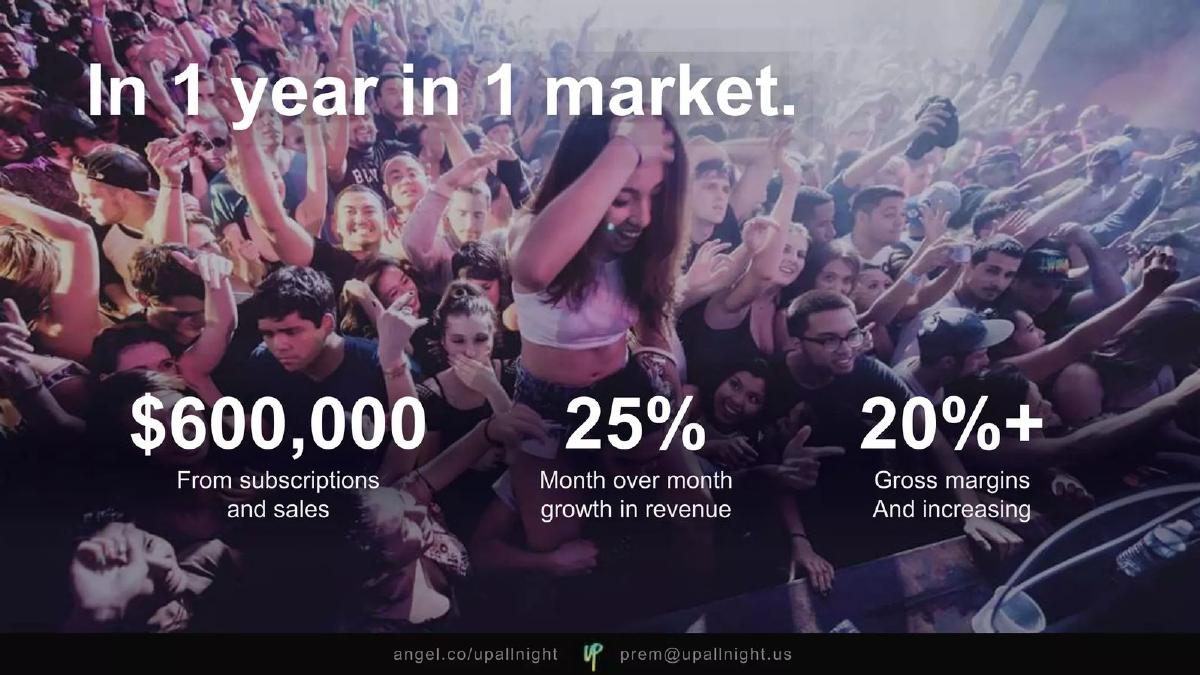
- The company achieved $600,000 in revenue from subscriptions and sales within its first year in a single market (Slide 5).
- Up All Night targets a $100 billion market where nearly 50% of event inventory currently goes unsold (Slide 3).
- Revenue is growing at a rate of 25% month-over-month with gross margins exceeding 20% (Slide 5).
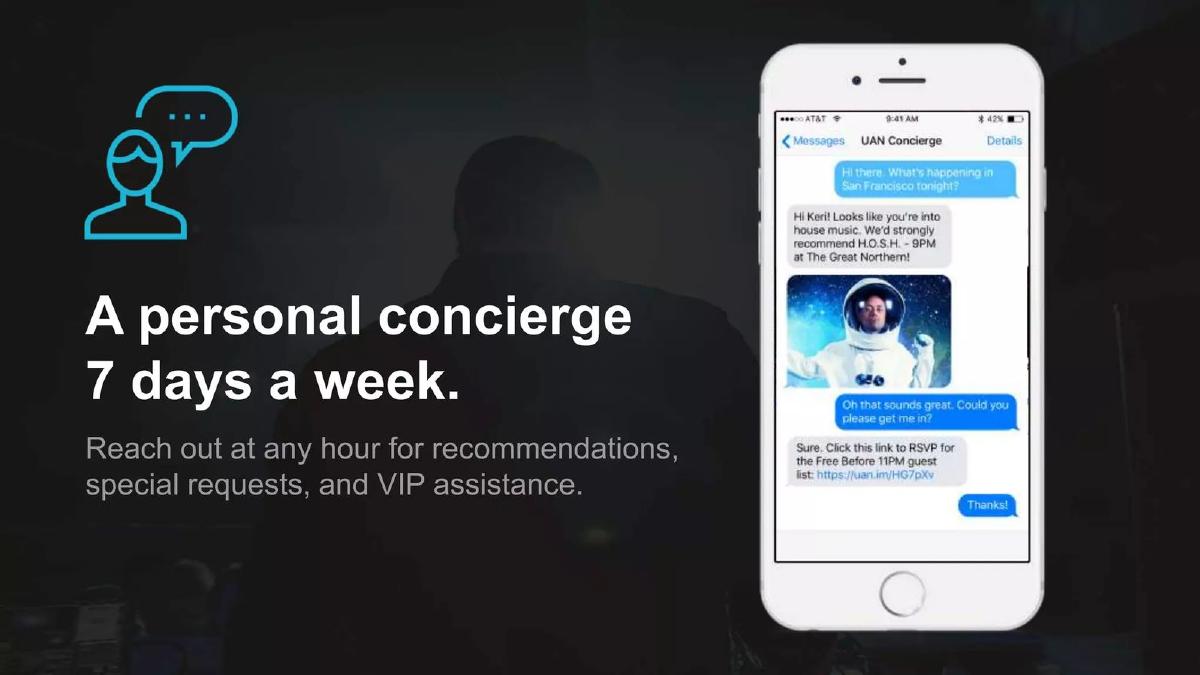
- The product strategy involves transitioning from a 7-day-a-week personal concierge to an automated 'affinity model' chatbot to reduce workload and scale (Slide 6, Slide 7).
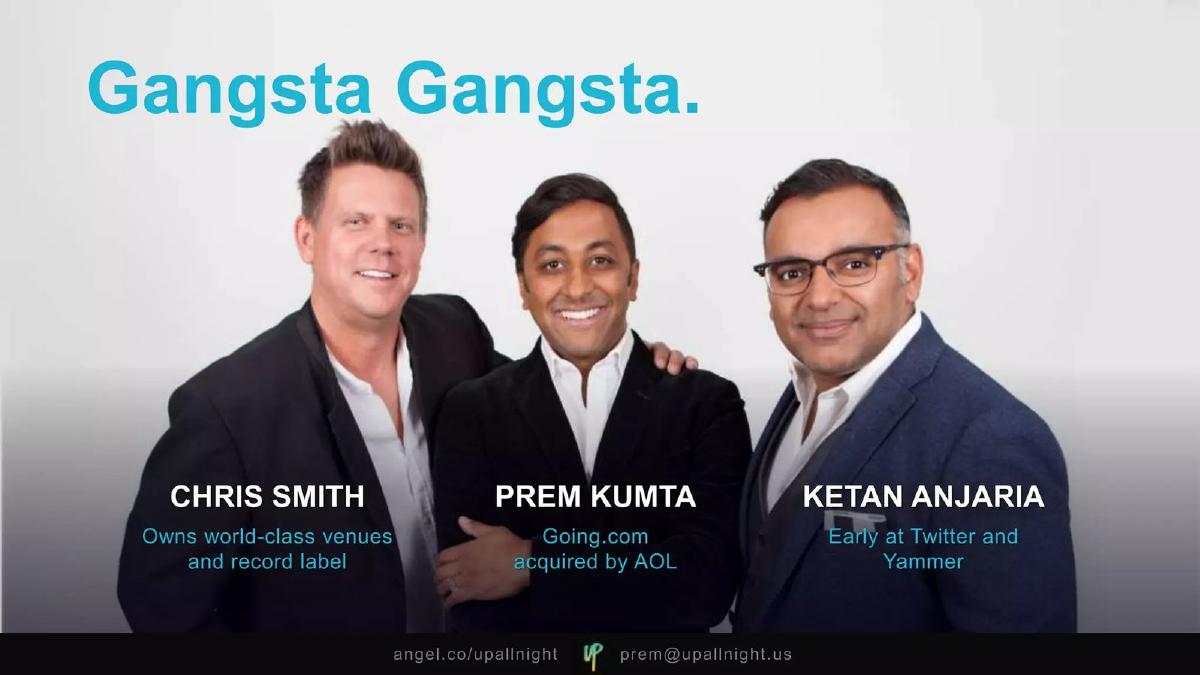
- The founding team includes Prem Kumta, whose previous company Going.com was acquired by AOL, and Ketan Anjaria, an early employee at Twitter and Yammer (Slide 4).
- The business model relies on a marketplace and membership structure where event creators provide content and the platform delivers it to members (Slide 8).
- Incumbents like Live Nation and Ticketmaster are framed as 'Old Dogs' that are widely disliked by consumers (Slide 3).
- The deck concludes with a summary of traction, team, and vision but omits a specific dollar amount for the current funding ask (Slide 9).
The 10-Slide Proof of Concept
Up All Night’s 2016 seed deck is a lean, high-impact presentation that relies heavily on two things: founder pedigree and immediate traction. At only 10 slides, it avoids the common pitfall of over-explaining the technology and instead focuses on the results of their first year in business. The deck serves as a blueprint for how to pitch a localized success story as a scalable global opportunity.
Slide 1 & 2: The Hook and Mission
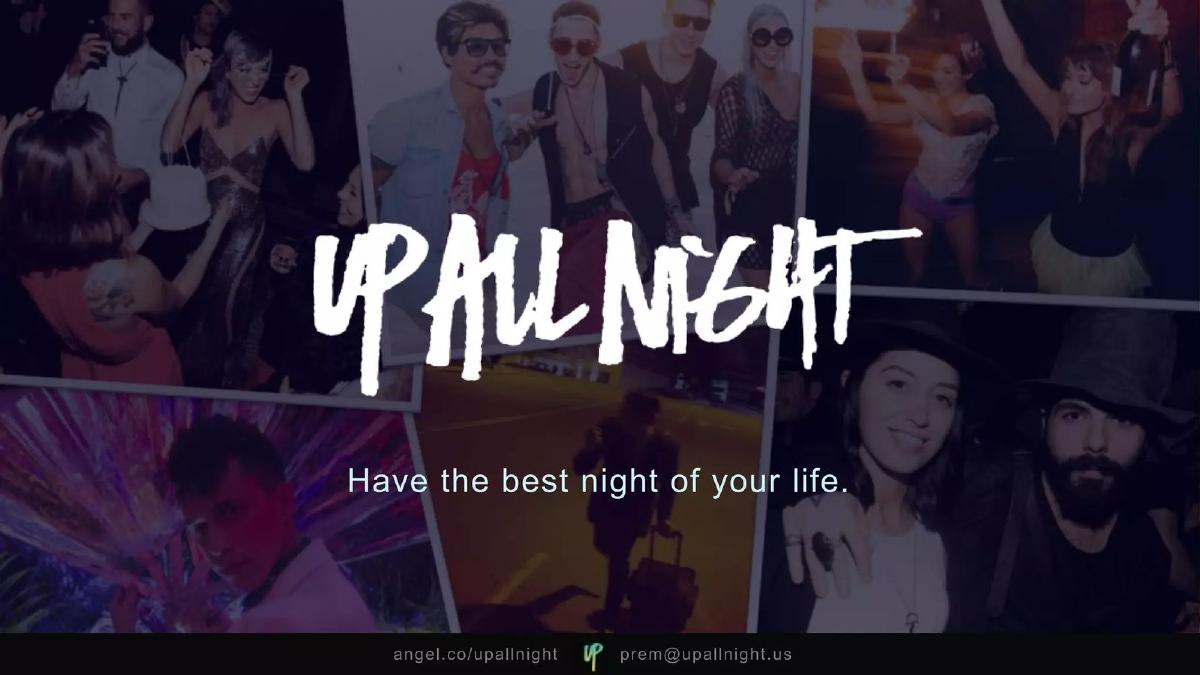
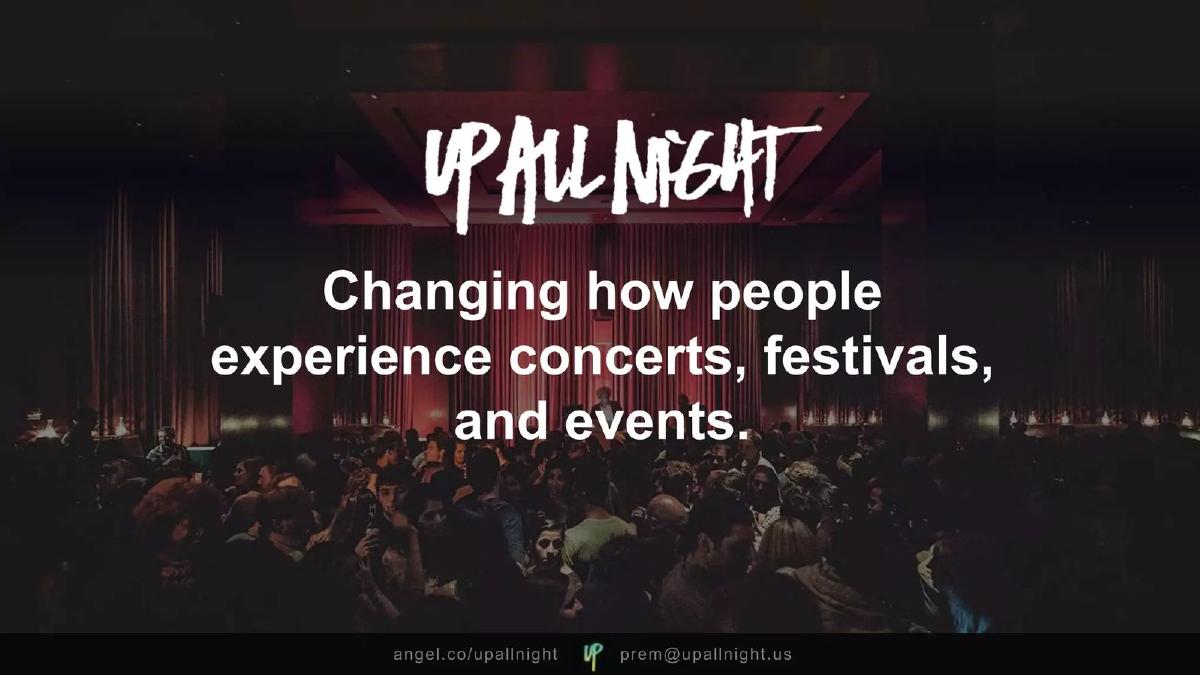
The deck opens with a high-energy collage of nightlife photography and the brand’s stylized, handwritten-style logo. The tagline, "Have the best night of your life," sets an emotional tone rather than a functional one. Slide 2 quickly pivots to a functional mission statement: "Changing how people experience concerts, festivals, and events." By keeping the opening slides visual and broad, the founders establish the lifestyle nature of the brand before diving into the mechanics of the business.
Slide 3: The Market Opportunity and the 'Old Dogs'
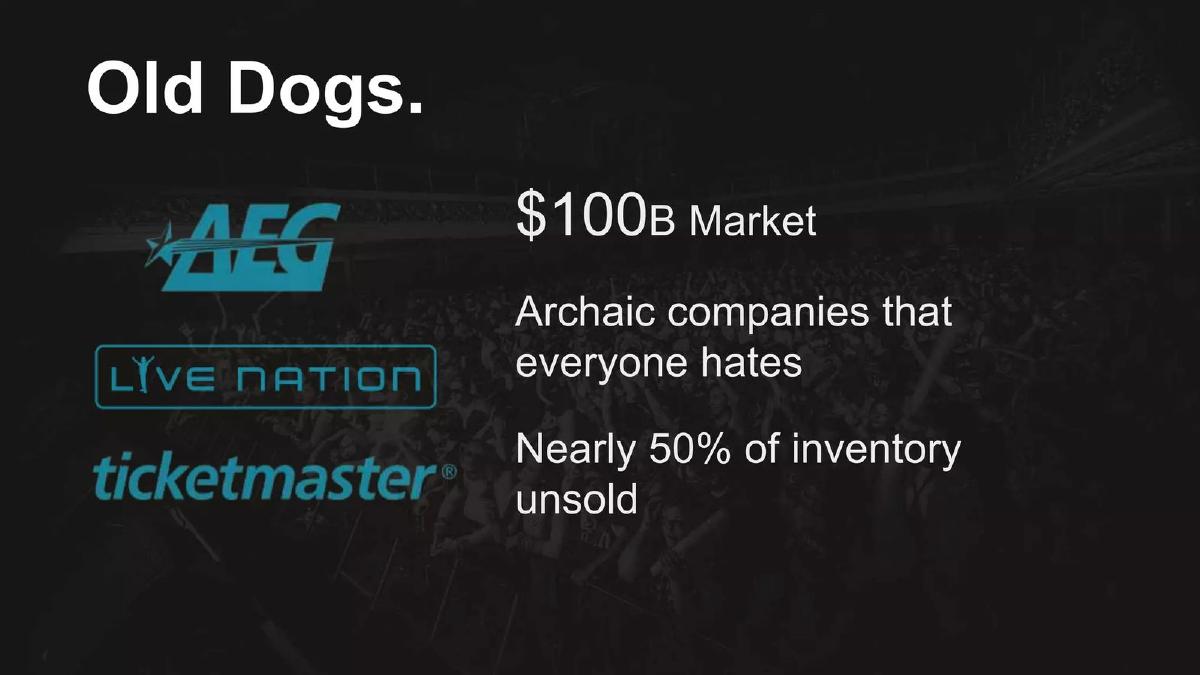
Slide 3 is the 'Problem' slide, though it frames the problem through the lens of competition. It labels industry giants AEG, Live Nation, and Ticketmaster as "Old Dogs." The slide lists three critical market facts: a "$100B Market," the claim that these are "Archaic companies that everyone hates," and the most important data point for their business model: "Nearly 50% of inventory unsold." This last point is crucial because it suggests a massive supply-side opportunity for a platform that can move tickets more efficiently than the incumbents.
Slide 4: The 'Gangsta' Team
In a bold stylistic choice, the team slide is headlined "Gangsta Gangsta." While the headline is informal, the credentials listed are anything but. The slide features three founders: Chris Smith (venue and record label owner), Prem Kumta (founder of Going.com, acquired by AOL), and Ketan Anjaria (early at Twitter and Yammer). This slide establishes immediate credibility, showing that the team has both the industry connections (venues/labels) and the technical/growth experience (Twitter/AOL) to execute on the vision.
Slide 5: Traction in a Bottle
Slide 5 is the strongest slide in the deck. It focuses on a single year of operation in a single market. The metrics are clear and impressive: "$600,000 from subscriptions and sales," "25% month over month growth in revenue," and "20%+ Gross margins and increasing." By isolating these numbers to one market, the founders imply that the model is a proven 'unit' that just needs capital to be replicated in other cities. This is a classic 'add fuel to the fire' pitch.
Slide 6 & 7: The Product and the Pivot to Scale
Slides 6 and 7 explain how the service actually works. Slide 6 introduces the "personal concierge 7 days a week," showing a text message interface where a user asks for recommendations and receives a guest list link. Slide 7 addresses the obvious question of scalability. It introduces an "Affinity model" and a "Chat bot" that "reduces concierge workload helping us scale faster." This transition from human-led service to AI-driven automation is a key selling point for investors worried about the high overhead of a concierge model.
Slide 8: The Business Model
Slide 8 clarifies the relationship between the platform, the creators, and the users. Titled "Marketplace & Membership," it states: "Event creators market for us and we deliver that content to our members." This suggests a low customer acquisition cost (CAC) because the venues and artists are incentivized to bring their fans onto the platform to fill that 50% of unsold inventory mentioned earlier in the deck.
Slide 9 & 10: The Close and Contact
Slide 9 serves as a summary, restating the "$600,000" traction, the "Legendary" team, and the "$100B Opportunity." Interestingly, there is no specific 'Ask' slide detailing how much money they are looking for or what the valuation is. The final slide is a repeat of the cover image with contact information for Prem Kumta and a link to their AngelList profile. The catalogue listing confirms they raised $500,000, but the deck itself leaves the door open for negotiation by not anchoring to a specific number.
What Up All Night Got Right
Focus on Unsold Inventory: Identifying that 50% of the market's inventory is wasted provides a clear 'why now' and 'why us.' It shows they aren't just fighting for existing market share but capturing lost value. · Localized Proof: By showing $600k in revenue from just one market, they proved the business model works in reality, not just on paper. · Founder-Market Fit: The team slide perfectly balances industry insiders with tech-scale veterans. · Scalability Path: They didn't just pitch a concierge service; they pitched a concierge service that was actively being automated by a chatbot.
What Was Missing
The Ask: The deck lacks a formal slide stating the amount of capital sought and the specific milestones that capital would achieve. While common in 'teaser' decks, a full pitch usually requires a roadmap for the next 18 months. · Unit Economics: While they mention 20% gross margins, there is no mention of Customer Acquisition Cost (CAC) or Lifetime Value (LTV), which are critical for a B2C subscription app. · Competitive Landscape: Beyond calling the big players 'Old Dogs,' the deck doesn't address other startups in the discovery space (e.g., Dice, Songkick, or Bandsintown). · Market Expansion Plan: The deck says '1 market,' but doesn't explicitly state which market it was or which cities were next on the list.
Founder Lessons
Prove the unit, then ask for the factory. Up All Night didn't try to show they could conquer the world on day one. They showed they could make $600,000 in one city. For a seed round, proving a repeatable revenue model in a single geography is often more convincing than a theoretical plan for fifty cities. Founders should focus on their 'North Star' metric—in this case, revenue and growth—and put it front and center.
Use your pedigree to handle objections. If you are building a high-touch service, investors will immediately worry about margins and scale. Up All Night countered this by showing a team that had already scaled companies like Twitter and Yammer, and then immediately followed up with a slide about their automation chatbot. They anticipated the 'scale' objection and answered it with both personnel and product strategy.
Keep the design consistent with the brand. The 'gritty' nightlife aesthetic of the deck matches the product. It doesn't look like a corporate banking presentation because the business isn't corporate banking. The visual identity of your deck should give the investor a 'feel' for the user experience you are building.
Frequently asked questions
- How much did Up All Night raise with this deck?
- According to the catalogue listing, Up All Night raised $500,000 in a Seed round in 2016. The deck itself does not specify the amount being raised on the final slide, which is a common omission in decks intended for broad distribution or platform listings like AngelList.
- What is the core problem Up All Night is solving?
- Slide 3 identifies two primary problems: consumer dissatisfaction with 'archaic' ticketing giants like Ticketmaster and AEG, and a massive inefficiency in the market where nearly 50% of event inventory goes unsold. They aim to bridge this gap through better discovery and a membership model.
- What are the key financial metrics mentioned in the deck?
- Slide 5 highlights three critical metrics: $600,000 in total revenue from subscriptions and sales, a 25% month-over-month revenue growth rate, and gross margins of 20% or higher. These figures were achieved within one year of operation in a single test market.
- How does the company plan to scale its personalized service?
- The company initially used a human-led 'personal concierge' available 7 days a week (Slide 6). To scale, they introduced an 'affinity model' chatbot that learns user preferences and predicts events, thereby reducing the manual workload of the concierge team (Slide 7).
- Who are the founders and what is their background?
- The team consists of Chris Smith, who owns venues and a record label; Prem Kumta, who previously founded Going.com (acquired by AOL); and Ketan Anjaria, who was an early team member at both Twitter and Yammer. This combination provides a mix of industry-specific domain expertise and high-growth tech experience.