Twine’s 2017 Seed deck is a masterclass in demonstrating marketplace sequencing. By explicitly dividing their progress into 'Phase 1' (Supply) and 'Phase 2' (Demand), the founders showed a clear strategic path to liquidity. The deck highlights a massive supply of 175,000 creatives across 169 countries, providing a strong foundation for their 20% commission model. While the deck lacks a specific financial 'Ask' slide and detailed unit economics like CAC or LTV, it compensates with strong social proof and a clear competitive positioning that moves beyond simple job boards into a 'social marketp…
Key takeaways
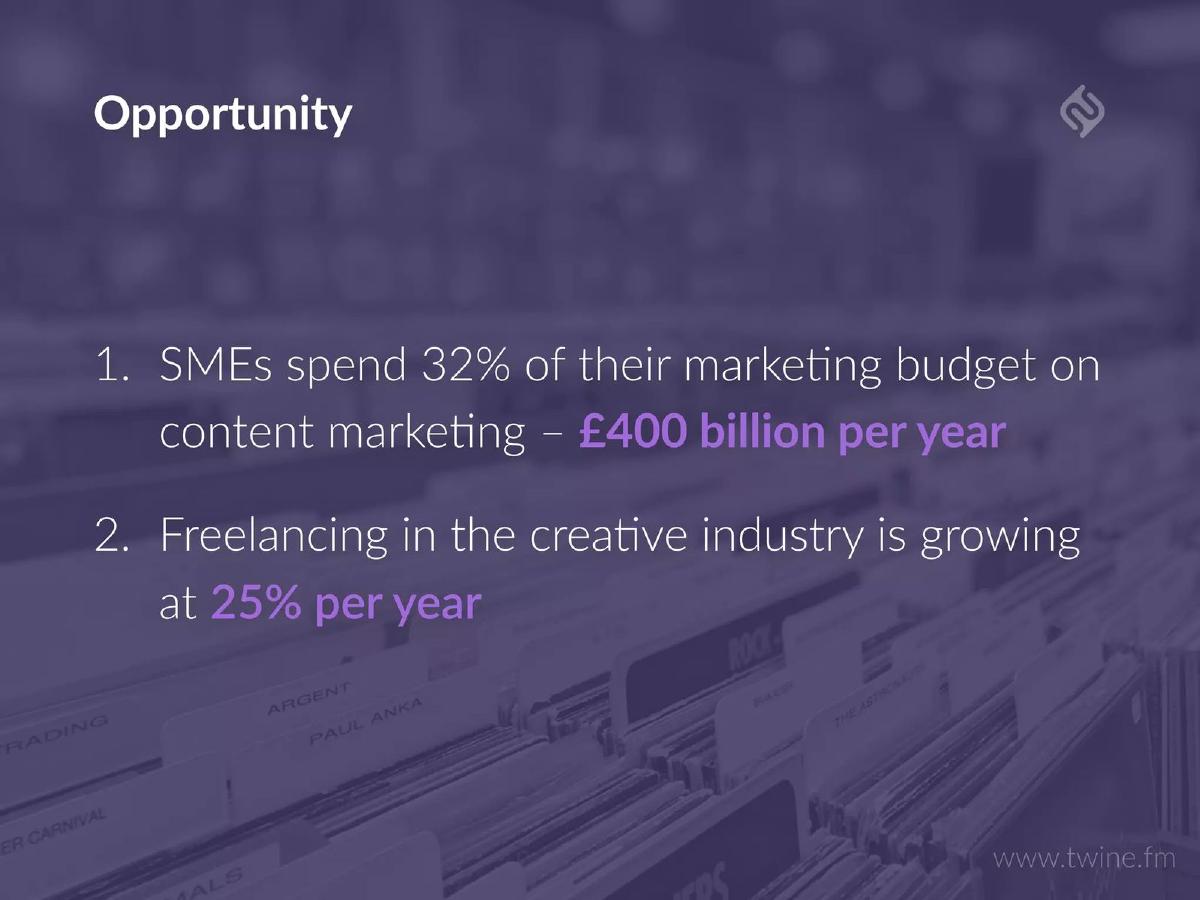
- The company identifies a £400 billion annual spend by SMEs on content marketing as the primary market opportunity (Slide 2).
- Twine successfully built a supply of 175,000 registered creatives across 169 countries before aggressively pursuing the demand side (Slide 7).
- The business model relies on a 20% commission for facilitating hires and payments, using milestones to prevent platform circumvention (Slide 9).
- Growth is driven by a programmatic SEO strategy featuring 41,000 localized landing pages to capture long-tail organic search (Slide 10).
- The founder, Stuart Logan, brings credibility as a second-time founder who previously built an ad-tech company to £1.4m in gross annual revenue (Slide 11).
- Twine positions itself in the 'Social Marketplace' quadrant, distinguishing itself from pure marketplaces like Upwork and pure social platforms like Behance (Slide 13).
- The deck reports £12k of project briefs added in September during the early stages of their demand-side growth phase (Slide 8).
The Twine Teardown: A Strategic Approach to Creative Marketplaces
Twine’s 2017 pitch deck is a focused, 15-slide presentation that successfully secured over $1M in seed funding. The deck is notable for its clean design and its emphasis on the 'supply-first' marketplace strategy. By the time this deck was presented, Twine had already solved the hardest part of any marketplace: the cold-start problem on the supply side.
The Market Opportunity and Problem Statement
Slides 2-4 set the stage by defining the scale of the creative economy. On Slide 2, Twine identifies that SMEs spend 32% of their marketing budgets on content marketing, totaling £400 billion per year. They also note that creative freelancing is growing at 25% annually. This provides a clear 'why now' for investors, pointing to a massive, expanding market.
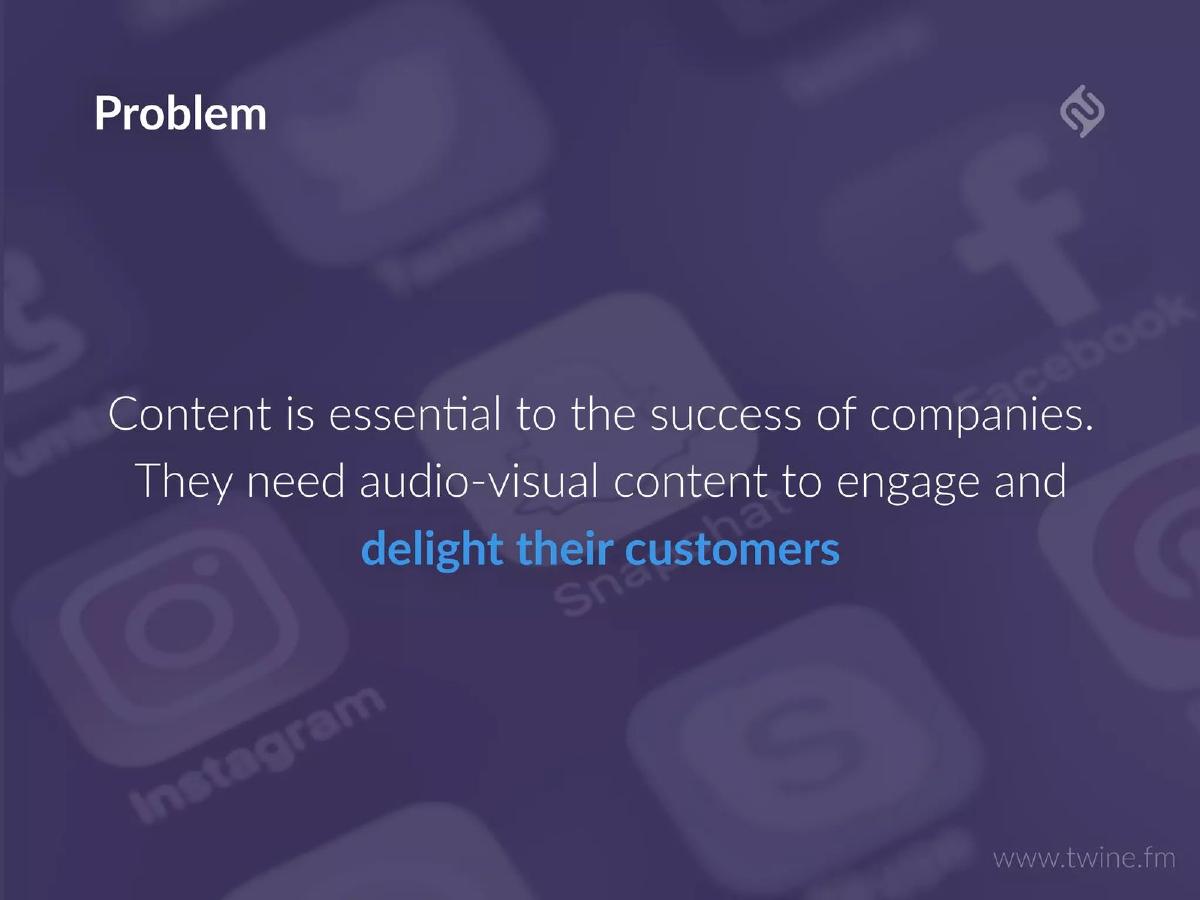
The problem is framed from two perspectives (Slides 3 and 4): companies need high-quality audio-visual content to engage customers, while creative freelancers struggle to build networks and find consistent paid work. This dual-sided problem is the classic justification for a marketplace solution.
The Solution: A Social Marketplace Hybrid
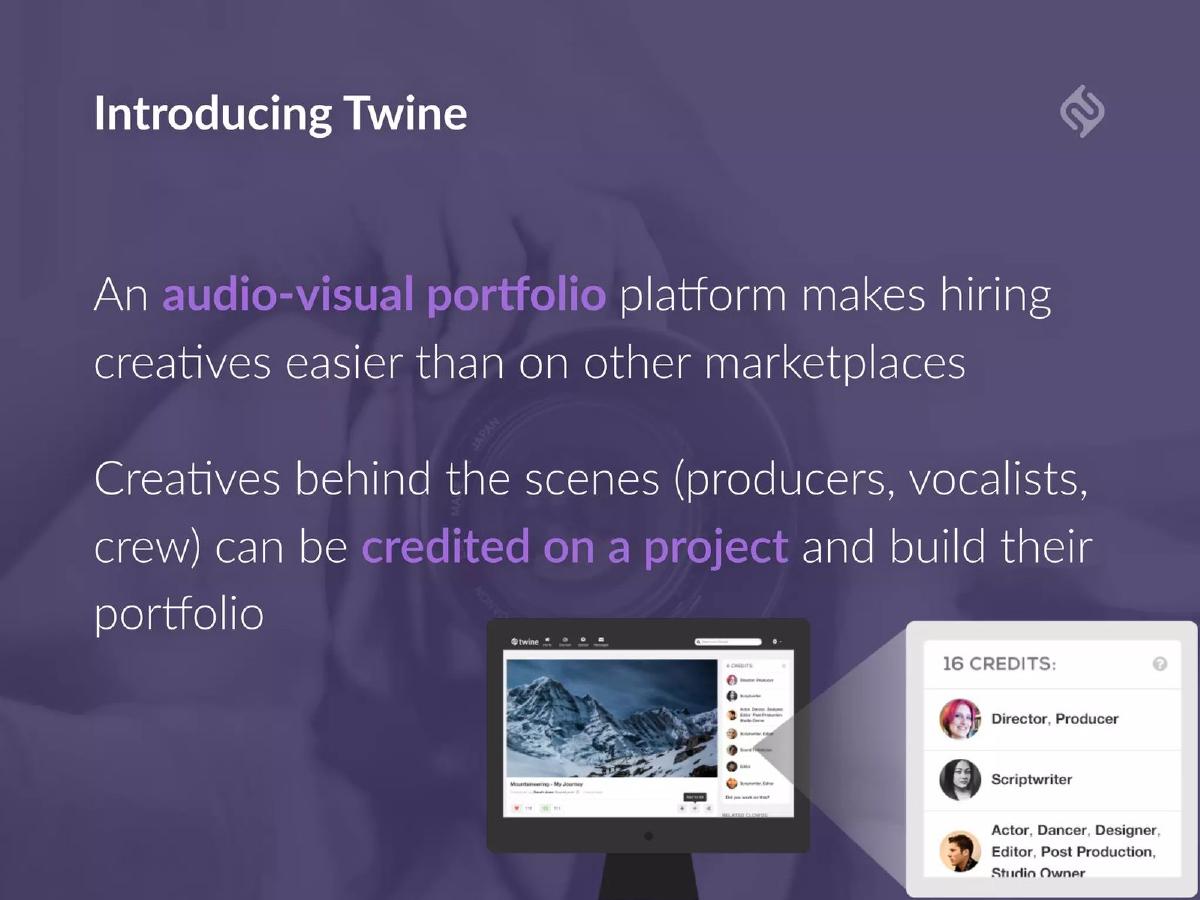
Slides 5-6 introduce Twine. The company defines itself as a marketplace connecting companies to a network of freelancers in design, music, and film. A key differentiator mentioned on Slide 6 is the 'audio-visual portfolio platform.' Unlike generic freelance sites, Twine allows 'creatives behind the scenes' (producers, vocalists, crew) to be credited on projects. This feature is designed to incentivize freelancers to stay on the platform to build their professional reputation, not just to find a one-off job.
Traction and Marketplace Sequencing
Slides 7-8 are the core of the deck's credibility. Twine uses a 'Phase' approach to explain their growth. Slide 7 shows 'Phase 1' as complete, having grown the supply side to 175,000 registered creatives across 169 countries (30% US, 10% UK). This is a significant number for a seed-stage company and proves they can attract talent.
Slide 8 introduces 'Phase 2,' which focuses on the demand side (SMEs). They report £12k of project briefs added in September. While this revenue figure is modest compared to the supply numbers, it demonstrates that the transition from a community to a commercial marketplace has begun. The line graph shows a clear upward trend in demand from May to July.
Business Model and Growth Strategy
Slides 9-10 detail how the company makes money and how it plans to scale. Twine takes a 20% commission on transactions (Slide 9). They explicitly mention that 'project milestones create trust and reduce platform circumvention,' acknowledging a common investor fear in the marketplace sector.
The growth strategy (Slide 10) is highly tactical. Twine claims to have 41,000 localized landing pages designed for organic search. This programmatic SEO approach targets the 2 million monthly searches from companies looking for creative talent. This is a sophisticated, low-cost acquisition strategy that suggests the team understands digital marketing at scale.
Team and Social Proof
Slide 11 introduces the team. Stuart Logan (CEO) is highlighted as a second-time founder with prior success in ad-tech (£1.4m revenue). Damien Shiells (CTO) provides the technical backbone with a Computer Science degree and a long-standing working relationship with Logan. The slide also prominently features logos from existing investors like Seedcamp, Creative England, and AXM VC, which provides significant institutional validation.
Competitive Landscape and Vision
Slides 12-15 wrap up the deck with market positioning and mission. Slide 13 uses a 2x2 matrix to place Twine in the 'Social Marketplace' quadrant. They position themselves as more 'social' than Upwork or Fiverr, and more 'marketplace-oriented' than Behance or Dribbble. This is a standard but effective way to visualize a unique value proposition.
Slide 14 provides 'Feedback' from a multi-platinum award-winning music producer, adding a layer of high-end industry social proof. The deck concludes on Slide 15 with a simple mission statement: helping creatives find success and giving buyers a quality service.
What Works in This Deck
Clear Sequencing: Dividing the business into Phase 1 (Supply) and Phase 2 (Demand) shows a sophisticated understanding of marketplace dynamics. It tells investors exactly where the company is in its lifecycle. · Massive Supply Proof: 175,000 registered users is an impressive figure for a seed round. It proves the product has 'gravity' for the creative community. · Specific Growth Levers: Mentioning the 41,000 localized landing pages is much more effective than saying 'we will use SEO.' It shows the work has already been done. · Founder Track Record: Highlighting the CEO's previous £1.4m revenue milestone reduces the perceived risk of the investment.
What Is Missing
The Ask: There is no slide detailing how much money is being raised, the valuation, or the specific use of funds. While often removed for public versions, its absence makes the narrative feel incomplete. · Unit Economics: There is no mention of Customer Acquisition Cost (CAC) or Lifetime Value (LTV). For a marketplace, understanding the cost to acquire an SME versus the commission earned from them is vital. · Burn Rate and Runway: The deck does not show the current financial health of the company or how long the new capital will last. · Detailed Financial Projections: While they show current project brief volume, there is no forward-looking projection of where the 20% commission model leads in 3-5 years.
What a Founder Should Copy
The 'Phase' Slide: If you are building a marketplace, copy the way Twine separated supply growth from demand growth. It prevents you from being judged on low revenue if you can show massive supply-side traction. · Competitive Quadrant: The 2x2 matrix on Slide 13 is a perfect example of how to define a 'middle ground' that combines the best of two existing categories. · Localized Landing Page Strategy: If your business relies on search, be as specific as Twine was about your SEO infrastructure. It proves you have a 'machine' for growth, not just a hope. · Crediting System: The focus on 'credits' for behind-the-scenes workers (Slide 6) is a great example of building a 'moat' through user-generated data that makes the platform sticky.
Frequently asked questions
- How much did Twine raise with this deck?
- According to the catalogue listing, Twine raised over $1M in funding using this pitch deck. In total, the company has raised $1.1M across seven investment rounds. The deck itself does not state the specific amount being sought in the 2017 round, which is a common omission in decks shared publicly after the close.
- What is Twine's primary revenue model?
- As stated on slide 9, Twine operates on a marketplace commission model. They take a 20% commission for facilitating the hire and payment process. The platform uses user ratings and project milestones to build trust and specifically to reduce 'platform circumvention,' where users might try to take transactions offline to avoid fees.
- How does Twine differentiate itself from competitors like Upwork or Fiverr?
- Twine uses a 2x2 matrix on slide 13 to position itself as a 'Social Marketplace.' Unlike Upwork or Freelancer, which they categorize as pure marketplaces, or Behance and Dribbble, which are pure social/portfolio sites, Twine claims to combine the two. This allows creatives to build portfolios and receive credits on projects while also finding paid work.
- What was Twine's user acquisition strategy?
- Twine's 'Route to Market' (Slide 10) focuses heavily on organic search. They built 41,000 localized landing pages to capture the 2 million monthly searches from small companies looking for creatives. They also target startups in the fashion and tech sectors specifically through content marketing.
- Who are the key people behind Twine?
- The leadership team includes Founder and CEO Stuart Logan, a second-time founder with a track record of building an ad-tech firm to £1.4m in revenue, and Co-Founder/CTO Damien Shiells, who holds a BEng in Computer Science and has worked with Logan for four years (Slide 11).