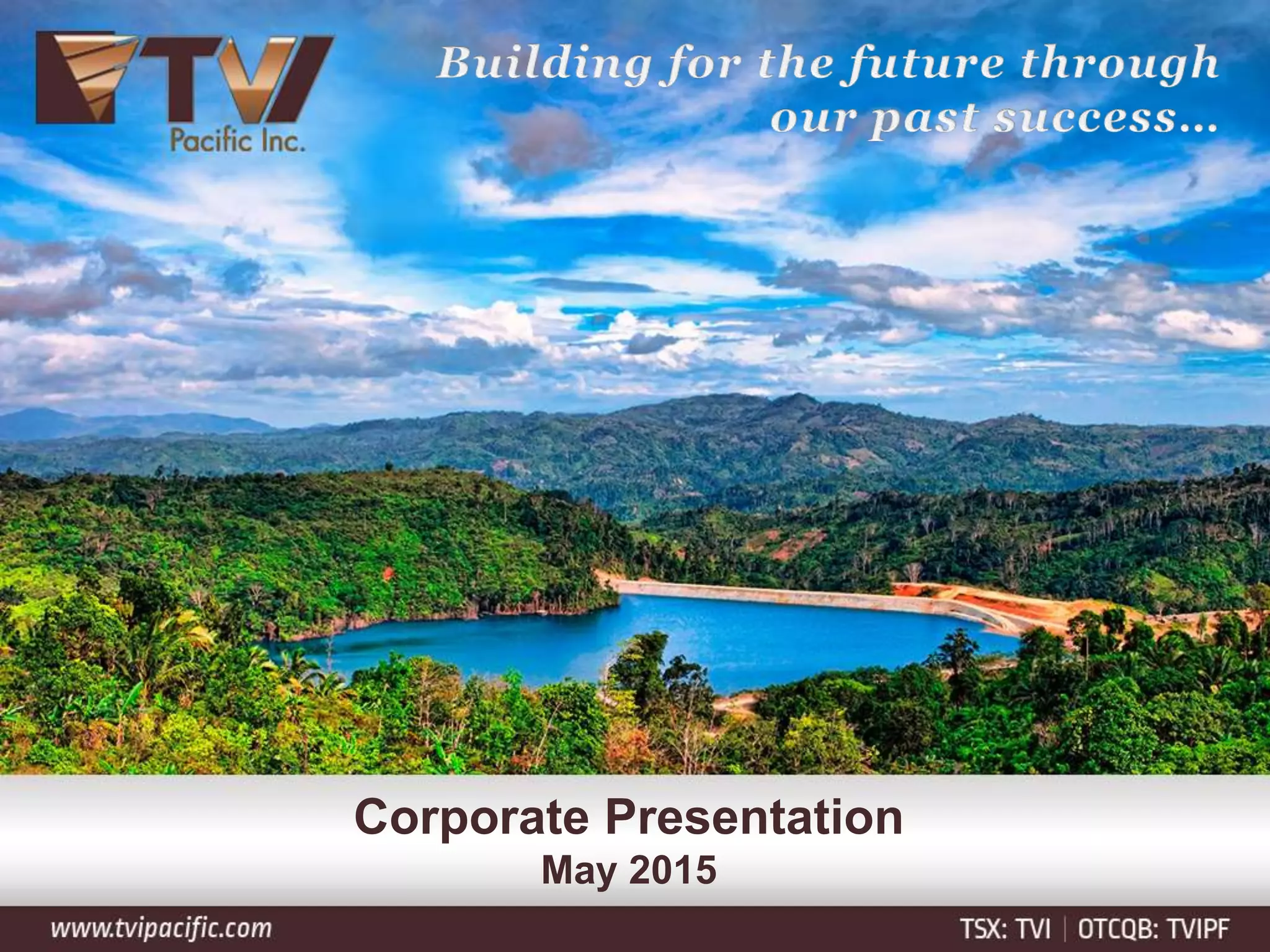
TVI Pacific's May 2015 presentation serves as a technical and strategic roadmap for a publicly traded mining company (TSX: TVI) operating primarily in the Philippines. The deck centers on a 'Bootstrap Growth' philosophy: acquiring modest initial deposits, generating rapid cash flow, and self-financing further exploration to minimize shareholder dilution. With a market capitalization of C$13.11 million at the time of the deck, the company highlights its Agata Nickel DSO project and Balabag Gold-Silver project as primary value drivers. The presentation is data-heavy, focusing on proven reserves…
Key takeaways
- The company utilizes a 'Bootstrap Growth' strategy to fund exploration through operational cash flow and minimize dilution (Slide 7).
- TVI Pacific holds a 60% interest in the Agata Nickel DSO Project, which features proven and probable reserves of 9.7 million wet metric tonnes (Slide 13).
- The Agata project is strategically located near a deep protected seaport, enabling year-round shipping to Asian markets (Slide 13).
- The Balabag Gold-Silver Project is 100% owned by TVIRD and was in the final stages of mine engineering as of H2 2015 (Slide 19).
- Management is highly experienced, with CEO Clifford M. James bringing over 40 years of technical and financial experience in the resource sector (Slide 22).
- The company maintains a complex organizational structure with subsidiaries in Canada, Anguilla, Hong Kong, and the Philippines (Slide 25).
- Retail investors held the majority of shares (72.4%) as of April 2015, with institutional investors at 14.5% (Slide 4).
- The deck emphasizes infrastructure advantages, such as the proximity of the proposed nickel processing plant to the port (within 2km) to lower operating costs (Slide 16).
Introduction and Market Context
The TVI Pacific Corporate Presentation from May 2015 is a technical briefing for a publicly traded mining entity. Unlike early-stage tech startups that sell a vision of the future, TVI Pacific sells a combination of geological certainty, operational history, and a specific financial methodology. The deck is designed for the TSX (Toronto Stock Exchange) environment, where resource investors look for specific metrics like reserve grades, infrastructure proximity, and ownership percentages. The cover slide sets a professional, industrial tone with the tagline "Building for the future through our past success," signaling that this is not the company's first project.
Slide 4: Share Structure, Liquidity & Ownership
This slide provides the essential 'hard numbers' for a public company. It lists 655.4 million issued and outstanding shares and a market capitalization of C$13.11 million as of April 30, 2015. A critical figure for investors is the C$5.3 million in cash and short-term investments (as of December 31, 2014), which provides a snapshot of the company's runway. The shareholder breakdown is notably retail-heavy at 72.4%, which often suggests a need for more institutional marketing—a likely goal of this very presentation. The insider list shows CEO Clifford James holds a significant 8.78% stake through Seajay Management Enterprises, aligning his interests with other shareholders.
Slide 7: Resource Acquisition & Development Strategy
TVI Pacific defines its competitive edge not through a specific technology, but through a business model labeled "Bootstrap Growth." The slide outlines three pillars: acquiring deposits with growth potential, generating early cash flow, and self-financing expansion. This is a defensive strategy designed to appeal to risk-averse investors. By emphasizing "minimal dilution to shareholders," the company addresses a common pain point in the junior mining sector, where frequent capital raises often wipe out early investors. The mention of "economic and social benefits" for local communities is a nod to ESG (Environmental, Social, and Governance) concerns, which are vital for maintaining a social license to operate in the Philippines.
Slide 10: Our Investments
This is a transition slide that visualizes the company's portfolio. It lists TVI Resource Development (Phils.) Inc. (TVIRD) as the primary vehicle, alongside interests in Mindoro Resources Ltd, Foyson Resources Limited, and TG World. This slide establishes that TVI Pacific is a holding company with a diversified set of resource bets, rather than a single-asset gamble.
Slide 13: TVIRD’s Agata Nickel DSO Project
This slide moves into the technical specifics of the company's lead asset. It identifies the Agata project as a 60% owned joint venture located in the Surigao mining region of Mindanao. The slide provides crucial pricing data: Limonite Zone ore at $12-$14 per wmt and Saprolite Zone ore at $37 to $42 per wmt. The headline metric here is the "Proven & Probable Reserves of 9.7 million wet metric tonnes grading 0.6% nickel and 48% iron." For a mining investor, this is the core value proposition. The inclusion of photos showing active machinery and shipping operations serves as proof of life, confirming that this is an active site rather than a theoretical prospect.
Slide 16: TVIRD’s Agata Nickel Processing Project
Building on the previous slide, this page details the processing strategy. It uses a topographical map to show the spatial relationship between the ore body, the proposed processing plant, and the port. The key takeaway is the "1 Km" distance highlighted in red, emphasizing low logistics costs. The goal is to produce Mixed Hydroxide Product (MHP) with ~40% nickel content, a higher-value product than raw ore. By mentioning that MHP is in "high demand in the global stainless steel market," the company connects its local operations to global commodity trends.
Slide 19: TVIRD’s Balabag Gold-Silver Project
The deck shifts focus to the company's 100% owned gold-silver asset. This slide is dense with exploration data: 296 holes drilled for 34,156 meters. It lists a resource of 1.78 million tonnes averaging 2.34 g/t gold and 72.3 g/t silver. The slide also reports results from a 2013 pilot plant, showing high recovery rates (93% for gold). The "call to action" on this slide is the expected approval of the Declaration of Mining Project Feasibility in H2 2015, providing a clear upcoming catalyst for stock price movement.
Slide 22: Management Team
In resource investing, the team is often as important as the geology. The deck highlights three key figures. Clifford M. James (CEO) is positioned as a 40-year veteran who brought the first foreign-funded mine to the Philippines after the 1995 Mining Act. Patrick Hanna (CFO) adds weight with 28 years of experience, including time at Glencore and Kazakhmys (a top 10 copper producer). Shirley Anthony (VP Corporate Communications) rounds out the team with 10 years of investor relations experience. The bios focus heavily on tenure and specific international mining experience, which builds credibility for managing complex operations in emerging markets.
Slide 25: Appendix: Organizational Structure
The final slide is a complex flow chart of the corporate hierarchy. It shows TVI Pacific Inc. as the parent company of an Alberta corporation, with subsidiaries in Anguilla, Hong Kong, and the Philippines. This level of transparency is necessary for public companies to explain how capital flows between jurisdictions and how joint venture interests (like the 60% in Agata) are legally held. It also reveals smaller interests, such as a 10% stake in the Amazon Bay joint venture via Foyson Resources.
What TVI Pacific Does Well
The deck excels at providing technical validation. In the mining sector, investors are wary of "lifestyle companies" that spend money on exploration without a path to production. TVI Pacific counters this by showing active operations (Slide 13), pilot plant recovery rates (Slide 19), and a clear infrastructure map (Slide 16). The "Bootstrap Growth" strategy is a strong narrative hook that differentiates them from competitors who rely solely on dilutive equity financing. They also do a good job of identifying specific catalysts—such as the H2 2015 feasibility approval—which gives investors a reason to buy now rather than waiting.
What is Missing from the Deck
While the deck is technically sound, it lacks a clear macro-economic outlook on nickel and gold prices for the 2015-2020 period. While they mention "high demand," they don't provide the supply/demand curves that often help justify a resource investment. Furthermore, there is no detailed "Use of Proceeds" slide. While the company is public and follows a bootstrap model, an investor presentation usually includes a slide detailing how the next C$5M-C$10M will be spent to reach the next milestone. Finally, the deck does not address the specific political risks of operating in the Philippines, which is a common concern for North American investors in this region.
Founder's Takeaway: Copy This, Ignore That
Copy the 'Strategy as a Brand': TVI Pacific didn't just say they were careful with money; they branded it as "Bootstrap Growth" and dedicated a slide to its benefits (Slide 7). If your startup has a unique way of operating—whether it's a specific sales motion or a capital-efficient R&D process—give it a name and treat it as a core asset.
Copy the Infrastructure Context: Slide 16 is a masterclass in showing, not just telling, operational efficiency. By mapping the 1km distance to the port, they make the low-cost claim undeniable. Founders should use maps, diagrams, or workflow charts to show how their physical or digital infrastructure creates a moat.
Ignore the Text Density: The management bios (Slide 22) and the project descriptions are extremely text-heavy. While this is standard for public company filings, it is a poor choice for a live pitch. A modern founder should use high-impact headlines and move the dense biographical or technical data to an appendix or a linked data room.
Conclusion
The TVI Pacific deck is a functional, data-driven document that successfully communicates the company's transition from an explorer to a producer. It prioritizes geological and financial facts over flashy design, which is appropriate for its target audience of professional resource investors. By anchoring the presentation in the "Bootstrap Growth" philosophy, the company provides a logical framework for its diverse activities, making a complex multi-asset story easier to digest.
Frequently asked questions
- What is TVI Pacific's core investment philosophy?
- TVI Pacific follows a 'Bootstrap Growth' model. This involves acquiring resource deposits with modest initial sizes but significant growth potential, starting operations quickly to generate cash flow, and using that revenue to fund further exploration and expansion. This approach aims to lower upfront capital expenditures and reduce risk while minimizing shareholder dilution through self-financed growth.
- What are the primary assets discussed in the deck?
- The deck focuses on two main Philippine projects: the Agata Nickel DSO Project and the Balabag Gold-Silver Project. Agata is a joint venture (60% interest) with 9.7 million wet metric tonnes of reserves. Balabag is a 100% owned epithermal gold and silver vein deposit with an estimated 1.78 million tonnes of resource averaging 2.34 g/t gold and 72.3 g/t silver.
- Who are the major shareholders of TVI Pacific?
- As of May 2015, the shareholder base was 72.4% retail, 14.5% institutional, and 13.1% insiders. The largest single holder listed is Lim Asia Funds at 9.49%, followed by Seajay Management Enterprises (controlled by CEO Cliff James) at 8.78%, and Prime Resource Holdings at 5.00%.
- What is the status of the Balabag Gold-Silver Project in this deck?
- At the time of the presentation, the Balabag project was in the final stages of mine engineering and processing design. A Declaration of Mining Project Feasibility was being completed, with approval expected in the second half of 2015. A pilot plant established in 2013 had already shown recovery rates of 93% for gold and 90% for silver.
- How does the company plan to process its nickel ore?
- The company proposed a nickel processing plant located within two kilometers of its port to produce Mixed Hydroxide Product (MHP) with approximately 40% nickel content. The strategy targets the global stainless steel market, utilizing local infrastructure including grid power, fresh water, and a deep-water causeway to keep operating costs low.