Tushky’s 18-slide deck from 2011 is a classic example of early-stage marketplace storytelling. The company positioned itself as the solution to a fragmented $33 billion market for local activities in India, moving beyond the standard 'movie, mall, and dinner' routine. With a lean team of IIT Bombay alumni and a roster of high-profile angel investors, the deck highlights a rapid supply-side growth from 100 to over 800 sellers in less than a year. While the financial metrics were nascent—reporting just 5 tickets per day—the strength of the 'sharing economy' narrative and the focus on unique, bo…
Key takeaways
- The deck identifies a $33 billion total addressable market in India, combining local tours, restaurants, movies, and hobby classes (Slide 7).
- Tushky reported a monthly run rate of $15,000 with 20% gross margins at the time of the pitch (Slide 13).
- The platform scaled its supply side to over 1,300 experiences and 850 sellers across three cities by May 2013 (Slide 14).
- The founders leverage significant social proof, listing 16 corporate clients including Google, HSBC, and JPMorgan (Slide 15).
- The team slide emphasizes technical and operational pedigree, featuring IIT Bombay degrees and 8+ years of experience (Slide 11).
- The 'Ask' was presented using a Super Mario-themed graphic, seeking $750,000 (Slide 17).
- The deck highlights a high-quality supply of 55 premium hotels in Mumbai as distribution or activity partners (Slide 16).
- Customer retention was a key early metric, with the deck claiming 30% returning customers (Slide 13).
The 2011 Vision for Indian Leisure
Tushky emerged in 2011 during the first major wave of the sharing economy. While companies like Airbnb were transforming lodging, Tushky sought to do the same for time and talent. This teardown examines the 18-slide deck that helped define their early journey, focusing on their attempt to organize the highly fragmented Indian activity market.
Slides 1-5: The Problem of Boredom
Slide 1 introduces the brand with a playful monkey mascot and the tagline "keep wandering." It immediately identifies the niche: a "Marketplace for real-world leisure activities," specifically in India. This geographic focus was a common strategy for early 2010s startups looking to build defensible local networks.
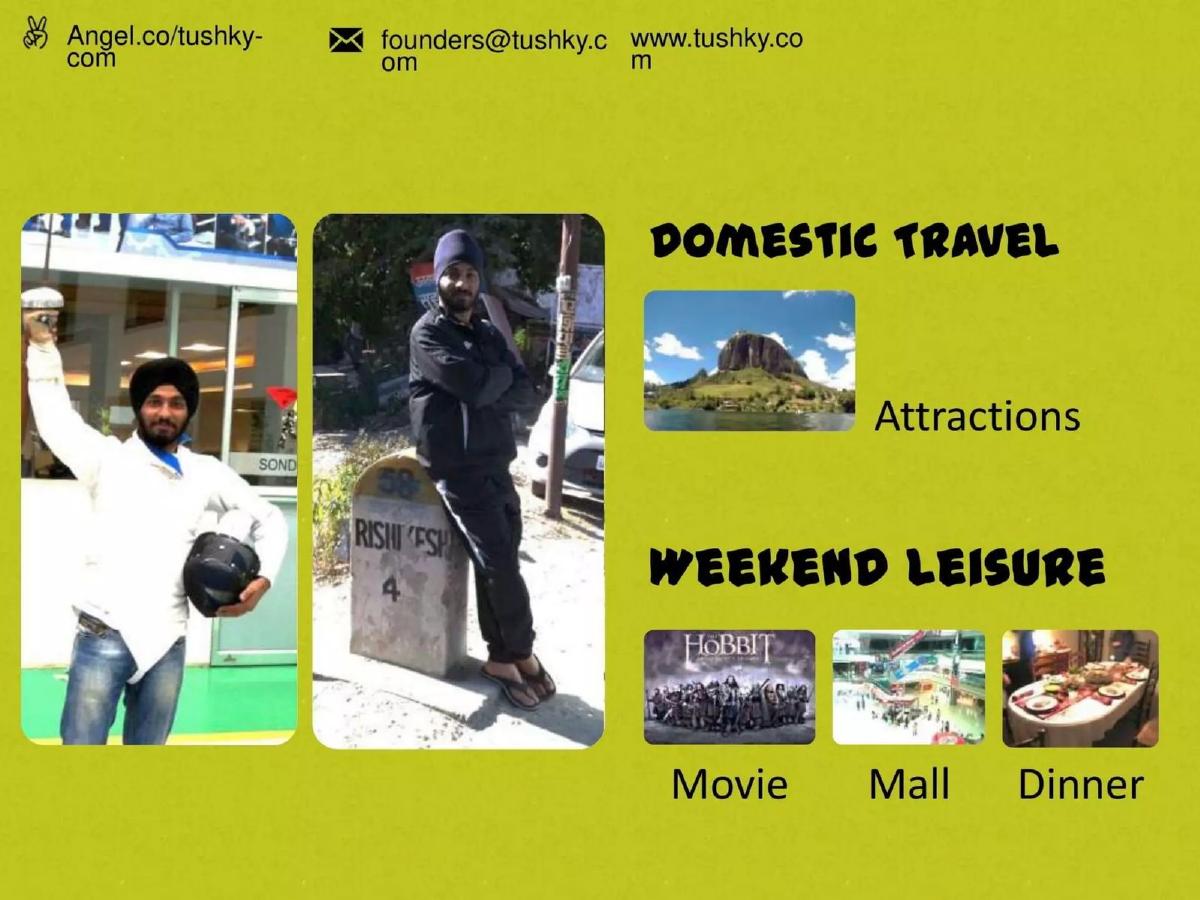
Slide 2 sets the stage by contrasting "Domestic Travel" (attractions) with "Weekend Leisure." It argues that current weekend options are stagnant, limited to movies, malls, and dinner. This is a classic 'status quo' slide, identifying a lack of variety in the lives of the urban middle class.
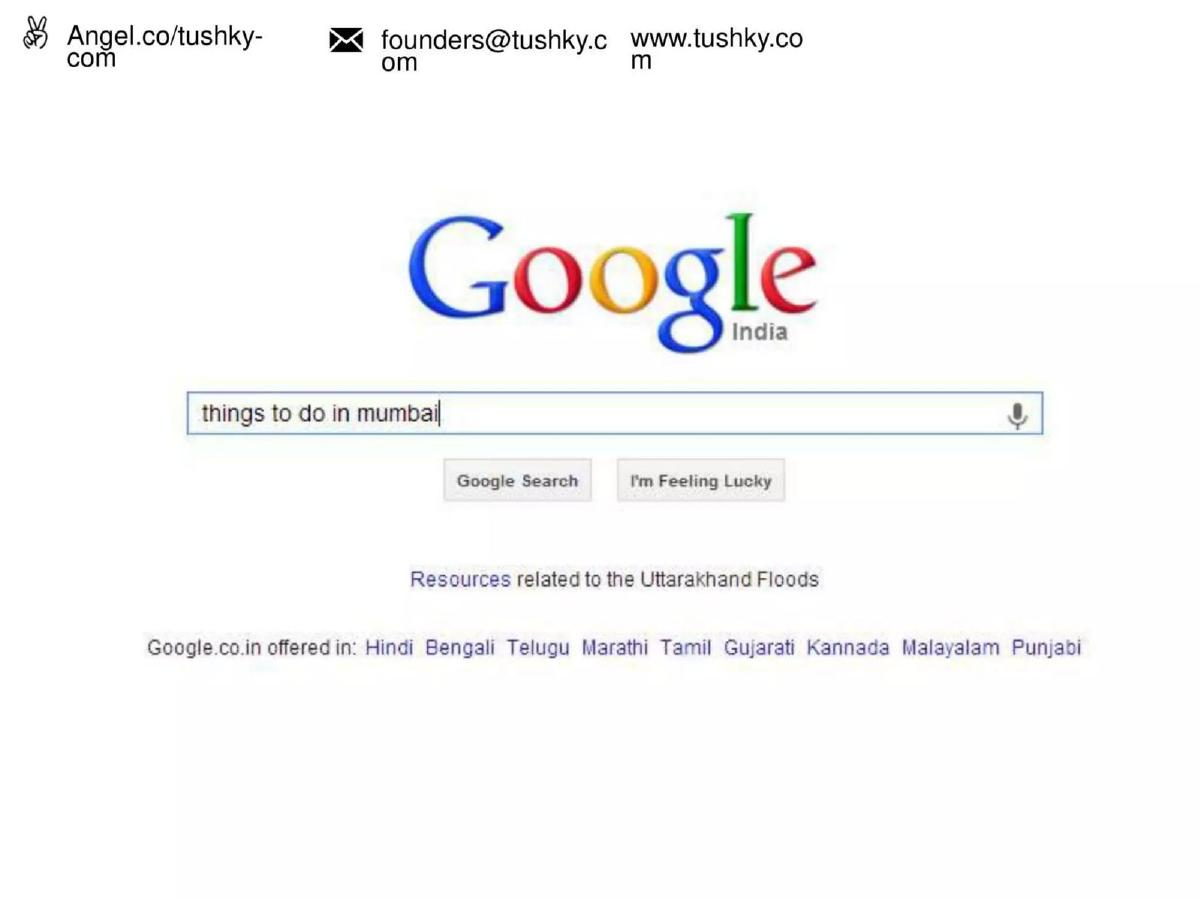
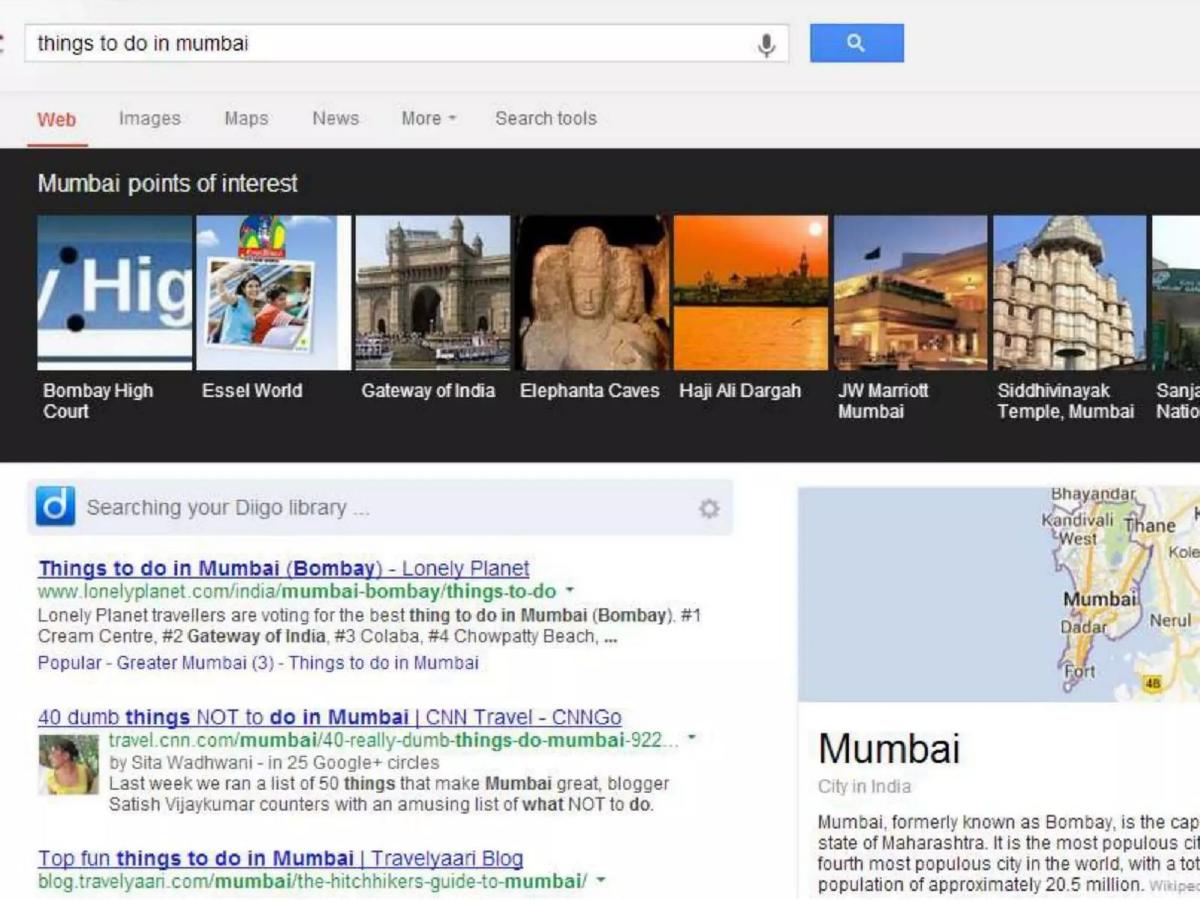
Slide 3 and 4 use a minimalist approach to highlight the search problem. Slide 3 shows a Google India search for "things to do in mumbai," and Slide 4 simply says "BUPKIS" over a bowl of popcorn. This is a high-risk, high-reward storytelling device intended to show that search engines fail to provide actionable, bookable local experiences.
Slide 5 provides the evidence for the previous claim, showing a Google search result page filled with generic points of interest (Gateway of India, Elephanta Caves) and articles like "40 dumb things NOT to do in Mumbai." The implication is clear: there is plenty of information, but no way to book a specific, unique activity.
Slides 6-7: The $33 Billion Opportunity
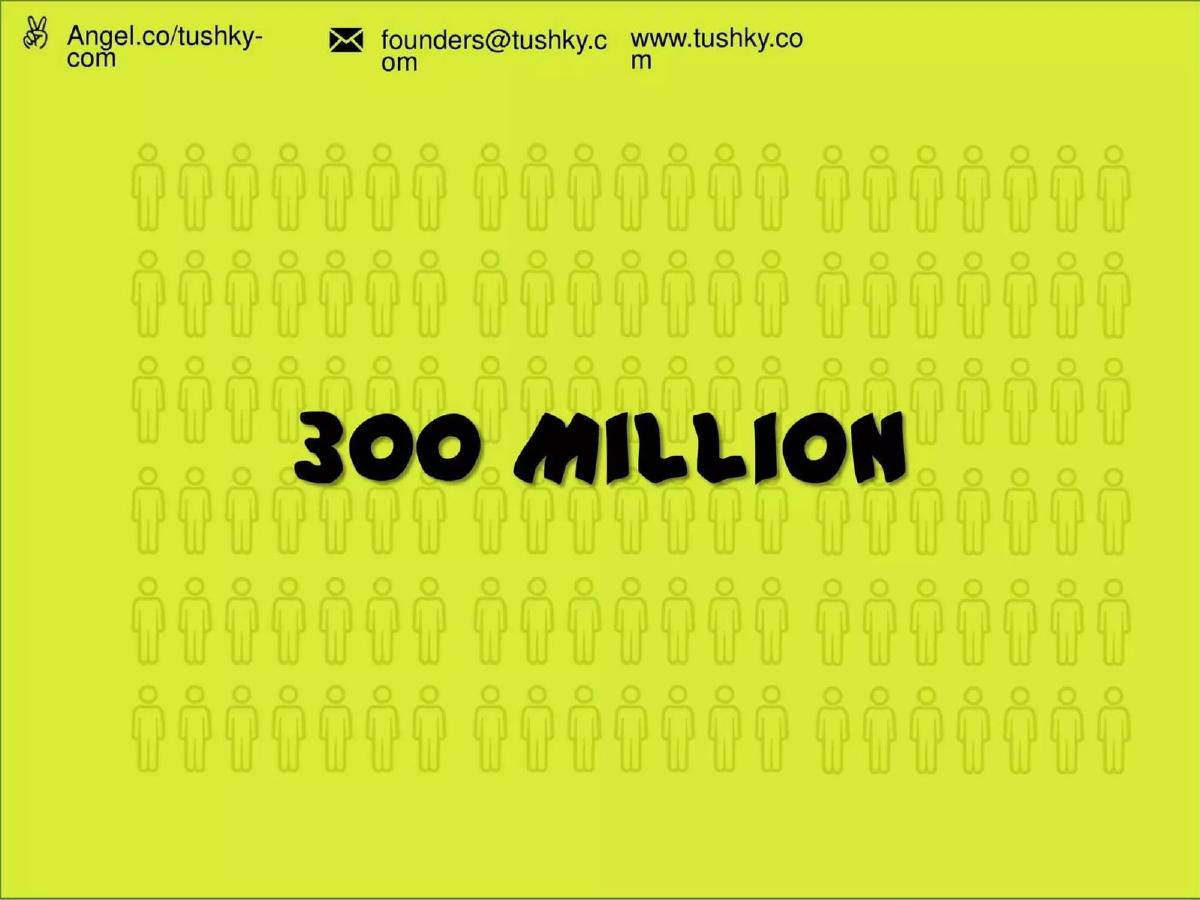
Slide 6 displays the number "300 MILLION" against a backdrop of human icons. While the slide doesn't explicitly label this, it likely refers to the burgeoning Indian middle class or the addressable urban population at the time.
Slide 7 is the core market sizing slide. It breaks down the $33 billion market into four components: $8B for local tours, $16B for organized restaurants, $3B for movie tickets, and $6B for hobby classes. By aggregating these, Tushky positions itself as a horizontal player across multiple high-value verticals. This is a strategic move to convince investors that the 'local activities' category is not a niche, but a massive consolidation opportunity.
Slides 8-10: The Product and the Experience
Slide 8 shows a screenshot of the Tushky dashboard. The UI is typical for 2011—clean, tab-based, and focused on the dual nature of the marketplace (Booking vs. Hosting). It emphasizes that users can "List an experience" as easily as they can book one, a hallmark of the sharing economy model.
Slide 9 illustrates the user journey through a circular flow: Dream, Plan, Book, Experience, Share. This highlights the social aspect of the platform, suggesting that the 'Share' phase feeds back into the 'Dream' phase for other users, creating a viral loop.
Slide 10 is one of the most effective slides in the deck. It shows a grid of actual experiences: signature analysis, chaat making, pottery, fencing, and calligraphy. It specifically highlights a "Rifle shooting coach on weekends" who is a "Banker on weekdays." This perfectly encapsulates the 'monetizing spare time' aspect of the sharing economy that was so attractive to investors in this era.
Slides 11-12: Pedigree and Social Proof
Slide 11 introduces the founders. Talvinder Singh (CEO) and Kunal Sharma (Angel/Co-founder) both cite IIT Bombay credentials, which carries significant weight in the Indian venture ecosystem. Kranti Agarwal (COO) brings the operational experience. The slide emphasizes "Web geek" and "Serial Entrepreneur" traits, signaling a mix of technical skill and business grit.
Slide 12 is a massive 'trust' slide. It features logos from Google, McKinsey, ICICI Bank, and Stanford, alongside a list of prominent angel investors. Including names like Anupam Mittal (Shaadi.com) and Naveen Tewari (InMobi) tells the investor that the 'smart money' in India has already vetted this team.
Slides 13-14: Traction and Supply Growth
Slide 13 presents the hard numbers. A $15,000 monthly run rate and $140,000 in total bookings (though the slide just lists the number) are paired with a 20% gross margin. The most important figure here is the "30% returning customers," which suggests product-market fit. However, the "5 tickets per day" metric reveals that the company was still in very early stages of volume.
Slide 14 shows a growth chart of sellers. The curve is relatively flat from September 2011 to September 2012, followed by a sharp hockey-stick inflection point. Reaching 850 sellers and 1,300+ experiences by May 2013 demonstrates that the team figured out a scalable way to onboard supply, which is often the hardest part of a two-sided marketplace.
Slides 15-18: Partnerships and the Ask
Slide 15 and 16 focus on B2B and distribution. Slide 15 lists 16 corporate clients (JPMorgan, Barclays, HSBC), suggesting Tushky was used for corporate outings or employee perks. Slide 16 shows 55 premium hotel partners in Mumbai, indicating a strategy to capture the tourist market through concierge recommendations.
Slide 17 is the "Ask" slide, utilizing a Super Mario theme. It clearly states they are raising $750,000. While the theme is a bit dated, the clarity of the number is helpful. However, it lacks a breakdown of how the funds will be used.
Slide 18 concludes with press mentions from major outlets like TechCrunch, The Economic Times, and The Times of India. This final layer of validation reinforces the idea that Tushky is a leader in its category.
What Works in This Deck
The Supply-Side Proof: Marketplace decks live or die by their supply. By showing the specific faces and dual lives of their sellers (the banker/rifle coach), Tushky made the abstract concept of a 'sharing economy' feel real and attainable.
Market Aggregation: Instead of just saying "we sell tours," they combined four massive industries to create a $33 billion narrative. This makes the venture look like a potential 'unicorn' rather than a small lifestyle business.
Social Proof: The density of high-tier logos (McKinsey, Google, IIT) and the names of famous angel investors on Slide 12 do a lot of the heavy lifting. For a seed stage company, who you know is often as important as what you've built.
What Is Missing
Unit Economics: While they mention a 20% margin, there is no mention of the cost to acquire a customer (CAC). In a marketplace with only 5 tickets sold per day, understanding the marketing spend required to get those 5 tickets is crucial for assessing scalability.
Competitive Landscape: The deck assumes Tushky is the only player. In 2011, there were several global and local competitors emerging in the 'experiences' space. A slide addressing why Tushky's tech or local network was superior would have been valuable.
Use of Funds: The $750,000 ask is a significant jump from their current traction. Investors would want to see if that money is going toward hiring more developers, expanding to new cities, or a massive consumer marketing push.
What a Founder Should Copy
The "Status Quo" Contrast: Slide 2's simple breakdown of "Movie, Mall, Dinner" is a great way to identify a boring status quo that your product disrupts. It’s relatable and immediately makes the audience want an alternative.
Visualizing the Seller: If you are building a marketplace, don't just show stats. Show the people on the other side. Slide 10's "Banker on weekdays, Coach on weekends" is a masterclass in explaining the sharing economy in a single image.
Inflection Point Charts: Slide 14 is a perfect example of how to show a change in momentum. By highlighting when growth shifted from linear to exponential, you tell a story of a team that has "cracked the code" on a specific problem (in this case, seller onboarding).
Frequently asked questions
- What was Tushky's primary value proposition?
- Tushky aimed to solve the fragmentation in the Indian leisure market. According to the deck, the existing options for weekend leisure were limited to 'Movie, Mall, Dinner' (Slide 2). Tushky provided a marketplace for 'real-world leisure activities' like fencing, archery, and pottery, allowing users to discover and book unique experiences from local experts.
- How did Tushky define its market size?
- The deck calculates a $33 billion market by aggregating four sectors: Local tours ($8B), Organized restaurants ($16B), Movie ticket booking ($3B), and Hobby classes ($6B). This bottom-up approach on Slide 7 was intended to show that 'local activities' is a massive, albeit fragmented, vertical in the Indian economy.
- Who were the key people behind the company?
- The leadership included Founder & CEO Talvinder Singh (IIT Bombay, ex-CTO), Co-founder & COO Kranti Agarwal (8+ years operations experience), and Co-founder/Angel Kunal Sharma (IIT Bombay, serial entrepreneur). Slide 12 also lists prominent Indian tech ecosystem figures like Anupam Mittal and Naveen Tewari as angels.
- What were the company's key growth metrics?
- By May 2013, Tushky was adding 15 sellers per day organically (Slide 14). Their traction slide (Slide 13) showed a $15,000 monthly run rate, $140,000 in total bookings (implied by the large figure), and a 30% customer return rate, though they were only processing 5 tickets per day.
- What is missing from this pitch deck?
- The deck lacks a detailed breakdown of Customer Acquisition Cost (CAC) and Lifetime Value (LTV). It also omits a clear competitor analysis or a specific roadmap for how the $750,000 'Ask' would be allocated across marketing, product development, or geographic expansion.