Twentyeight Health’s Pre-Series A deck is a masterclass in identifying a specific, high-need demographic—underserved women—and demonstrating a scalable solution that bridges the gap between telehealth and Medicaid. By highlighting a 5.6x revenue growth from 2020 to 2022 and a pipeline of 75 enterprise deals worth a probability-adjusted $14M, the company successfully shifted the narrative from a simple D2C pharmacy play to a comprehensive population health platform. The deck relies heavily on stark health disparity statistics to establish urgency, then follows up with operational proof of thei…
Key takeaways
- The deck identifies a total addressable market of 38 million underserved women living at or below 200% of the Federal Poverty Level (Slide 3).
- Twentyeight Health achieved 5.6x revenue growth between June 2020 and June 2022, reaching $1.6M in ARR (Slide 9).
- The company expanded its geographic footprint from 6 states in 2020 to 34 states and DC by mid-2022 (Slide 9).
- A significant portion of the value proposition lies in Medicaid acceptance, noting that 1/3 of doctors do not accept new Medicaid patients (Slide 3).
- The product roadmap outlines a transition from pregnancy prevention to a full-spectrum platform including prenatal, postpartum, and menopause care (Slide 11).
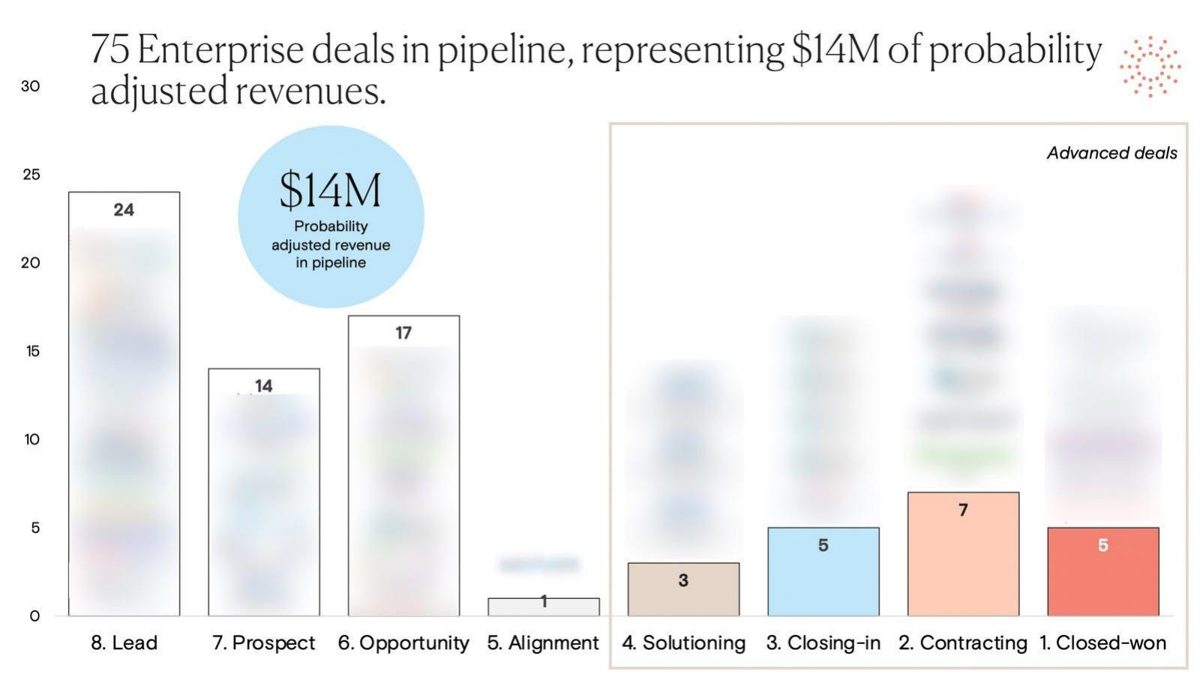
- The enterprise sales strategy is robust, with 75 deals in the pipeline representing $14M in probability-adjusted revenue (Slide 13).
- The deck highlights a $35B revenue opportunity specifically within the payer market (Slide 12).
- User retention is supported by qualitative testimonials from Medicaid, commercial insurance, and cash-pay users (Slide 7).
The Problem: A Crisis in Access
Slides 1-3: Mission and Market Realities
Twentyeight Health opens with a clear, mission-driven focus. Slide 2 states their goal: "to increase access to reproductive and sexual health for underserved communities." This isn't just a generic health play; it is a targeted intervention for a specific demographic. Slide 3 provides the data to back up the urgency, citing 38 million underserved women who face barriers. The slide defines this group in a footnote as women of color and low-income women living at or below 200% of the Federal Poverty Level.
The deck uses stark statistics to establish the 'Why Now.' It notes that 45% of 18-29 year olds don't have PCPs and 1/3 of doctors don't accept new Medicaid patients . Furthermore, it highlights racial disparities, stating that maternal mortality rates are 3x-4x higher for Black women . By framing the problem through the lens of systemic failure—contraceptive deserts, racial bias, and economic barriers—Twentyeight Health positions itself as a social necessity rather than just another telehealth app.
Slide 4: The Financial Opportunity
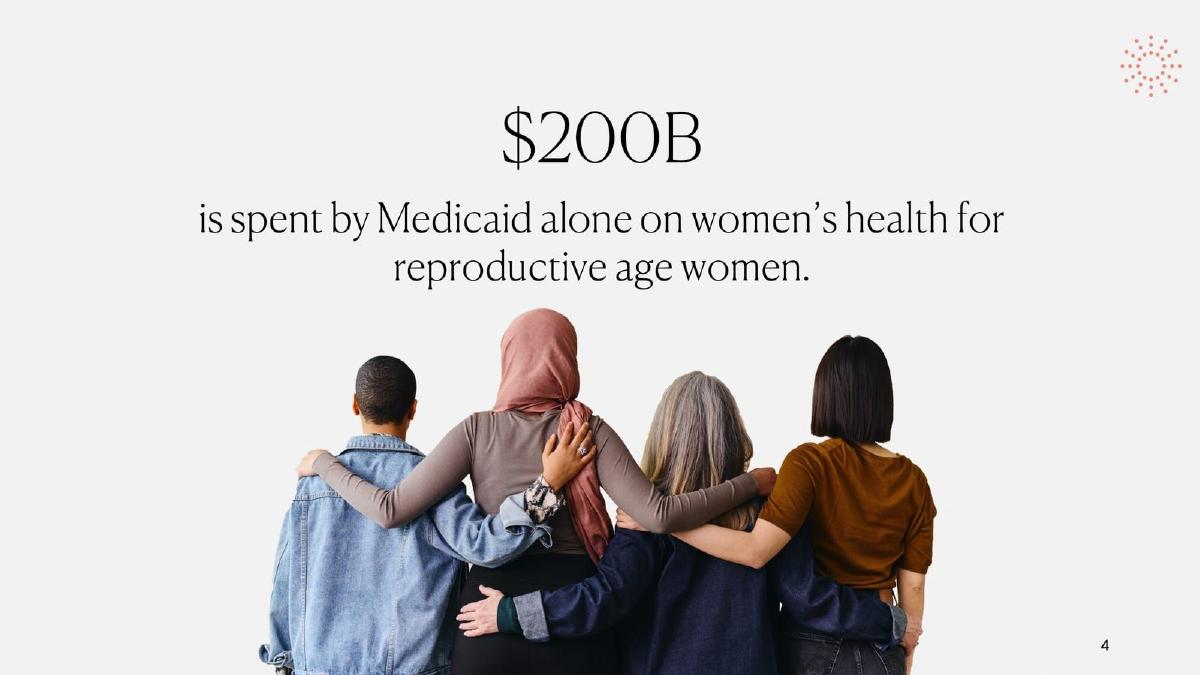
Slide 4 bridges the gap between social impact and market size. It notes that $200B is spent by Medicaid alone on women's health for those of reproductive age. This is a critical pivot; it tells investors that while the mission is underserved communities, the payer is a massive, government-backed entity. This mitigates the perceived risk of building a business for low-income users by identifying a reliable, high-volume revenue source.
The Solution: A Superior Patient Journey
Slides 5-7: Product and User Experience
Slide 5 contrasts the Twentyeight Health experience with the 'In-Person' status quo. The status quo is depicted as an 8-step ordeal involving waiting 4+ weeks for appointments and finding affordable transportation. In contrast, Twentyeight offers a 3-step digital process: asynchronous medical questionnaires available 24/7 , insurance-covered prescriptions delivered to the home, and continuous access to doctors via direct messaging. A key differentiator mentioned here is "Culturally competent physicians," which directly addresses the racial bias barrier mentioned in the problem slides.
Slide 6 and 7 focus on engagement and retention. Slide 7 uses testimonials from three distinct user types: a Medicaid user in her early 20s, a commercial insurance user in her mid-30s, and a cash user who has been with the platform since 2019. This variety proves the platform's flexibility across different financial backgrounds, though the emphasis remains on the 'caring attitude' and convenience that drives loyalty.
Traction and Growth Metrics
Slides 8-9: Proving the Model
Slide 8 claims 60,000 users served , providing a solid baseline for a Pre-Series A company. Slide 9 is the 'money slide' for investors, showing a clear upward trajectory. Between June 2020 and June 2022, the company achieved 5.6x revenue growth . The ARR (Annual Recurring Revenue) scaled from $290k to $1.6M in that two-year window. Simultaneously, the company expanded its footprint from 6 states to 34 states and DC , now covering 85% of women of reproductive age in the United States. This slide successfully demonstrates that the founders can execute on geographic expansion and revenue generation simultaneously.
Future Strategy: The Population Health Platform
Slides 10-13: Enterprise and Roadmap
The latter half of the deck focuses on the transition from a D2C-style service to an enterprise population health platform. Slide 10 explicitly mentions growing through "Enterprise partnerships." Slide 11 details the clinical roadmap, moving beyond pregnancy prevention into STI health, prenatal care, and postpartum care. It lists specific services like PrEP, iron supplements, and lactation consulting , with a note to add menopause care in 2024 . This indicates a 'land and expand' strategy—once they acquire a user for birth control, they can support her through every life stage.
Slide 12 quantifies the enterprise market as a $35B revenue opportunity in the payer market. Slide 13 provides the most compelling forward-looking data: a pipeline of 75 Enterprise deals . The deck breaks these down by stage, showing 5 deals already 'Closed-won' and 7 in 'Contracting.' The company estimates this pipeline represents $14M of probability-adjusted revenues . This gives investors a concrete reason to believe the $1.6M ARR is just the beginning of a much larger B2B revenue stream.
The Ask and Outcome
Slide 14-15: The Round
Slide 14 states the company "aimed to raise $6 million in pre-Series A funding." According to publisher-reported facts from Business Insider, the company actually raised $8.3M in 2024 . This oversubscription suggests that the enterprise pipeline and the massive Medicaid market opportunity resonated strongly with investors. The deck concludes on Slide 15 with a simple thank you and contact information for the founders.
What Twentyeight Health Does Well
Demographic Specificity: Instead of trying to be 'telehealth for everyone,' they lean into the Medicaid and underserved niche. This makes their marketing and operational hurdles (like insurance navigation) look like a competitive moat. · Visualizing the Friction: Slide 5 effectively uses a flow chart to show how miserable the current healthcare experience is for their target user, making their digital solution feel like a relief rather than just a convenience. · Pipeline Transparency: Slide 13 is excellent. Many founders just say they have 'lots of interest.' Twentyeight Health shows a weighted pipeline with specific deal counts at every stage of the sales funnel. · Market Expansion: Showing that they already cover 85% of the target population's geography (Slide 9) proves they have solved the regulatory and licensing hurdles that often sink early-stage health startups.
What is Missing from the Deck
Team Slide: This is a glaring omission in the provided slides. In healthcare, the clinical and regulatory pedigree of the leadership team is paramount. While names are on the intro/outro, their backgrounds are not highlighted. · Unit Economics: While ARR is shown, there is no mention of Customer Acquisition Cost (CAC) or Lifetime Value (LTV). For a company serving low-income and Medicaid populations, investors would want to see how they keep acquisition costs low enough to remain profitable on Medicaid reimbursement rates. · Competitive Landscape: The deck assumes the only competition is the 'In-Person' experience. It ignores other telehealth giants (like Hims & Hers or Nurx) that might be moving into the Medicaid space. · Regulatory/Compliance Details: Given the sensitive nature of reproductive health and medication abortion (mentioned on Slide 11), a slide addressing how they navigate the post-Roe legal landscape would likely be a requirement for modern healthcare investors.
Founder Lessons: Copy These Moves
Use 'Probability-Adjusted' Revenue: If you are moving into enterprise sales, don't just list the total value of your pipeline. Use a slide like Slide 13 to show the stages of the funnel. It builds much more trust with sophisticated investors. · Highlight the Payer, Not Just the User: Twentyeight Health knows their users might have limited disposable income, so they emphasize the $200B Medicaid spend. Always show who is actually going to sign the big checks. · Connect Mission to Metrics: The deck starts with maternal mortality and ends with a $35B market opportunity. This connects the 'heart' of the company to the 'wallet' of the investor, creating a narrative of 'doing well by doing good.' · Roadmap as a Revenue Multiplier: Slide 11 doesn't just show new features; it shows new ways to bill insurance for the same patient. When presenting a roadmap, frame it as increasing the 'Health Outcomes' and the 'Revenue per User.'
Frequently asked questions
- What is Twentyeight Health's primary target demographic?
- The company focuses on 38 million underserved women in the U.S., specifically those of color and low-income individuals living at or below 200% of the Federal Poverty Level. Slide 3 emphasizes that these women face significant barriers, such as living in 'contraceptive deserts' or lacking access to doctors who accept Medicaid.
- How does Twentyeight Health generate revenue?
- While the deck shows a historical ARR of $1.6M from direct services, it highlights a strategic shift toward the payer market. Slide 12 identifies a $35B opportunity in enterprise partnerships, and Slide 13 details a pipeline of 75 deals, suggesting a B2B2C model where insurance companies pay for their members' access.
- What are the key growth metrics shared in the deck?
- The most prominent metrics are found on Slide 9: revenue grew 5.6x over two years, ARR hit $1.6M in June 2022, and the service area expanded to 34 states and DC, covering 85% of women of reproductive age in the U.S.
- What services does the platform provide beyond birth control?
- According to Slide 11, the platform is expanding into a full population health suite. Current services include contraception and medication abortion, but the 12-to-24-month roadmap includes STI treatment, prenatal vitamins, iron supplements, postpartum depression screening, and lactation consulting.
- Is there a team slide in the Twentyeight Health deck?
- No, the provided 15-slide deck does not include a team slide. While the intro and outro slides provide contact emails for 'Amy' and 'Bruno,' there is no biographical information or professional history for the founders or key leadership included in this version of the presentation.