OroraTech’s Series B deck is a highly focused technical presentation that leans into the company’s unique hardware-software vertical integration. Rather than following the standard venture capital template of 'Problem, Solution, Market, Team,' the deck functions as a product deep-dive. It highlights a global footprint of over 300 users across 20 countries and the operation of two proprietary satellites in orbit. By using high-resolution thermal imagery and specific case studies from Chile and Quebec, the deck proves the efficacy of its AI-based wildfire detection. While it lacks explicit fina…
Key takeaways
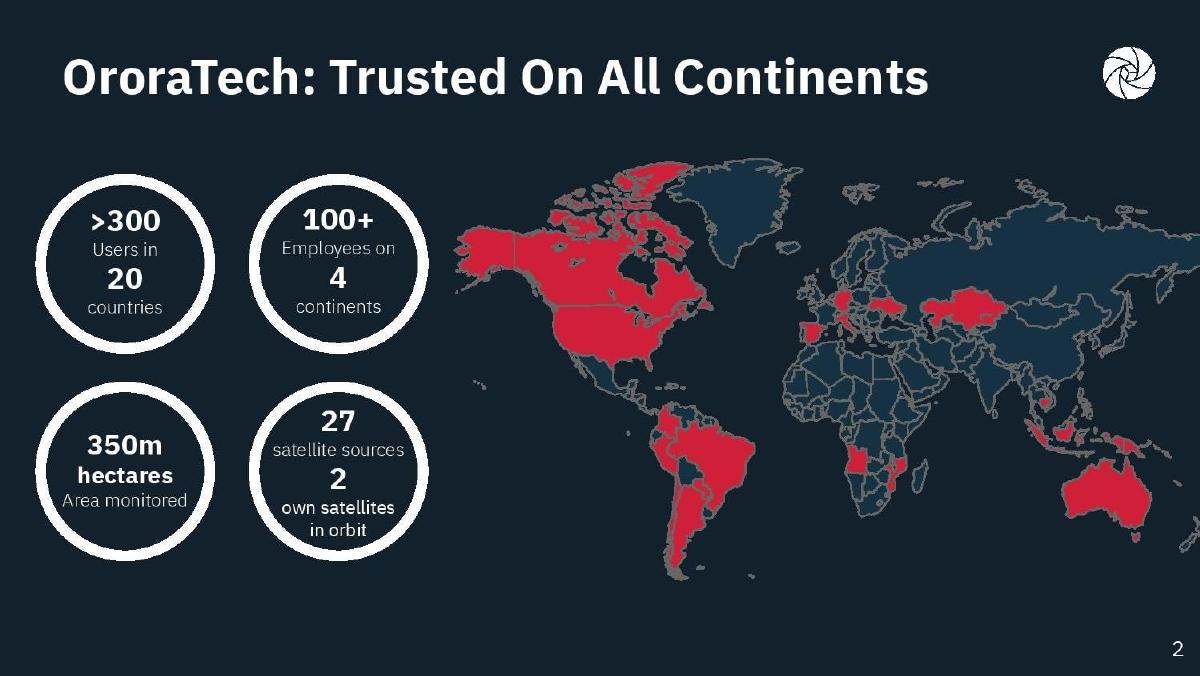
- The company monitors a massive scale of 350 million hectares using 27 satellite sources, including 2 proprietary satellites (Slide 2).
- OroraTech has established a significant global presence with over 300 users in 20 countries and 100+ employees (Slide 2).
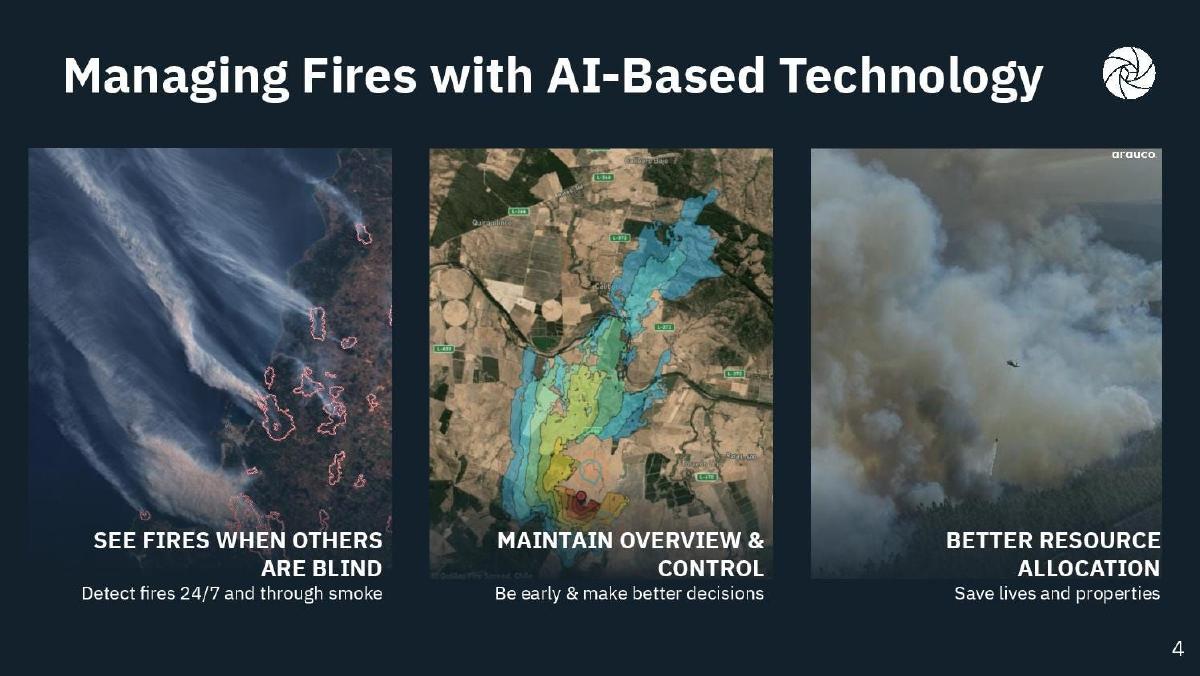
- The value proposition is built on 'seeing through smoke' 24/7, a critical technical advantage over traditional optical sensors (Slide 4).
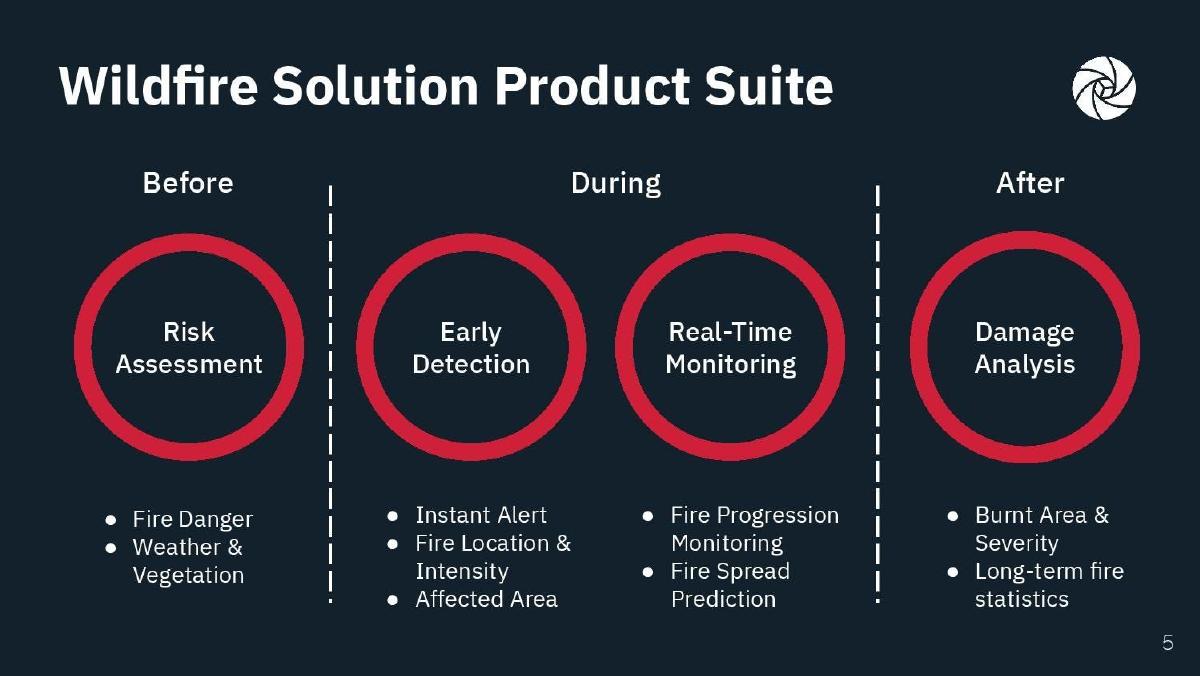
- The product suite covers the entire disaster lifecycle: Risk Assessment (Before), Early Detection (During), and Damage Analysis (After) (Slide 5).
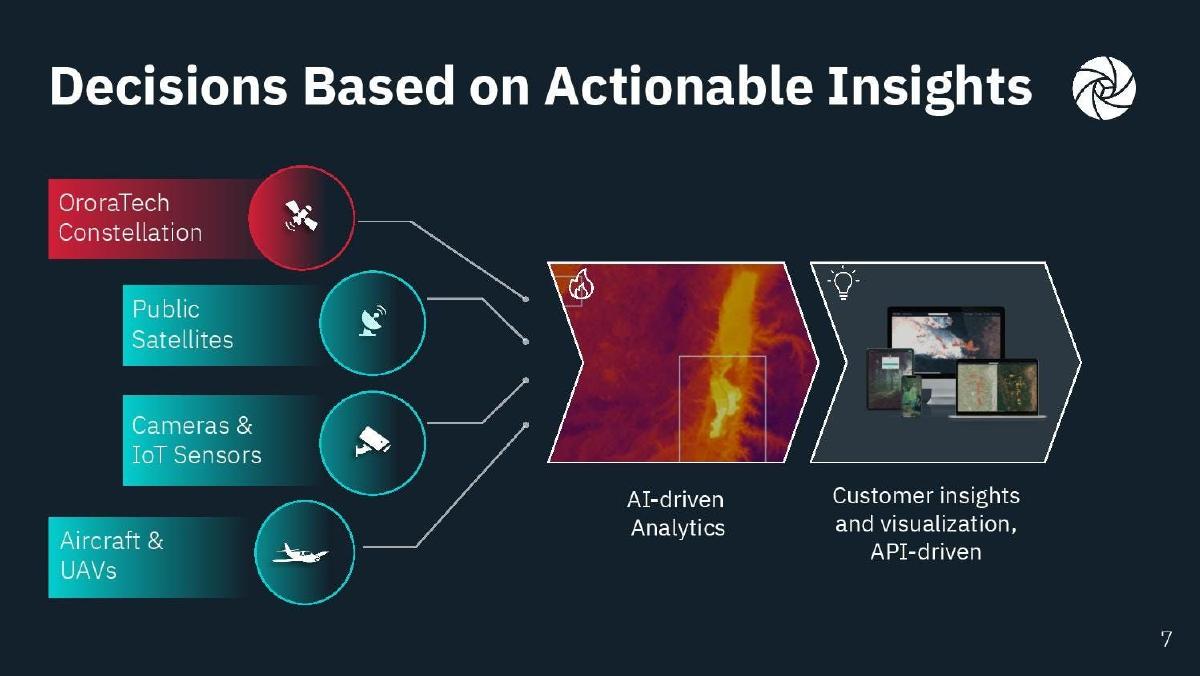
- The technology stack is vertically integrated, combining proprietary satellite constellations with public data, IoT sensors, and AI analytics (Slide 7).
- Real-world efficacy is demonstrated through specific 2023 case studies in Chile and Quebec, showing 'detection within minutes' (Slides 8-10).
- The deck completely omits traditional investor slides such as competition, business model, financials, and the management team.
- The narrative focuses on 'Actionable Insights' and 'Situational Awareness,' positioning the company as a critical infrastructure partner for governments (Slide 7).
The Power of Vertical Integration in Space-Tech
OroraTech’s Series B pitch deck is a departure from the standard Silicon Valley narrative. It does not spend time introducing the founders or explaining the business model. Instead, it focuses on the sheer scale of its operations and the technical superiority of its data. In an industry like wildfire management, where minutes determine the difference between a contained blaze and a multi-billion dollar disaster, the deck correctly identifies that technical validation is the most important currency.
Slide 1: The Hook
The title slide is minimalist, featuring the company name and the phrase "Wildfire Solution From Space." The use of a camera-shutter-style logo and a dark, high-contrast color palette immediately sets a professional, mission-critical tone. There are no taglines about 'saving the planet'—just a direct statement of what they do and where they do it from.
Slide 2: Traction and Scale
This is arguably the most important slide in the deck. It establishes immediate credibility through four key metrics: ">300 Users in 20 countries," "100+ Employees on 4 continents," "350m hectares Area monitored," and "27 satellite sources" including "2 own satellites in orbit." By leading with these figures, OroraTech bypasses the 'is this real?' phase of an investor meeting. The map highlights a global footprint, emphasizing that wildfires are a global problem and OroraTech is a global solution.
Slide 3: The Problem Statement
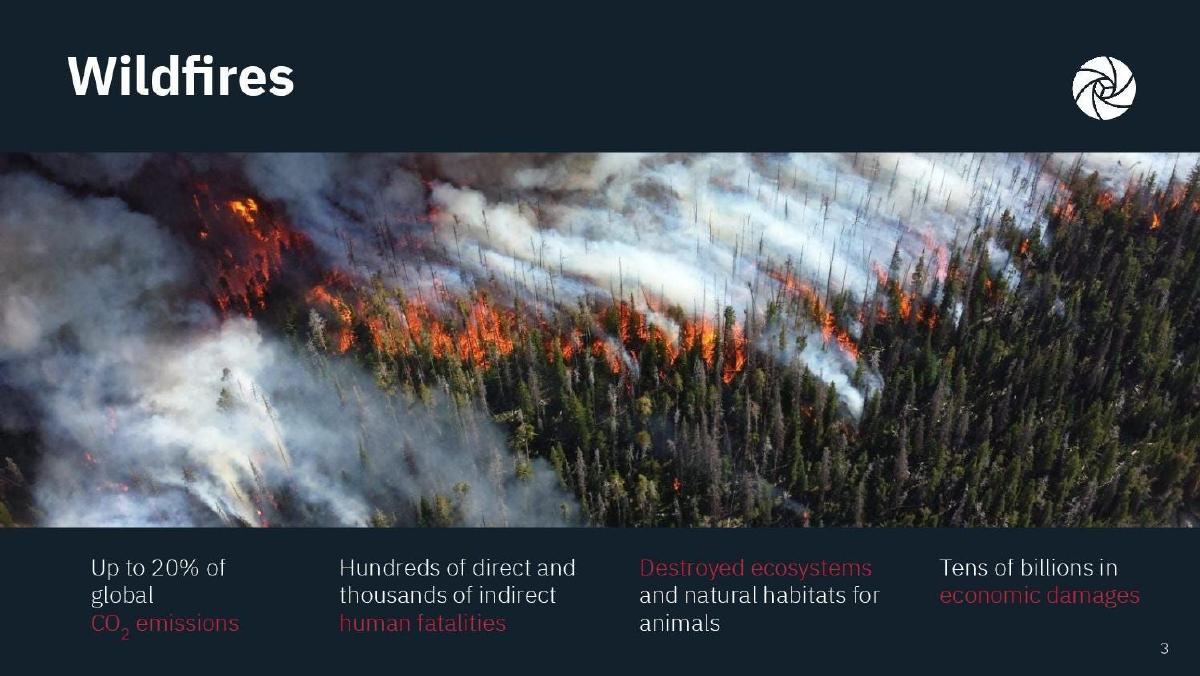
Slide 3 uses a high-impact aerial photograph of a forest fire to ground the pitch in reality. It lists the stakes: "Up to 20% of global CO2 emissions," "Hundreds of direct and thousands of indirect human fatalities," and "Tens of billions in economic damages." This slide justifies the urgency of the Series B round without needing a complex market size (TAM) chart; the destruction shown is the market opportunity.
Slide 4: The Core Value Proposition
This slide introduces "Managing Fires with AI-Based Technology." It highlights three pillars: "SEE FIRES WHEN OTHERS ARE BLIND" (detecting through smoke), "MAINTAIN OVERVIEW & CONTROL" (early decision making), and "BETTER RESOURCE ALLOCATION" (saving lives and properties). The middle image, showing a heat map overlaid on a topographical map, is a crucial visual proof of their 'situational awareness' claim.
Slide 5: The Product Lifecycle
The "Wildfire Solution Product Suite" is broken down into three phases: Before, During, and After. This is a sophisticated way to show a sticky product. They aren't just a 'fire alarm'; they provide "Risk Assessment" (Before), "Real-Time Monitoring" (During), and "Damage Analysis" (After). This suggests multiple touchpoints with a customer and a comprehensive data-as-a-service (DaaS) model.
Slide 6: The User Interface
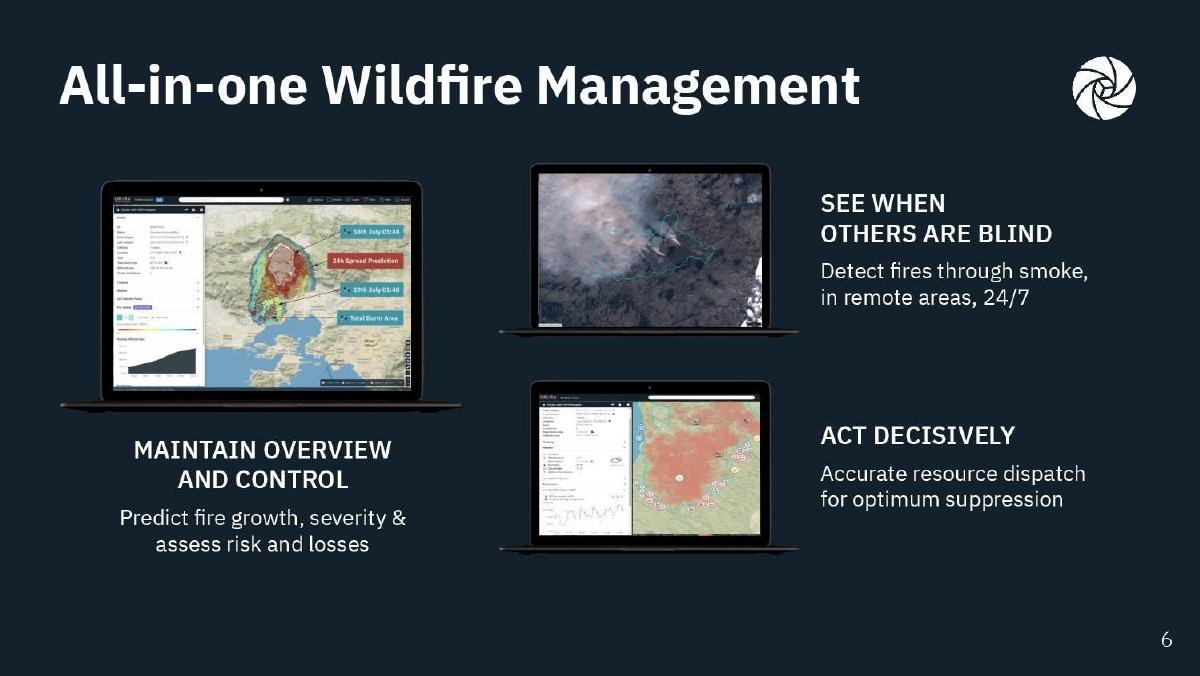
Slide 6 shows the software in action across different devices. The phrase "All-in-one Wildfire Management" is paired with screenshots of their dashboard. This proves that the complex satellite data is translated into a usable interface for field officers. It emphasizes "Accurate resource dispatch," which is the primary pain point for firefighting agencies.
Slide 7: The Technology Stack
This diagram explains how OroraTech creates a 'moat.' They ingest data from their own "OroraTech Constellation," "Public Satellites," "Cameras & IoT Sensors," and "Aircraft & UAVs." This data is fed into "AI-driven Analytics" to produce "Customer insights and visualization." By showing that they use multiple data sources, they position themselves as an aggregator and intelligence layer, not just a hardware company.
Slide 8 & 9: Case Study - Chile 2023
These slides provide a deep dive into a specific event. Slide 8 shows "Proprietary Live Data" compared to "Clusters overlaid with visual images." Slide 9 emphasizes "Continuous Situational Awareness," claiming "Detection within minutes." The use of specific dates (10.02.2023) and locations (Chillán) makes the claims unfalsifiable and demonstrates the platform's reliability in a crisis.
Slide 10: Case Study - Quebec 2023
The final slide focuses on "Emergency Response" in Quebec. It shows a "Daily Burnt Area Assessment," which is critical for post-fire recovery and insurance claims. This slide reinforces the 'After' part of the product suite mentioned on Slide 5. It ends the deck on a high note of utility: the product is currently being used in some of the world's most challenging fire environments.
What OroraTech Does Exceptionally Well
The deck is a masterclass in visual evidence. In the world of AI and Space-Tech, there is a lot of 'vaporware.' OroraTech counters this by showing actual thermal imagery, actual dashboard screenshots, and actual results from recent 2023 fire seasons. They also do an excellent job of vertical positioning. By owning the satellites (hardware) and the AI (software), they present themselves as a full-stack solution that is difficult for a pure software competitor to displace.
What is Missing from the Deck
As a standalone document, this deck is missing several traditional venture capital components. There is no Business Model slide explaining how they charge (per hectare, per user, or annual license). There is no Competition slide, which is surprising given the crowded nature of the geospatial intelligence market. Most notably, there is no Team slide or Financial Ask. While these were likely handled in a separate document or during the verbal pitch, their absence here makes the deck feel more like a product sales presentation than a traditional fundraising deck.
What Other Founders Should Copy
Founders in deep-tech should emulate OroraTech’s "Metric-First" approach on Slide 2. Instead of a long history of the company, they provide four circles that summarize their entire existence and scale. Additionally, the "Before/During/After" framework on Slide 5 is a brilliant way to explain a complex product's value proposition across a timeline. It helps investors understand the 'stickiness' of the solution—it’s not just a tool used during an emergency, but a platform used year-round for planning and recovery.
Frequently asked questions
- Why does the deck lack a team or financial slide?
- At the Series B stage, especially for deep-tech or space-tech companies, the 'proof' is often in the hardware and the contracts. OroraTech likely used this deck as a technical supplement or a high-level overview, relying on a separate data room for sensitive financials and team bios. The presence of 100+ employees and 300+ users already implies a mature organization.
- What is the significance of the '2 own satellites' mentioned on Slide 2?
- This is a major differentiator. Most geospatial startups rely entirely on third-party data (like Sentinel or Landsat). By launching their own thermal sensors, OroraTech controls their revisit rates and data resolution, allowing them to 'see fires when others are blind' and provide proprietary live data that competitors cannot access.
- How does OroraTech use AI in this context?
- As shown on Slide 7, AI is the processing layer between raw data (satellites, IoT, cameras) and customer insights. It is specifically used for 'Fire Spread Prediction' and 'Triage,' helping emergency responders identify which fires are most likely to cause the largest damage based on vegetation and weather data.
- Who are the primary customers for this technology?
- While not explicitly listed, the deck mentions 'Emergency Response' and 'Resource Allocation' (Slides 4 and 10). This points toward government agencies, forestry departments, and large-scale industrial landholders who manage millions of hectares and require real-time monitoring to protect assets and lives.
- Is the 350 million hectare figure impressive?
- Yes. To put that in perspective, 350 million hectares is roughly the size of India. Monitoring an area of that scale requires a sophisticated data pipeline and significant compute power, signaling to investors that OroraTech's platform is highly scalable and already battle-tested at a continental level.