Origin’s 12-slide seed deck presents a compelling case for a 'human + AI' travel curation app, moving away from the fragmented experience of traditional and online travel agencies. The company successfully raised $5M in 2024 by positioning itself as a premium membership service that captures 100% of a user's travel wallet. The deck relies heavily on a three-stage scaling roadmap, drawing a direct parallel to the founder's experience at Stitch Fix to prove they can scale a high-touch service. While the deck is light on hard financial metrics and specific team bios, it excels at defining a clea…
Key takeaways
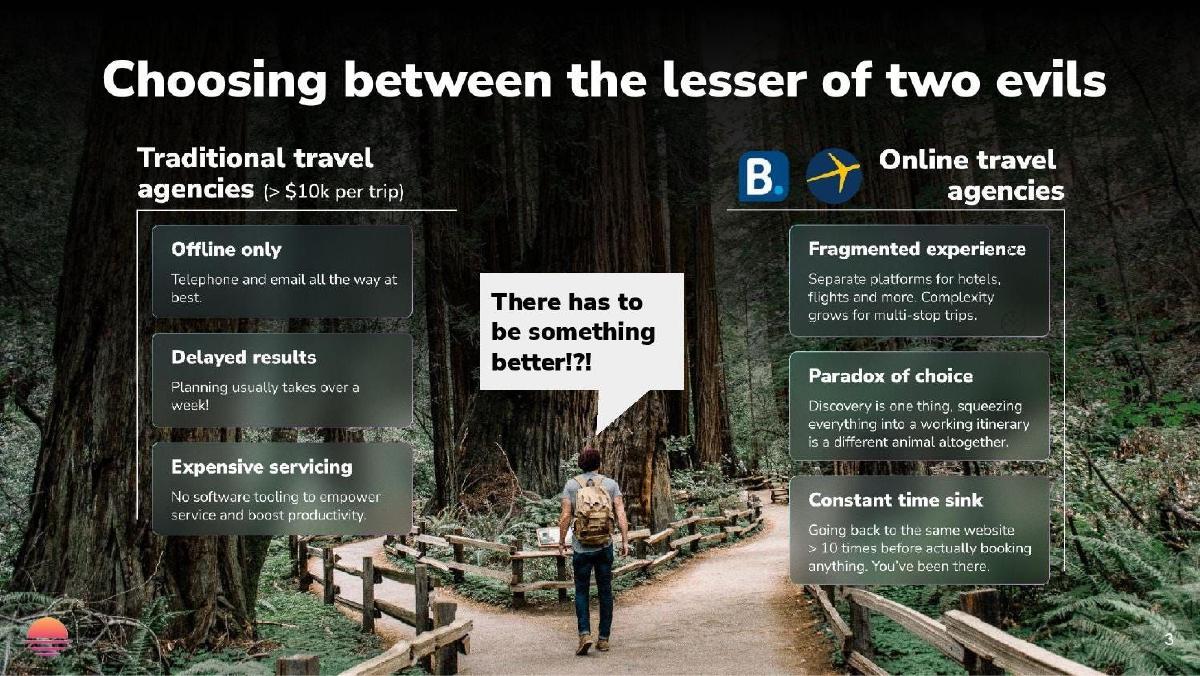
- The deck identifies a market gap between traditional agencies costing over $10k per trip and fragmented online agencies (Slide 3).
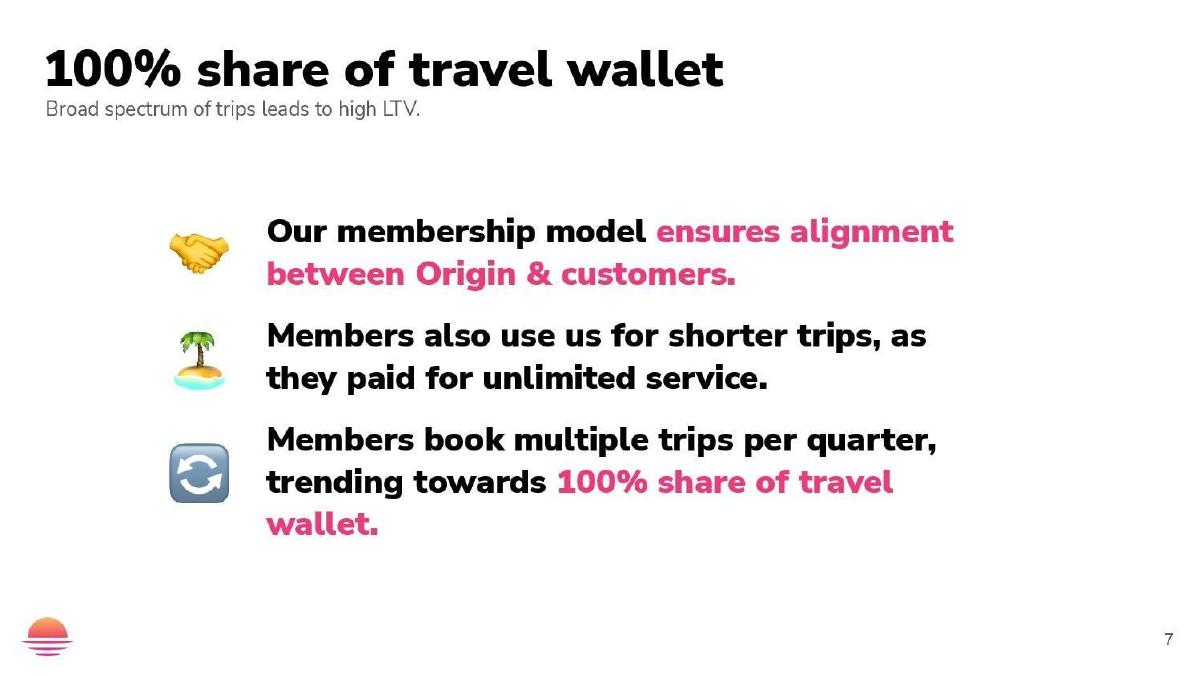
- Origin uses a membership model to align incentives and capture '100% share of travel wallet' across all trip types (Slide 7).
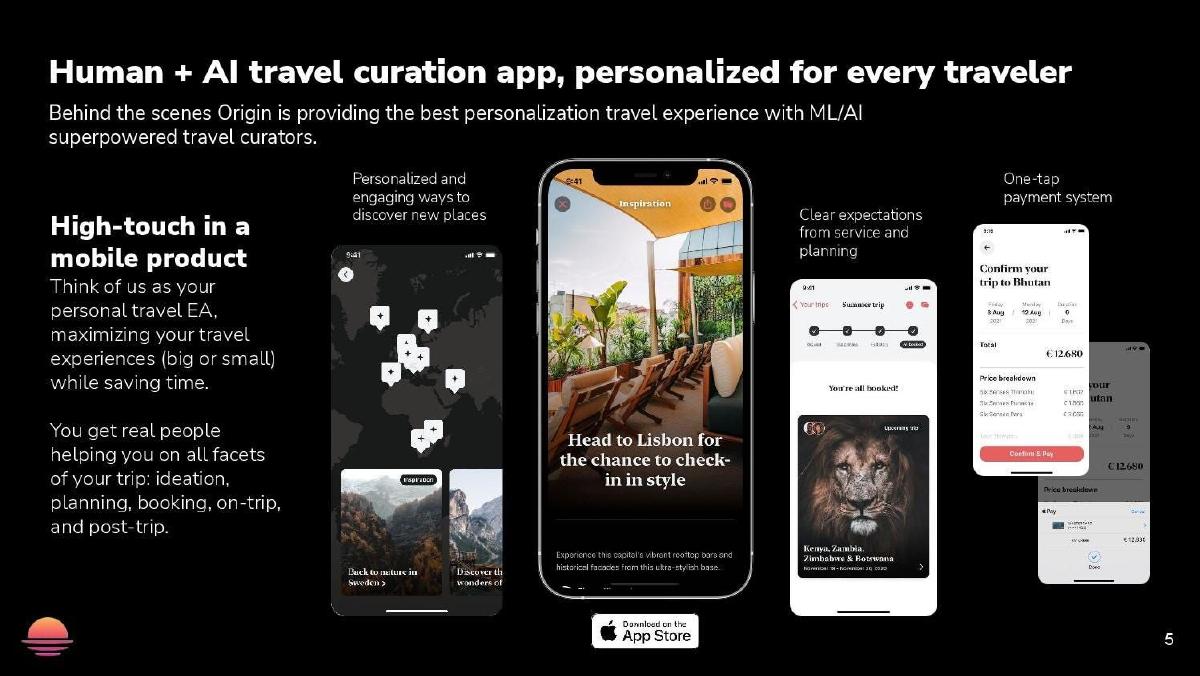
- The product is positioned as a 'personal travel EA' that handles ideation, planning, booking, and on-trip support (Slide 5).
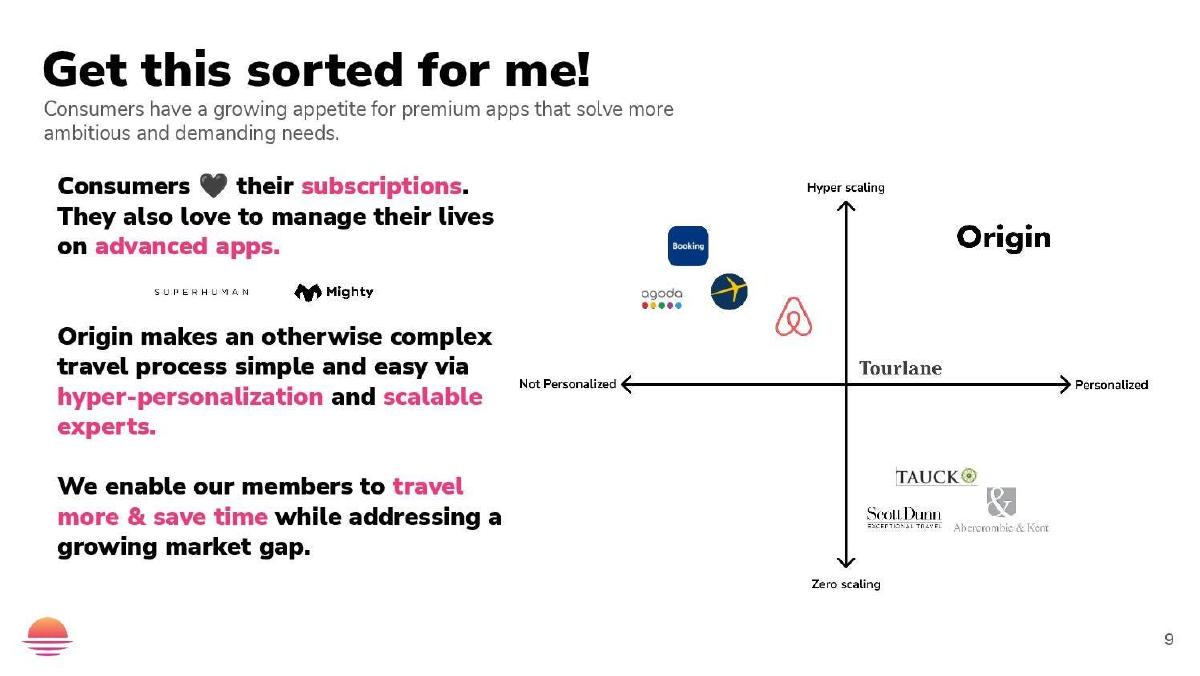
- A 2x2 competitive matrix places Origin in the 'Hyper scaling' and 'Personalized' quadrant, contrasting it with Airbnb and Booking.com (Slide 9).
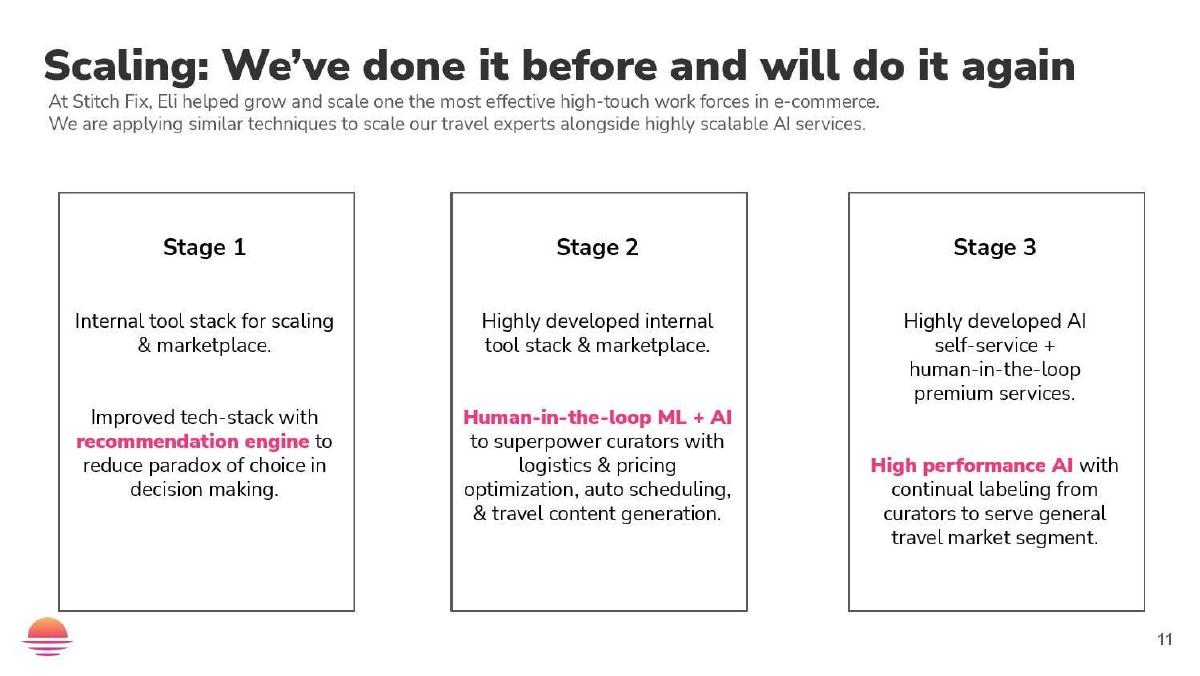
- The scaling strategy is explicitly modeled after Stitch Fix, utilizing human-in-the-loop ML to boost curator productivity (Slide 11).
- The roadmap outlines a transition from an internal tool stack to a high-performance AI self-service model (Slide 11).
- The deck omits a dedicated team slide with names/photos, though it mentions 'Eli' and his background at Stitch Fix in the text (Slide 11).
- There is no explicit 'Ask' slide detailing the $5M round size or specific use of funds within the 12-slide sequence provided.
The Strategy Behind Origin's $5M Seed Round
Origin entered the travel tech space in 2024 with a clear mission: to fix the broken experience of planning complex trips. Their 12-slide pitch deck, which helped secure $5M in Seed funding, focuses on the intersection of human expertise and machine learning. By positioning themselves against both the 'expensive' traditional agency and the 'time-consuming' online booking site, Origin carves out a niche for a premium, subscription-based travel assistant.
Slide 1-2: Brand Identity
The deck opens with minimalist branding. Slide 1 features the company name 'Origin' over a lush, aerial view of tropical rice terraces. This immediately sets a high-end, aspirational tone for a travel product. Slide 2 continues this visual theme, establishing the brand's aesthetic before diving into the mechanics of the business.
Slide 3: The Problem - The Lesser of Two Evils
Slide 3 is the core 'Problem' slide. It categorizes the current market into two 'evils.' On one side are Traditional travel agencies , which Origin notes cost more than '$10k per trip' and suffer from being 'Offline only,' having 'Delayed results' (taking over a week), and 'Expensive servicing' due to a lack of software tooling. On the other side are Online travel agencies (represented by icons for Booking.com and others), which suffer from a 'Fragmented experience,' the 'Paradox of choice,' and being a 'Constant time sink.' The slide uses a central callout—'There has to be something better!?!'—to bridge the gap to their solution.
Slide 5: The Solution - Human + AI Curation
Slide 5 introduces the product as a 'Human + AI travel curation app.' It defines the service as a 'personal travel EA' (Executive Assistant). The slide highlights four key features through mobile mockups: personalized discovery, clear service expectations, one-tap payments, and end-to-end support (ideation, planning, booking, and on-trip). The text emphasizes that 'real people' are helped by 'ML/AI superpowered travel curators,' establishing the 'human-in-the-loop' model early on.
Slide 7: The Business Model - 100% Share of Wallet
Slide 7 explains the membership model. Origin argues that a subscription 'ensures alignment' because they aren't just chasing commissions. The goal is to capture the '100% share of travel wallet.' By offering unlimited service, they encourage members to use the app for 'shorter trips' in addition to major vacations, which leads to a 'Broad spectrum of trips' and 'high LTV' (Lifetime Value). This is a crucial pivot from the 'one-and-done' nature of traditional travel planning.
Slide 9: Market Positioning and Competition
Slide 9 uses a 2x2 matrix to position Origin against competitors. The axes are 'Not Personalized vs. Personalized' and 'Zero scaling vs. Hyper scaling.' Origin places itself in the top-right quadrant (Hyper-scaling/Personalized). It contrasts itself with Airbnb, Booking.com, and Agoda (Hyper-scaling but Not Personalized) and Tauck, Scott Dunn, and Abercrombie & Kent (Personalized but Zero scaling). The slide also references 'advanced apps' like Superhuman and Mighty to show that consumers are already comfortable paying for premium, high-utility subscriptions.
Slide 11: The Scaling Roadmap
Slide 11 is perhaps the most important for investors concerned about the margins of a service-heavy business. Titled 'Scaling: We’ve done it before and will do it again,' it references founder Eli’s experience at Stitch Fix . The slide breaks down the evolution into three stages:
Stage 1: Internal tool stack and recommendation engine to reduce the paradox of choice. · Stage 2: Human-in-the-loop ML + AI to optimize logistics, pricing, and content generation. · Stage 3: High-performance AI self-service + human-in-the-loop premium services to serve the 'general travel market segment.'
This roadmap attempts to prove that while the business starts as high-touch, it has a clear path to software-like scalability.
What Works in This Deck
Clear Market Gap: The 'Lesser of two evils' framing on Slide 3 is highly effective. It acknowledges that while travel booking is 'solved' for simple trips, it remains a nightmare for complex, high-value trips. By attaching a price tag (>$10k) to traditional agencies, they justify their own premium membership fee.
The Stitch Fix Parallel: Scaling a service business is notoriously difficult. By explicitly citing the founder's experience scaling the workforce at Stitch Fix (Slide 11), Origin provides a 'proof of founder-market fit' that mitigates the risk of the human-in-the-loop model.
Alignment of Incentives: Slide 7 addresses a common skepticism in travel: the commission conflict. By stating that a membership model 'ensures alignment,' they appeal to the modern traveler's desire for unbiased advice rather than being sold the hotel with the highest kickback.
What is Missing from the Deck
Hard Traction Data: While the deck mentions that members are 'trending towards 100% share of travel wallet' (Slide 7), it lacks specific numbers. There are no figures for current Member Count, Monthly Recurring Revenue (MRR), or Net Promoter Score (NPS). For a Seed round, some early pilot data or waitlist numbers are usually expected.
Detailed Team Slide: The deck mentions 'Eli' and his Stitch Fix background in the text of Slide 11, but there is no dedicated team slide featuring the full founding team, their photos, or their specific roles. Investors typically want to see the 'who' as much as the 'what' in a Seed deck.
The Financial Ask: The 12-slide sequence provided does not include a slide detailing how much they are raising or how the capital will be deployed. While the publisher reports a $5M raise, the deck itself remains silent on the terms and the runway the funding provides.
What Other Founders Should Copy
The 2x2 Matrix Strategy: Origin’s competitive matrix on Slide 9 is a masterclass in positioning. They don't just compare features; they compare 'Scalability' and 'Personalization.' This allows them to group massive incumbents (Booking.com) together and dismiss them as 'not personalized,' while dismissing luxury boutiques as 'unscalable.'
The Three-Stage Evolution: Founders building service-heavy startups should copy the 'Stage 1, 2, 3' roadmap from Slide 11. It shows investors that you aren't just building a 'lifestyle business' or a 'concierge service,' but a technology platform that uses humans to train the AI that will eventually replace the manual labor.
Visual Consistency: The deck uses high-quality photography and a consistent color palette (the sunset logo and pink/white text) that feels like a premium travel brand. For a B2C product, the 'vibe' of the deck serves as a proxy for the 'vibe' of the app.
Frequently asked questions
- How does Origin differentiate itself from Expedia or Booking.com?
- Origin argues that online travel agencies (OTAs) suffer from a 'paradox of choice' and a 'fragmented experience,' requiring users to visit sites more than 10 times before booking (Slide 3). Origin positions itself as a personalized service that handles the complexity of multi-stop trips through a single app, rather than just a search engine for flights and hotels.
- What is the core business model presented in the deck?
- Origin utilizes a membership model. According to Slide 7, this ensures alignment between the company and the customer. The goal is to encourage members to book multiple trips per quarter—including shorter trips—to achieve a '100% share of travel wallet' and high Lifetime Value (LTV).
- How does the company plan to scale a high-touch service?
- The deck outlines a three-stage scaling plan (Slide 11). It starts with internal tools for curators, moves to human-in-the-loop ML for logistics and pricing optimization, and eventually aims for high-performance AI self-service. They cite the founder's experience scaling the workforce at Stitch Fix as proof of concept.
- What specific travel pain points does the deck address?
- Slide 3 highlights six pain points: offline-only communication, delayed results (taking over a week), expensive servicing, fragmented platforms, the paradox of choice, and the 'constant time sink' of repetitive searching. Origin aims to solve these by providing a mobile-first, AI-powered curation experience.
- Does the deck provide financial projections or current traction?
- No. The provided slides focus on the problem, solution, market positioning, and scaling methodology. It mentions that members are 'trending towards 100% share of travel wallet' (Slide 7), but it does not list specific revenue figures, user counts, or growth percentages.