Sazabi’s 12-slide Seed deck is a masterclass in product-led storytelling, prioritizing 'show' over 'tell.' By dedicating nearly half the deck to a linear product walkthrough—from setup to automated remediation—the company demonstrates a high-utility AI application in the crowded observability space. The deck relies heavily on the pedigree of founder Sherwood Callaway, a former infrastructure leader at Brex and two-time YC founder, to bridge the gap between a young product and a complex enterprise market. With 50 customers onboarded within just two weeks of launch, the traction slide serves as…
Key takeaways
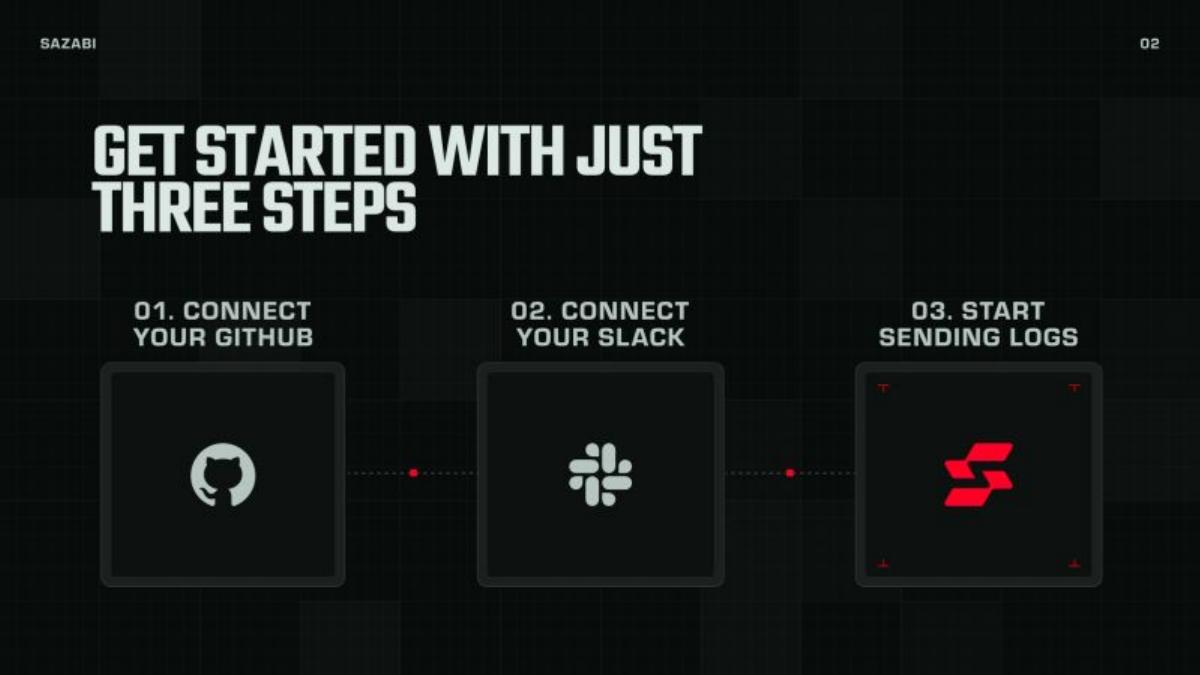
- The deck uses a linear three-step onboarding process (GitHub, Slack, Logs) to emphasize ease of deployment (Slide 02).
- Product screenshots demonstrate a full-loop AI capability: monitoring issues, sending context-rich Slack alerts, and opening GitHub Pull Requests with fixes (Slides 03-05).
- Founder Sherwood Callaway’s background as an 'Infra & Observability Leader at Brex' provides immediate domain authority (Slide 06).
- Traction is the deck's strongest signal, reporting 50 customers live on the platform within two weeks of launch (Slide 07).
- The deck lists 18 legacy competitors by logo, including Datadog and Splunk, to position them as outdated 'non-AI era' tools (Slide 09).
- The presentation omits a formal 'Ask' slide, financial forecasts, and a detailed breakdown of the $8M round's use of funds.
- Visual branding is aggressive and high-contrast, using a red-and-black 'cyber' aesthetic to differentiate from corporate SaaS competitors.
The Product-First Narrative
Sazabi’s deck is a departure from the traditional 'Problem-Solution-Market' structure. Instead, it adopts a product-first narrative that assumes the audience is already familiar with the pain points of modern software observability. By skipping the 'Problem' slide, the deck moves immediately into a demonstration of speed and automation.
Slide 00: Title Slide
The deck opens with a minimalist black grid background and the Sazabi logo in bright red. There is no tagline or introductory text here, setting a high-contrast, technical tone for the rest of the presentation.
Slide 01: The Vision
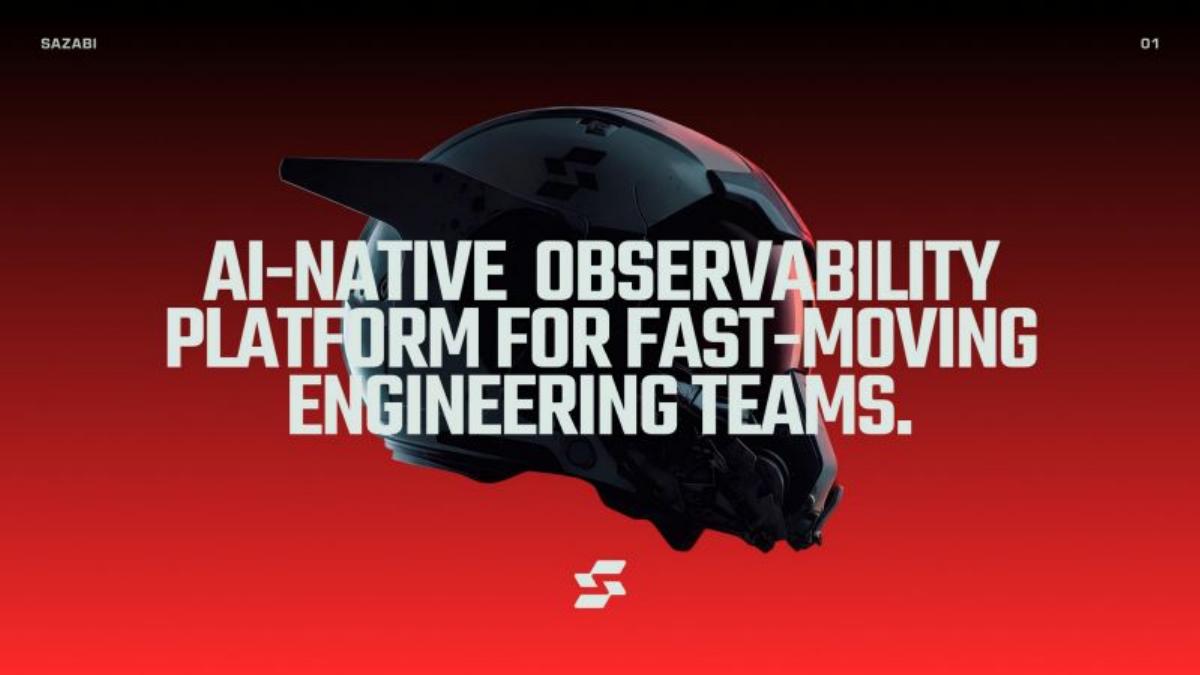
The first numbered slide introduces the core value proposition: "AI-Native Observability Platform for Fast-Moving Engineering Teams." The imagery—a futuristic, high-tech helmet—reinforces the 'AI-native' and 'fast-moving' themes. This slide establishes the target persona: engineering teams that prioritize shipping speed.
Slide 02: Onboarding and Integration
Slide 02 focuses on the 'Time to Value.' It outlines a three-step process: 01. Connect GitHub, 02. Connect Slack, and 03. Start Sending Logs. This simplicity is a direct challenge to legacy observability tools, which often require complex agent installations and weeks of configuration.
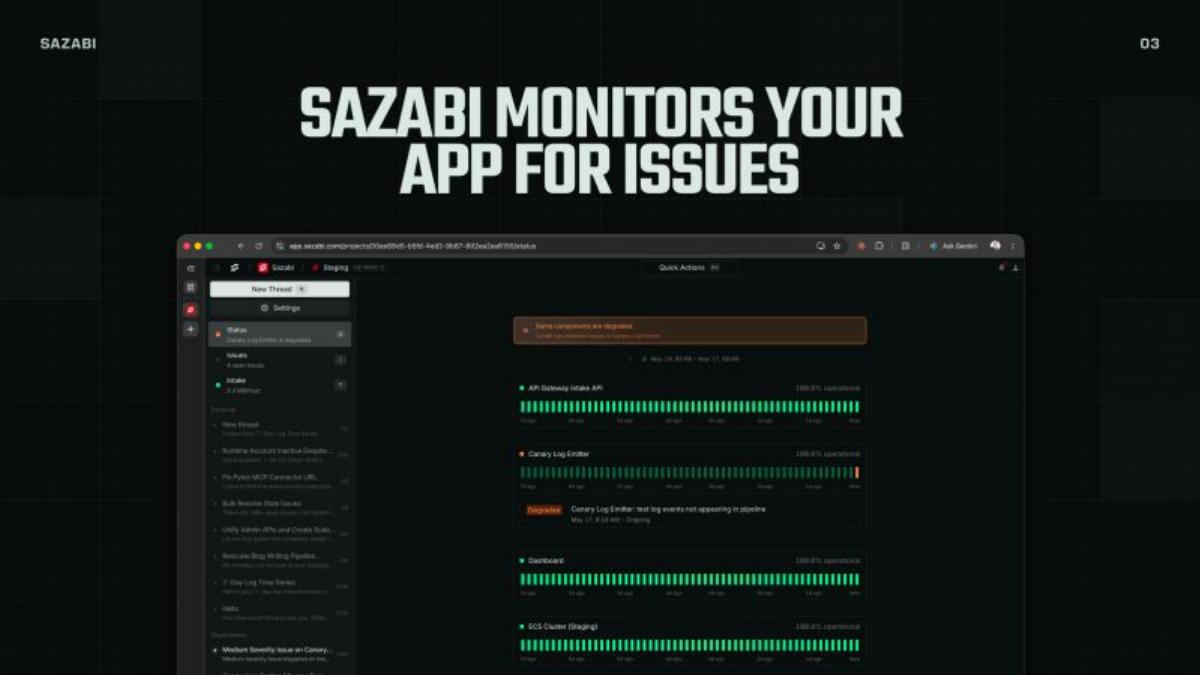
Slide 03: Monitoring Interface
This slide provides the first look at the actual product UI. The screenshot shows a dashboard labeled "Sazabi monitors your app for issues." It displays various components (API Gateway, Canary Log Emitter, Dashboard) with status bars. The UI is dark-themed and looks like a modern developer tool, emphasizing 'Quick Actions' and thread-based issue tracking.
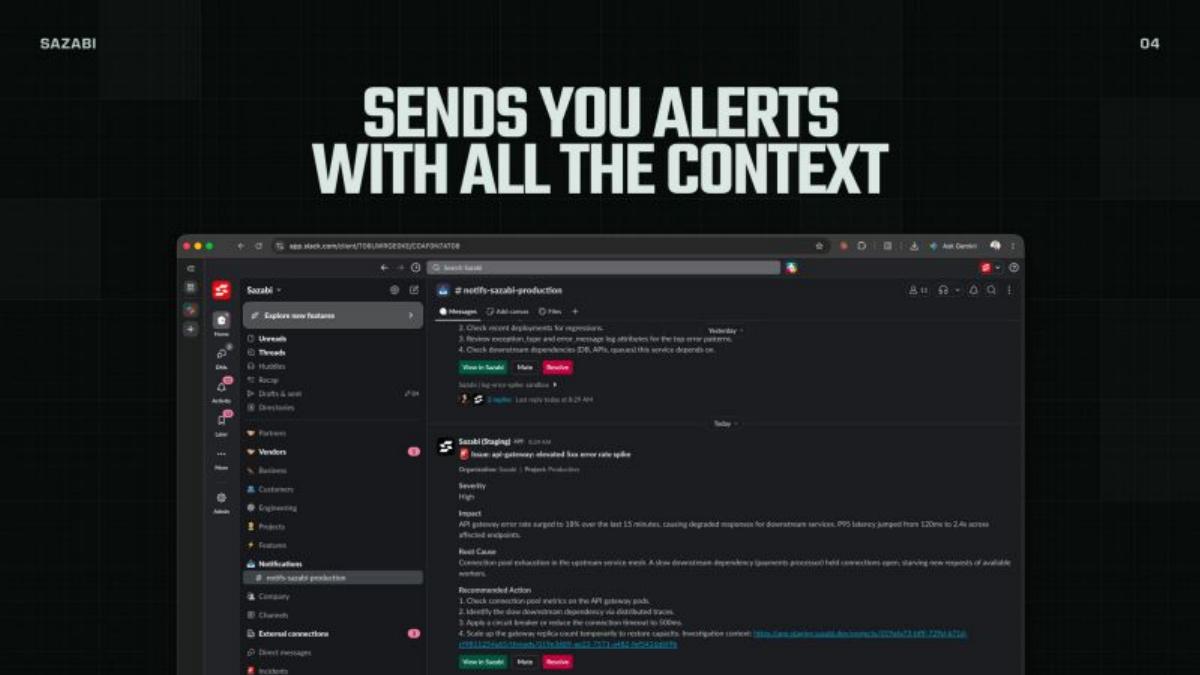
Slide 04: Contextual Alerting
Slide 04 moves the narrative into Slack. It shows a Sazabi alert that includes 'Severity,' 'Impact,' 'Root Cause,' and 'Recommended Action.' By showing the product operating within the developer's existing workflow (Slack), Sazabi demonstrates how it reduces the 'context switching' tax that plagues engineering teams.
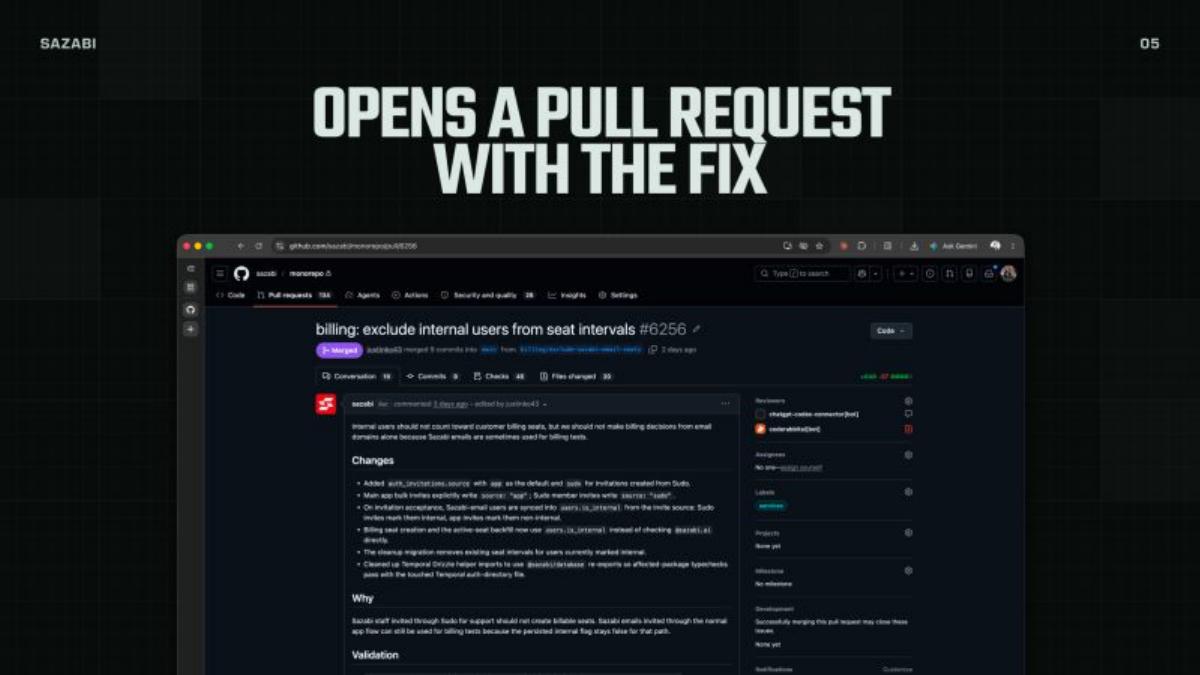
Slide 05: Automated Remediation
This is the 'Aha!' moment of the deck. Slide 05 shows a GitHub Pull Request (PR) opened by Sazabi. The PR title is "billing: exclude internal users from seat intervals," and it includes a detailed description of the changes, the 'Why,' and 'Validation.' This slide claims that Sazabi doesn't just find bugs; it writes the code to fix them.
Slide 06: Founder Pedigree
The deck introduces Sherwood Callaway. The slide highlights his role as an "Infra & Observability Leader at Brex" and notes he is a "2X YC Founder" with "+10 Years Experience." In the world of Seed investing, this slide is often as important as the product. It signals that the person building the tool has lived the problem at a high-growth scale (Brex).
Slide 07: Explosive Traction
Slide 07 provides the hard data: "2 Weeks Since Launch" and "50 Customers Live on the Platform." Below this, a wall of logos (including Daytona, Mintlify, and Mastra) validates that the product is already being used by other startups. Achieving 50 live customers in 14 days is a powerful indicator of product-market resonance.
Slide 08: Market Positioning
This slide serves as a transition, positioning Sazabi as "The default observability and security solution of the AI era." It uses a low-angle shot of a heavy vehicle, suggesting power and stability. It attempts to expand the scope from just 'observability' to include 'security.'
Slide 09: The Competitive Landscape
Rather than a feature-by-feature comparison table, Slide 09 lists 18 logos of established companies (Datadog, Sentry, Splunk, etc.) under the heading "If you're still using." This is an aggressive 'us vs. them' framing, implying that any team using these tools is lagging behind the 'AI era.'
Slide 10: The 10x Claim
The final content slide features a massive robot and the text "You could be moving 10x faster." It’s a bold, aspirational claim that ties back to the initial promise of serving 'fast-moving engineering teams.' It positions Sazabi as the force multiplier for developer productivity.
Slide 11: Closing
The deck ends with the Sazabi logo on a dark background. There is no contact information or 'Ask' on this slide, which is common for decks used in live pitches where the next steps are handled verbally.
What Sazabi Does Well
The Sazabi deck excels at demonstrating a closed-loop workflow . Most AI tools in the coding space either focus on monitoring or on generation. Sazabi shows the entire journey from log ingestion to a merged PR. This makes the value proposition tangible and immediate.
The traction-to-time ratio is another standout feature. By highlighting that 50 customers joined in just two weeks, the founders create a sense of urgency and FOMO (fear of missing out) for investors. It suggests a 'product-led growth' engine that is already firing.
Finally, the founder-market fit is undeniable. Sherwood Callaway’s background at Brex—a company known for its complex, high-scale infrastructure—gives him the credibility to build a tool that other infrastructure leaders will trust.
What is Missing from the Sazabi Deck
Despite its strengths, the deck leaves several critical questions unanswered:
No Financials or Projections: There is no mention of current revenue, burn rate, or future financial targets. While common in Seed decks, the absence of any business model detail is notable. · No Use of Funds: The deck does not explain how the $8M will be spent. Investors typically want to see a breakdown of hiring plans (e.g., engineering vs. sales) and R&D milestones. · No Market Size (TAM): There is no 'Total Addressable Market' slide. While the observability market is known to be large (dominated by multi-billion dollar players), the deck doesn't quantify the specific slice Sazabi is targeting. · No Team Beyond the Founder: Slide 06 only features Sherwood Callaway. There is no mention of a CTO, early engineers, or advisors, which can be a red flag if the 'team' is actually a solo founder.
What Other Founders Should Copy
Founders building in technical categories should take note of Sazabi’s linear product walkthrough . Instead of abstract diagrams, use actual screenshots of the product in the environments where your customers live (Slack, GitHub, VS Code). This proves the product is real and functional.
The aggressive competitive positioning on Slide 09 is also worth emulating if you are entering a crowded market. Don't shy away from naming the giants; instead, frame them as 'legacy' or 'pre-AI' to create a new category where you are the leader.
Lastly, the minimalist aesthetic works well for developer tools. The high-contrast red and black, combined with 'cyber' imagery, signals that this is a tool built for engineers, not for HR or marketing departments. Aligning your deck's visual identity with your target user's culture is a subtle but effective way to build rapport.
Frequently asked questions
- How much did Sazabi raise and who were the investors?
- According to the catalogue facts, Sazabi raised $8M in a Seed round. The round was co-led by J2 Ventures, Village Global, and Y Combinator. The round also included participation from over 60 angel investors, suggesting a broad base of support from industry practitioners.
- What is the core value proposition of the Sazabi platform?
- Sazabi positions itself as an 'AI-native observability platform' (Slide 01). Unlike traditional monitoring tools that merely alert engineers to problems, Sazabi claims to close the loop by providing full context in Slack (Slide 04) and automatically opening Pull Requests with code fixes in GitHub (Slide 05).
- Does the deck provide any information on pricing or business model?
- No. The deck is entirely focused on product functionality, founder pedigree, and early traction. There are no slides detailing pricing tiers, seat-based costs, or unit economics. The catalogue facts identify the business model as B2B SaaS, but the deck itself omits these details.
- How does Sazabi address its competition in the observability space?
- Sazabi takes a direct approach on Slide 09, listing logos of major incumbents like Datadog, New Relic, Splunk, and Sentry under the header 'If you're still using.' It frames these established players as legacy solutions that are not built for the speed of the 'AI era.'
- What is the significance of the founder's background in this raise?
- The founder, Sherwood Callaway, is a '2X YC Founder' with over 10 years of experience, specifically as an infrastructure leader at Brex (Slide 06). In a technical category like observability, this 'Founder-Market Fit' is likely what gave investors the confidence to back a Seed-stage company with only two weeks of public traction.