Satgana’s pitch deck is a masterclass in establishing credibility for a first-time fund. By targeting the 'underserved' seed segment of the climate tech market, the firm positions itself as a necessary bridge between early-stage risk and the abundance of late-stage capital. The deck successfully balances high-level mission statements with granular operational details, such as their 'human capital' offering and specific impact frameworks (SFDR Article 9). With a target portfolio of 40 startups and a clear focus on Europe and Africa, Satgana leverages the entrepreneurial backgrounds of its GPs—…
Key takeaways
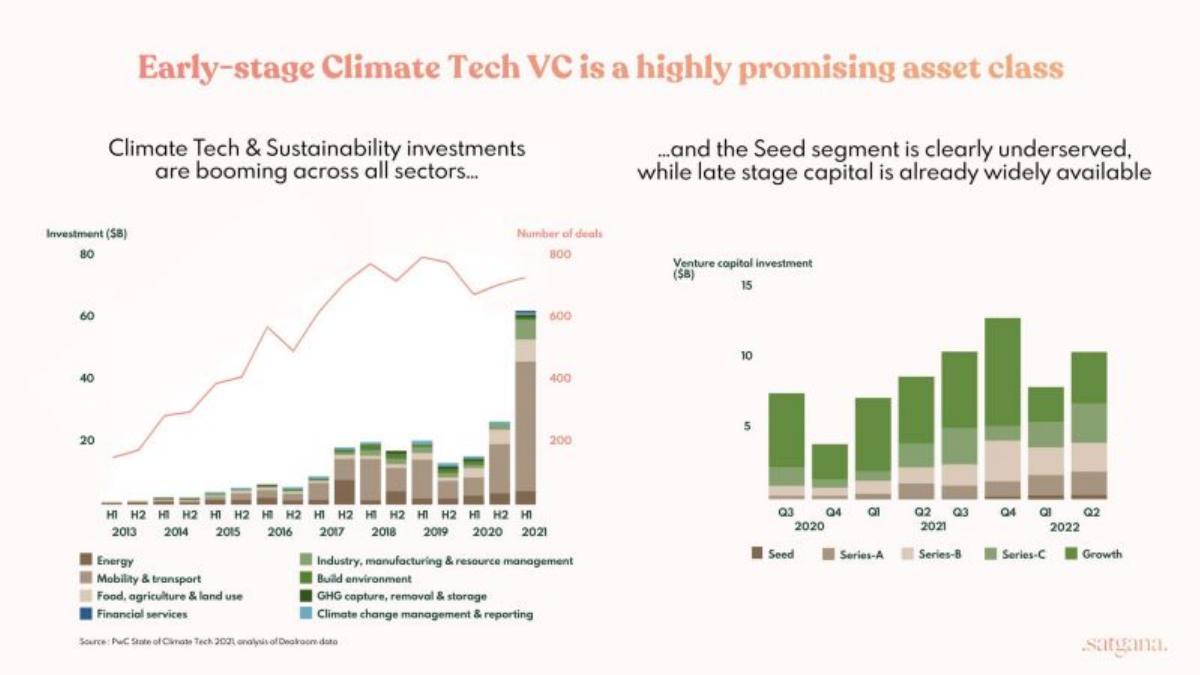
- The fund identifies a specific market gap: while late-stage climate capital is widely available, the Seed segment remains underserved (Slide 5).
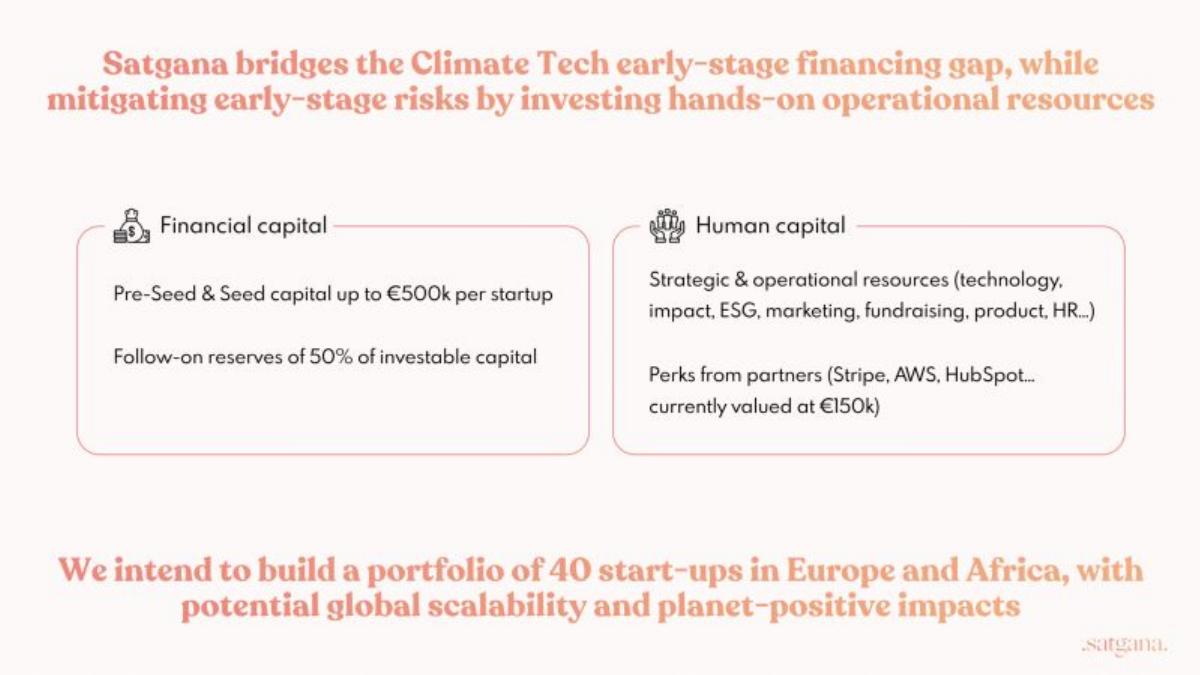
- Satgana's investment strategy targets a portfolio of 40 startups across Europe and Africa with checks up to €500k (Slide 6).
- The firm differentiates through 'Human Capital,' offering operational resources in tech, ESG, and marketing valued at €150k in partner perks (Slide 6).
- Deal flow is driven by a 'self-reinforcing flywheel' including 200k+ organic social media impressions and 500+ analyzed opportunities (Slide 8).
- The deck showcases immediate traction with three active investments: Mazi Mobility (Kenya), Orbio Earth (Germany), and Yeasty (France) (Slide 9).
- Regulatory compliance is a core pillar, with the fund operating as an SFDR Article 9 fund in line with EU Taxonomy (Slide 11).
- The leadership team features deep venture building experience, citing a previous TVPI of x12 and IRR of 50%+ for CEO Romain Diaz (Slide 13).
- Governance is prioritized through an independent Board of Directors and a dedicated Compensation Committee to safeguard stakeholder interests (Slide 14).
The Satgana Pitch Deck Teardown
Satgana entered the venture capital landscape in 2022 with a clear mission: to invest in the "Future of Earth." This teardown examines the 17-slide deck used to communicate their €30 million fund thesis to Limited Partners (LPs). Unlike a typical startup deck, a VC fund deck must sell three things: the market opportunity, the proprietary access to deals, and the operational ability to return capital. Satgana addresses these through a blend of impact-driven mission and hard-nosed venture building metrics.
Slide 1-2: Mission and Identity
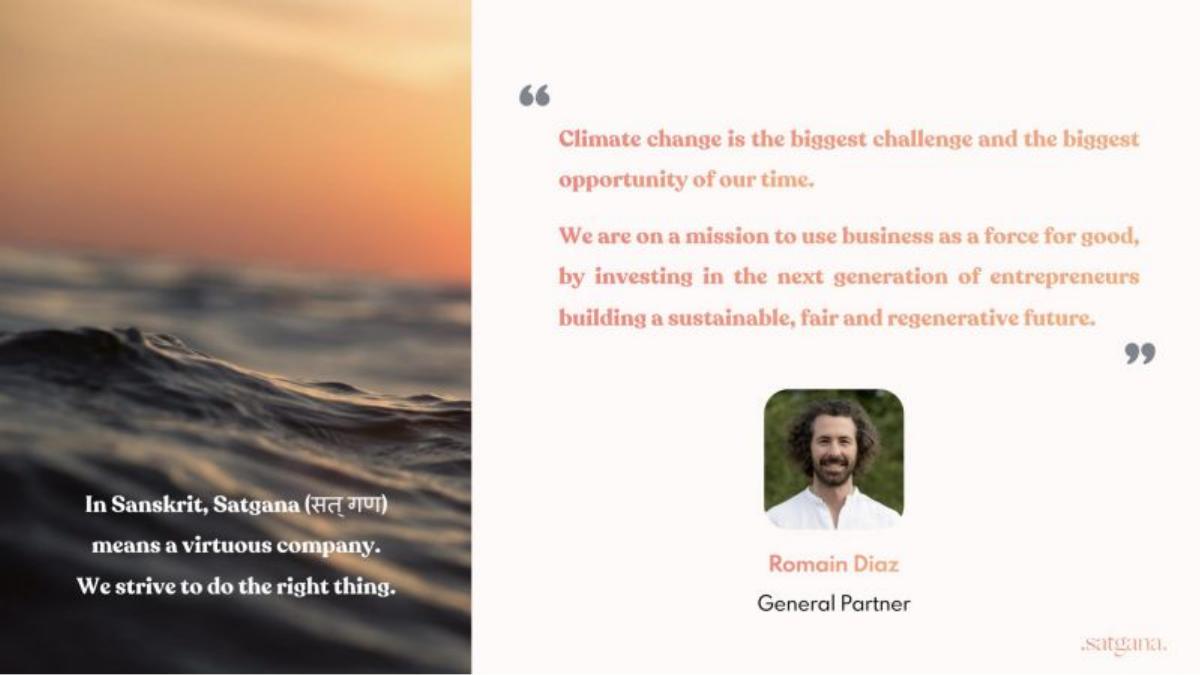
The deck opens with high-resolution nature imagery, establishing the "Planet Positive" brand immediately. Slide 2 introduces Romain Diaz , General Partner, and defines the name: "In Sanskrit, Satgana means a virtuous company." This slide sets the emotional tone, framing climate change as both the "biggest challenge" and the "biggest opportunity." It establishes the fund's philosophical North Star before diving into the financial mechanics.
Slide 3-5: The Opportunity & Thesis
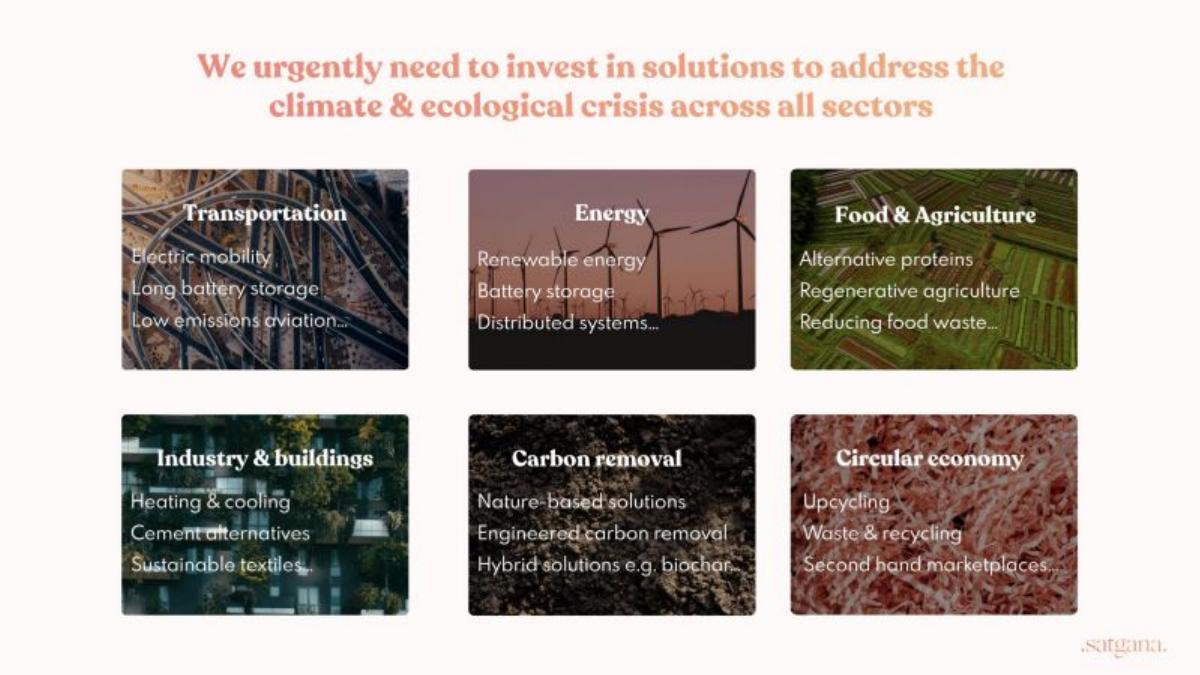
Slide 4 categorizes the climate crisis into six investable sectors: Transportation, Energy, Food & Agriculture, Industry & Buildings, Carbon Removal, and Circular Economy . This breadth is intentional, showing that the fund is not a niche player but a diversified climate tech observer. Slide 5 provides the quantitative "Why Now?" using PwC and Dealroom data. It highlights a critical market inefficiency: while total climate tech investment is booming (reaching nearly $60B in H1 2021), the Seed segment is underserved compared to the "widely available" late-stage capital. This is a classic VC pitch tactic—identifying a capital gap where entry valuations are lower and the need for hands-on help is higher.
Slide 6: The Value Proposition
Slide 6 is the core of the Satgana model. They bridge the financing gap with two types of capital: Financial Capital (Pre-Seed & Seed up to €500k) and Human Capital . The mention of "Follow-on reserves of 50% of investable capital" is a crucial detail for LPs, as it demonstrates a strategy for defending equity stakes in winning companies. The "Human Capital" section lists operational resources in tech, ESG, and marketing, plus €150k in partner perks from providers like AWS and Stripe. This positions Satgana as a "Venture Builder" style VC rather than a passive check-writer.
Slide 7-8: Strategy and Sourcing
Slide 8 explains how they find deals. They claim a "self-reinforcing flywheel" driven by a strong social media presence ( 200k+ organic impressions ) and partnerships with accelerators like Google for Startups and Tech2Impact. The most important figure on this slide is "500+ investment opportunities analyzed since inception," which proves the fund's top-of-funnel health even before the full fund close.
Slide 9-10: Portfolio and Social Proof
Nothing builds credibility like an existing portfolio. Slide 9 showcases three early investments: Mazi Mobility (Kenya), Orbio Earth (Germany), and Yeasty (France). This confirms their ability to execute across their two target geographies (Europe and Africa) and three of their six target sectors. Slide 10 doubles down on this with founder testimonials. Quotes from CEOs Jesse Forrester, Robert Huppertz, and Nikola Stefanovic emphasize Satgana's "impact ethos" and "operational support," validating the claims made on Slide 6.
Slide 11: Impact Frameworks
In the world of ESG, "greenwashing" is a major concern for LPs. Slide 11 addresses this head-on by listing specific regulatory and industry frameworks. Satgana is an SFDR Article 9 fund , which is the most stringent sustainability designation under EU law. They also cite alignment with the 2X Challenge (gender-lens investing) and the Impact Management Project . This slide is designed to satisfy the compliance and impact-reporting requirements of institutional investors.
Slide 12-15: Team, Governance, and Advisors
Slide 13 introduces the team, led by Romain Diaz. His track record is the anchor: 10 years in venture building with a TVPI of x12 and IRR of 50%+ at Far Ventures. This provides the necessary financial credibility. The team is balanced with Isabelle Albert (COO, 20 years in finance) and technical experts like Julien Zory, PhD. Slide 14 is unique for a fund of this size, highlighting a "best-in-class governance" structure with an independent Board of Directors and a Compensation Committee. This signals to LPs that the fund is managed with institutional-grade oversight. Slide 15 lists advisors from Plan A, Hearth Ventures, and FMO, further extending the fund's network and expertise.
Slide 16: The Close
The deck concludes with Slide 16, announcing the first closing in June 2022 with 30+ LPs . They list high-profile individual LPs like Thibaud Hug de Larauze (CEO of Back Market, a $5.7Bn company) and Fabrice de Gaudemar (former Eurazeo Partner). Listing successful entrepreneurs as LPs is a powerful signal; it suggests that people who know how to build billion-dollar companies trust Satgana to find the next ones.
What Satgana Does Well
1. Identifying the Gap: The deck doesn't just say "Climate is good." It specifically identifies the Seed-stage financing gap (Slide 5) as the reason for the fund's existence. This gives LPs a clear financial rationale for the investment.
2. Operational Credibility: By detailing their "Human Capital" offering and showing a team with venture-building experience, they move away from the "Generalist VC" trope and toward a "Value-Add Partner" model.
3. Regulatory Rigor: Mentioning SFDR Article 9 and EU Taxonomy alignment (Slide 11) is essential for attracting European institutional capital. It shows they have done the legal and administrative legwork required for modern impact investing.
4. Geographic Arbitrage: By investing in both Europe and Africa, Satgana can capture high-growth opportunities in emerging markets while maintaining a footprint in established tech hubs. The portfolio slide (Slide 9) proves they can actually manage this dual-continent strategy.
What is Missing
1. Fund Terms: While the amount raised is known from the catalogue (€30M), the deck does not explicitly state the management fee or carry structure. While these are often in the Private Placement Memorandum (PPM), a summary of terms is common in fund decks.
2. Exit Strategy: The deck discusses the "Seed gap" but does not detail the expected exit environment for climate tech in 5-10 years. While implied by the "late stage capital is widely available" comment, more detail on M&A or IPO trends in the sector would strengthen the financial case.
3. Deployment Timeline: There is no slide detailing the expected pace of investment (e.g., how many deals per year) or the lifecycle of the fund (e.g., 10-year term). This is helpful for LPs to understand capital call schedules.
Founder and GP Takeaways
For Fund Managers: Follow the Satgana model of "Show, Don't Just Tell." If you claim to be a value-add investor, list the specific perks and resources (Slide 6). If you claim to have a network, show the LPs and advisors who are part of it (Slides 15-16). Most importantly, use data to show exactly where the market is broken and how your fund fixes it.
For Founders: This deck shows what VCs are looking for in the current market. They want to see how you fit into a larger impact framework (SDGs, EU Taxonomy) and how you can leverage their "Human Capital" to scale. If you are pitching a fund like Satgana, emphasize your operational needs as much as your capital needs.
Frequently asked questions
- What is Satgana's primary investment focus?
- Satgana focuses on early-stage Climate Tech startups (Pre-Seed and Seed) across six key sectors: Transportation, Energy, Food & Agriculture, Industry & Buildings, Carbon Removal, and Circular Economy. They specifically target the 'financing gap' in the Seed segment where capital is less abundant than in later stages.
- How does Satgana support its portfolio companies beyond capital?
- The firm provides 'Human Capital' in the form of strategic and operational resources. This includes hands-on help with technology, impact/ESG frameworks, marketing, fundraising, and HR. They also provide access to a partner perk package (AWS, Stripe, HubSpot) valued at approximately €150,000 per startup.
- What geographical regions does the fund cover?
- Satgana invests in startups located in Europe and Africa. This dual-continent approach is reflected in their initial portfolio, which includes companies in Kenya, Germany, and France, and is supported by a team with experience in both markets.
- What are the fund's impact credentials?
- Satgana is an SFDR Article 9 fund, the highest sustainability classification under EU regulations. They align with the EU Taxonomy, focus on specific UN Sustainable Development Goals, use Impact Management Project frameworks, and intend to achieve B-Corp certification for both the fund and its portfolio.
- Who are the key people behind Satgana?
- The fund is led by CEO Romain Diaz, who has 10 years of experience in venture building (Far Ventures), and COO Isabelle Albert, who has 20 years of experience in finance and sustainability. They are supported by a team of investment directors, analysts, and a robust board of directors.