Aura's 2022 Series F deck is a masterclass in category creation and value proposition clarity. By introducing the 'Intelligent Safety' category, Aura differentiates itself from legacy, fear-based cybersecurity firms. The deck focuses heavily on the fragmentation of the current market, where consumers juggle multiple subscriptions for identity, device, and privacy protection. Aura presents a compelling financial case for consolidation, showing how they can replace $76.90 worth of monthly services with a single $19.85 bill. While the deck is light on specific growth metrics and team bios, it le…
Key takeaways
- Aura identifies a $100B market opportunity centered on creating a safer internet for families (Slide 2).
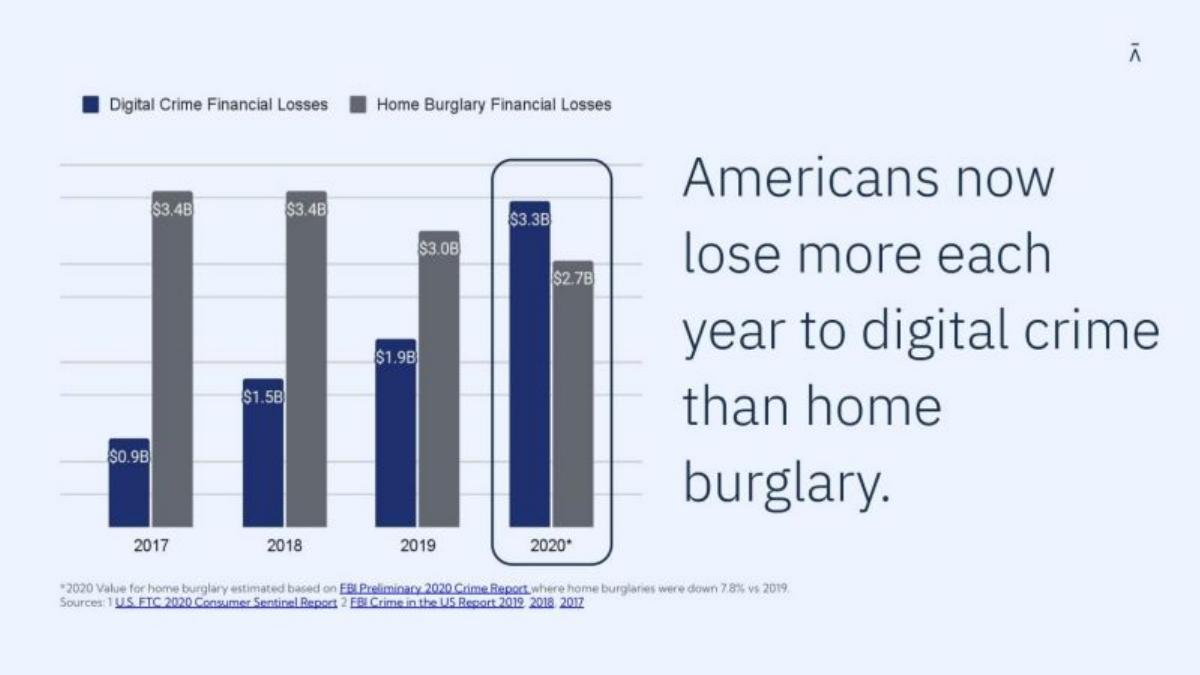
- The deck uses a powerful comparison showing that digital crime losses reached $3.3B in 2020, exceeding the $2.7B lost to home burglaries (Slide 4).
- Aura attempts to create a new market category called 'Intelligent Safety' to move away from 'cold, fear-based language' used by competitors (Slide 8).
- The core value proposition is consolidation, replacing six separate bills totaling $76.90/month with one Aura bill for $19.85/month (Slide 11).
- The product scope is broad, covering identity, devices, WiFi, social media, assets, and privacy (Slide 9).
- Aura emphasizes a 'Learning Engine' and 'Automation tools' as their primary proprietary IP to reduce the cognitive load on the user (Slide 16).
- The technical architecture relies on a 'Data Lake' that combines proprietary data from Aura products with 3rd party data like public records and WHOIS (Slide 17).
- The deck completely omits a team slide, historical revenue growth metrics, and a specific use-of-funds breakdown.
The Narrative of Intelligent Safety
Aura’s Series F pitch deck is a study in high-level strategic positioning. At this stage of funding, a company is typically expected to show deep operational metrics, but Aura chooses to lead with a narrative shift. They are not just selling software; they are defining a new category: Intelligent Safety . This teardown explores how Aura uses simplicity and a clear consolidation argument to justify a $200M investment.
Slides 1-2: The Mission and the Market
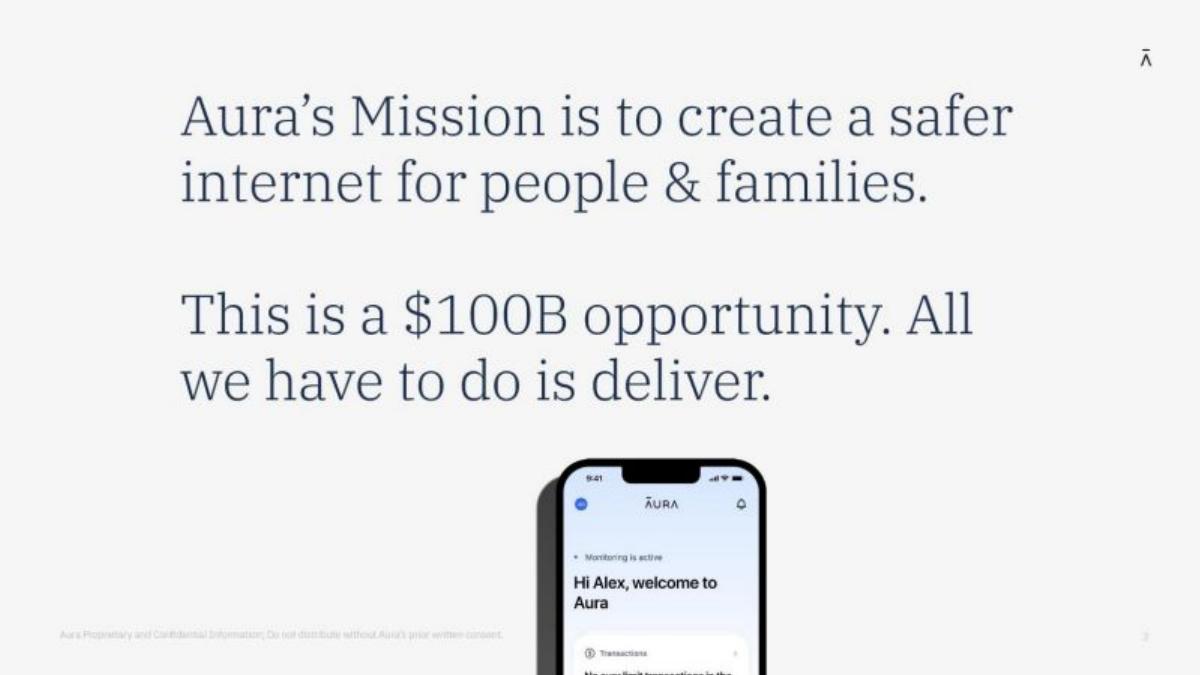
The deck opens with a minimalist title slide (Slide 1) and immediately pivots to the mission statement on Slide 2. Aura defines its mission as creating a "safer internet for people & families." Crucially, it attaches a massive number to this mission: a $100B opportunity . By framing the goal as a delivery challenge ("All we have to do is deliver"), they signal to investors that the market demand is already proven and the execution phase is the current priority.
Slides 3-5: The Problem of Fragmentation
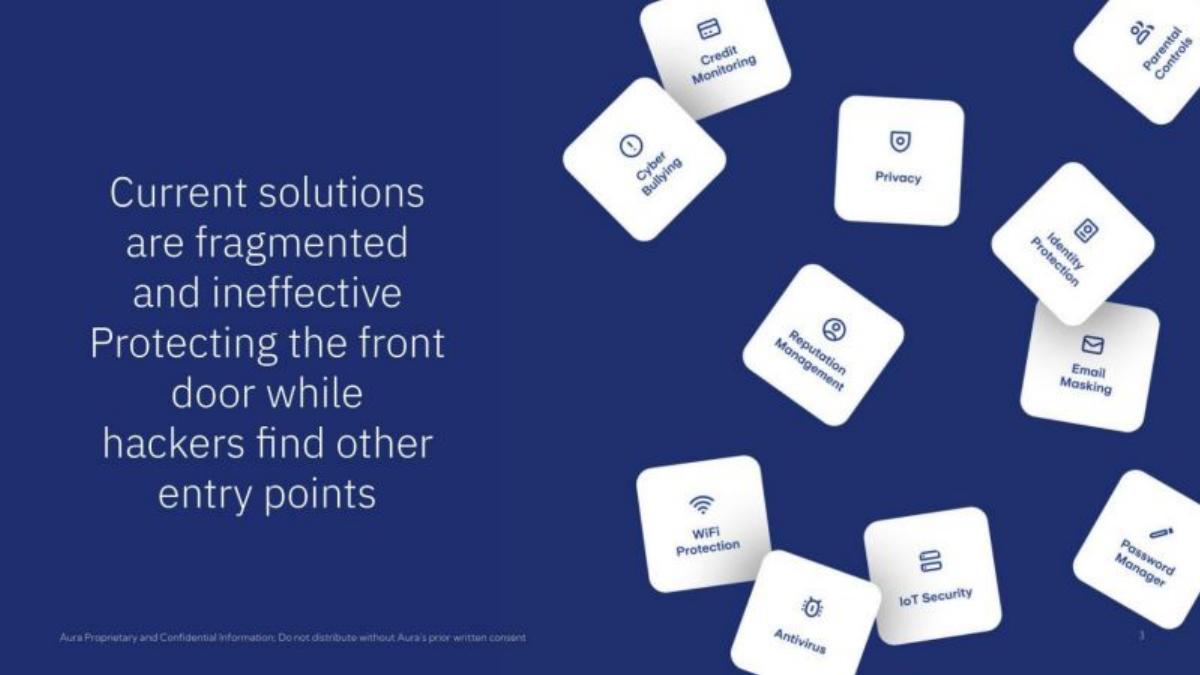
Slide 3 uses a visual metaphor of scattered tiles to represent the fragmented nature of current security solutions. It lists categories like Cyber Bullying, IoT Security, and Reputation Management, arguing that protecting only the "front door" is insufficient. Slide 4 provides the most compelling data point in the deck: a bar chart showing that digital crime financial losses ($3.3B) surpassed home burglary losses ($2.7B) in 2020. This effectively recontextualizes digital security as a physical necessity. Slide 5 lists the specific risks of an unprotected digital footprint, ranging from identity theft to catfish scams, reinforcing the breadth of the threat landscape.
Slides 6-8: Category Creation
Aura explicitly states on Slide 6 that legacy companies haven't solved the underlying problem. This sets the stage for Slide 7, which introduces the "Intelligent Safety Category." Slide 8 breaks down this new category into two pillars: Intelligent (advanced, holistic technology) and Safety (proactive, peace of mind). The deck makes a pointed critique of competitors, noting that Aura avoids "cold, fear-based language" like "guard" or "shield," opting instead for a more human-centric approach.
Slides 9-11: The Consolidation Play
Slide 9 details the six areas of proactive protection: Identity, Devices, Wifi Network, Social Media, Assets, and Privacy. This leads into the core economic argument of the deck. Slide 10 lists "Hundreds of Vendor Options" that a consumer might currently use, resulting in six products, six bills, and six logins. Slide 11 delivers the punchline: while the fragmented market costs a consumer $76.90 per month , Aura provides the unified solution for $19.85 per month . This 74% price reduction is a powerful hook for both customer acquisition and investor interest.
Slides 12-14: Product and UI
Slide 12 uses a circular diagram to describe the product as Simple, Smart, Innovative, and Universal. Slide 13 shows the app in a real-world context, emphasizing a clean UI that alerts users to threats like found login credentials or over-limit transactions. Slide 14 provides a grid of ten specific feature mockups, illustrating how the app handles everything from credit monitoring to data broker opt-outs and parental controls. This visual evidence is intended to prove that the "unified solution" is a functional reality, not just a concept.
Slides 15-17: The Technology Stack
Slide 15 serves as a transition, claiming Aura is disrupting the market with unique value and leading technology. Slide 16 identifies the company's proprietary IP as a "Learning Engine" that does the thinking and "Automation tools" that do the work. Slide 17 provides the most technical depth in the deck, showing a stack that starts with a "Data Lake" (ingesting proprietary and 3rd party data), moves through an ML/AI engine, and results in a personalized experience. The slide emphasizes that Aura takes the decision-making responsibility out of the hands of the consumer, which is a key differentiator from tools that simply provide alerts without resolution.
What Aura’s Deck Does Well
Aura excels at problem framing . By comparing digital crime to home burglary, they tap into a primal sense of security that makes their product feel essential rather than optional. The consolidation argument on Slide 11 is also exceptionally strong; it presents a clear, mathematical reason why Aura should win the market. Furthermore, the branding is consistent and professional, avoiding the aggressive, dark aesthetics common in the cybersecurity industry in favor of a clean, "family-friendly" look.
What is Missing from the Aura Deck
Despite being a Series F deck, there is a glaring lack of traction metrics . There are no mentions of total active users, Annual Recurring Revenue (ARR), or Year-over-Year growth rates. The Team Slide is also missing, which is highly unusual. Investors at this stage typically want to see the pedigree of the leadership team and their ability to scale a global enterprise. Finally, there is no Ask or Use of Funds slide. While the catalogue facts indicate a $200M raise, the deck itself does not specify how that capital will be deployed—whether for R&D, international expansion, or marketing.
Founder Takeaways
Quantify the Problem: Use relatable comparisons. Aura’s comparison of digital crime to home burglary (Slide 4) makes the abstract threat of hacking feel tangible. · The Power of Consolidation: If your product replaces multiple tools, show the math. The side-by-side cost comparison on Slide 11 is the most persuasive slide in the deck. · Define Your Category: If you are entering a crowded market, don't just say you are better; say you are different. Aura’s "Intelligent Safety" (Slide 8) is a strategic attempt to own a new space rather than fight for scraps in the "Antivirus" space. · Focus on Automation: In the modern SaaS landscape, "doing the work for the user" (Slide 16) is a more valuable promise than "giving the user more data."
Frequently asked questions
- What is the primary problem Aura aims to solve?
- Aura addresses the fragmentation and ineffectiveness of current digital security solutions. Slide 3 notes that current tools only 'protect the front door' while hackers find other entry points. The deck argues that consumers are overwhelmed by having to manage multiple siloed products for identity theft, device security, and privacy, leading to a digital footprint that remains largely unprotected.
- How does Aura differentiate itself from traditional antivirus or identity theft companies?
- Aura differentiates through its 'Intelligent Safety' category. According to Slide 8, this approach is proactive rather than reactive and uses holistic protection instead of fear-based marketing. Unlike legacy providers that focus solely on identity, Aura covers six distinct areas: Identity, Devices, WiFi, Social Media, Assets, and Privacy, all managed through a single interface.
- What is the financial incentive for a customer to switch to Aura?
- The deck presents a clear 'consolidation play' on Slide 11. It lists the cost of individual services—such as $17.95 for identity protection and $24.00 for privacy tools—totaling $76.90 per month across six different vendors. Aura offers the same breadth of coverage for $19.85 per month, providing a 74% cost reduction and the convenience of one login.
- What technical advantages does Aura claim to have?
- Aura claims a 'distinct advantage' through its robust and diverse data sets. Slide 17 illustrates a 'Data Lake' that ingests information from IoT, financial transactions, the dark web, and public records. This data feeds into a Machine Learning/AI engine that powers a 'Personalized Experience Engine,' allowing the software to address user needs at the right time with the right tools.
- What key information is missing from this Series F deck?
- For a Series F round, the deck is surprisingly light on hard business data. It lacks a team slide, which is unusual even for late-stage companies. Furthermore, there are no charts showing Year-over-Year (YoY) revenue growth, customer acquisition costs (CAC), churn rates, or a specific breakdown of how the $200M will be allocated.