Authoritive's 2021 seed deck is a masterclass in brevity and narrative focus. With only 11 slides, the company successfully articulated a shift in the EdTech landscape: moving away from low-engagement, one-way course platforms toward high-touch, two-way messaging via SMS, WhatsApp, and Slack. The deck relies heavily on the 'Creator Economy' tailwinds of the era, positioning its proprietary AI-driven delivery platform as the bridge between expert creators and their audiences. While the deck is notably light on financial projections and specific traction metrics, the inclusion of high-profile b…
Key takeaways
- The company defines its mission as transforming expertise into scalable learning experiences on slide 1.
- Authoritive identifies a low ROI for creators on traditional course platforms due to poor discoverability and lost audience connection on slide 3.
- The solution is a proprietary two-way messaging platform that allows creators to scale with their existing audiences, as stated on slide 4.
- The product supports multiple delivery channels including SMS, WhatsApp (slide 5), and Slack for cohort-based learning (slides 6 and 7).
- The technology platform is described as messaging-network agnostic and utilizes NLP for rich-media experiences on slide 8.
- Authoritive positions itself at the intersection of Zoom, Substack, Community, and Udemy on slide 9.
- The team slide (slide 10) features eight individuals, including Eric Ries as a Board member/Investor.
- The deck completely omits financial forecasts, current revenue, and a specific 'Ask' or use of funds slide.
Executive Summary: The 11-Slide Vision
Authoritive’s pitch deck is a lean, narrative-driven document that focuses on the 'why' and 'how' rather than the 'how much.' Raised in 2021 during the height of the creator economy boom, the deck successfully convinced top-tier VCs like Owl Ventures to commit $5 million in a very short window. The deck’s primary strength lies in its clear identification of the friction points in traditional online education and its proposal of a 'frictionless' alternative: messaging.
Slide 1: Title and Mission
The deck opens with a minimalist dark green slide featuring the Authoritive logo—a stylized slash and comma. The tagline, "Transforming expertise into scalable learning experiences," immediately positions the company within the knowledge economy. It doesn't call itself a 'course platform,' but rather an 'experience' provider, which is a subtle but important distinction for the premium creator market.
Slide 2: The Value Proposition
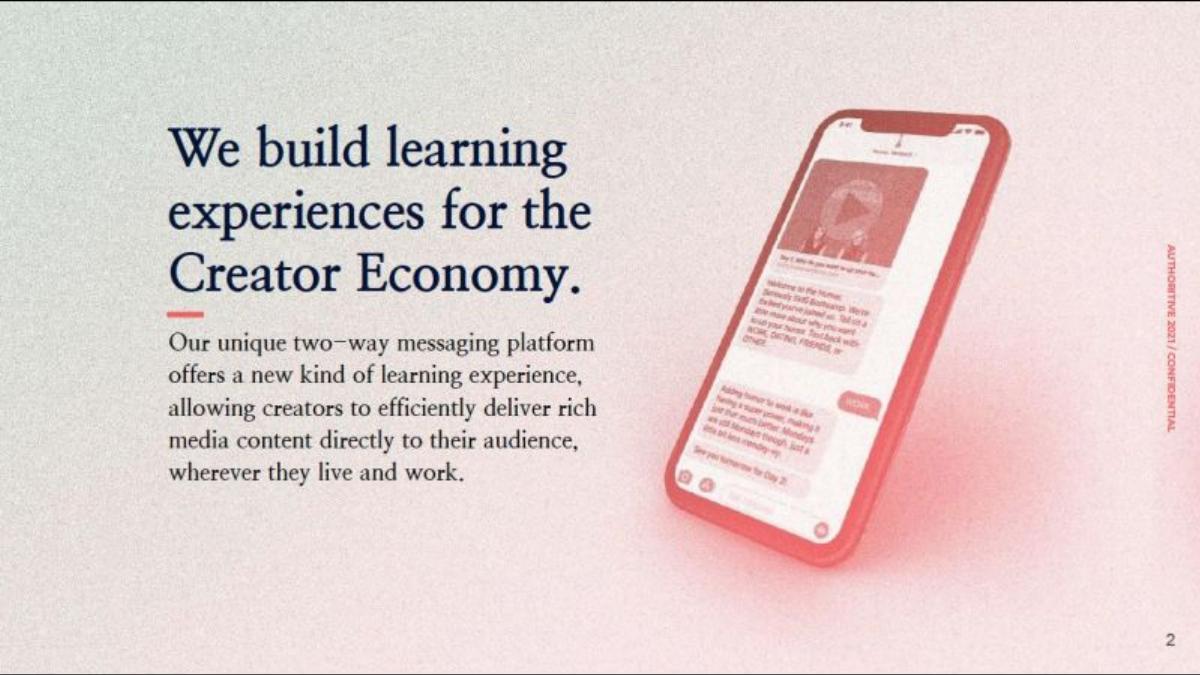
Slide 2 introduces the core product: "We build learning experiences for the Creator Economy." It defines the product as a "unique two-way messaging platform" that delivers rich media content directly to audiences "wherever they live and work." The accompanying visual is a smartphone showing an SMS-style interface with video and text, signaling that this is not a destination site but a push-content service.
Slide 3: The Opportunity (Problem)
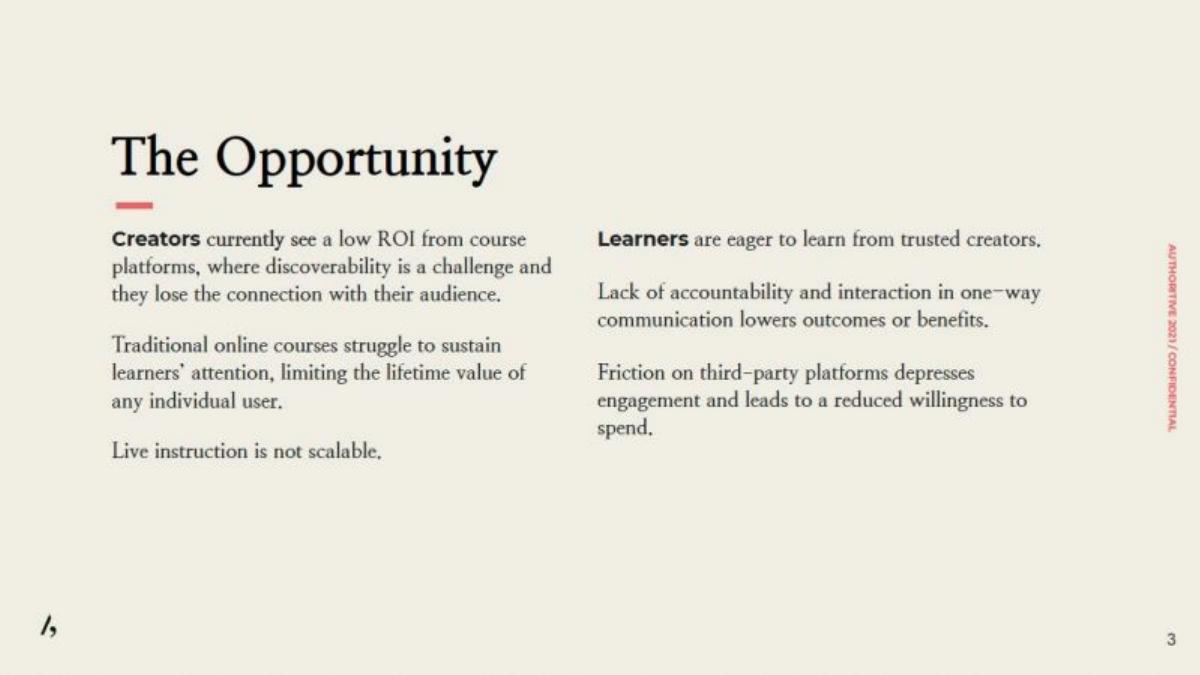
This slide breaks down the pain points for two distinct groups: Creators and Learners. For Creators , the deck cites low ROI on traditional platforms due to discoverability challenges and a loss of audience connection. It also notes that "Live instruction is not scalable." For Learners , it highlights a lack of accountability and interaction in one-way communication, which "lowers outcomes or benefits." This slide sets up the 'messaging' solution as the logical fix for both engagement and scalability.
Slide 4: The Solution
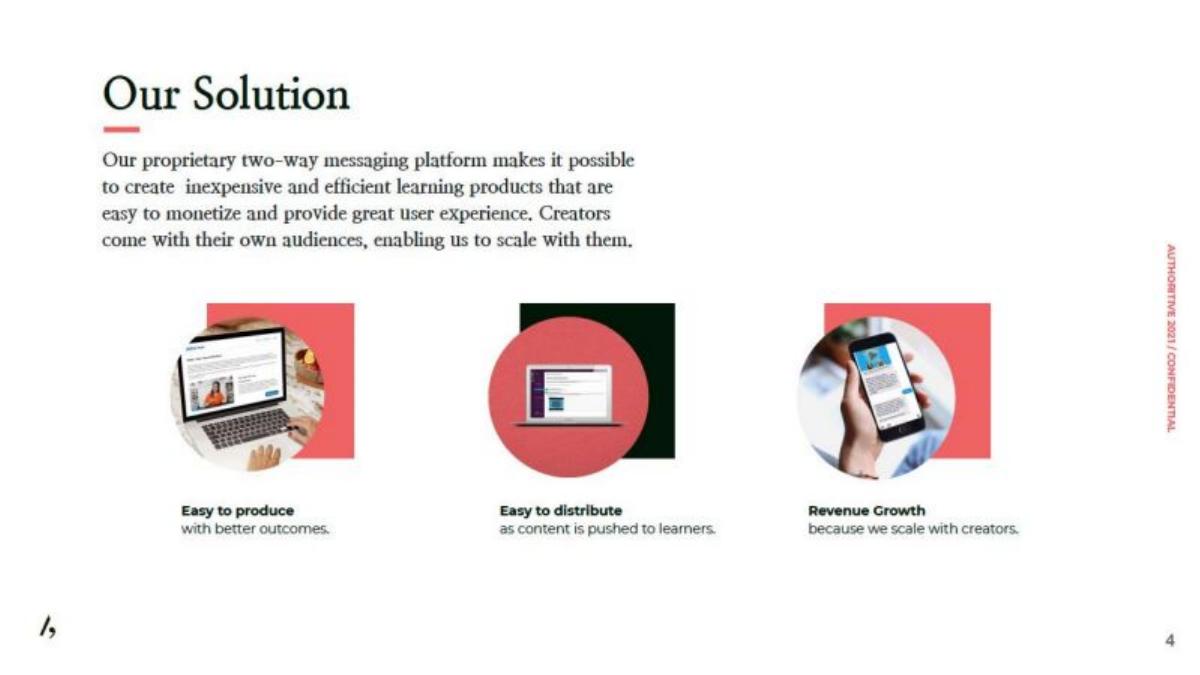
The solution slide reiterates the "proprietary two-way messaging platform" and lists three key benefits: Easy to produce (better outcomes), Easy to distribute (content is pushed), and Revenue Growth (scaling with creators). By stating that creators "come with their own audiences," Authoritive effectively tells investors that their customer acquisition cost (CAC) will be low because the creators handle the marketing.
Slide 5: Messaging – SMS + WhatsApp
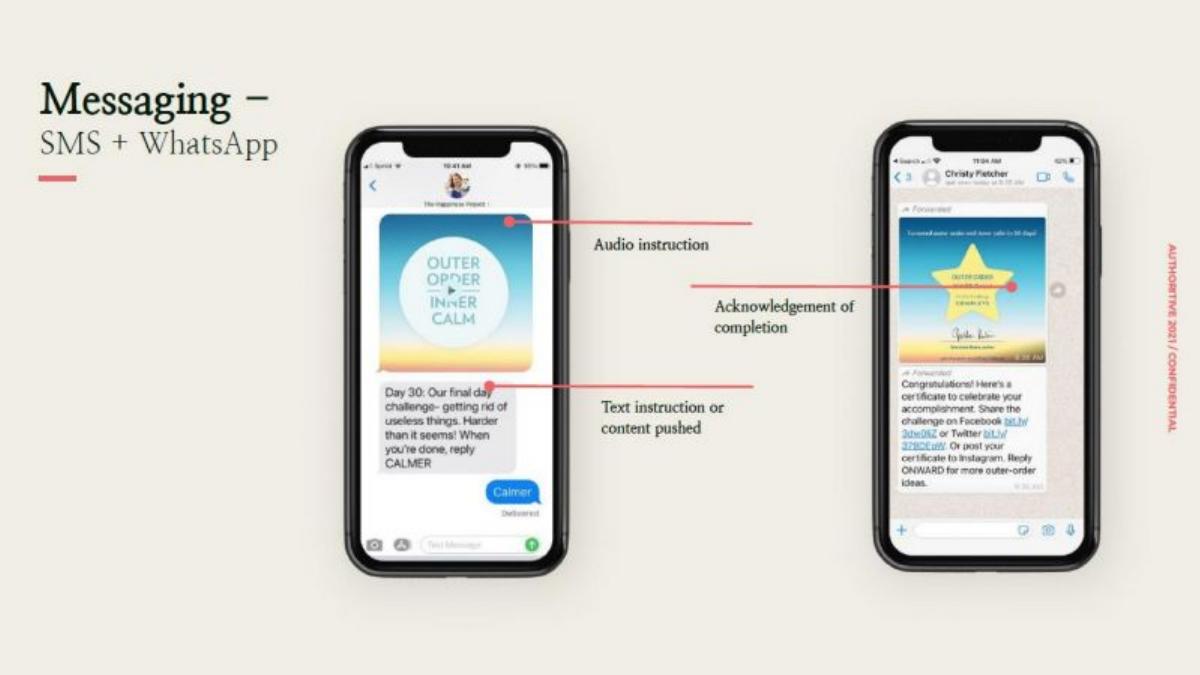
This slide provides a concrete look at the product interface on mobile. It labels specific features: Audio instruction , Text instruction or content pushed , and Acknowledgement of completion . The visual shows a user replying with a keyword ('CALMER') to trigger the next step, demonstrating the 'two-way' nature of the AI-driven platform.
Slides 6 & 7: Cohort Learning via Slack
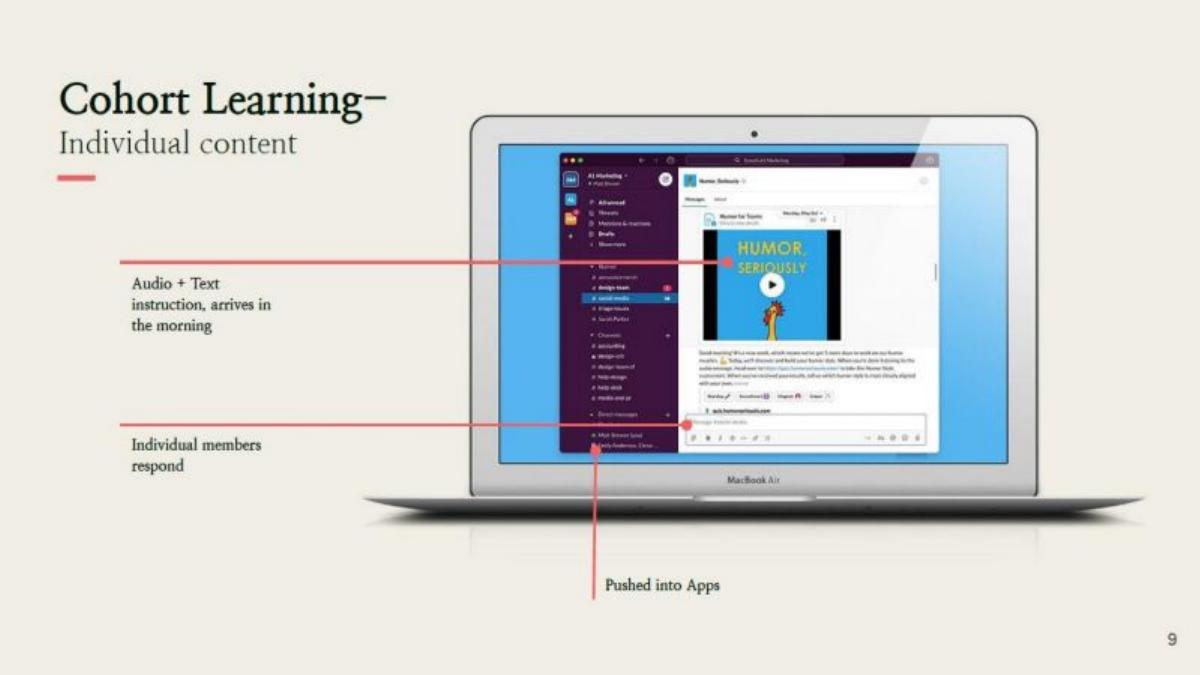
Moving beyond 1-on-1 messaging, these slides show how the platform integrates with professional tools like Slack. Slide 6 focuses on "Individual content" pushed into apps, while Slide 7 focuses on "Facilitation content" within private group channels. This demonstrates the platform's versatility, moving from personal self-improvement (SMS) to professional B2B training (Slack).
Slide 8: Technology Platform
Authoritive describes its tech as "Proprietary AI-driven" and "messaging-network agnostic." It mentions the use of NLP (Natural Language Processing) for personalization and gamification. Crucially, it mentions a "Planned conversion of course management tools to self-service," which indicates the company’s roadmap toward becoming a true SaaS platform rather than a tech-enabled service provider.
Slide 9: Competitive Context
The 'Context' slide is a creative take on the traditional 2x2 matrix. It uses a four-circle Venn diagram to show Authoritive at the center of Zoom (Two-Way Communication), Substack (Owned Audience), Community (Messaging), and Udemy (Education). This effectively communicates that while these giants exist, none of them cover the specific intersection Authoritive has claimed.
Slide 10: The Team
The team slide is a significant credibility booster. It features eight leaders, including Co-CEOs Christy Fletcher and Jacob Lewis and CTO Gene Cohen . The standout name is Eric Ries , listed as "Board/Investor." Having the author of The Lean Startup on the board provides an immediate stamp of approval for a seed-stage company. The presence of VPs for Product, Engineering, Operations, and Marketing suggests a team that is ready to scale immediately.
Slide 11: Closing
The deck ends simply with "Thank You." There is no 'Ask' slide detailing the $5 million raise or how the funds will be allocated. This is common in 'teaser' decks or decks used by founders with high social capital where the terms are discussed in person.
What Works in This Deck
Clarity of Vision: The deck never wavers from its core thesis: messaging is the future of learning. By repeating terms like 'two-way' and 'owned audience,' the founders ensure the investor remembers their specific niche.
Visual Simplicity: The use of actual product mockups (SMS, WhatsApp, Slack) makes a somewhat abstract concept ('AI-driven learning') feel tangible and easy to understand.
Strategic Positioning: Slide 9 is an excellent example of how to frame competition. Instead of saying competitors are 'bad,' the deck suggests they are 'incomplete,' positioning Authoritive as the missing piece of the puzzle.
What Is Missing
Traction Metrics: There are no numbers regarding current users, creator partnerships, or revenue. For a $5M seed round, investors usually want to see some evidence of product-market fit, even if it's just early pilot data.
Business Model Specifics: While the catalogue facts state this is a B2B2C SaaS model, the deck doesn't explain the pricing. Do they take a percentage of creator revenue? Is it a monthly subscription for the tools? This is a major omission for a business-focused pitch.
The Ask: The deck does not state how much money is being raised or what the milestones for the next 18 months are. This suggests the deck was likely a visual aid for a conversation rather than a standalone document sent via email.
What Founders Should Copy
The 'Context' Slide: Founders should emulate the way Authoritive mapped itself against massive incumbents. It doesn't try to 'beat' Zoom or Substack; it explains how it complements the behaviors those platforms have already popularized.
Platform Agnosticism: By showing the product on SMS, WhatsApp, and Slack, Authoritive avoids being pigeonholed as 'just another app.' Founders building middleware or delivery layers should emphasize this flexibility.
Focus on the 'Why Now': The deck leans heavily into the 'Creator Economy' trend of 2021. Identifying a macro-trend and explaining why your specific technology is the necessary evolution of that trend is a powerful way to build urgency with investors.
Final Thought: Authoritive’s deck is a reminder that at the seed stage, the pedigree of the team and the clarity of the narrative can be more persuasive than a spreadsheet of early-stage metrics. By focusing on the 'friction' of existing solutions, they created a compelling case for a new category of EdTech.
Frequently asked questions
- What is Authoritive's core product offering?
- Authoritive offers a two-way messaging platform designed for the creator economy. Unlike traditional EdTech platforms that host static video courses, Authoritive delivers learning content—including audio, text, and rich media—directly through messaging apps like SMS, WhatsApp, and Slack. This allows creators to maintain a direct connection with their audience and facilitates interactive, cohort-based learning experiences.
- How does the company differentiate itself from competitors like Udemy or Substack?
- According to slide 9, Authoritive occupies a unique 'Context' at the convergence of four elements: education, owned-audience, messaging, and two-way communication. While Udemy focuses on education but lacks the owned-audience connection, and Substack focuses on owned-audiences but lacks interactive education tools, Authoritive claims to bridge these gaps by using messaging as the primary delivery and interaction layer.
- Who are the key people involved in the startup?
- The leadership team includes Co-CEOs Christy Fletcher and Jacob Lewis, and CTO Gene Cohen. A significant highlight on the team slide (slide 10) is the inclusion of Eric Ries, author of The Lean Startup, as a Board member and Investor. The team also includes VPs for Product, Engineering, Operations, and Marketing, suggesting a well-rounded early-stage leadership structure.
- What metrics or traction are included in the deck?
- The deck is remarkably devoid of hard metrics. There are no mentions of current ARR, user growth rates, churn, or specific pilot results. It relies entirely on the 'Opportunity' and 'Solution' narrative. This suggests the $5M seed round was raised primarily on the strength of the vision, the product prototype shown in the mockups, and the credibility of the founding team.
- What is the primary technology behind the platform?
- Slide 8 describes the 'Technology Platform' as a proprietary AI-driven, two-way delivery system. It is messaging-network agnostic and utilizes Natural Language Processing (NLP) to deliver personalized and gamified experiences. The company also notes plans to convert its course management tools to a self-service model to enable creators to optimize their own content and view analytics.