AvatarOS secured a $7M Seed round in 2024 by positioning itself as the technical successor to the world's most famous virtual influencer, Lil Miquela. The 11-slide deck is a masterclass in 'founder-market fit,' spending significant real estate on Slide 2 and Slide 3 to establish that the core team built the industry's biggest success story. Rather than focusing on broad market platitudes, the deck highlights a specific technical moat: proprietary 4D/ML training that enables real-time inference. By showcasing a live demo integration with ChatGPT and ElevenLabs on Slide 7, the company proves it…
Key takeaways
- The deck leads with a massive credibility play, citing the creation of Lil Miquela on Slide 2 and Slide 3.
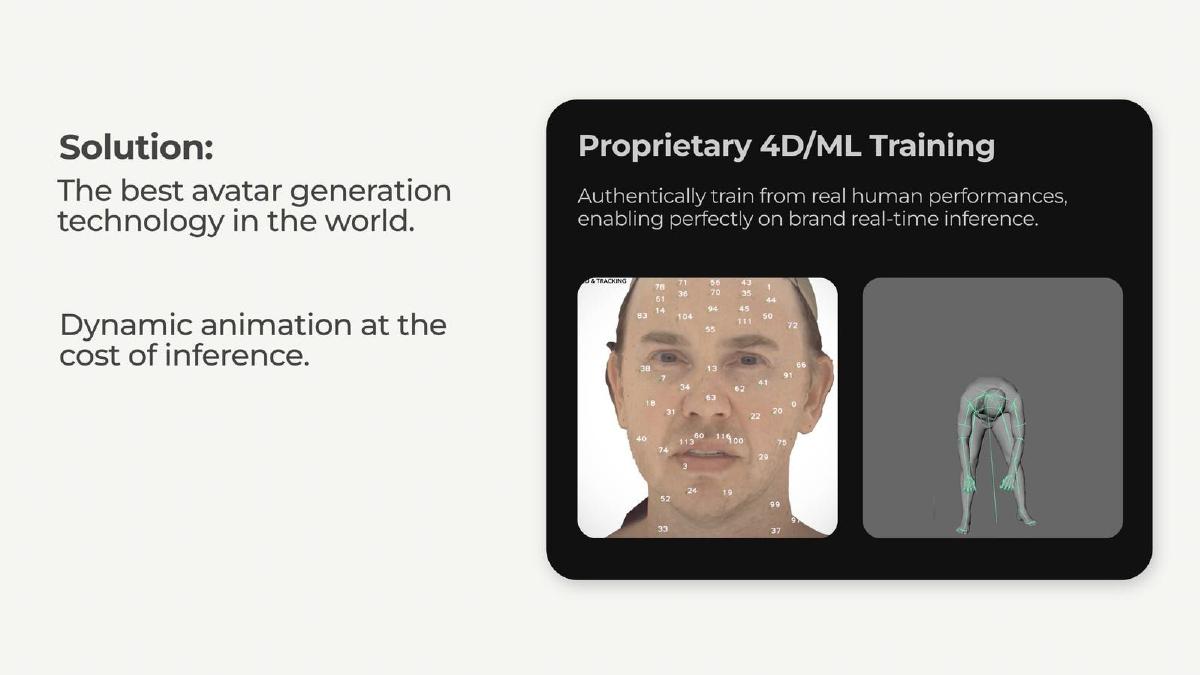
- Proprietary technology is defined as 4D/ML training that allows for 'dynamic animation at the cost of inference' on Slide 5.
- The product vision shifts from static influencers to interactive 3D avatars live on every platform as shown on Slide 7.
- Technical integrations include ChatGPT and ElevenLabs to power the LLM and voice components of the avatars (Slide 7).
- The market opportunity is framed as an $18B industry growing to $527.58B by 2030, citing Emergen Research on Slide 9.
- The deck omits a specific 'Ask' slide detailing how the $7M will be spent or the specific milestones targeted.
- There is no competitive landscape slide, suggesting the founders believe their specific pedigree and tech stack are unique.
- The visual identity of the deck is high-fidelity, mirroring the quality of the 'Real. Digital. Humans.' promised on Slide 1.
The AvatarOS Pitch Deck: A Masterclass in Founder-Market Fit
AvatarOS, a North American startup operating at the intersection of AI and Social Media, raised $7M in a Seed round in 2024. The deck they used is remarkably concise at just 11 slides, relying heavily on the 'halo effect' of the founder’s previous work. By focusing on the technical barriers to entry in the digital human space—specifically cost and real-time interactivity—the deck makes a compelling case for why this specific team is best positioned to capture a half-trillion-dollar market.
Slide 1: The Hook
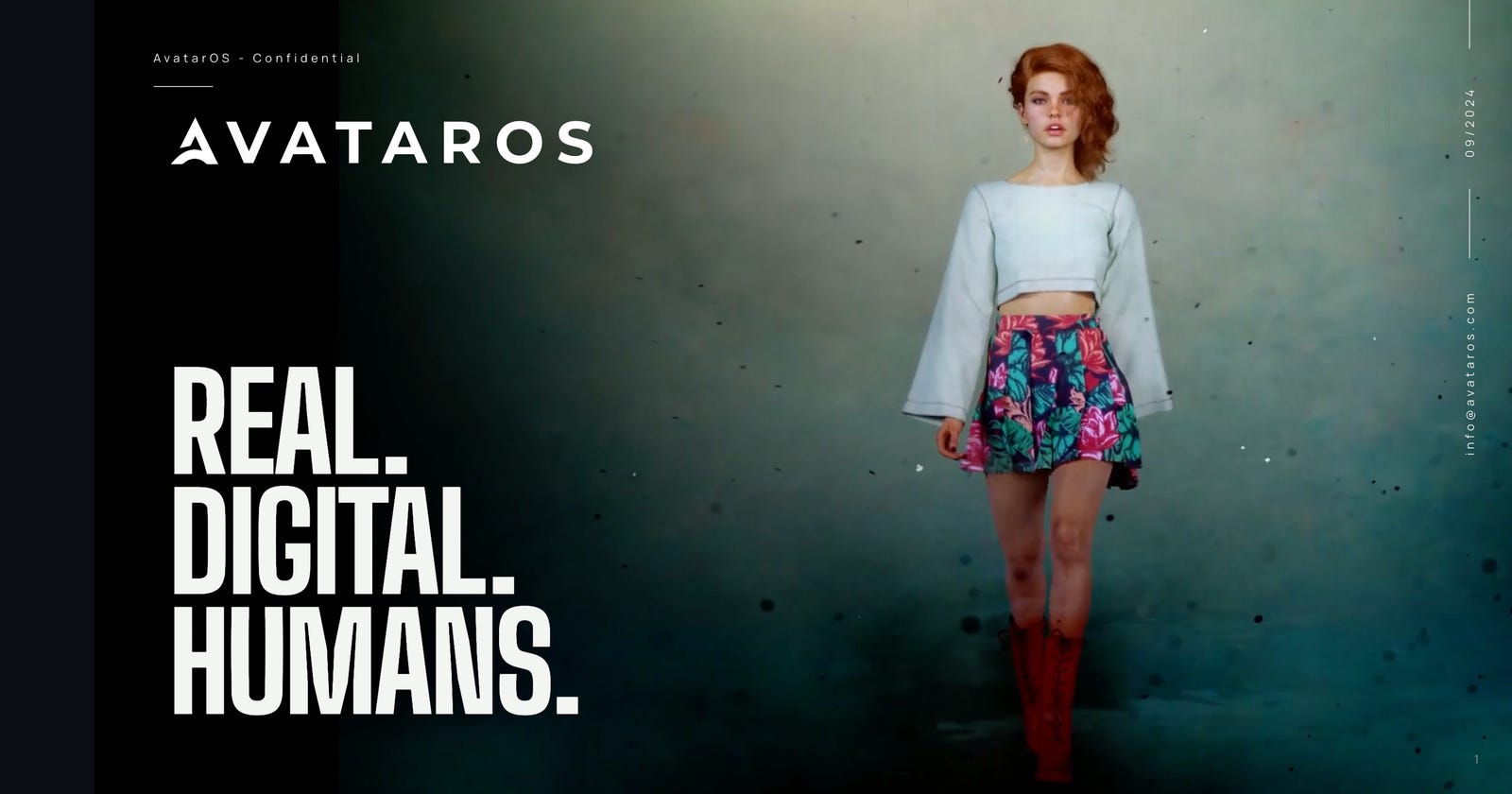
The cover slide is minimalist and high-impact. It features the company name, AVATAROS , and a bold three-word value proposition: REAL. DIGITAL. HUMANS. The background image shows a high-fidelity digital avatar, setting a quality bar immediately. The date 09/2024 is visible, marking this as a very recent fundraising effort in the post-generative AI boom.
Slide 2 & 3: The Pedigree
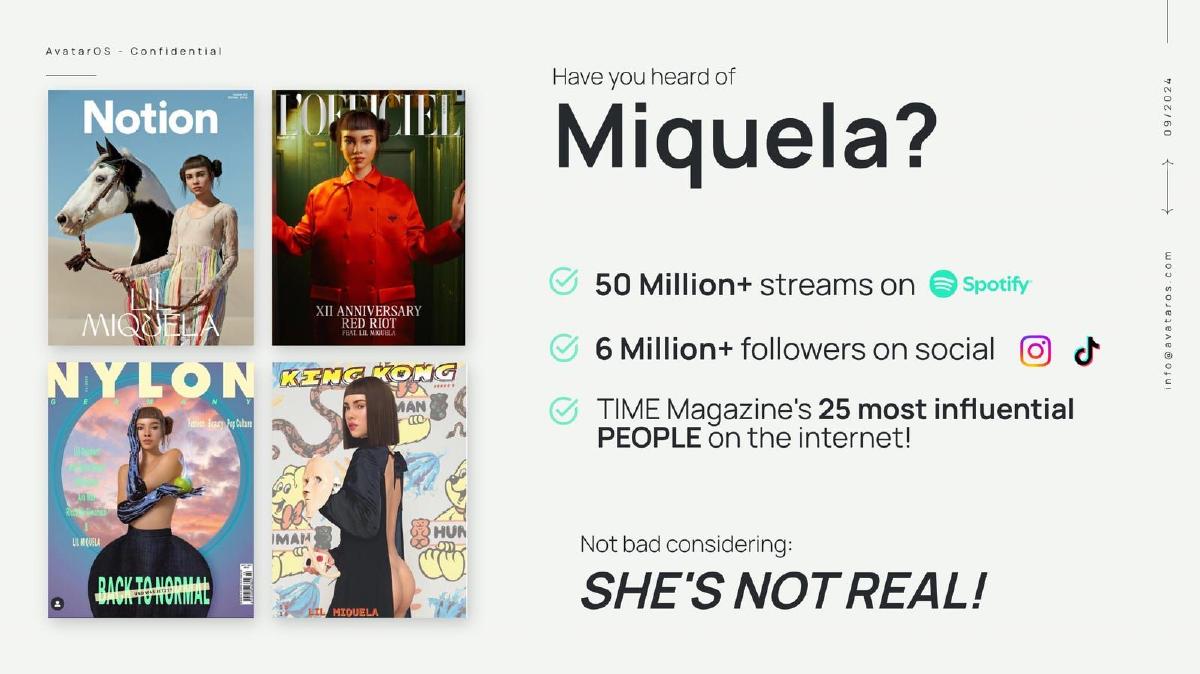
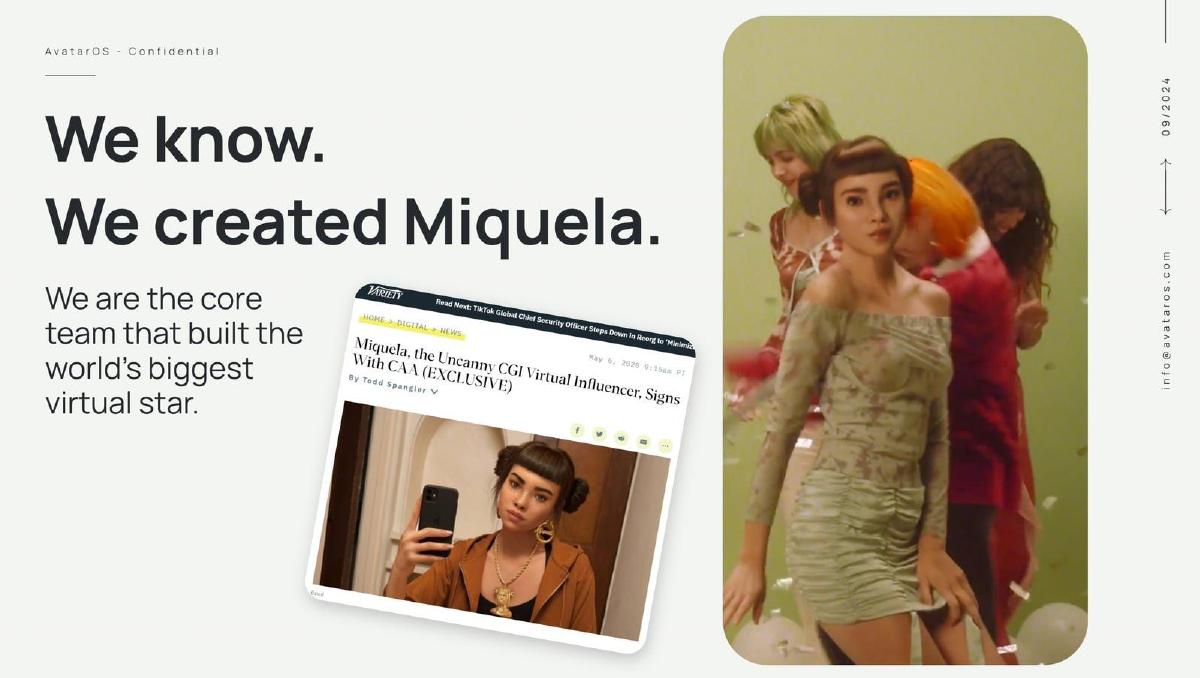
Slide 2 features a single name: Lil Miquela . For those in the social media or venture space, this is a household name—the first and most successful virtual influencer. Slide 3 follows up with the punchline: "We know. We created Miquela." It explicitly states they are the core team that built the world's biggest virtual star. This is the strongest possible 'Why Us' argument. By claiming the creation of a cultural phenomenon, the founders bypass the need to prove they understand the market; they created the market.
Slide 4: The Problem (Cost of Animation)
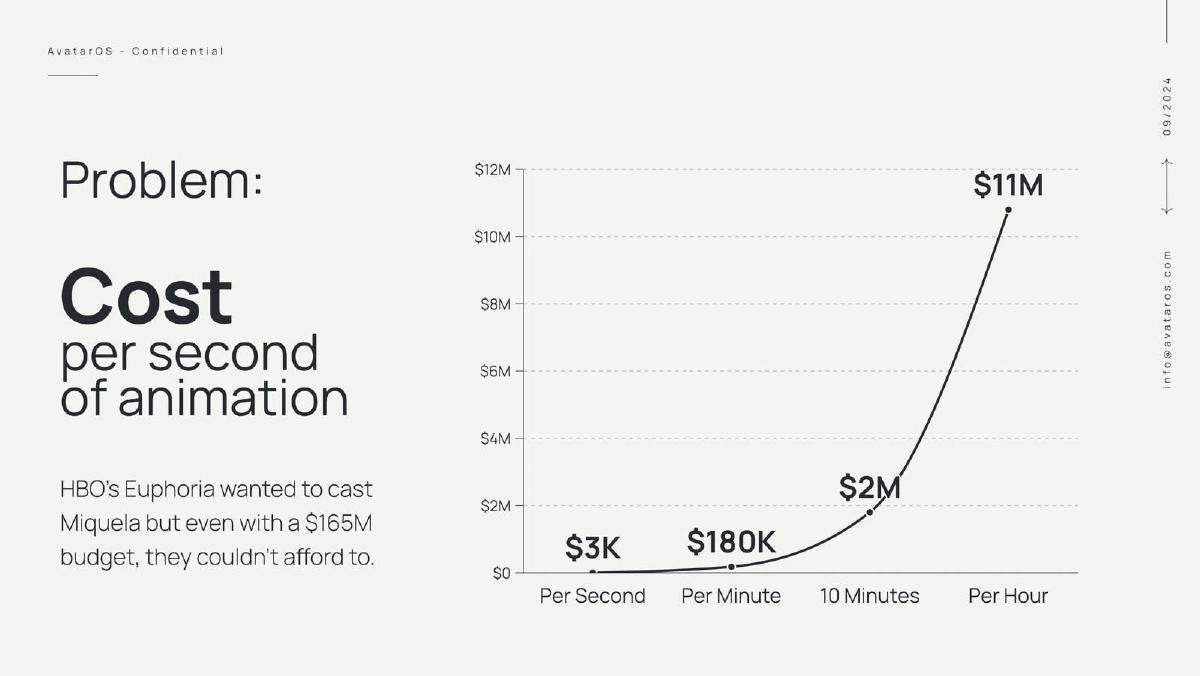
Slide 4 addresses the primary bottleneck in the virtual influencer industry: the cost of animation. Traditional CGI is prohibitively expensive and slow, requiring massive teams of animators. While the slide text provided is brief, it sets the stage for the technological solution that follows. The implication is that while Lil Miquela was a success, the manual labor required to maintain her was a scaling nightmare.
Slide 5: The Technical Moat
The solution is presented on Slide 5: Proprietary 4D/ML Training . The slide promises "The best avatar generation technology in the world" and "Dynamic animation at the cost of inference." This is a critical distinction. By moving from manual animation to ML-driven inference, AvatarOS is pitching a software-scale business rather than a creative agency. The slide shows a human face with tracking markers, illustrating how they train their models from real human performances to ensure authenticity.
Slide 6 & 7: The Product and Integration
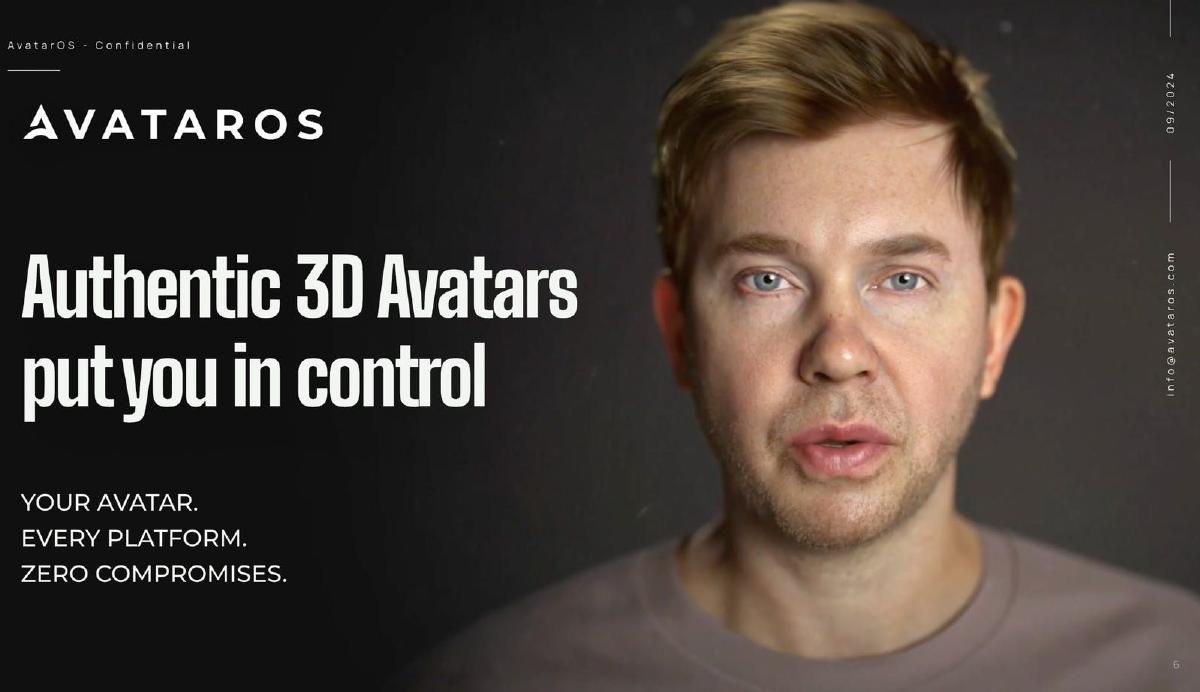
Slide 6 features a virtual avatar of the founder, a "dogfooding" move that proves the tech works on real people, not just stylized characters. Slide 7 dives into the Interactive 3D Avatars . It provides a technical flowchart: API request > Audio to Text > LLM response > Text to Voice > Audio to Animation . Crucially, it mentions a live demo streaming in-browser using ChatGPT and ElevenLabs . This shows that AvatarOS isn't trying to build the entire AI stack; they are building the specialized 'Avatar OS' layer that sits on top of existing LLMs and voice models.
Slide 8: Use Case Mapping
Slide 8 outlines where this technology will live. The mapping includes virtual influencers, social media, gaming, and immersive experiences. By showing the avatar's ability to output to Game/Edge Clients or Pixel stream video , they demonstrate flexibility across different hardware and platforms, from mobile phones to high-end VR headsets.
Slide 9: The Market Opportunity
Slide 9 presents the macro case. Citing Emergen Research, it describes an "$18B market that is expected to reach $527.58 Billion by 2030." The use of a specific figure ($527.58B) adds an air of precision to the projection. This slide is designed to show that even a small slice of this market represents a multi-billion dollar opportunity, justifying a $7M Seed round.
Slide 10 & 11: The Close
Slide 10 lists the investors who participated in the round, though the specific names are not detailed in the text provided. Slide 11 is a simple closing slide with the URL and contact information. Notably, the deck ends without a specific 'Ask' slide or a detailed breakdown of the $7M allocation, which is common for high-pedigree founders who may be negotiating terms in real-time rather than presenting a fixed offer.
What AvatarOS Does Well
The deck’s greatest strength is its brevity and focus . It doesn't waste time explaining what a virtual influencer is; it assumes the investor knows and then immediately claims ownership of the most successful example in history. This creates an immediate sense of FOMO (Fear Of Missing Out). If the team that built the first generation of virtual stars is building the 'Operating System' for the next generation, investors will want in.
Furthermore, the technical specificity on Slide 7 is excellent. By showing exactly how they integrate with ChatGPT and ElevenLabs, they clarify their position in the AI ecosystem. They aren't a general AI company; they are the 'last mile' of digital human interaction. This makes the business model feel much more tangible and less like a research project.
What is Missing from the Deck
The most glaring omission is Unit Economics and Revenue Strategy . While the deck mentions "animation at the cost of inference," it doesn't explain how they plan to charge for it. Is it a SaaS model? A per-minute streaming fee? A licensing model for gaming studios? Without this, the deck relies entirely on the 'build it and they will come' philosophy.
Additionally, there is no competitive analysis . Companies like Synthesia, HeyGen, and Soul Machines are all operating in the digital human space. AvatarOS ignores them entirely, perhaps betting that their 4D/ML approach and Miquela-pedigree are enough to differentiate them. However, a sophisticated investor would likely ask how their real-time inference compares to the latency and quality of these established players.
Lessons for Founders
Lead with your 'Unfair Advantage': If you have built a category-defining product before, that should be your second slide. AvatarOS uses the Miquela connection to establish instant authority. · Show, Don't Just Tell: Using the founder's own avatar (Slide 6) and a live demo flowchart (Slide 7) proves the technology is functional, not just theoretical. · Define Your Layer in the Stack: In the crowded AI market, you must explain where you sit. AvatarOS clearly defines itself as the animation/rendering layer that connects LLMs to the end-user. · Keep it Visual: For a product that is inherently visual (digital humans), the deck must be beautiful. AvatarOS uses high-fidelity imagery and clean layouts to reinforce their brand promise of 'Real. Digital. Humans.' · Market Projections Matter: When raising a Seed round for a new category, use reputable third-party data (like Emergen Research) to validate the scale of the opportunity. It moves the conversation from 'Is this a good idea?' to 'How big can this get?'
Frequently asked questions
- What is the primary technical advantage claimed by AvatarOS?
- AvatarOS claims a proprietary 4D/ML training pipeline. According to Slide 5, this allows them to authentically train avatars from real human performances, enabling 'perfectly on-brand real-time inference.' This is positioned as a way to achieve dynamic animation at a significantly lower cost than traditional CGI methods.
- How does AvatarOS handle the 'interactive' part of their avatars?
- Slide 7 outlines a technical flow: API request > Audio to Text > LLM response > Text to Voice > Audio to Animation. The deck notes a live demo integration with ChatGPT for the logic and ElevenLabs for the voice, outputting to either a Game/Edge client or a pixel stream video.
- Who is the intended customer for this technology?
- While the deck is light on a specific B2B vs. B2C breakdown, Slide 8 maps out use cases including virtual influencers, social media, gaming, and immersive experiences. The publisher-reported summary confirms these sectors as the primary targets for their AI-powered digital humans.
- Is there any mention of revenue or traction in the deck?
- No. The 11-slide deck focuses entirely on the team's past success with Lil Miquela, the technical architecture of the new platform, and the total addressable market. It functions as a 'vision and team' deck rather than a 'traction and growth' deck.
- What market data does the company use to justify the $7M raise?
- On Slide 9, AvatarOS cites Emergen Research, stating the Digital Human Avatar Market is currently $18B and is expected to reach $527.58 Billion by 2030. This massive projected CAGR is used to justify the scalability of their automated animation technology.