Lord of the Trees is an Australian-based startup utilizing aviation-grade carbon fiber drones to automate reforestation. Their pre-seed deck outlines a massive ambition: capturing 2% of the global tree-planting market to generate $1.5 billion in annual revenue. The technology centers on 'Seedpods'—organic capsules that mimic bird droppings to protect seeds from predators and extreme weather. While the deck is heavy on environmental statistics and high-level goals, it lacks traditional venture capital components such as a specific funding ask, detailed use of funds, or a competitive landscape…
Key takeaways
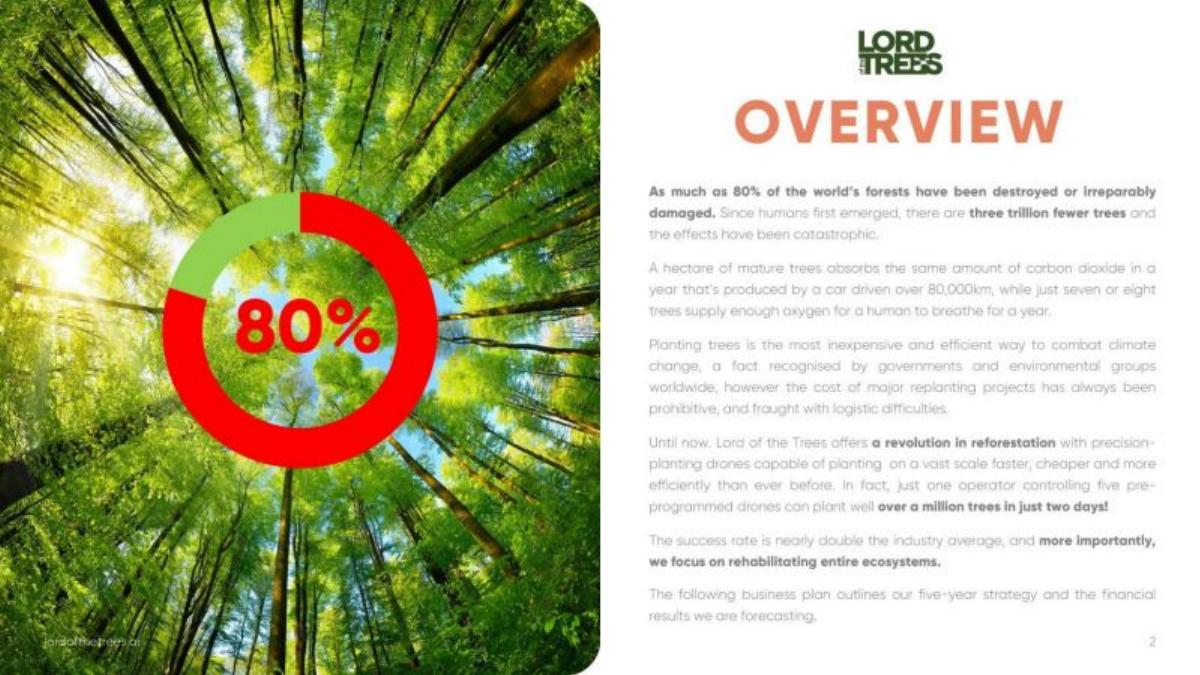
- The company claims a single operator controlling five drones can plant over one million trees in just two days (Slide 2).
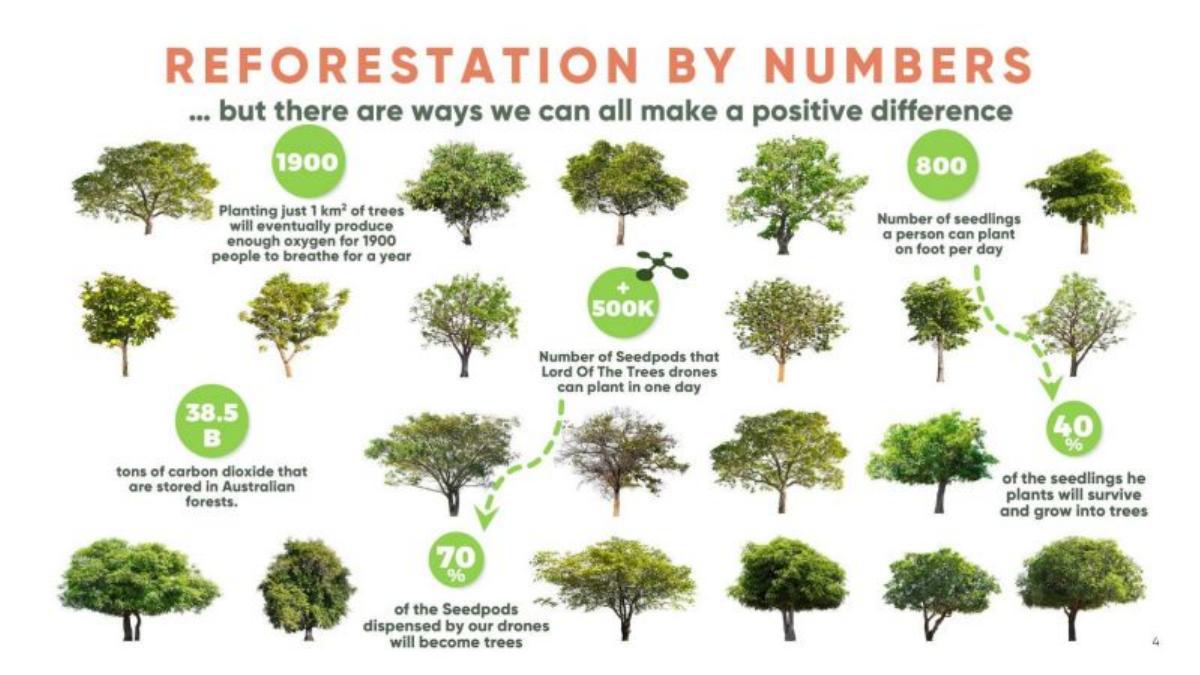
- Lord of the Trees targets a 70% survival rate for their drone-planted seedpods, compared to a 40% survival rate for manual planting (Slide 10).
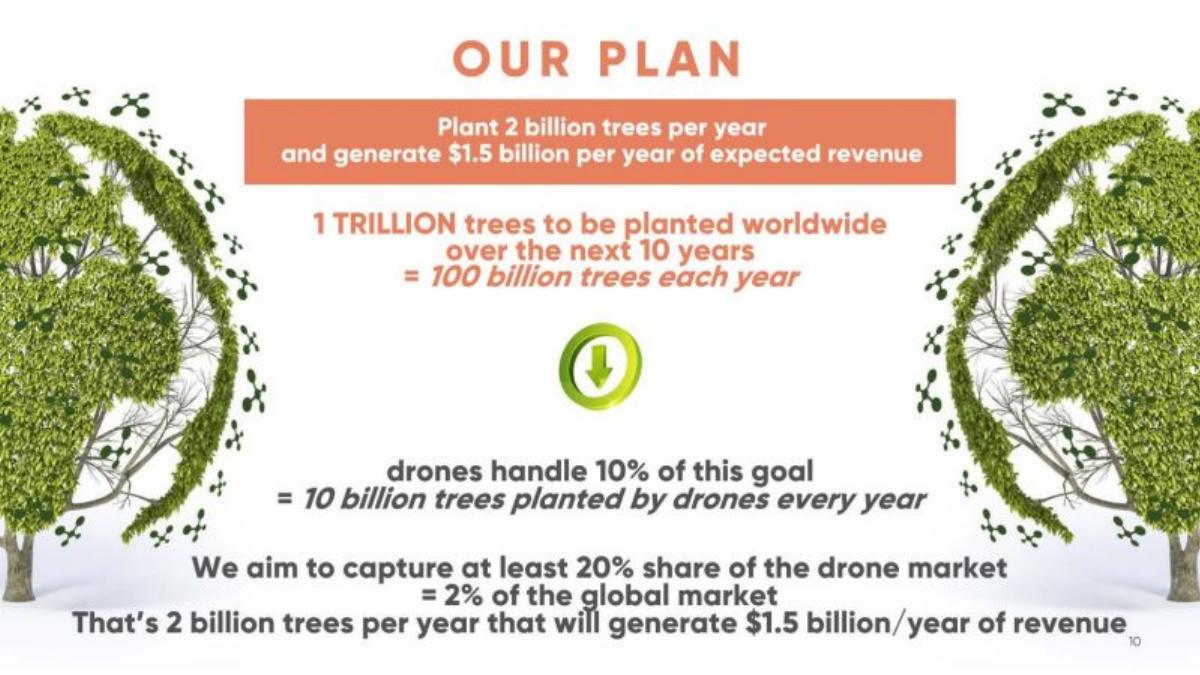
- The business model aims for $1.5 billion in annual revenue by planting 2 billion trees per year (Slide 5).
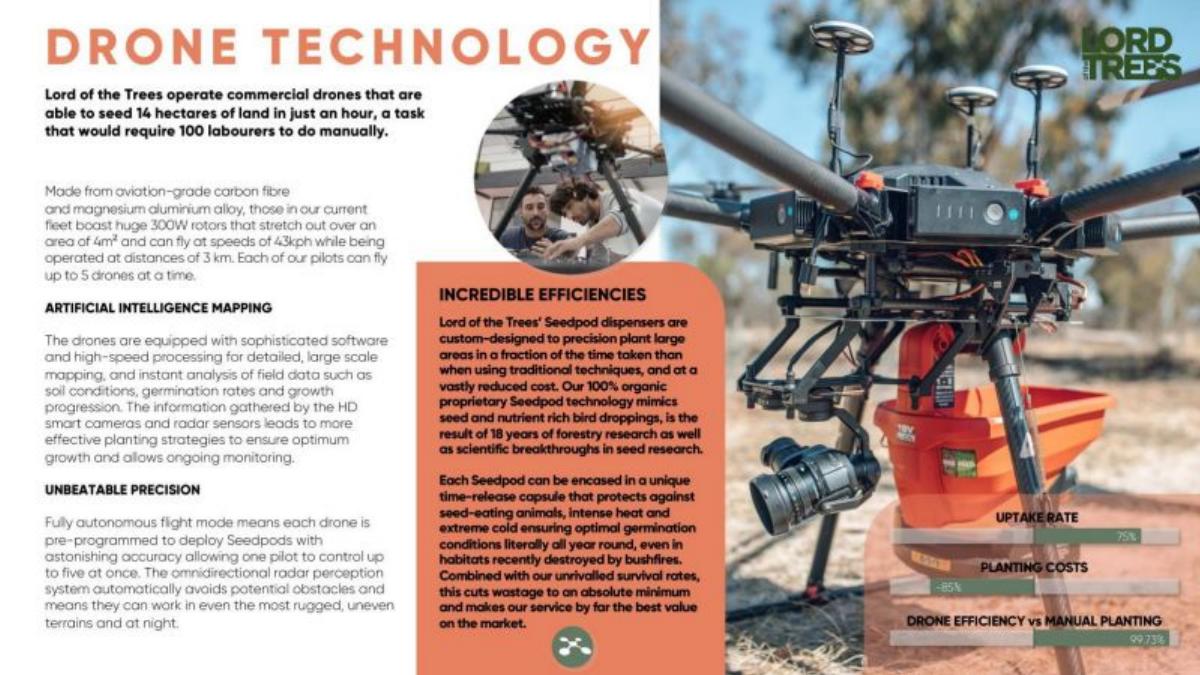
- Drones are capable of seeding 14 hectares in one hour, a task the deck states would require 100 manual laborers (Slide 6).
- The proprietary Seedpod technology is the result of 18 years of forestry research and scientific breakthroughs in seed protection (Slide 6).
- The management team includes a mix of environmental experts, a former Disney/MTV executive, and a Carbon Credits Advisor (Slide 9).
- The effective cost per tree is stated as $1.00 for drones versus $2.93 for manual planting (Slide 10).
- The deck omits a specific 'Ask' slide, leaving the intended use of the $125M pre-seed round mentioned in the catalogue unspecified (Slide 12).
The Vision: Scaling Nature with Robotics
Lord of the Trees enters the market with a pitch deck that is as much a manifesto for environmental restoration as it is a business plan. The deck, dated 2022, focuses on the massive discrepancy between the rate of global deforestation and the current capacity for manual replanting. By positioning their drone technology as the only viable way to reach the global goal of planting one trillion trees, they attempt to turn a philanthropic endeavor into a high-margin industrial service.
Slide 1: Title and Branding
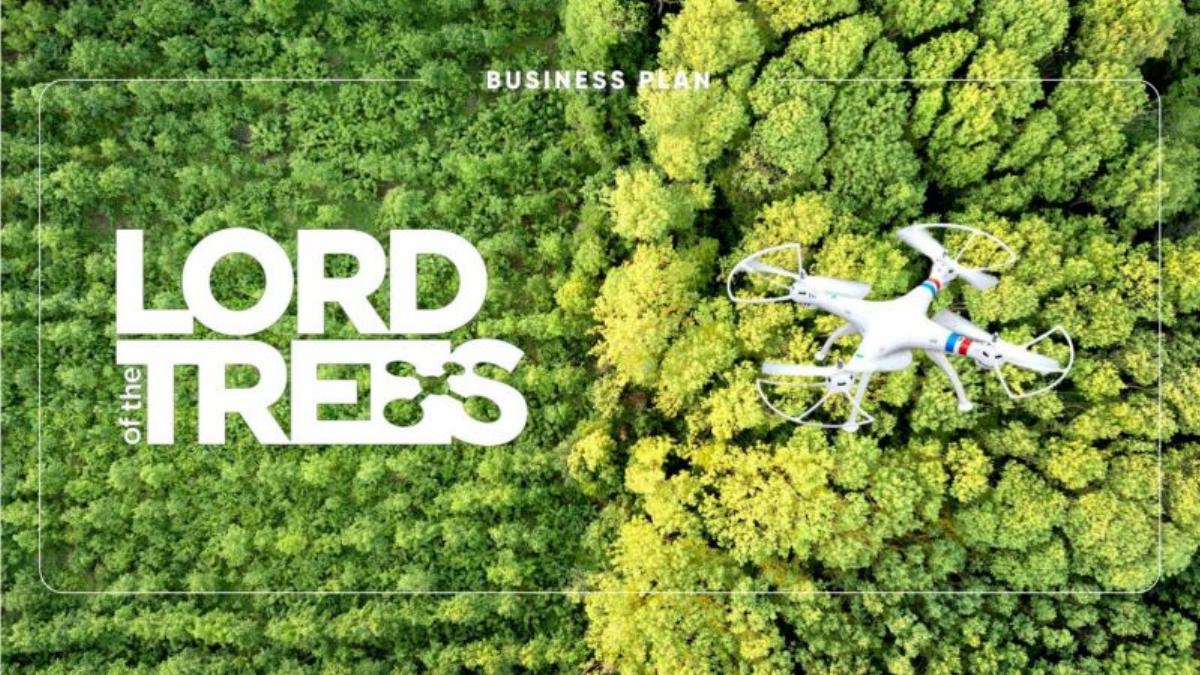
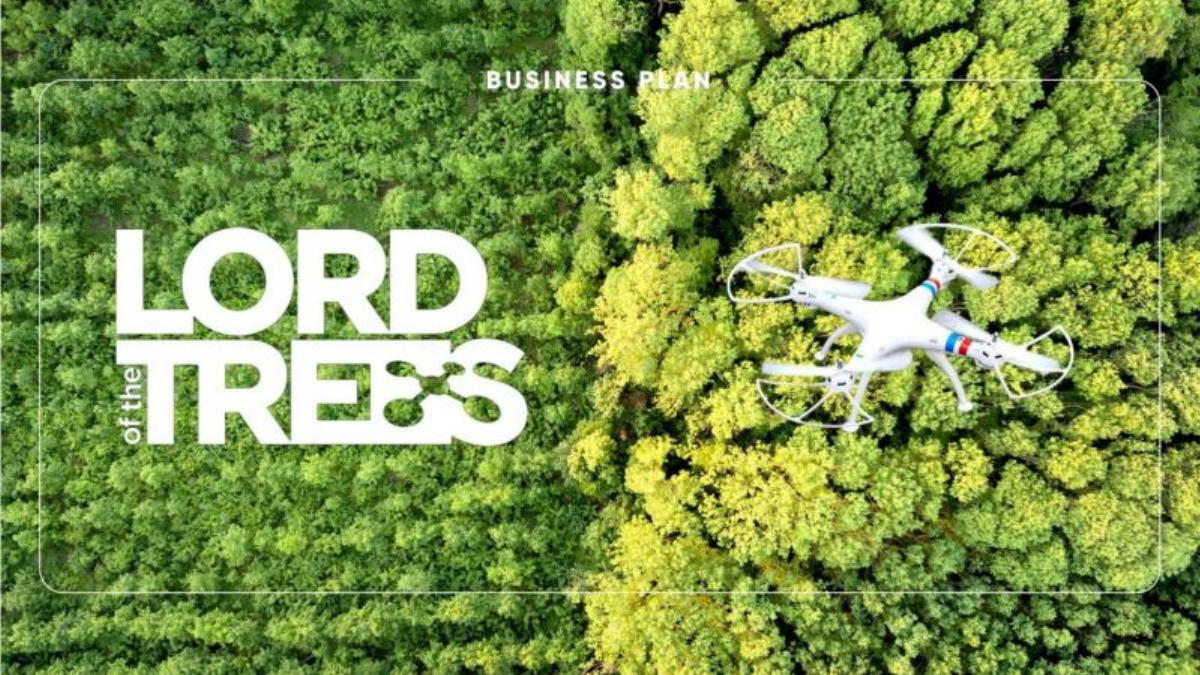
The cover slide features a top-down aerial view of a dense forest with a white quadcopter drone in mid-flight. The branding is bold, with the 'Lord of the Trees' logo integrating a drone icon into the letter 'E'. The subtitle 'BUSINESS PLAN' suggests this document is intended to serve as a comprehensive overview of their operational strategy rather than just a quick teaser.
Slide 2: The Macro Overview
Slide 2 establishes the 'Problem' through a stark statistic: 80% of the world's forests have been destroyed or damaged. It introduces the core value proposition: precision-planting drones that are faster and cheaper than manual methods. The most significant claim on this slide is that 'just one operator controlling five pre-programmed drones can plant well over a million trees in just two days.' This sets the stage for the massive scale discussed later in the deck.
Slide 3: Deforestation by Numbers
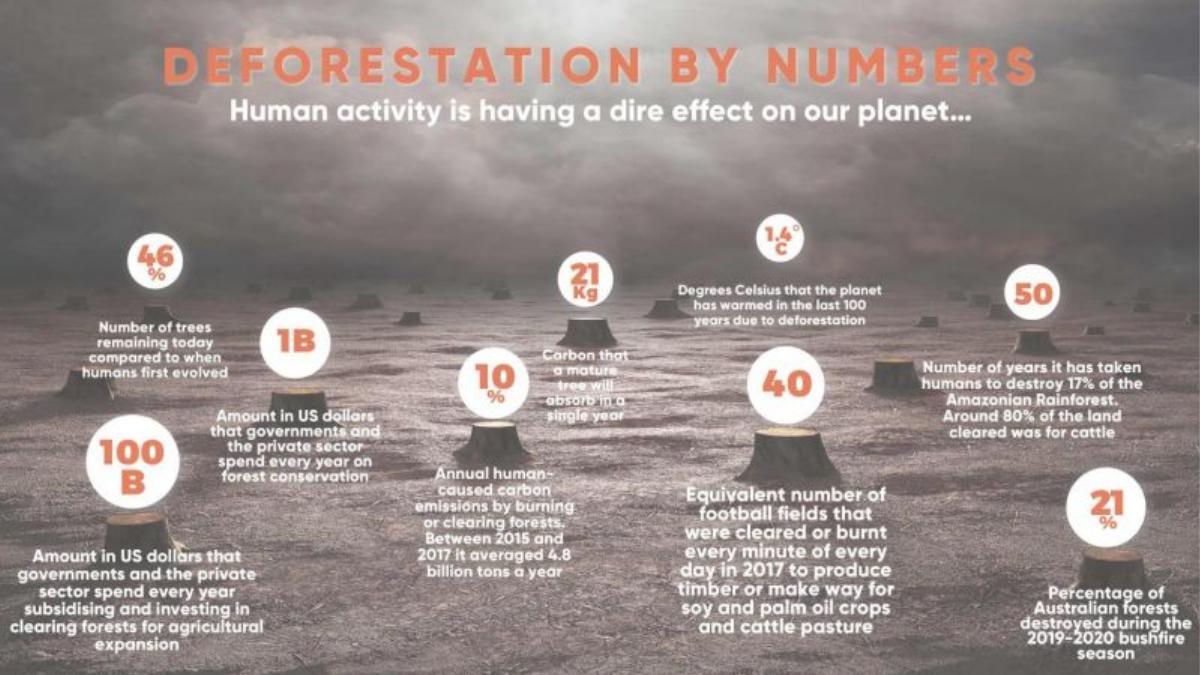
This slide uses a 'graveyard' of tree stumps as a background to present various environmental data points. Key figures include: $100 billion spent annually by governments and the private sector to clear forests for agriculture, compared to only $1 billion spent on conservation. It also notes that 40 football fields are cleared or burnt every minute. This slide serves to validate the market demand for a solution that can counteract such rapid destruction.
Slide 4: Reforestation by Numbers
Contrasting the previous slide, Slide 4 focuses on the 'Solution' metrics. It highlights that while a person can plant 800 seedlings on foot per day with a 40% survival rate, Lord of the Trees drones can plant 500,000+ seedpods in one day with a 70% survival rate . This 30% increase in survival rate is a critical differentiator, as it suggests the technology isn't just faster, but biologically superior.
Slide 5: The Financial Plan
Slide 5 contains the most ambitious financial projections in the deck. The company aims to plant 2 billion trees per year , which they forecast will generate $1.5 billion per year in revenue . They calculate this by targeting a 20% share of the drone-planting market, which they estimate will handle 10% of the global goal to plant 100 billion trees annually over the next decade.
Slide 6: Drone Technology Specifications
This slide dives into the hardware. The drones are made from aviation-grade carbon fiber and magnesium aluminum alloy , featuring 300W rotors and a flight speed of 43kph. The slide also mentions 'Artificial Intelligence Mapping,' which uses HD cameras and radar sensors to analyze soil conditions and germination rates. A small chart in the corner claims an 85% reduction in planting costs and a 99.73% efficiency rating compared to manual planting.
Slide 7: Environmental Impact and B-Corp Status
Lord of the Trees emphasizes their 'regenerative mission,' noting they consult with indigenous communities and forestry experts. A significant detail here is the 'B Corporation Pending' logo, signaling an intent to meet high standards of social and environmental performance. This is a common tactic for ESG-focused startups to build trust with institutional investors.
Slide 8: Market Segmentation
The company identifies three initial targets for their services: Environmental Legacy (governments), Transforming Agriculture (large-scale crop planting), and Restoring Ecosystems (mining land degradation). The slide mentions they are currently supporting projects in Australia and Sumatra to generate 'startup cash flows,' though it does not provide specific revenue figures for these existing projects.
Slide 9: Management Team
The team slide is robust, featuring six members with diverse backgrounds. Founder Aymeric Maudous is highlighted for his history in the sustainable arena and his participation in Al Gore’s Climate Reality Leadership Course. The inclusion of Monica Dodi (co-founder of MTV) and Raphael Wood (President of the Australian Carbon Standards Association) adds significant weight to the team's ability to navigate both global media and complex carbon markets. Logos from Disney, AOL, and Harvard are used to bolster the team's pedigree.
Slide 10: The Comparative Study
This is the most data-dense slide in the deck, providing a side-by-side cost analysis. It breaks down the 'Effective cost/tree' as $2.93 for manual planting versus $1.00 for drone planting . It also details the logistics: 2 seedpods shot per second, 7,200 seeds per hour, and the ability for 4 drones to plant 1,267,200 seeds in two days. This slide is the 'closer' for the economic argument of the business.
Slide 11: Conclusion
The conclusion slide reiterates the mission to restore ecosystems and the 'tremendous scaling potential' of the technology. It positions the company as uniquely placed to serve mining, agriculture, and government agencies. It is a standard summary slide intended to leave the reader with a sense of the company's purpose.
Slide 12: The Final Call to Action
The deck ends with a 'Thank You' and the phrase 'Invest in Us.' Notably, there is no 'Ask' slide . The deck does not specify how much capital is being raised in this specific presentation, what the valuation is, or how the funds will be allocated across R&D, fleet expansion, or marketing. According to the catalogue listing, the amount raised was $125M, but that figure is absent from the slides themselves.
What Lord of the Trees Does Well
The deck excels at quantifying the 'Biological ROI.' By focusing on the survival rate of the trees (70% vs 40%) and the effective cost per tree ($1.00 vs $2.93), they move the conversation away from 'drones are cool' to 'drones are a financial necessity for large-scale landholders.' The visual design is professional, using high-quality nature photography to maintain an emotional connection to the mission while the text handles the hard data.
What is Missing from the Deck
Despite the high-level metrics, the deck is missing several components essential for a $125M pre-seed round. First, there is no Competitive Landscape . Several other startups (such as Flash Forest or Dendra Systems) operate in this space, and failing to mention them leaves a gap in the strategic analysis. Second, the Roadmap is vague; there are no dates for when the 2-billion-tree-per-year goal will be reached. Finally, the lack of a specific Use of Funds slide is a glaring omission for a fundraising document, as it fails to explain what the $125M will actually build.
Founder Takeaways: What to Copy
Quantify the Alternative: The side-by-side comparison on Slide 10 is a masterclass in justifying a new technology by showing the inefficiency of the status quo. · Leverage Advisor Pedigree: Including a Carbon Credits Advisor and a Lawyer on the management slide (Slide 9) shows that the founders understand the regulatory and financial hurdles of their specific industry. · Focus on Survival, Not Just Output: In reforestation, planting a tree is easy; keeping it alive is hard. By highlighting their 70% survival rate, Lord of the Trees addresses the biggest skepticism in their market. · Clear Market Segmentation: Slide 8 clearly defines who pays the bills (governments, mines, and big ag), which helps investors understand the sales cycle.
Frequently asked questions
- What is the core technology behind Lord of the Trees?
- The company uses autonomous drones made from aviation-grade carbon fiber and magnesium aluminum alloy. These drones deploy proprietary 'Seedpods'—organic, time-release capsules that protect seeds from animals and weather. The system includes AI mapping software that analyzes soil conditions and germination rates to ensure optimum growth strategies.
- How does the company plan to generate revenue?
- According to slide 5, the company aims to plant 2 billion trees per year, which they expect to generate $1.5 billion in annual revenue. They target three main segments: government environmental legacies, agricultural transformation, and ecosystem restoration for mining companies.
- What is the stated efficiency advantage over manual labor?
- Slide 6 claims their drones can seed 14 hectares per hour, replacing 100 manual laborers. Slide 10 further quantifies this, showing a 75% performance increase over manual methods and a reduction in effective cost per tree from $2.93 to $1.00.
- Who are the key members of the management team?
- The team is led by Founder/CEO Aymeric Maudous, who has a background in sustainable marketing. Other key members include Co-Founder Monica Dodi (ex-MTV, Warner Bros), Carbon Credits Advisor Raphael Wood, and Mahmood Hussein, the founder of Global Drone Solutions.
- What critical information is missing from this pitch deck?
- The deck lacks a clear financial breakdown of the $125M raise, a roadmap of past milestones, a competitive analysis of other drone-planting startups, and a specific 'Ask' slide detailing what the investors' capital will specifically fund.