Long Journey Ventures (formerly LJ Ventures) presents a compelling case for an early-stage fund by leaning heavily into the individual track records of its partners. Rather than focusing on complex fund modeling, the deck prioritizes 'Value Add' case studies for companies like Loom, Pipefy, and Compound. By showcasing co-investments with top-tier firms like Founders Fund and Sequoia, the team positions themselves as high-signal 'first checks' that help founders navigate subsequent rounds. The deck is notably transparent about its terms, citing a $30M target fund size and a standard 2/20 fee s…
Key takeaways
- The fund highlights a high-signal angel track record including Uber, SpaceX, Notion, and Fitbit on slide 3.
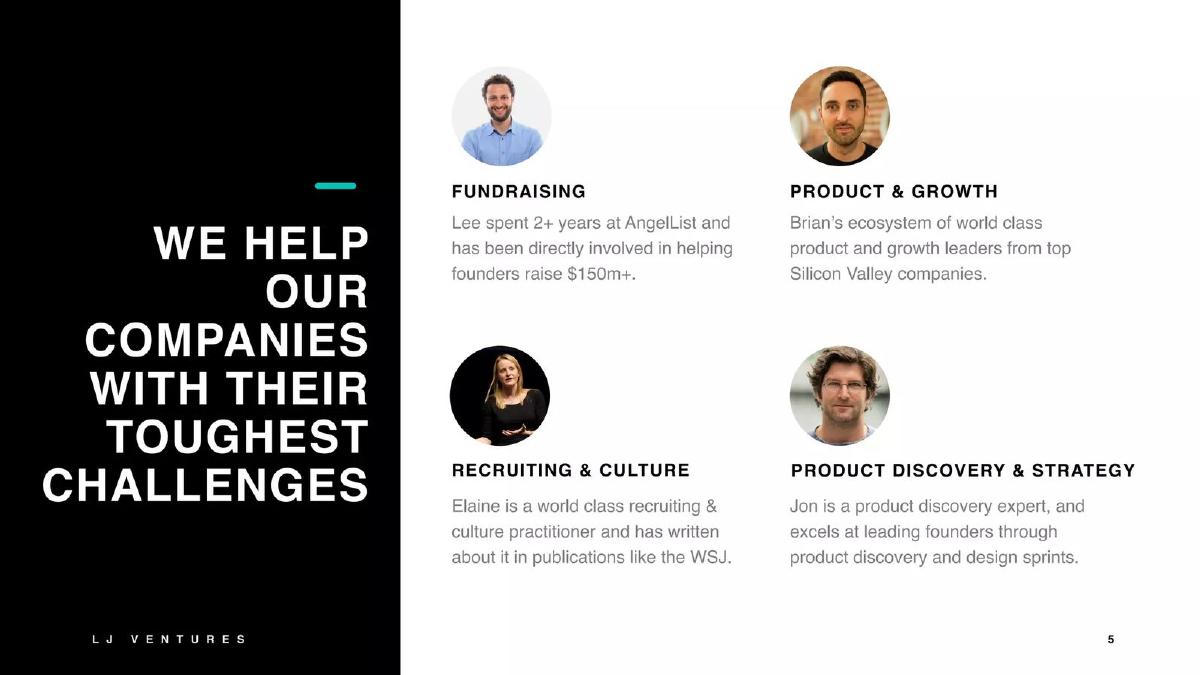
- Operational support is categorized into four distinct pillars: Fundraising, Product & Growth, Recruiting & Culture, and Product Discovery on slide 5.
- Detailed case studies for Loom (slide 7) and Pipefy (slide 9) demonstrate the team's ability to help companies scale from Seed to Series B.
- The deck emphasizes 'signal' by listing 6 co-investments with Founders Fund and 5 with Andreessen Horowitz on slide 13.
- A portfolio update on slide 19 shows significant markups, including Notion at 156x and Compound at 25x.
- The fund's target size is explicitly stated as $30M with a 10-year life and 20% carry on slide 21.
- Investment diversification is shown on slide 25, with B2B SaaS making up the largest share at 33.0%.
- The team leverages previous exits, such as Meebo's $100M acquisition by Google and Pocket's acquisition by Mozilla, to establish credibility on slide 3.
Introduction: The Power of the Operator-Investor
Long Journey Ventures (presented here as LJ Ventures) uses its pitch deck to bridge the gap between individual angel success and institutional fund management. For emerging managers, the challenge is often proving that a collection of successful personal bets can be systematized into a repeatable investment vehicle. This deck accomplishes that by focusing on two things: Access and Assistance .
Slide 1: Title Slide
The deck opens with a minimalist black background featuring the Long Journey logo. The subtitle 'EARLY STAGE VENTURE FUND' immediately establishes the asset class. It is clean, professional, and avoids the clutter often seen in first-time fund decks.
Slide 3: Experienced Builders and Investors
This is the 'Why Us' slide. It is arguably the most important slide in the deck because, in venture capital, the product is the people. The slide lists the core team: Lee Jacobs, Cyan Banister, Brian Balfour, Pascal Levy-Garboua, Jon Bruck, and Elaine Wherry. What makes this slide effective is the combination of logos and titles . They list heavy-hitting companies like Fitbit, Uber, SpaceX, and Notion as part of their 'World Class angel track record.' By including logos of companies like Postmates and Blue Bottle Coffee, they immediately signal to the LP that they have the 'eye' for winners and the network to get into competitive rounds.
Slide 5: We Help Our Companies With Their Toughest Challenges
Many funds claim to be 'founder-friendly' or 'value-add.' Long Journey defines exactly what that means. They break their support into four pillars: Fundraising (led by Lee Jacobs, citing $150m+ raised for founders), Product & Growth (leveraging Brian Balfour’s Reforge ecosystem), Recruiting & Culture (led by Elaine Wherry), and Product Discovery (led by Jon Bruck). This specificity is a major strength; it tells an LP exactly which partner a founder will call when they have a specific problem.
Slide 7 & 9: Value Add Case Studies (Loom and Pipefy)
These slides move from theory to practice. On slide 7, they track the journey of Loom from Seed+ to Series B-2. They don't just say they were there; they explain their role: helping vet the first growth hire and strategizing the Series A. They also highlight their ability to maintain pro-rata alongside firms like Sequoia and Kleiner Perkins. Slide 9 follows a similar format for Pipefy, emphasizing their role as a 'hyper connector' and helping the company reach a $45M Series B led by Insight Partners. These slides prove the team can navigate the 'Long Journey' of a startup's lifecycle.
Slide 11: Value Add: Fundraising (Compound)
This slide focuses on the 'white paper stage' investment in Compound. It highlights their ability to lead or be the 'First Fund to Commit.' This is a critical signal for LPs who want to know if the fund is a leader or a follower. By showing they introduced the CEO to Bain and helped design the pitch that led to an a16z-led Series A, they position themselves as the catalyst for a company's institutional success.
Slide 13: Co-investors
In venture capital, you are judged by the company you keep. Slide 13 lists their co-investors with frequency counts: Founders Fund (x6), Andreessen Horowitz (x5), Bain Capital (x4), and Sequoia (x3). This data point is intended to prove that the team has 'deal flow parity' with the best firms in the world. If these top-tier firms are consistently in the same deals as Long Journey, it validates the team's selection criteria.
Slide 15: Portfolio Continuity
This table provides a snapshot of five key companies: Blue Bottle Coffee, Pipefy, Loom, Kettle & Fire, and Modern Animal. It tracks them from the initial round (mostly Seed) to their last funding round or exit (e.g., Blue Bottle's exit to Nestle). This slide is about persistence —showing that their 'winners' continue to grow and attract capital from firms like True Ventures and Cavu.
Slide 17 & 19: Momentum and Updates
Slide 17 acts as a divider for an 'OCT 2020 UPDATE.' Slide 19 then delivers the 'meat' of the recent performance. It lists massive markups: Notion at 156x from seed, Opendoor's $4.4B SPAC, and Postmates' $2.65B sale to Uber. For an LP, these numbers are the ultimate validation. The footnote regarding the Compound position being held in an SPV (Special Purpose Vehicle) adds a layer of necessary financial transparency.
Slide 21: Summary of Terms
This slide is purely functional but essential. It lists the Target Fund Size of $30M . It also outlines the standard 10-year life, 5-year investment period, 2% management fee, and 20% carry. By the time an investor reaches this slide, the 'Why' has been answered, and this provides the 'How.'
Slide 25: Sector Diversification
The final slide in the provided set is an appendix item showing investments by sector from 2016-2019. While they are heavily weighted toward B2B SaaS (33%), the pie chart shows a healthy spread across Healthcare (11%), CPG (11%), AI (9%), and Education (9%). This suggests that while they have a core competency in software, their 'Value Add' is applicable to a broad range of industries.
What Long Journey Does Well
Social Proof: The deck is saturated with testimonials and logos of top-tier co-investors. This reduces the perceived risk for an LP. · Specific Value Proposition: Instead of saying 'we help founders,' they list specific domains (Recruiting, Growth, Fundraising) and the specific partners responsible for them. · Visualizing the Journey: The timeline format used in slides 7, 9, and 11 effectively communicates how a company evolves and where the fund intervened to add value.
What Is Missing
Detailed Fund Model: While the terms are listed, there is no slide showing the projected portfolio construction (e.g., number of investments, average check size, reserve strategy for follow-ons). · Pipeline/Sourcing: The deck shows where they have been, but it doesn't explicitly explain their 'edge' in sourcing new deals. Is it through an alumni network? A specific software tool? Or purely through the partners' reputations? · ESG/Diversity: There is no mention of the fund's stance on diversity or environmental/social governance, which is increasingly a requirement for many institutional LPs.
What Other Founders (and Managers) Should Copy
The 'Co-investor' Slide: If you are a founder or a fund manager, showing that you work with the 'best' is a shortcut to credibility. Slide 13 is a perfect example of how to display this data cleanly. · The 'Value Add' Pillars: Founders should copy the way this team categorizes their expertise. If you are pitching a startup, don't just say your team is 'experienced'; say exactly what each person is the 'expert' in. · The Momentum Slide: Slide 19 is a masterclass in showing 'up and to the right' without using a single traditional line graph. It uses logos and multiples to tell a story of success.
Frequently asked questions
- What is the primary investment strategy of Long Journey Ventures?
- Based on the deck, Long Journey Ventures focuses on early-stage investments where they can provide high-touch operational support. Slide 3 and 21 indicate they are an 'Early Stage Venture Fund' targeting the 'white paper stage' or Seed rounds. They prioritize sectors like B2B SaaS (33%), Healthcare (11%), and CPG (11%), as shown in the sector breakdown on slide 25.
- How does the team demonstrate their 'Value Add' to Limited Partners?
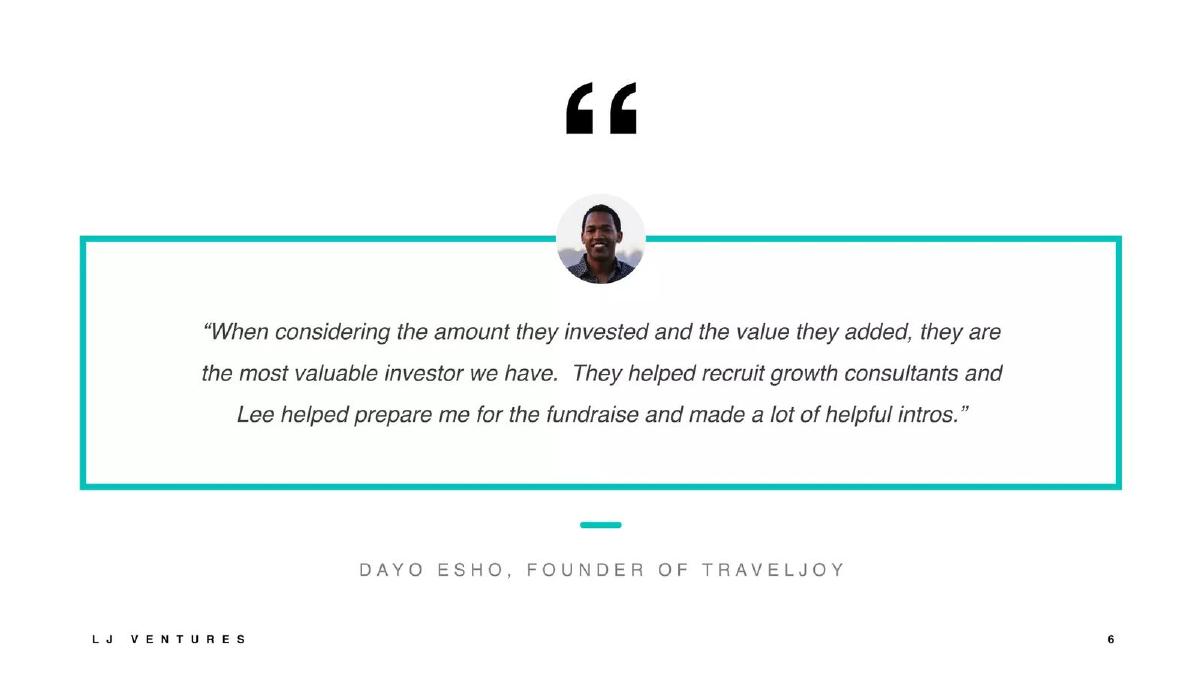
- The team uses specific case studies rather than vague promises. On slide 7, they show how they helped Loom with growth hiring and Series A strategy. On slide 9, they highlight helping Pipefy's CEO navigate the industry and recruit board members. This is backed by testimonials from the CEOs of those companies, providing social proof of their operational impact.
- Who are the key people behind the fund?
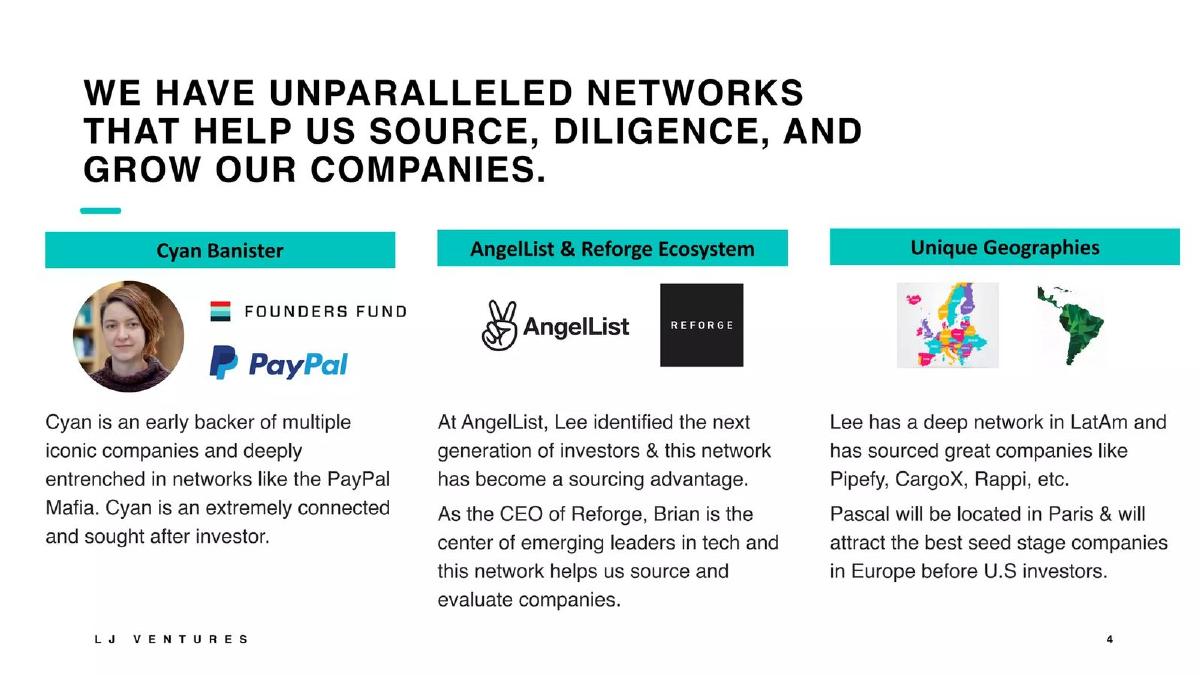
- The fund is led by Lee Jacobs (formerly of AngelList) and Cyan Banister (formerly of Founders Fund). They are supported by Venture Partners with deep operational backgrounds: Brian Balfour (Reforge/Hubspot), Pascal Levy-Garboua (Checkr), Jon Bruck (Pocket), and Elaine Wherry (Meebo). Their collective experience spans major tech successes like Uber, SpaceX, and Postmates, as detailed on slide 3.
- What are the financial terms offered to investors in this fund?
- Slide 21 outlines the 'Summary of Terms' clearly: a target fund size of $30M, a 10-year fund life with a 2-year extension option, a 5-year investment period, an average management fee of approximately 2%, and a 20% carried interest. This is a standard structure for a micro-VC or emerging manager fund.
- How successful has their previous angel portfolio been?
- Slide 19 provides a 'Momentum' update showing significant returns. Notable highlights include Postmates selling to Uber for $2.65B, Notion raising at a 156x markup from seed, and Opendoor going public at a $4.4B valuation. They also note a 25x return on their seed investment in Compound within two years, demonstrating a track record of identifying high-growth startups early.