LogRock’s Seed deck is a lean, 10-slide presentation that successfully raised $3.5M by focusing on a high-pain regulatory niche within the transportation sector. The deck identifies a specific legal threat—'nuclear verdicts'—and positions a freemium SaaS model as the solution for the underserved 'long tail' of motor carriers. While the deck lacks a specific financial 'Ask' slide and current traction metrics, it compensates with an exceptionally strong team slide featuring founders with deep domain expertise from Loadsmart. The market sizing is grounded in realistic driver counts and consultan…
Key takeaways
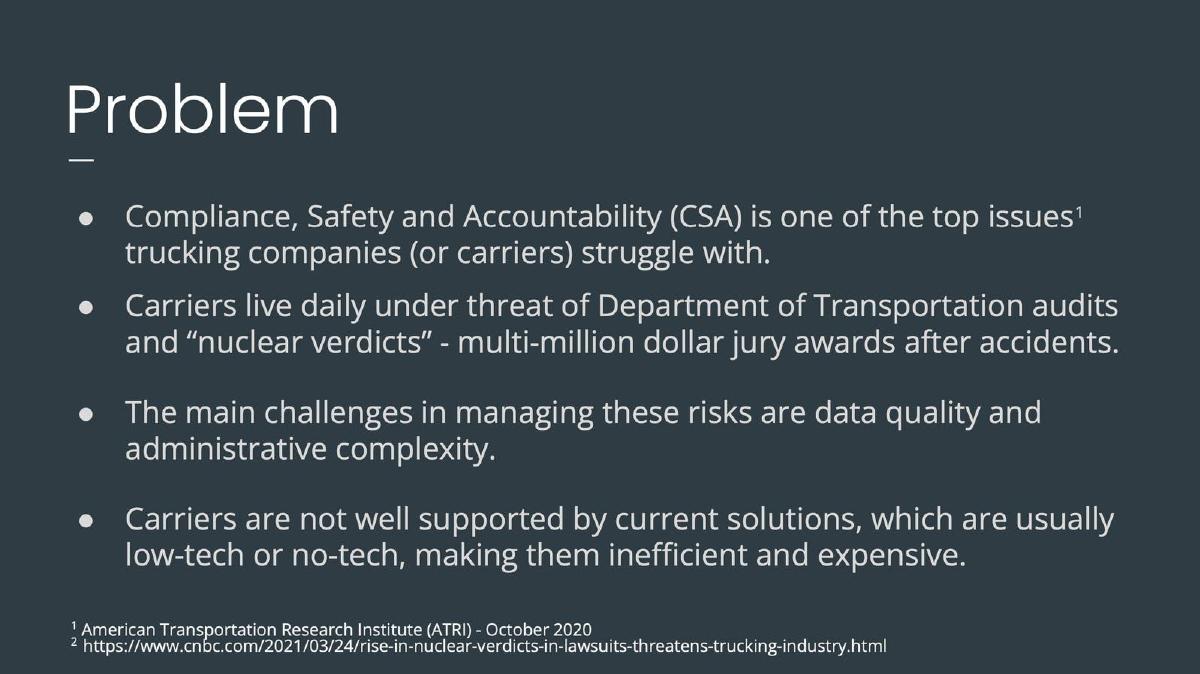
- The deck identifies 'nuclear verdicts'—multi-million dollar jury awards—as a primary emotional and financial driver for the customer (Slide 2).
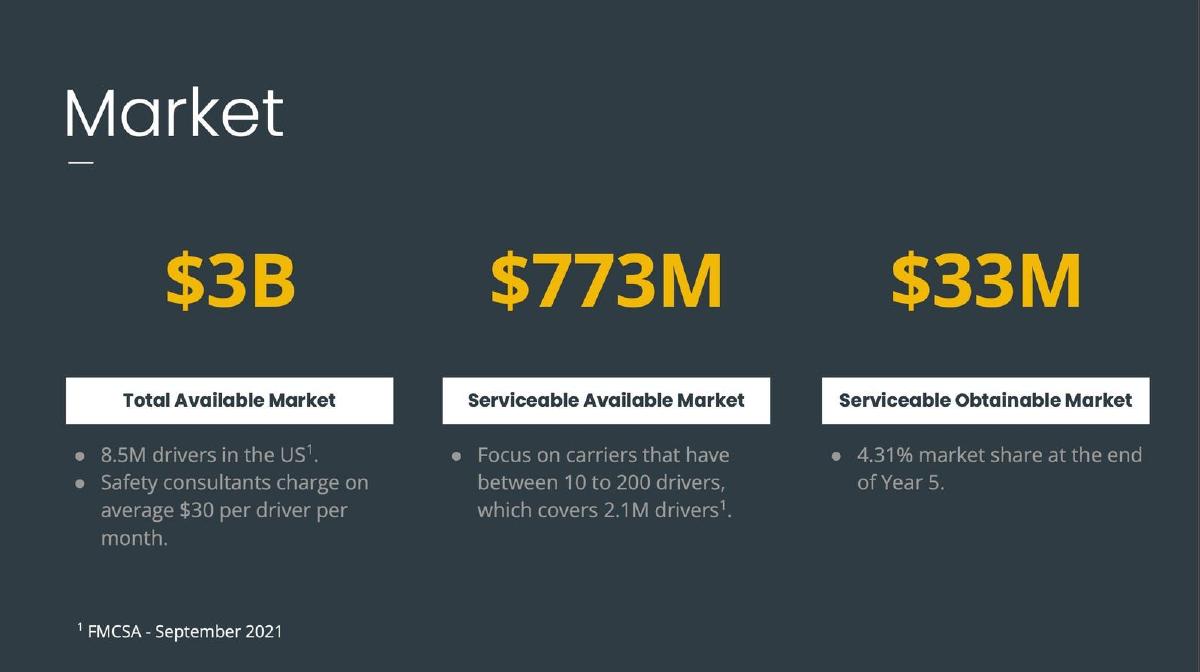
- LogRock calculates its $3B Total Available Market (TAM) based on 8.5M US drivers and a $30/month per driver consultant fee (Slide 4).
- The Serviceable Obtainable Market (SOM) is conservatively estimated at $33M, representing a 4.31% market share by Year 5 (Slide 4).
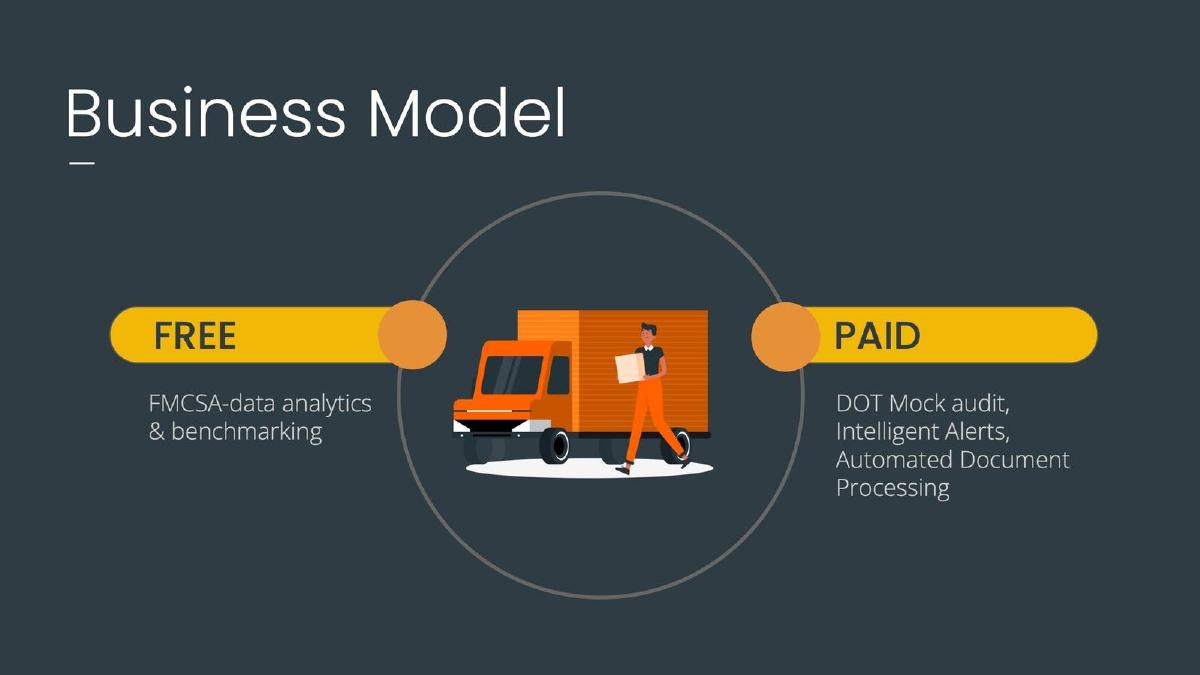
- A freemium 'hook' is used for customer acquisition, offering FMCSA data analytics for free to capture interest (Slide 6).
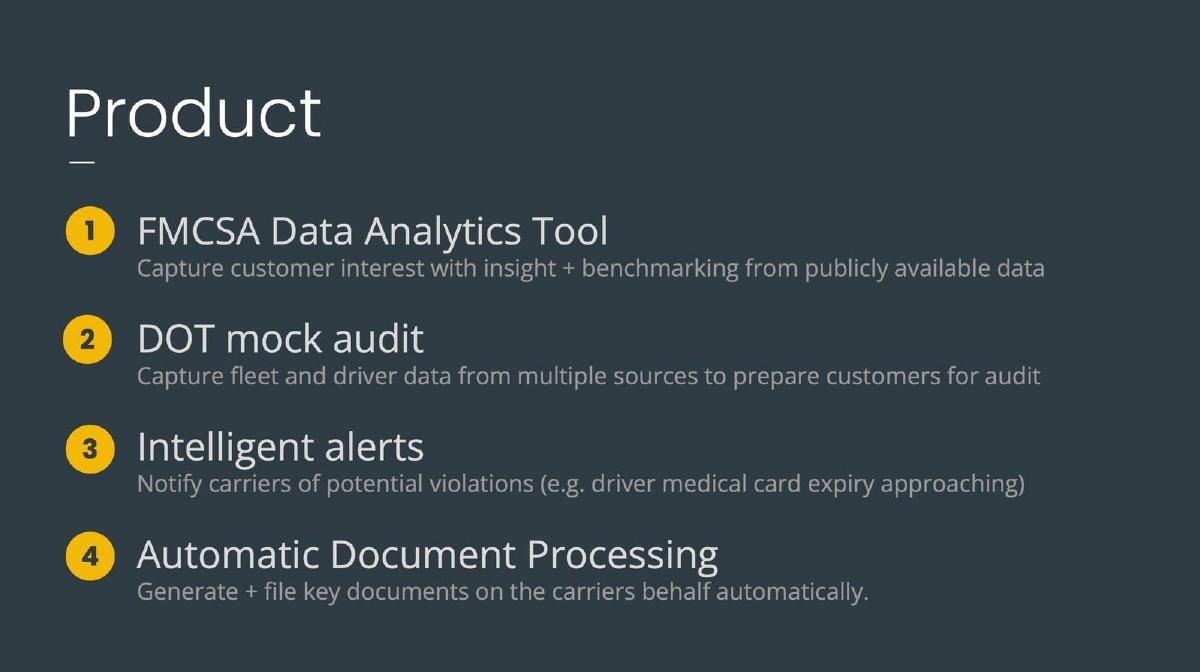
- The product roadmap focuses on automation, specifically 'Automatic Document Processing' to file key documents on behalf of carriers (Slide 5).
- Distribution strategy relies heavily on 3rd party partnerships with factoring services, ELD providers, and insurance brokers (Slide 7).
- The team slide highlights significant pedigree, noting the founders previously scaled Loadsmart from 7 to 140+ engineers (Slide 9).
- LogRock explicitly positions itself against competitors by targeting the 'long tail' of carriers with 10 to 200 drivers (Slide 4 and Slide 8).
Introduction
LogRock’s 10-slide Seed deck is a masterclass in vertical SaaS positioning. In an industry as fragmented and regulated as trucking, clarity often beats complexity. This deck, which helped secure a $3.5M Seed round in 2023 as reported by Business Insider, doesn't rely on flashy graphics or over-the-top promises of 'changing the world.' Instead, it identifies a specific, painful regulatory burden and offers a digitized path to relief. The following teardown examines how LogRock used a lean narrative to convince investors of the opportunity in motor carrier compliance.
Slide 1: Title Slide
The deck opens with a clean, professional title slide. It features the LogRock logo and a clear value proposition: "The efficient, low cost safety & compliance platform for motor carriers." The imagery of a truck at sunset is industry-appropriate without being distracting. This slide immediately establishes the target audience (motor carriers) and the two primary benefits (efficiency and low cost).
Slide 2: The Problem
Slide 2 dives straight into the pain points. It identifies Compliance, Safety, and Accountability (CSA) as a top issue for trucking companies, citing the American Transportation Research Institute (ATRI) from October 2020. Crucially, it introduces the concept of "nuclear verdicts" —multi-million dollar jury awards after accidents. By mentioning these verdicts, LogRock elevates the problem from a mere administrative annoyance to an existential financial threat. The slide also notes that current solutions are "low-tech or no-tech," creating a clear opening for a modern software solution.
Slide 3: The Solution
The solution slide is concise. It proposes to "Digitize the work of repetitive and bureaucratic safety data management tasks to minimize regulatory and litigation-related financial risk." The slide uses a simple cloud graphic and a checklist of attributes: Efficient, Low cost, Intelligent, Real time, and Peace of mind. While the graphic is somewhat generic, the text successfully links the "digitization" to the reduction of the "financial risk" mentioned in the previous slide.
Slide 4: Market Sizing
This is one of the strongest slides in the deck. LogRock breaks down the market into three clear tiers:
Total Available Market ($3B): Based on 8.5M US drivers and a $30/month per driver consultant fee. · Serviceable Available Market ($773M): Focused on carriers with 10 to 200 drivers (2.1M drivers). · Serviceable Obtainable Market ($33M): A conservative 4.31% market share at the end of Year 5.
By using a bottom-up calculation based on actual driver counts and existing consultant fees, LogRock makes the $3B TAM feel grounded and achievable rather than speculative.
Slide 5: Product Features
Slide 5 outlines four key product pillars: 1. FMCSA Data Analytics Tool: Uses public data to capture interest. 2. DOT mock audit: Prepares customers for actual audits using fleet and driver data. 3. Intelligent alerts: Notifies carriers of expirations, such as driver medical cards. 4. Automatic Document Processing: The most advanced feature, which generates and files documents automatically. This progression shows a clear path from simple data visualization to high-value automation.
Slide 6: Business Model
LogRock employs a classic freemium SaaS model. The slide uses a simple graphic to show that the "FREE" tier includes FMCSA-data analytics and benchmarking, acting as a lead magnet. The "PAID" tier includes the more labor-intensive and high-value features like mock audits and automated document processing. This strategy addresses the high cost of customer acquisition in a fragmented market by providing immediate, free value.
Slide 7: Distribution Channels
Recognizing that selling to thousands of small carriers is difficult, Slide 7 outlines a dual distribution strategy. Direct channels include inbound marketing and inside sales. 3rd Party channels are the real highlight here, leveraging existing relationships with Factoring Services, ELD (Electronic Logging Device) Providers, and Insurance Brokers. This shows investors that the company has a scalable way to reach the "long tail" of the market without hiring an army of sales reps.
Slide 8: Competitive Advantage
This slide lists six points of differentiation. The most compelling are the first two: "No other competitor has a free tier" and "No other competitor targets the long tail of carriers." By explicitly claiming a vacant niche (the smaller carriers) and a unique pricing strategy (freemium), LogRock carves out a defensible position against legacy incumbents who likely focus on enterprise fleets.
Slide 9: Team
The team slide is arguably the most impressive part of the deck, providing the "why now" and "why them." Hunter Yaw (CEO) and João Bosco (Co-founder) both come from Loadsmart, where they scaled the team from 7 to 140+ engineers and supported enterprise sales. Pavel Botev (Special Advisor) adds deep domain expertise as the founder of Logiflex and Kamion. This combination of high-growth tech experience and specific trucking industry knowledge is a significant de-risking factor for Seed investors.
Slide 10: Conclusion
The deck ends with a simple "Thank You" slide featuring the logo and a "rock on" hand emoji. Notably, there is no "Ask" slide. There is no mention of how much money is being raised, the valuation, or the specific milestones the funding will achieve. While this information is often handled in the verbal pitch or a separate document, its absence in the deck is a missed opportunity to create a sense of urgency.
What LogRock Does Well
LogRock excels at niche identification . By focusing on the "long tail" of carriers (10-200 drivers), they avoid a direct head-to-head battle with enterprise-focused incumbents. Their market sizing is also exemplary; by basing their TAM on the $30/month currently paid to human consultants, they prove that there is already a budget for this service—they are simply offering a more efficient way to spend it. Finally, the team pedigree is top-tier for a Seed round, showing they have the technical and operational experience to scale a transportation tech company.
What is Missing from the Deck
The most glaring omission is Traction . There are no mentions of current user counts, pilot programs, or revenue. Even for a Seed round, some indication of product-market fit or early interest (e.g., "X carriers on the waitlist") would strengthen the case. Additionally, there is no Financial Ask . Investors want to know exactly how much is being raised and how that capital will be deployed (e.g., 50% engineering, 30% sales). Lastly, a Roadmap beyond the current features would help illustrate the long-term vision—does LogRock eventually want to become an insurance provider or a broader TMS (Transportation Management System)?
Founder Takeaways
Founders should copy LogRock’s bottom-up market sizing . Avoid using generic $100B industry reports; instead, calculate your market based on your specific price point and the number of potential customers. Also, if you are entering a crowded space, follow LogRock’s lead in identifying an underserved segment (the "long tail") and a unique acquisition hook (the free tier). Finally, ensure your team slide highlights not just where you worked, but what you specifically achieved there (e.g., "scaled from 7 to 140 engineers").
Frequently asked questions
- How does LogRock justify its market size?
- LogRock uses a bottom-up approach on Slide 4. They cite 8.5M drivers in the US and an average safety consultant fee of $30 per driver per month to reach a $3B TAM. They then narrow this to a $773M SAM by focusing on carriers with 10–200 drivers, showing a realistic understanding of their target segment.
- What is the primary 'hook' for their business model?
- As shown on Slide 6, LogRock uses a freemium model. They offer FMCSA-data analytics and benchmarking for free to 'capture customer interest.' They then upsell users to paid features like DOT mock audits, intelligent alerts, and automated document processing.
- Who is the target customer for this platform?
- The deck specifies on Slide 4 that they are focusing on the 'long tail' of the market: motor carriers that have between 10 and 200 drivers. This covers approximately 2.1 million drivers according to their September 2021 FMCSA data source.
- What competitive advantage does LogRock claim?
- Slide 8 lists several advantages, but the most specific are that no other competitor offers a free tier and no others specifically target the 'long tail' of smaller carriers. They also emphasize 'Optimal UX' to minimize the friction of compliance tasks.
- Is there a clear exit or ROI strategy in the deck?
- No. The deck focuses entirely on the problem, product, and market. There are no financial projections beyond the Year 5 SOM estimate, no mention of previous funding rounds, and no specific 'Ask' regarding the $3.5M they were seeking at the time.