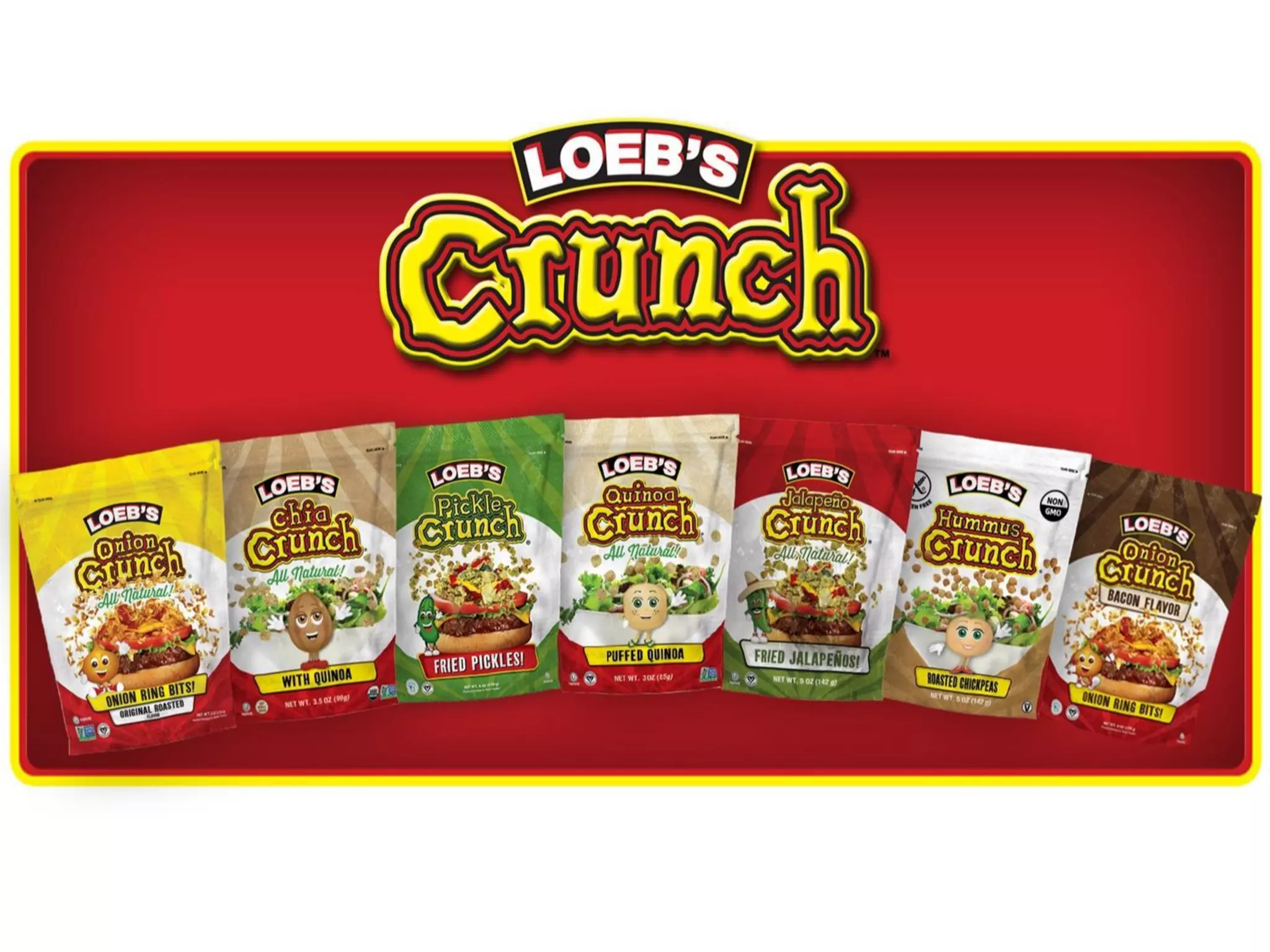
Loeb's Crunch, a CPG brand specializing in crispy vegetable toppings, utilized this 17-slide deck to seek a $5,000,000 investment. The company positioned itself as a guilt-free alternative to traditional condiments, boasting 40 calories per serving and an all-natural ingredient list (Slide 2). The deck leans heavily on established distribution, claiming presence in over 2,000 food service and convenience locations including major brands like 7-Eleven and Meijer (Slide 3). Financially, the company projected an aggressive growth curve, aiming to scale from $3.4 million in annual sales in 2016 t…
Key takeaways
- The company is seeking a total of $5,000,000 in fixed costs, with the largest allocations going to product inventory ($1.2M) and slotting fees ($1M) as shown on Slide 4.
- Loeb's Crunch claims a distribution footprint of over 2,000 locations across convenience stores, restaurants, universities, and stadiums (Slide 3).
- The product value proposition centers on health-conscious metrics: 40 calories per serving, 0g trans fat, and low sodium (Slide 2).
- Financial projections anticipate a massive scale-up in store count from 7,000 in 2016 to 25,000 by 2020 (Slide 5).
- The management team features deep CPG experience, including Bob Rosko (CFO/COO) with a background at Anheuser-Busch and Lisa Pyros (VP Sales) with experience at PepsiCo/Frito Lay (Slide 6).
- The brand utilizes aggressive cross-merchandising with established names like Vlasic, Hunt's, and Ball Park to drive trial (Slide 8).
- Celebrity endorsements from Iron Chefs like Michael Symon and Robert Irvine are used to validate product quality and culinary versatility (Slide 7).
- The deck omits a formal 'Problem' slide, instead leading with the product lineup and its nutritional benefits (Slide 1-2).
Loeb's Crunch: A Retail-First CPG Strategy
The Loeb's Crunch investor deck from 2015 is a classic example of a Consumer Packaged Goods (CPG) pitch that prioritizes distribution and brand validation over technological innovation. The company seeks $5 million to fuel a massive retail expansion, banking on the pedigree of its management team and a suite of celebrity endorsements to convince investors of its market potential.
Slide 1: Title and Product Lineup
The deck opens with a visual array of seven distinct product packages. The branding is consistent, featuring the 'Loeb's Crunch' logo prominently. The flavors visible include Onion Ring Bits, Chia Crunch, Pickle Crunch, Quinoa Crunch, Jalapeño Crunch, Hummus Crunch, and a Bacon-flavored Onion Crunch. This slide establishes the brand as a 'family of products' rather than a single-SKU startup.
Slide 2: Product and Value Proposition
Slide 2 splits the value proposition between consumers and retail 'customers.' For consumers, the focus is on health: 'All-natural,' 'Low fat,' 'Low sodium,' 'No cholesterol,' and 'Just 40 calories per serving.' For the retail customers (the buyers), the pitch focuses on business metrics: 'Fast product turnover,' '1-year shelf life,' and 'Excellent PR.' This dual-sided approach is essential in CPG, where you must sell to the person stocking the shelf as much as the person buying from it.
Slide 3: Current Distribution Footprint
This slide serves as the primary 'Traction' indicator. It claims a presence in over 2,000 food service and convenience stores. The logos are impressive, spanning major convenience chains like 7-Eleven and Meijer, restaurant chains like Auntie Anne's and Nathan's, and high-profile venues like the stadiums for the New England Patriots and Miami Dolphins. The inclusion of Stanford School of Medicine under 'Healthcare' suggests a push into institutional food service.
Slide 4: Use of Proceeds
The financial ask is detailed in a table titled 'Use of Proceeds.' The total 'Fixed Costs' (TFC) amount to $5,000,000. The breakdown is as follows:
Product Inventory: $1,200,000 · Slotting: $1,000,000 · Payroll: $840,000 · Marketing & Trade: $600,000 · Product Development: $500,000 · Manufacturing: $500,000 · Rent: $120,000 · Accounting, Legal: $100,000 · Miscellaneous: $100,000 · Insurance: $20,000 · Supplies: $20,000
The high allocation for 'Slotting' (fees paid to retailers to house the product) and 'Inventory' indicates a capital-intensive strategy focused on physical retail dominance.
Slide 5: Financial Projections
The company provides a five-year outlook from 2016 to 2020. The projections are highly aggressive. In 2016, they project $3,494,400 in annual sales based on 7,000 stores and 3 SKUs per store. By 2020, they anticipate $53,040,000 in annual sales, driven by an expansion to 25,000 stores, 6 SKUs per store, and a doubling of weekly unit volume per SKU (from 2 to 4). The average unit price is projected to rise slightly from $1.60 to $1.70 over this period.
Slide 6: Management Team
The deck highlights two key executives. Bob Rosko (CFO/COO) is credited with a career starting at Anheuser-Busch and experience as a CEO of snack food distribution companies. Lisa Pyros (VP of National Sales) is presented as a CPG veteran with experience at Danone, PepsiCo/Frito Lay, and Nabisco. The bios emphasize 'extensive food industry knowledge' and 'broad-based background,' which is intended to de-risk the execution of the aggressive sales plan.
Slide 7: Celebrity Endorsements
To build brand equity, the deck showcases a 'Celebrity Endorsements' slide. It includes quotes and photos from Iron Chefs Robert Irvine and Michael Symon, as well as celebrity chef Josh Capon. It also mentions media placements on Access Hollywood (Donny Deutsch) and Howard Stern Radio (Ivy Supersonic). This slide aims to prove that the product has 'culinary credibility' and mainstream appeal.
Slide 8: Cross Merchandising Programs
This slide demonstrates how the company plans to drive sales at the point of purchase. It shows co-branded coupons and 'together' promotions with massive household names like Vlasic, Idahoan, Hebrew National, Fresh Express, Hunt's, Ball Park, Gulden's, and Wolf Chili. One coupon shows a '$1.00 OFF' deal when buying Onion Crunch with Idahoan mashed potatoes. This strategy leverages the marketing budgets and shelf presence of established category leaders.
Slide 9: Conclusion
The final slide is a simple 'Thank You' with the company logo. There is no specific call to action, contact information, or summary of the investment terms on this slide, though the 'Use of Proceeds' slide earlier established the $5 million target.
What Loeb's Crunch Does Well
The deck is exceptionally strong at demonstrating industry validation . By listing over 2,000 current locations and showing cross-merchandising partnerships with brands like Hunt's and Ball Park, the founders prove they aren't just a 'kitchen concept'—they are an operational business with a supply chain. The management bios are also well-tailored to the ask; investors in CPG look for people who have navigated the complex world of distributors and retail buyers before.
What is Missing from the Deck
The most glaring omission is a Competitor Analysis . The 'crispy onion' and 'salad topper' categories are crowded with private labels and established brands like French's. The deck doesn't explain why a consumer would choose Loeb's over a cheaper store brand. Additionally, there is no mention of Unit Economics . While we see the 'Average Unit $' ($1.60-$1.70), we don't see the Cost of Goods Sold (COGS) or the gross margin. Without knowing the margin, it is impossible to tell if the $53 million in projected revenue would actually result in a profitable business. Finally, there is no Exit Strategy or mention of potential acquirers, which is a standard expectation for a $5M raise.
Lessons for Founders
Founders should emulate the Use of Proceeds transparency found on Slide 4. Many decks are vague about how they will spend millions of dollars; Loeb's is specific, even down to the $20,000 for insurance. This level of detail shows a founder who has actually built a budget. However, founders should avoid the 'Hockey Stick' Trap seen on Slide 5. Projecting a 15x revenue growth in four years by simultaneously assuming store count will triple AND unit velocity will double is a 'perfect storm' scenario that often invites skepticism from seasoned investors. It is better to show growth based on one primary lever rather than assuming every variable will improve at the same time.
Frequently asked questions
- What is the primary use of the $5 million investment?
- According to Slide 4, the $5,000,000 'Total Fixed Costs' budget is heavily weighted toward retail expansion. The two largest line items are Product Inventory at $1,200,000 and Slotting fees at $1,000,000. This indicates the capital is intended to buy shelf space and fund the working capital necessary to fill those shelves, rather than just R&D or digital marketing.
- How does Loeb's Crunch plan to grow its revenue by 15x in four years?
- The financial projections on Slide 5 show a strategy based on three levers: increasing store count (from 7,000 to 25,000), increasing the number of SKUs per store (from 3 to 6), and increasing the average weekly unit volume per SKU (from 2 to 4). By compounding these factors, they project annual sales to rise from $3,494,400 to $53,040,000.
- Who are the key members of the leadership team?
- Slide 6 highlights Bob Rosko as CFO/COO, noting his history as a division manager at Anheuser-Busch and CEO of various distribution companies. Lisa Pyros serves as VP of National Sales, bringing 20+ years of experience from major CPG firms including Danone, PepsiCo/Frito Lay, and Nabisco. The deck emphasizes their 'broad-based background' in the food industry.
- What retail channels is the company currently targeting?
- Slide 3 lists four primary categories: Convenience (Meijer, 7-Eleven, Circle K), Restaurants (Auntie Anne's, Nathan's, Just Salad), Universities (Tulane, Stanford), and Stadiums/Amusement Parks (Dolphins, Patriots, Raging Waves). This diversified approach suggests the product is intended for both retail purchase and food service integration.
- How does the company differentiate itself from other condiments?
- Slide 2 defines the value proposition through nutritional superiority. It markets the crunch as 'guilt-free,' highlighting that it is all-natural, low fat, low sodium, cholesterol-free, and contains only 40 calories per serving. It positions the product as a versatile 'sprinkle' for any meal, rather than a specific sauce or side dish.